
Aptos Foundation released a comprehensive tokenomics update on April 14, using seven mechanisms to drive the protocol’s supply model transition from a “subsidy-driven” approach to a “performance-driven” approach. Key adjustments include lowering the staking annualized rate from 5.19% to 2.6%, increasing Gas fees by 10x, setting a hard cap of 2.1 billion tokens for the protocol layer, and permanently locking 210 million APT.
Seven Core Token Reform Measures
Staking annualized rate lowered to 2.6%: Reduced from the current 5.19%; at the same time, exploring differentiated designs that can offer higher reward rates for long-term staking commitments; validator operating costs will be significantly reduced according to AIP-139
Gas fees increased by 10x: After the increase, stablecoin transfers remain as low as about 0.00014 USD, maintaining their status among the world’s lowest fees; all Gas fees paid in APT are permanently burned
Set a hard cap of 2.1 billion tokens for total supply: The protocol layer’s total supply cap is established through governance; with the current circulating supply at 1.2B, there are still 904 million within the hard-cap space (about 43%)
Permanently lock 210 million APT: The Foundation permanently locks and stakes them, accounting for about 18% of the current circulating supply; these tokens are never sold or distributed, effectively equivalent to burning
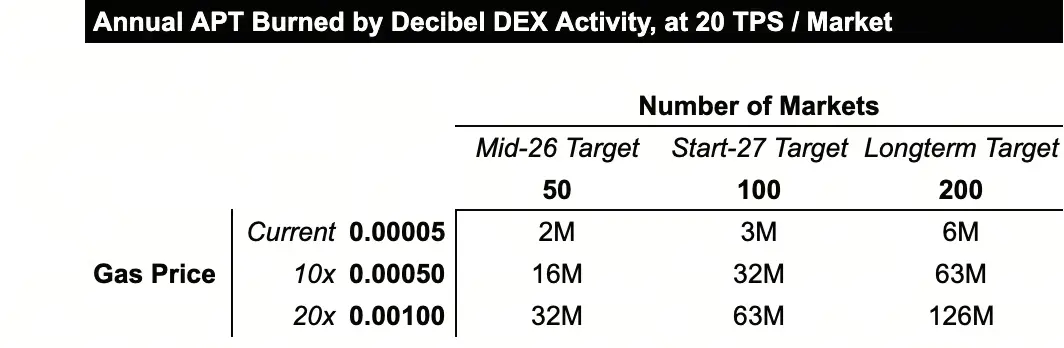
Decibel DEX burns over 32 million tokens annually: The first fully on-chain decentralized exchange, planned to cover 100+ markets; once each market reaches 10k TPS, the annual burn volume will further grow
Milestone-triggered incentives: In the future, subsidies and rewards will be tied to KPIs; if performance targets are not met, token allocations are delayed rather than canceled
Programmatic buyback plan: The Foundation explores using existing cash or future authorized income, along with ecosystem investment income, to programmatically buy back APT on the open market
Structural Background for a Deflationary Transition: 2026 Is a Critical Turning Point
This reform timing has structural support. The four-year unlock cycle for initial investors and key contributors will end in October 2026; at that time, the annual token supply unlock amount will naturally decrease by about 60%; the Foundation’s grant allocations will also reduce by over 50% year over year between 2026 and 2027. Aptos’s supply pressure was already at a natural turning point; with these seven mechanisms layered with structural constraints, the goal is for the annual APT removal amount to exceed the issuance amount after Decibel DEX scales up, achieving deflationary supply.
From the demand side, institutions such as BlackRock, Franklin Templeton, and Apollo have already deployed hundreds of millions of dollars on Aptos. Application revenue growth reached 1,552%, rising to $33.5 million, providing a sustained foundation for trading activity for the deflationary model.
Frequently Asked Questions
What is the real impact of Aptos lowering its staking annualized rate from 5.19% to 2.6% on stakers?
Staking rewards shrink by about half; returns for stakers whose purpose is purely passive holding yield will decrease. But the Foundation is also exploring differentiated mechanisms that offer higher reward rates for long-term commitments, encouraging long-term network participation; with validator hardware costs reduced significantly under AIP-139, it also offsets, to some extent, the impact of the reward reduction.
Does increasing Gas fees by 10x affect Aptos’s cost-competitiveness for usage?
The impact is extremely small. Even after the 10x increase, the stablecoin transfer cost is still about $0.00014, remaining among the world’s lowest fees across mainstream blockchains. The main purpose of raising Gas fees is to increase the amount of APT burned, not to change the cost-competitiveness landscape—so it has almost no effect on the real day-to-day usage costs for individual users and institutions.
How does Decibel DEX drive deflationary momentum for APT?
As a fully on-chain decentralized exchange that executes every trade on-chain, Decibel consumes APT as Gas fees for each order, matching, and cancellation, and burns all of it permanently. After it is expected to cover 100+ markets, it is projected to burn over 32 million APT per year. As TPS and market scale expand, the burn volume will continue to grow, forming a deflationary flywheel effect driven by trading activity.
Disclaimer: The information on this page may come from third parties and does not represent the views or opinions of Gate. The content displayed on this page is for reference only and does not constitute any financial, investment, or legal advice. Gate does not guarantee the accuracy or completeness of the information and shall not be liable for any losses arising from the use of this information. Virtual asset investments carry high risks and are subject to significant price volatility. You may lose all of your invested principal. Please fully understand the relevant risks and make prudent decisions based on your own financial situation and risk tolerance. For details, please refer to
Disclaimer.
Related Articles
Solana Foundation Supports Aave with USDT Contribution
The Solana Foundation announced it will contribute USDT to the Aave platform for the first time as part of recovery efforts following the KelpDAO-related rsETH crisis in the DeFi ecosystem. Lily Liu, President of the Solana Foundation, stated that this support aims to strengthen both Aave and the
CryptoFrontier1h ago
Pavel Durov Says TON Fees Will Drop 6x Targeting Near-Zero Costs
TON reduces transaction fees sixfold to near-zero levels, shifting to fixed pricing independent of network congestion.
Upgrade boosts speed and finality, enabling faster, cheaper transactions compared to Ethereum, Bitcoin, and Solana.
Lower costs support microtransactions and apps,
CryptoFrontNews2h ago
Sui DeFi lending protocol Scallop is hacked, with a vulnerability in the old contract leading to 150k SUI stolen
Scallop was attacked on the Sui chain, and the side contract involved led to the sSUI rewards pool being exploited. Approximately 150k SUI were stolen. The core contract is secure, and deposits and withdrawals have been restored. The official statement applies only to the deprecated rewards contract; users’ funds were not affected. Former NEAR developer Vadim said the vulnerability originated from an outdated V2 package from 17 months ago, where not initializing last_index caused rewards to accumulate starting in 2023. The fix requires adding a version field to the shared object and strengthening version checks to prevent risks caused by outdated packages.
ChainNewsAbmedia2h ago
JPMorgan: Tokenization Will Transform Funds Industry, But 'Good Use Cases' Years Away
JPMorgan's global head of ETF product, securities services, Ciarán Fitzpatrick, stated that tokenization will drive change across the entire funds industry, according to a post from Friday. Fitzpatrick noted that while experimentation with tokenizing ETFs is ongoing, the bank estimates it will be "a
CryptoFrontier4h ago
Aave, Kelp, LayerZero Propose Releasing $71M in Frozen ETH to Support rsETH Recovery
Gate News message, April 26 — A coalition of major DeFi protocols led by Aave Labs, joined by Kelp DAO, LayerZero, EtherFi, and Compound, filed a Constitutional AIP on Saturday morning asking the Arbitrum DAO to release approximately $71 million in frozen ETH to support DeFi United, a cross-protocol
GateNews6h ago
Scallop Discovers sSUI Reward Pool Vulnerability, Suffers 150K SUI Loss but Pledges Full Reimbursement
Gate News message, April 26 — Scallop, a lending protocol in the Sui ecosystem, announced the discovery of a vulnerability in an auxiliary contract associated with its sSUI reward pool, resulting in a loss of approximately 150,000 SUI. The affected contract has been frozen, and Scallop confirmed
GateNews7h ago


