The Argentine Securities and Exchange Commission (CNV) now recognizes cryptocurrencies as assets that can be considered part of an individual’s net worth to qualify as an investor. The move might allow investors to reach the nearly $478K in assets to be part of this class.
Key Takeaways:
- CNV Resolution 1125/2026 lets crypto count for the $479K investor limit, expanding future market access.
- A 2022 Central Bank ban still halts retail crypto services, but banks are testing blockchain settlement.
- President Milei is expected to lift the 2022 banking ban soon, expanding Argentina’s crypto adoption.
Argentina Changes Law to Recognize Crypto as Net Worth for Qualified Investors
Argentina is slowly working to open its financial industry to crypto assets, moving to increase the recognition of cryptocurrency across all sectors of its economy.
The Argentine Securities and Exchange Commission (CNV) issued General Resolution 1125/2026, which establishes that virtual assets will be recognized as part of an individual’s worth for reaching the classification of a qualified investor in the country.
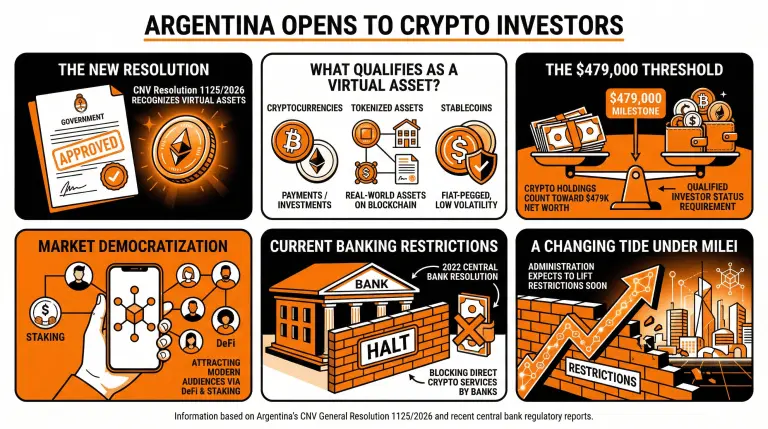
The resolution defines virtual assets as “any digital representation of value that can be traded and/or transferred digitally and used for payments or investments.” This means that cryptocurrencies, tokenized assets, and even stablecoins could be used as these assets.
The CNV argued that “the progressive incorporation of new asset classes—such as Virtual Assets—into investment portfolios renders their inclusion advisable for the purpose of demonstrating the required financial capacity, since they constitute an additional manifestation of the investor’s economic capacity and financial experience.”
Before, when investors disclosed their crypto holdings, these could not be accounted as part of the assets needed to reach the nearly $479,000 to enter this investment classification.
With this measure, the CNV seeks to democratize and open investment markets to new target audiences who are not normally interested in traditional investments and focus more on digital alternatives, including staking and decentralized finance platforms.
While Argentina is advancing in this regard, financial institutions cannot offer cryptocurrency services to their customers, as the central bank issued a resolution in 2022 to “mitigate the risks associated with operations with these assets that could be generated for users of financial services and for the financial system as a whole.”
Nonetheless, some banks are testing blockchain-based plumbing for their internal settlements. Reports indicate this restriction will be lifted in the short term, as President Milei’s administration opens up to crypto.
Disclaimer: The information on this page may come from third parties and does not represent the views or opinions of Gate. The content displayed on this page is for reference only and does not constitute any financial, investment, or legal advice. Gate does not guarantee the accuracy or completeness of the information and shall not be liable for any losses arising from the use of this information. Virtual asset investments carry high risks and are subject to significant price volatility. You may lose all of your invested principal. Please fully understand the relevant risks and make prudent decisions based on your own financial situation and risk tolerance. For details, please refer to
Disclaimer.
Related Articles
Bipartisan PACE Act Proposes Opening Federal Reserve Payment Networks to Non-Banks
Gate News message, April 21 — The PACE Act, introduced by bipartisan U.S. lawmakers, aims to allow compliant non-bank payment institutions direct access to the Federal Reserve's payment systems, garnering support from the crypto industry.
The legislation would establish a federal framework
GateNews1h ago
SEC Commissioner Hester Peirce Admits Past Crypto Policies Were "Wrong in Method"
Peirce admits the SEC mishandled crypto regulation under Gensler, urging earlier framework and more stakeholder engagement, cautioning against overreach, and outlining future focus on stablecoins, RWA tokenization, and custody.
Abstract: In an interview, SEC Commissioner Hester Peirce—often dubbed 'Crypto Mom'—said the agency's crypto regulation during Gary Gensler's tenure was flawed. She called for an earlier, clearer regulatory framework and greater engagement with industry stakeholders before policy actions, cautioned against overreach given Congress's limits, and highlighted future priorities such as stablecoins, tokenization of money market funds and real-world assets, and improved custody frameworks.
GateNews2h ago
Fed Chair Nominee Warsh Backs Crypto Assets at Senate Hearing, Discloses $100M Portfolio
Gate News message, April 21 — US Federal Reserve Chair nominee Kevin Warsh expressed support for digital assets during his Senate Banking Committee confirmation hearing today, stating that cryptocurrencies are "already part of the fabric of our financial industry."
During the nearly 3-hour public s
GateNews3h ago
Trump's Crypto Backing Reaches Historic $1.2B, Sparking National Security Concerns
Gate News message, April 21 — Federal filings reveal that Trump and the Republican Party have accumulated a historic $1.2 billion cash stockpile for the November midterms, with cryptocurrency executives playing a major role in funding the GOP war chest. Democrats currently hold only $261 million in
GateNews6h ago
U.S. Federal Reserve Chair Nominee Wosh: Digital Assets Already Part of U.S. Financial System
Gate News message, April 21 — During a Senate hearing on April 22, U.S. Senator Cynthia Lummis asked Federal Reserve chair nominee Wosh whether digital assets should be integrated into the nation's financial system to provide Americans with new investment opportunities and consumer protections.
Wos
GateNews7h ago
Poland's Crypto Legislation Stalled as MiCA Alignment Deadline Approaches, Triggering Business Exodus
Poland fails to override Nawrocki's veto on crypto regulation, delaying MiCA alignment by the July 1 deadline as firms relocate to Latvia, Czech Republic, Lithuania, and Malta amid regulatory uncertainty.
Poland's parliament again blocks the crypto regulation by Nawrocki's veto, leaving MiCA alignment to a future date and spurring domestic firms to move operations to other EU member states. The dispute centers on concerns about overregulation and broad KNF powers, intensifying political tensions and accelerating crypto outflows before MiCA's transition ends.
GateNews7h ago


