The central bank will focus on designing a regulatory framework for the so-called institutional VASPs, defined as organizations that operate infrastructure and provide crypto services to other institutions. The move would bring clarity to companies like Fireblock, Ripple, and Bitgo in the Brazilian market.
Brazil to Regulate Institutional VASPs by 2027
Brazil is advancing fast to bring clarity to all sectors of the crypto market, including Business-to-Business (B2B) interactions.
Local reports indicate that the Central Bank of Brazil will advance regulations regarding the operation of institutional virtual asset service providers (VASPs) in the country before 2027.
Institutional VASPs are defined as companies that construct, provide, and operate crypto infrastructure to serve other institutions, focusing their action on serving other businesses rather than end users.
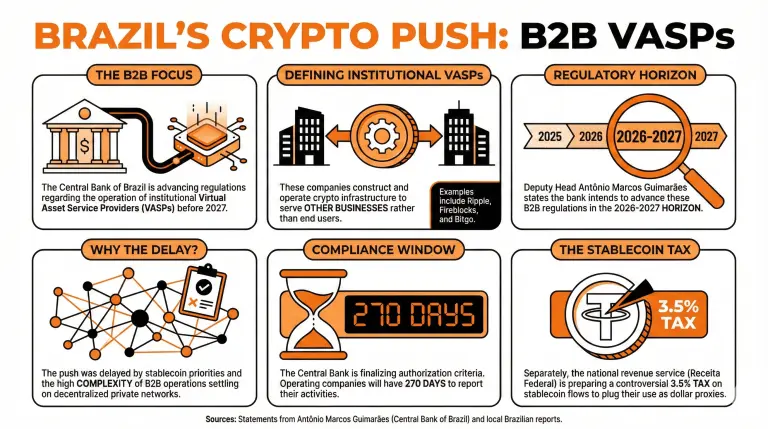
Companies like Ripple, which operates crypto-based payment networks; Fireblocks, which provides various crypto infrastructure products and services; and Bitgo, a custody provider, would fall under this classification.
During a live transmission, Antônio Marcos Guimarães, deputy head of the bank’s Regulation Department, stated that the bank would “intend to advance in the regulation of institutional VASPs (B2B)” in the 2026-2027 horizon.
Furthermore, he stated that the proposal to regulate these institutions’ activities was born of the bank’s public consultations. Nonetheless, other regulatory activities involving stablecoins and more pressing matters took the bank’s attention before this.
An element that has taken this regulatory push aback is the complexity of these businesses’ activities, as there is no brokerage between them, and transactions or deals are settled using decentralized private networks.
In addition, Guimarães added that the bank is finalizing the authorization criteria for companies operating in the country, which will have 270 days to report their activities.
Brazil has been hard at work regarding crypto regulation in 2026, having already streamlined new rules for banks entering the crypto market.
In addition, the national revenue service (Receita Federal) is reportedly preparing a controversial measure that would tax stablecoin flows with 3.5%, aiming to plug a loophole that allowed users and institutions to benefit from using these solutions as dollar proxies for payments and remittances.
FAQ
- What steps is Brazil taking towards crypto regulation?
Brazil is advancing regulations for institutional virtual asset service providers (VASPs) to clarify operations in the B2B sector before 2027.
- What defines an institutional VASP in Brazil?
Institutional VASPs are companies that provide and manage crypto infrastructure specifically to serve other businesses rather than individual users.
- What is the Central Bank’s timeline for these regulations?
Deputy head Antônio Marcos Guimarães indicated that the regulation of institutional VASPs is expected to progress during the 2026-2027 timeframe.
- Are there additional regulatory measures related to stablecoins?
Yes, Brazil’s national revenue service is preparing to implement a 3.5% tax on stablecoin flows to close a loophole in their use as dollar proxies for payments.
Disclaimer: The information on this page may come from third parties and does not represent the views or opinions of Gate. The content displayed on this page is for reference only and does not constitute any financial, investment, or legal advice. Gate does not guarantee the accuracy or completeness of the information and shall not be liable for any losses arising from the use of this information. Virtual asset investments carry high risks and are subject to significant price volatility. You may lose all of your invested principal. Please fully understand the relevant risks and make prudent decisions based on your own financial situation and risk tolerance. For details, please refer to
Disclaimer.
Related Articles
South Korea plans to implement mandatory asset disclosure for influencers in the crypto sector
South Korean lawmaker Kim Seung-won proposed amending the law to require cryptocurrency investment advisors on social media to disclose personal assets and compensation in order to improve market transparency and combat misleading information and self-dealing. This move aims to protect investors' rights.
GateNewsBot12m ago
India's crypto regulatory gap sparks a rights protection dilemma: courts reject investors' claims, and fund freeze disputes escalate
February 25 News, the Delhi High Court recently dismissed a lawsuit filed by a group of cryptocurrency investors against a certain crypto platform. Judge Prushaindra Kumar Kaurav pointed out that the platform is a private company and does not meet the definition of a "state" entity under Article 12 of the Constitution, therefore it cannot be subject to judicial intervention under Article 226. The petition lacks a legally admissible basis.
The lawsuit was initiated by investors such as Rana Handa and Aditya Malhotra, requesting the court to strengthen regulation of the crypto platform, and to direct the CBI or a special investigation team to intervene, as well as to unfreeze the user funds that are reportedly restricted. However, the court explicitly stated that ordering a criminal investigation is an extremely exceptional circumstance, and some complaints have not even completed the FIR process, which is insufficient to trigger a mandatory investigation mechanism.
GateNewsBot1h ago
Hong Kong advances the implementation of the tokenized bond platform and connects with the regional tokenization center. Stablecoin license issuance begins in March.
February 25 News, Hong Kong is accelerating the development of core infrastructure for digital assets. Financial Secretary Paul Chan announced in the 2026-27 fiscal budget that Hong Kong will establish a brand-new digital asset platform within the year to support the issuance and settlement of tokenized bonds. The platform will be built and operated by CMU OmniClear Holdings, a subsidiary of the Hong Kong Monetary Authority, marking the official transition of tokenized bonds from pilot phase to a market-level infrastructure system.
This platform will gradually expand to include more categories of digital assets and achieve interoperability with regional tokenization platforms, forming a cross-market tokenized financial network. This move is seen as an important step to strengthen Hong Kong's position as a digital asset hub in China, while also improving on-chain settlement efficiency and asset liquidity. As post-trade infrastructure becomes part of the official financial system, the issuance mechanism for tokenized bonds is evolving toward standardization and institutionalization.
GateNewsBot2h ago
California's new DFAL crypto license will take effect in July, forcing a quarter of all US crypto companies to face a major decision
California Enacts the Digital Financial Assets Law (DFAL), requiring all individuals or companies providing crypto asset services to California residents to obtain a license or meet exemption criteria by July 1, 2026, or face enforcement actions. The DFAL license application will open on March 9, 2026, covering multiple types of digital asset businesses and including consumer protection provisions. This legislation marks a new phase in state-level crypto regulation in the United States and could drive the unification of compliance standards nationwide.
動區BlockTempo2h ago
Hong Kong issues the first stablecoin license in March, with legislation to regulate trading firms and custodians accelerating compliance within the year
On February 25, it was announced that Hong Kong's Financial Secretary, Paul Chan, revealed in the 2026-27 fiscal budget that Hong Kong will issue the first batch of fiat-backed stablecoin licenses next month, marking the substantive implementation phase of the stablecoin regulatory framework. The regulatory authorities will continue to assist licensed issuers in exploring applications of stablecoins in payments, cross-border settlements, and real asset digitization in a compliant and risk-controlled manner, strengthening Hong Kong's institutional advantages in the digital asset regulatory system.
At the policy level, it was also confirmed that Hong Kong plans to introduce new legislation later in 2026 to establish a licensing system covering crypto asset exchanges and custodial service providers. The scope of regulation will be expanded from platforms and stablecoins to key areas such as over-the-counter trading and custody, further improving the compliant virtual asset ecosystem. Meanwhile, the Hong Kong Securities and Futures Commission will take measures to enhance market liquidity, expand the categories of crypto financing and derivative products available to professional investors, and promote compliant innovation and market depth through the establishment of an innovation accelerator.
GateNewsBot3h ago
Bitcoin Depot Requires ID for Every Crypto ATM Transaction
Bitcoin Depot has implemented a new policy mandating identification for every transaction at its ATMs to enhance compliance and reduce fraud. This change extends previous ID checks and responds to increased regulatory scrutiny and fraud concerns, notably following lawsuits from various states.
TheNewsCrypto3h ago


