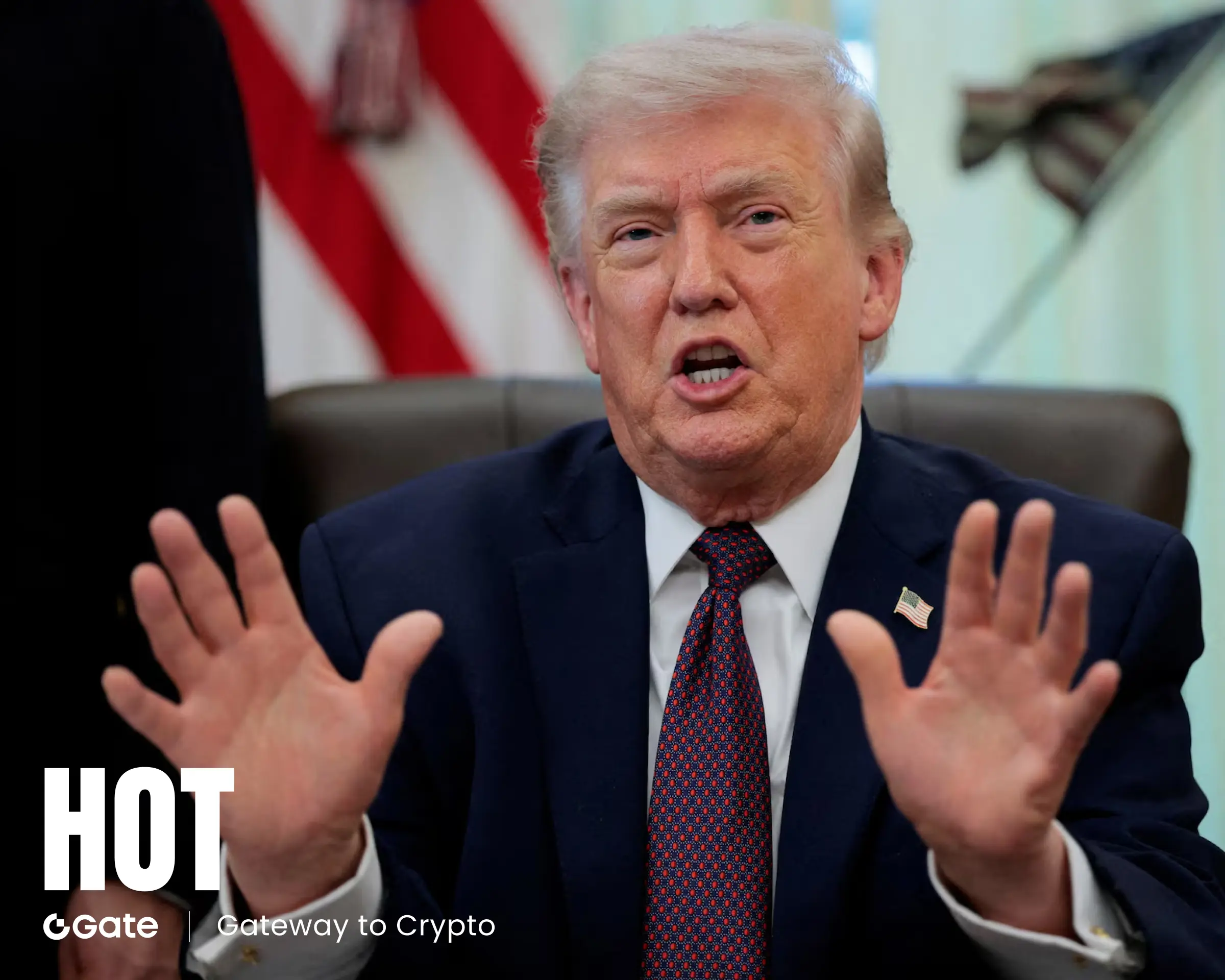
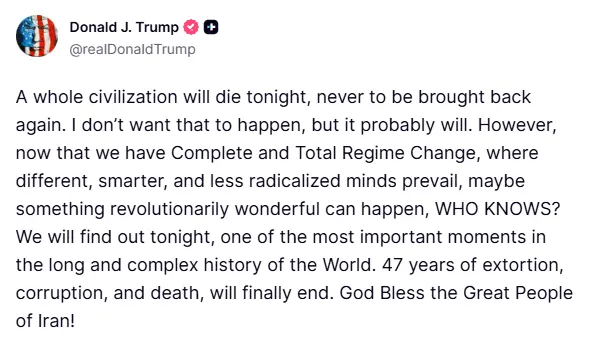
On April 7, 2026, U.S. President Trump posted a tweet on the social media platform X. In the tweet, he explicitly stated that “the entire civilization will end tonight,” and set 8:00 p.m. Eastern Time on April 7 as the final deadline, demanding that Iran reopen the Strait of Hormuz before then; otherwise, a military strike would be carried out to destroy civilian infrastructure in Iran, such as power plants and bridges. This extreme statement pushes the standoff between the U.S. and Iran to the breaking point.
As of the time of posting, WTI crude oil futures were at $115.47 per barrel, and Brent crude oil futures were at $111.46 per barrel; Bitcoin (BTC) was at $68,320, down 1.71% over the past 24 hours; Ethereum (ETH) was at $2,080.52, down 3.30%.
Trump’s “Civilization Is Doomed” Remarks and the Ultimatum Timeline
Trump’s “the entire Iranian civilization will end tonight” is not an isolated remark, but the culmination of pressure actions sustained for weeks. The following are key timeline points:
- March 21: Trump first issued a 48-hour ultimatum, demanding that Iran open the Strait of Hormuz
- March 23: Trump announced a five-day pause in military strikes
- March 26: He delayed again by 10 days, extending the deadline to 8:00 p.m. on April 6
- March 30: Iran’s parliament passed the “Strait of Hormuz Traffic Management Act”
- April 2: Iran’s deputy foreign minister Abadi said it would not accept dollar-settled strait passage fees
- April 4: Trump issued a “48-hour warning”
- April 5: Trump hinted that the final deadline would be extended again to 8:00 p.m. on April 7
- April 6: Iran announced it would accept cryptocurrency payments for passage fees
- April 7: Trump posted “the entire Iranian civilization will end tonight,” setting 8:00 p.m. that day as the final cutoff
In the tweet, Trump used the phrase “Complete and Total Regime Change” (complete and thorough regime change). At the same time, he suggested that if a “more sensible, less aggressive regime” came to power, “a revolutionary and wonderful change” might occur. This expression that combines threats with negotiation room makes it difficult for the market to accurately assess the probability of actual military action.
Shock to Energy Markets: Oil Prices Break $115
The Strait of Hormuz carries about 20 million barrels of crude oil per day, accounting for roughly 20% of global supply. Trump’s “civilization will end” remarks directly intensified market concerns that the strait could be closed for the long term. As of April 7:
- WTI crude oil futures: $115.47 per barrel, up about 50% versus before the conflict
- Brent crude oil futures: $111.46 per barrel
Rapidan Energy estimates that a closure of the strait would threaten a supply reduction of about 630 million barrels by the end of June. Eight OPEC+ countries agreed to increase output by 206k barrels per day starting in May, but if the strait is not actually passable, transporting additional supply faces serious challenges. IMF Managing Director Georgieva said that this conflict has caused the most severe disruption to global energy supplies in history.
Real-Time Crypto Market Data and Fund Flows
As of April 7, 2026, the performance of major crypto assets is as follows (data source: Gate market data):
- Bitcoin (BTC) — Price: $68,320 | 24-hour change: -1.71% | Market cap: 1.33T
- Ethereum (ETH) — Price: $2,080.52 | 24-hour change: -3.30% | Market cap: 256.34B
Before and after Trump posted the tweet “the entire Iranian civilization will end tonight,” the crypto market experienced sharp volatility:
- On April 6, driven by reports of a ceasefire negotiation, Bitcoin surged by more than 4% to around $70,300, triggering forced liquidation of more than $145 million in short positions.
- On April 7 during Asian trading hours, there were reports that Iran, via the mediator Pakistan, rejected the ceasefire proposal, and Bitcoin fell by about 2.2% to around $68,800.
- After Trump’s tweet was published, the market faced further pressure, and Bitcoin dropped to $68,320.
Regarding fund flows, the spot Bitcoin ETFs listed in the U.S. recorded a net inflow of $471.3 million on April 6, the highest single-day level since February 25. Glassnode data shows that the participation of funds from exchanges, ETFs, and on-chain activity has not yet recovered significantly, indicating that current volatility is being driven mainly by news rather than systematic new capital inflows.
Iran’s Response: Legislation for Crypto Payments
Against the backdrop of Trump’s “civilization will end” threat, Iran has taken two key countermeasures:
First, Iran’s parliament passed the “Strait of Hormuz Traffic Management Act” on March 30, bringing all passage fees for tankers transiting through the strait under legal jurisdiction. Fees are divided into five rate tiers based on the country of the vessel’s registry and its relationship with the United States. Rates for “ally” countries such as China and Russia are $0.5 per barrel; U.S. and Israeli vessels are prohibited from passage.
Second, on April 2, Iran’s deputy foreign minister Abadi formally announced that it would not accept dollar-settled strait passage fees, offering two alternative payment methods: cross-border remittances in renminbi, or settling via a decentralized network using dollar stablecoins. Iran set up a dedicated crypto-currency exchange window on Kish (Qeshm) Island to ensure that once funds are received, they can be quickly converted to rials or transferred to overseas accounts.
This is the first time a sovereign state has included stablecoins in strategic payment infrastructure. The U.S. Treasury previously sanctioned the crypto exchanges Zedcex and Zedxion, which are associated with Iran’s Islamic Revolutionary Guard Corps.
Divergence in Market Views: How Should Crypto Assets Interpret the “Civilization Is Doomed” Threat?
Regarding the impact of Trump’s extreme remark that “the entire Iranian civilization will end tonight” on the crypto market, market participants have formed the following main views:
View 1: Bitcoin as “digital gold” gets support from a safe-haven narrative
Some analysts argue that since the conflict began, gold has cumulatively fallen by more than 10%, while Bitcoin has shown relative resilience. Research indicates that within two months after major global crises occur, Bitcoin’s performance often outpaces gold and the S&P 500 index. Trump’s “civilization will end” remarks intensify concerns about sovereign risk, which may prompt some funds to flow into non-sovereign assets.
View 2: Geopolitical conflict is fundamentally a risk-aversion event
By contrast, this view holds that a threat on the scale of “civilization will end” would drive traditional safe-haven funds toward the U.S. dollar, U.S. Treasuries, and gold—not toward highly volatile crypto assets. Bitcoin’s drop on April 7 suggests that once expectations of the conflict escalate, funds tend to leave the crypto market. Rachael Lucas, an analyst at BTC Markets, said that Bitcoin market sentiment is “still bearish in the short to medium term.”
View 3: Positioning games are the main cause of short-term volatility
sFOX Chief Commercial Officer Diana Pires said that the recent large swings in Bitcoin reflect, more than anything, mismatches in positioning. Before the weekend, market sentiment was clearly bearish, and short positions accumulated. Once ceasefire news is released, these positions are forced to cover; meanwhile, Trump’s “civilization will end” remarks once again trigger long stop-losses.
View 4: Focus on the chain from oil prices → inflation → monetary policy transmission
High oil prices raise inflation expectations. As the market adjusts pricing for the Federal Reserve’s rate-cut path, tightening liquidity expectations then affects crypto asset valuations. This is an indirect but far-reaching transmission path from Trump’s remarks to the crypto market.
Conclusion
As of 8:00 p.m. Eastern Time on April 7, 2026, the ultimatum moment set by Trump—“the entire Iranian civilization will end tonight”—has arrived. The blockade of the Strait of Hormuz has pushed international oil prices above $115 per barrel, and the crypto market has shown high-volatility characteristics driven by extreme rhetoric—Bitcoin is at $68,320, down 1.71% over the past 24 hours. Iran has incorporated cryptocurrency into the passage-fee payment system, setting a precedent for sovereign states to adopt digital assets in key economic functions. Market participants will continue to watch the strait’s actual passage situation, the extent to which Trump’s remarks are carried out in practice, and subsequent regulatory actions by the U.S. Treasury.
Frequently Asked Questions (FAQ)
Q: What is the specific background behind Trump’s remark that “the entire Iranian civilization will end tonight”?
A: On April 7, 2026, Trump posted a tweet on the social media platform X, saying “the entire civilization will end tonight, never to return,” and set 8:00 p.m. on that same day Eastern Time as the final deadline. Previously, Trump had repeatedly postponed ultimatums to Iran (earliest issued on March 21). In the tweet, Trump also mentioned “Complete and Total Regime Change” and “a revolutionary and wonderful change,” using language that combines both threats and room for negotiation. The remark directly targets Iran’s actions in blocking the Strait of Hormuz.
Q: How does this remark affect cryptocurrency prices?
A: This remark affects the crypto market through three channels: first, a direct news shock that raises market uncertainty and triggers short-term volatility (Bitcoin fell to $68,320 after the tweet was posted); second, it pushes up oil prices (WTI rises to $115.47 per barrel), exacerbating inflation expectations and affecting the Federal Reserve’s monetary policy path; third, Iran’s announcement that it will accept cryptocurrency payments for passage fees pulls digital assets directly into geopolitical games, which may prompt regulatory countermeasures from the U.S.
Q: What is the legal basis for Iran to accept cryptocurrency payments for passage fees?
A: Iran’s parliament passed the “Strait of Hormuz Traffic Management Act” on March 30, providing a domestic legal basis for cryptocurrency payments. The law stipulates that all ultra-large tankers passing through the Strait of Hormuz must pay passage fees to the Islamic Revolutionary Guard Corps and explicitly excludes dollar settlement. Iran offers two payment options: cross-border remittances in renminbi, or settlement via a decentralized network using dollar stablecoins. This is the first time a sovereign state has included stablecoins in strategic payment infrastructure.


