
The U.S. Department of the Treasury has officially classified stablecoin issuers as “financial institutions,” requiring them to comply with the Bank Secrecy Act and implement anti-money laundering rules. In addition, the compliance officer responsible for issuer compliance must be an American resident with no criminal record.
The Treasury teams up with two major agencies to implement oversight; stablecoin firms are formally listed as financial institutions
The U.S. Department of the Treasury officially took a key regulatory step yesterday (4/8). The Financial Crimes Enforcement Network (FinCEN) and the Office of Foreign Assets Control (OFAC) jointly issued a proposed rule aimed at fully implementing the GENIUS Act passed in July 2025.
At the heart of this regulatory framework is defining “Authorized Payment Stablecoin Issuers” (PPSIs) as “financial institutions” under the scope of the Bank Secrecy Act (BSA). In a statement, U.S. Treasury Secretary Scott Bessent clearly said that the proposal’s primary goal is to protect the U.S. financial system from national security threats, while also ensuring that U.S. companies can continue to maintain competitiveness in the stablecoin payment ecosystem.
The push for this legislation reflects the Trump administration’s ambition to position the United States as a global leader in digital assets, and also shows the government’s tough stance on national security defenses.
Strengthening anti-money laundering and sanctions compliance, and granting issuers the authority to freeze transactions
Under this proposed new rule, stablecoin issuers will bear legal responsibilities comparable to those of traditional banks. Issuers must establish comprehensive anti-money laundering (AML) and counter-terrorist financing (CFT) programs, and have the capability to proactively detect and report suspicious activity. The new rule also clearly requires issuers, at the technical level, to have the authority to “intercept, freeze, and refuse” certain transactions so that, in response to requests from law enforcement agencies, they can block the flow of funds linked to illegal actors.
Snir Levi, CEO of blockchain intelligence firm Nominis, said this change will turn issuers into gatekeepers similar to banks; going forward, the market will see larger-scale wallet freezes, transaction interceptions, and asset seizure actions.
The Treasury believes these obligations are “tailored” and fit their purpose. The agency will adjust standards based on the issuer’s size and the complexity of its business, seeking a balance between fighting crime and promoting technological R&D, while avoiding an overly heavy administrative burden on the industry.
Strictly vetting compliance officers and building a digital cash ecosystem through cross-agency coordination
To ensure the compliance program is effectively carried out, the proposal sets strict thresholds for issuer staffing arrangements. In the future, stablecoin issuers must assign dedicated personnel to oversee anti-money laundering and counter-terrorism financing defense systems. The responsible person must reside within the United States, and it is strictly prohibited for individuals with criminal records—such as insider trading, cybercrime, or financial fraud—to hold this position of authority. In addition to the Treasury, the Federal Deposit Insurance Corporation (FDIC) and the Office of the Comptroller of the Currency (OCC) have also issued related implementation details.
In the proposal, the FDIC specifically clarified that while reserve deposits of stablecoin issuers will be protected, individual stablecoin holders will not be covered by federal deposit insurance. Rating agency Moody’s Senior Vice President Warren Kornfeld analyzed that if these regulations are fully implemented, a tiered digital cash ecosystem will be established within the banking system, and the lines between traditional banks and digital assets will further overlap.
- Related news: New FDIC rules in the U.S.! Stablecoin reserves have strict requirements and do not offer the $250k per-person deposit insurance
Market outlook and political wrangling: the risks and opportunities facing stablecoin issuers
With the GENIUS Act expected to take full effect in 2027, major issuers such as Tether, Circle, Ripple, and World Liberty Financial, which is related to the Trump family, are all awaiting the final rule details. Despite rising regulatory pressure, the industry generally believes that clarifying the regulations will help stablecoin assets move into the mainstream market. According to Chainalysis’s report, by 2035, annual stablecoin transaction volume could surge to $1,500 trillion.
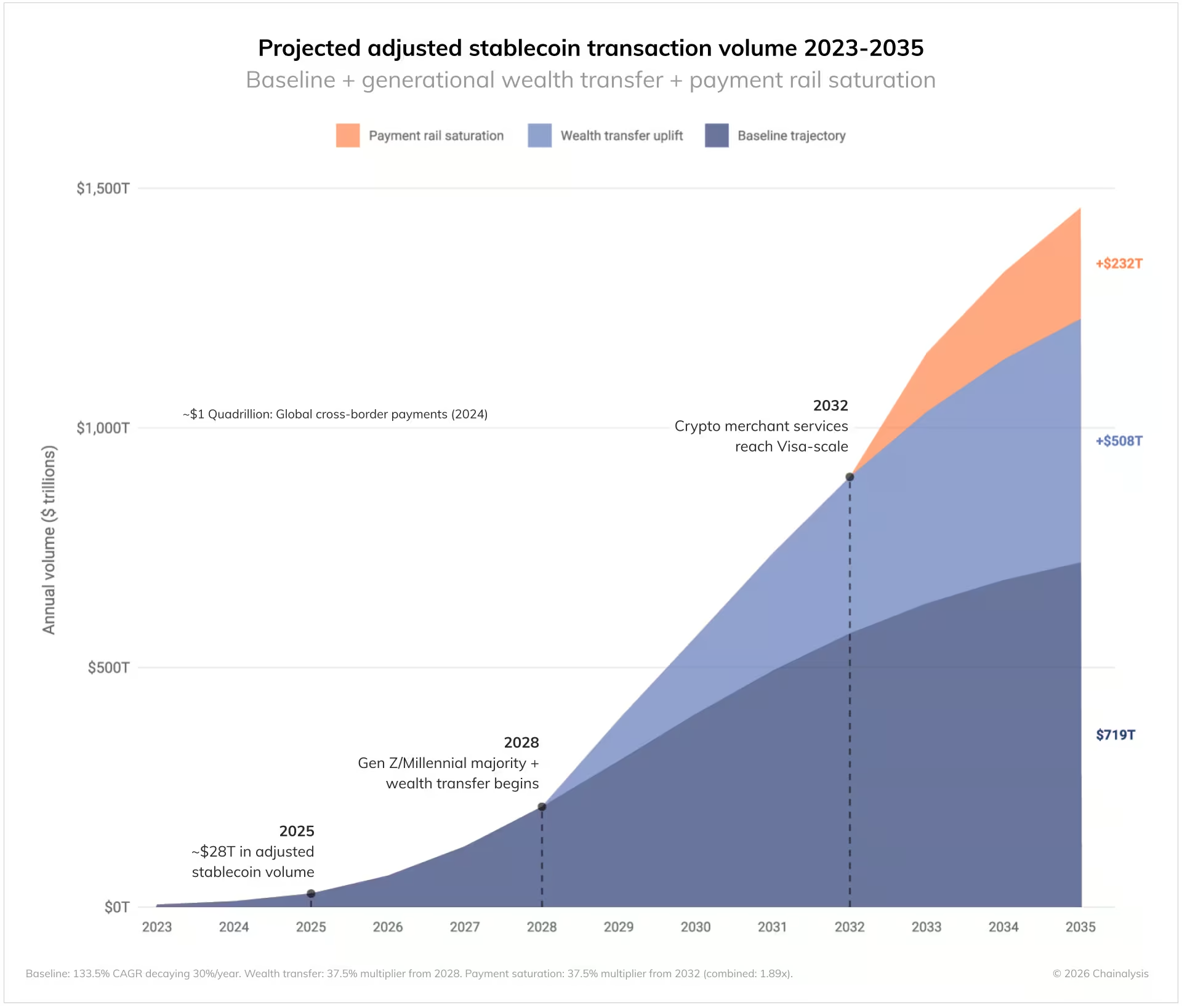
Image source: Chainalysis Chainalysis predicts that by 2035, annual stablecoin transaction volume could surge to $1,500 trillion
However, political wrangling has not stopped. The Senate’s debate over the CLARITY Act remains mired in a stalemate. The White House Council of Economic Advisers opposes the stablecoin interest ban, arguing that the ban does nothing to protect bank lending and instead would increase costs for users.
On the international front, Iran recently announced plans to charge oil tankers crossing the Strait of Hormuz a $1 per-barrel Bitcoin ($BTC) toll as a way to evade sanctions. The illegal financial risk arising from such geopolitical conflicts has prompted the U.S. Treasury to accelerate the implementation of strict control mechanisms through the GENIUS Act.
Further reading
White House research: Banning stablecoin interest is almost useless for protecting bank lending; it actually strips consumers of benefits
Strait of Hormuz opens! Iran requires paying tolls with Bitcoin; the Persian Gulf is still “swamped” with large ships
Disclaimer: The information on this page may come from third parties and does not represent the views or opinions of Gate. The content displayed on this page is for reference only and does not constitute any financial, investment, or legal advice. Gate does not guarantee the accuracy or completeness of the information and shall not be liable for any losses arising from the use of this information. Virtual asset investments carry high risks and are subject to significant price volatility. You may lose all of your invested principal. Please fully understand the relevant risks and make prudent decisions based on your own financial situation and risk tolerance. For details, please refer to
Disclaimer.


