
In the face of the risk of quantum computer attacks, two major defense approaches have recently emerged within the Bitcoin community. Lightning Labs has introduced a rescue tool that can prove ownership without disclosing the seed; StarkWare has proposed a QSB solution.
Asset security under quantum threats: the survival challenge facing existing cryptography
The elliptic curve digital signature algorithm (ECDSA) and Schnorr signatures that Bitcoin ($BTC) currently relies on face potential threats from future large-scale quantum computers. If quantum computers can run Shor’s Algorithm, they will be able to break existing cryptography, enabling attackers to reverse-engineer private keys from publicly available blockchain information and steal funds.
Developer communities have discussed this risk for years and once proposed an extreme “emergency brake” upgrade plan to defend against attacks by disabling the existing signature system. However, this protective measure has side effects—it would block users whose funds have not yet migrated from the system, causing millions of wallets (including modern Taproot wallets) to permanently lock funds due to the lack of alternative verification methods.
- Related news: Google warns quantum can crack Bitcoin in 9 minutes! Binance CZ and quantum experts: urgent but no panic
Rescue tools on the way? A wallet ownership proof mechanism that does not disclose the seed
Lightning Labs CTO Olaoluwa “Roasbeef” Osuntokun disclosed a prototype tool yesterday (4/9) on the Bitcoin developer mailing list, aiming to provide users with an escape path for asset evacuation. This system** is**** built on Osuntokun’s prior research into quantum-resistant signatures and allows users to prove they own a wallet without exposing the original Seed.**
The tool establishes a mathematical link between the wallet and the original generation seed, ensuring that the rescue process for a single wallet does not compromise the security of other wallets generated from the same set of seeds. This mechanism provides the Bitcoin network with an alternative authorization method, granting users the right to retrieve their assets in extreme scenarios where traditional digital signatures fail or are disabled.
Based on real-world performance tests, the prototype runs on a high-performance MacBook, taking about 55 seconds to generate the proof, while the verification process takes less than 2 seconds. The generated proof file is about 1.7 MB in size—roughly the size of a high-resolution photo. Although the system is still in an unoptimized prototype stage and has not yet been integrated into mainstream wallet software, it successfully fills a long-standing technical gap that the community has been debating.
This approach changes the proof method from “I can perform a digital signature” to “I can prove that this wallet originates from my seed,” while avoiding the risk of asset freezes caused by an emergency protocol upgrade.
Transaction schemes that resist quantum attacks without modifying the core consensus
In addition to wallet rescue tools, StarkWare developer Avihu Levy also proposed research called “Quantum Safe Bitcoin” (Quantum Safe Bitcoin, abbreviated as QSB) yesterday (4/9).
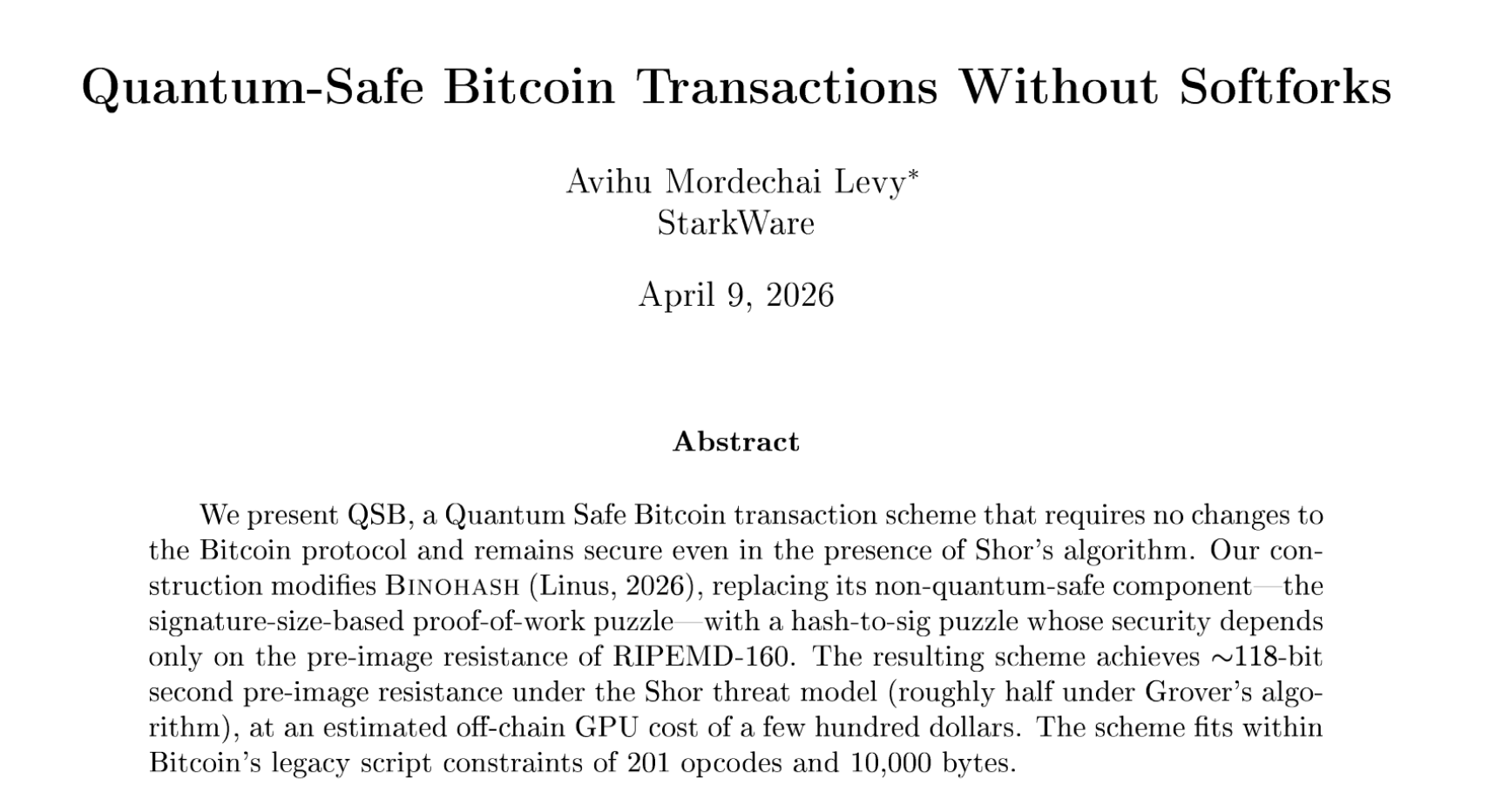
Image source: Github StarkWare developer Avihu Levy proposed research called “Quantum Safe Bitcoin” (Quantum Safe Bitcoin, abbreviated as QSB)
This proposal argues for achieving quantum-resistant transactions without changing Bitcoin’s core consensus rules or performing a soft fork. QSB’s technical core is to shift the security assumptions from elliptic curves to hash pre-image resistance. Since quantum computers have only limited acceleration capability when cracking hash functions, this architecture can effectively resist quantum attacks while maintaining an estimated security margin of about 118 bits.
QSB embeds a “hash-to-signature” puzzle within the constraints of Bitcoin’s existing scripting system, using functions such as RIPEMD-160 to construct a verification mechanism. Users need to find specific transaction parameters to satisfy the hash proof conditions; this is similar to a mini proof-of-work process, with a success probability of about 70.4 trillionths.
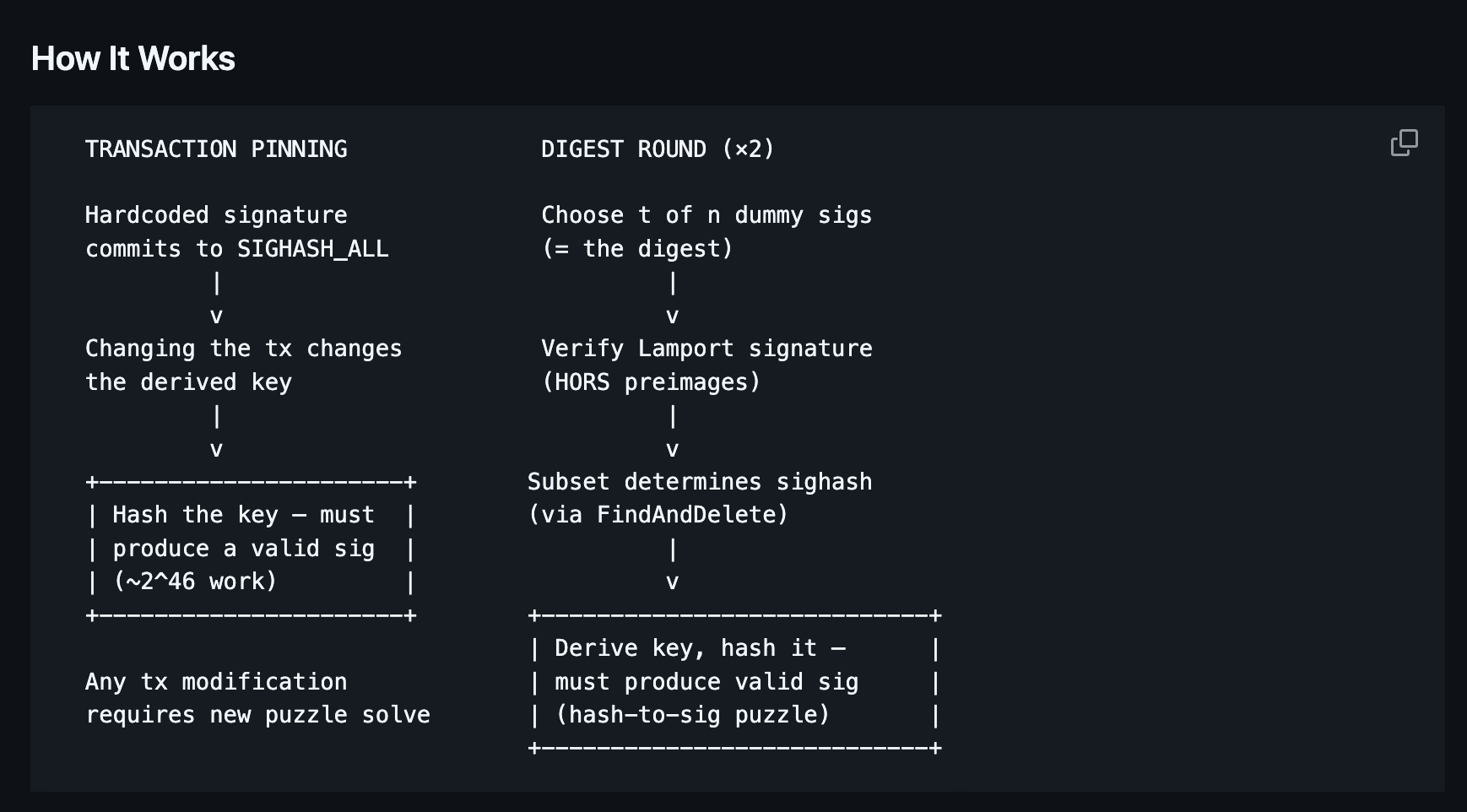
Image source: Github QSB operating principle
Research estimates that the cost of generating such transactions using cloud GPUs is about 75 to 150. Although QSB transactions are too large to be propagated through standard nodes and must be submitted directly to miners via services such as Slipstream, it demonstrates that Bitcoin retains flexibility to address future technological challenges without changing existing rules.
Defense mechanisms and assessment of market adoption
Widespread adoption of quantum defense technology still needs to overcome considerations of cost and performance. Quantum-resistant signatures typically occupy more block space, which will lead to higher transaction fees. Currently, the market remains divided on the timeline for Bitcoin’s quantum upgrade.
On the prediction platform Polymarket, traders believe the probability that Bitcoin’s quantum resistance upgrade proposals (such as BIP-360) will be adopted before 2027 is 26%. Although there is still debate in academia about when large-scale quantum attacks might occur, these rescue tools and transaction proposals that have appeared recently significantly improve the network’s resilience in preparing for future risks.
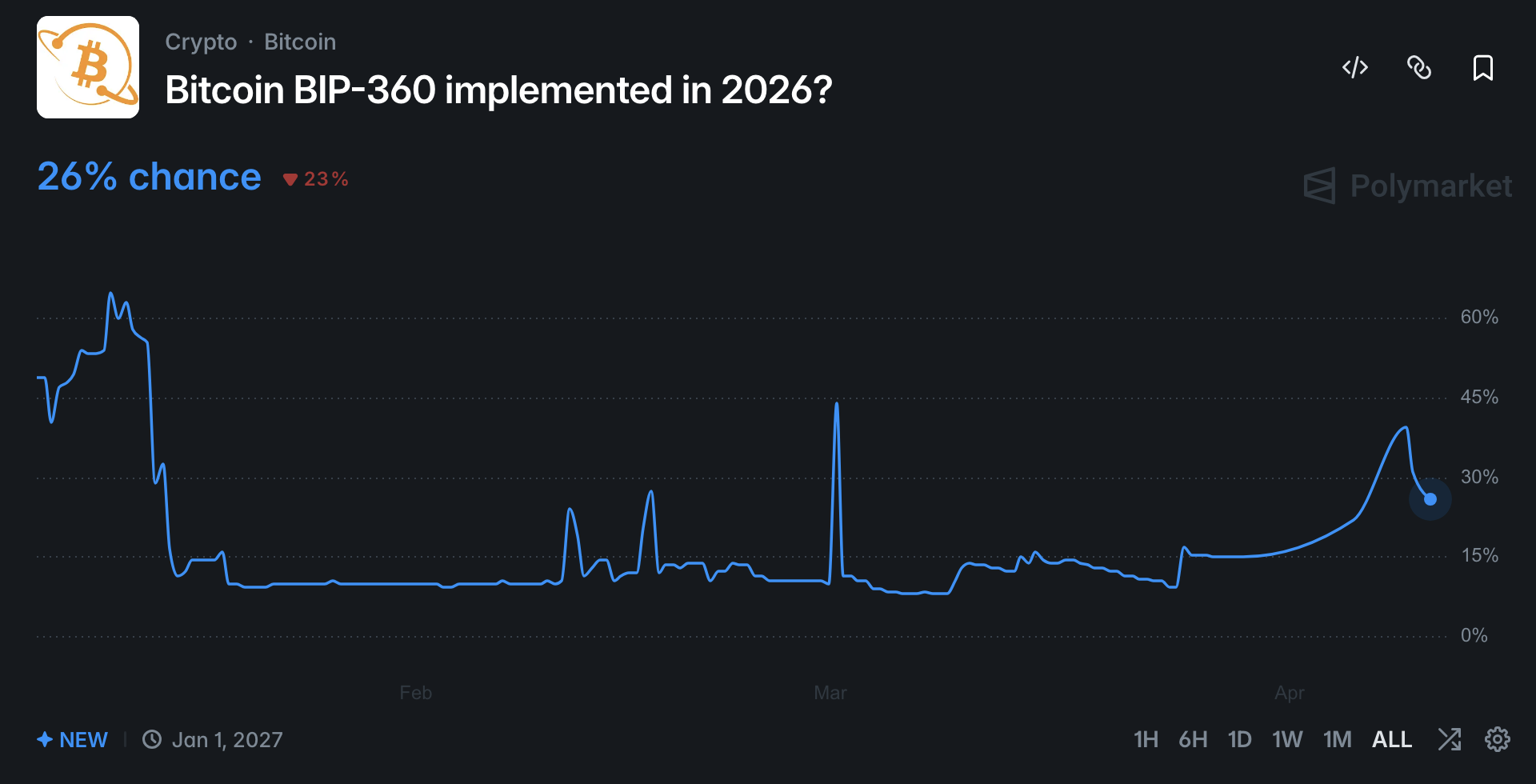
Image source: Polymarket traders believe the probability that Bitcoin’s quantum resistance upgrade proposals (such as BIP-360) will be adopted before 2027 is 26%
Through the development of these defensive prototypes, the Bitcoin community is gradually building a bridge between theory and real-world applications. Osuntokun’s rescue prototype and Levy’s QSB scheme provide diverse defense options for users with different needs. As computing resources are optimized and proof generation technologies improve, these tools are expected to become more lightweight and easier for the general public to use. For the Bitcoin ecosystem, continuous R&D of various quantum backup solutions is a necessary strategic setup for preserving the long-term value of digital gold. Before the threats truly arrive, these preventative technical reserves will become a critical moat to protect users’ assets from being made obsolete by the times.
Disclaimer: The information on this page may come from third parties and does not represent the views or opinions of Gate. The content displayed on this page is for reference only and does not constitute any financial, investment, or legal advice. Gate does not guarantee the accuracy or completeness of the information and shall not be liable for any losses arising from the use of this information. Virtual asset investments carry high risks and are subject to significant price volatility. You may lose all of your invested principal. Please fully understand the relevant risks and make prudent decisions based on your own financial situation and risk tolerance. For details, please refer to
Disclaimer.
Related Articles
Aave, Kelp, LayerZero Propose Releasing $71M in Frozen ETH to Support rsETH Recovery
Gate News message, April 26 — A coalition of major DeFi protocols led by Aave Labs, joined by Kelp DAO, LayerZero, EtherFi, and Compound, filed a Constitutional AIP on Saturday morning asking the Arbitrum DAO to release approximately $71 million in frozen ETH to support DeFi United, a cross-protocol
GateNews1h ago
Scallop Discovers sSUI Reward Pool Vulnerability, Suffers 150K SUI Loss but Pledges Full Reimbursement
Gate News message, April 26 — Scallop, a lending protocol in the Sui ecosystem, announced the discovery of a vulnerability in an auxiliary contract associated with its sSUI reward pool, resulting in a loss of approximately 150,000 SUI. The affected contract has been frozen, and Scallop confirmed
GateNews2h ago
BHT Device Cluster DAPP Goes Live Globally, MOVA Ecosystem Application Layer Advances
Gate News message, April 26 — BHT (Balance Hub Terminal) announced today that its device cluster DAPP has officially launched globally, with operations beginning at 12:00 UTC / 08:00 ET on April 26, 2026.
As a core application layer within the MOVA Chain ecosystem, BHT focuses on device clusters an
GateNews4h ago
Ripple Custody Platform Now Live With Major Banks Across Europe, Asia, and Middle East
Gate News message, April 26 — Ripple has deployed its institutional-grade digital asset custody platform, Ripple Custody, with leading financial institutions across multiple regions. The API-first platform integrates with existing banking infrastructure and provides instant wallet provisioning,
GateNews5h ago
Aave, Kelp, LayerZero Seek $71M Frozen ETH Release from Arbitrum DAO
Aave Labs, Kelp DAO, LayerZero, EtherFi, and Compound filed a Constitutional AIP on the Arbitrum forum Saturday morning requesting the network's DAO release approximately $71 million in frozen ETH to support rsETH recovery efforts following last week's $292 million Kelp DAO exploit. The proposal
CryptoFrontier6h ago


