
Reserve announced on the X platform on April 20 that, as the ABC Labs team is closely monitoring the Kelp DAO rsETH attack incident, it has temporarily paused eUSD and USD3 minting, rebalancing, and RSR redemption (unlock) operations. The redemption feature remains normally open. According to Reserve’s announcement, Reserve DTF holders are almost unaffected.
Reserve Protocol Suspension Measures and Risk Assessment
According to Reserve Protocol’s official announcement dated April 20, 2026, this precautionary measure covers: pausing eUSD minting, pausing USD3 minting, pausing rebalancing, and pausing RSR redemption (unlock); the redemption feature remains normally open. In the announcement, Reserve recommended that if users need RSR overcollateralization protection, they should continue holding.
Reserve’s announcement explains that if rsETH on the mainnet experiences a significant drop in value (estimated 15.5% to 18.5% loss), Aave may incur bad debt, which could then affect Aave V3’s USDC collateral. In the Reserve Protocol, USD3 and eUSD RSR stakers may play the role of a “first-loss capital” protection layer, but Reserve states the impact is extremely small, and RSR overcollateralization is sufficient to cover it.
Kelp DAO rsETH Attack: Timeline and Attack Mechanism
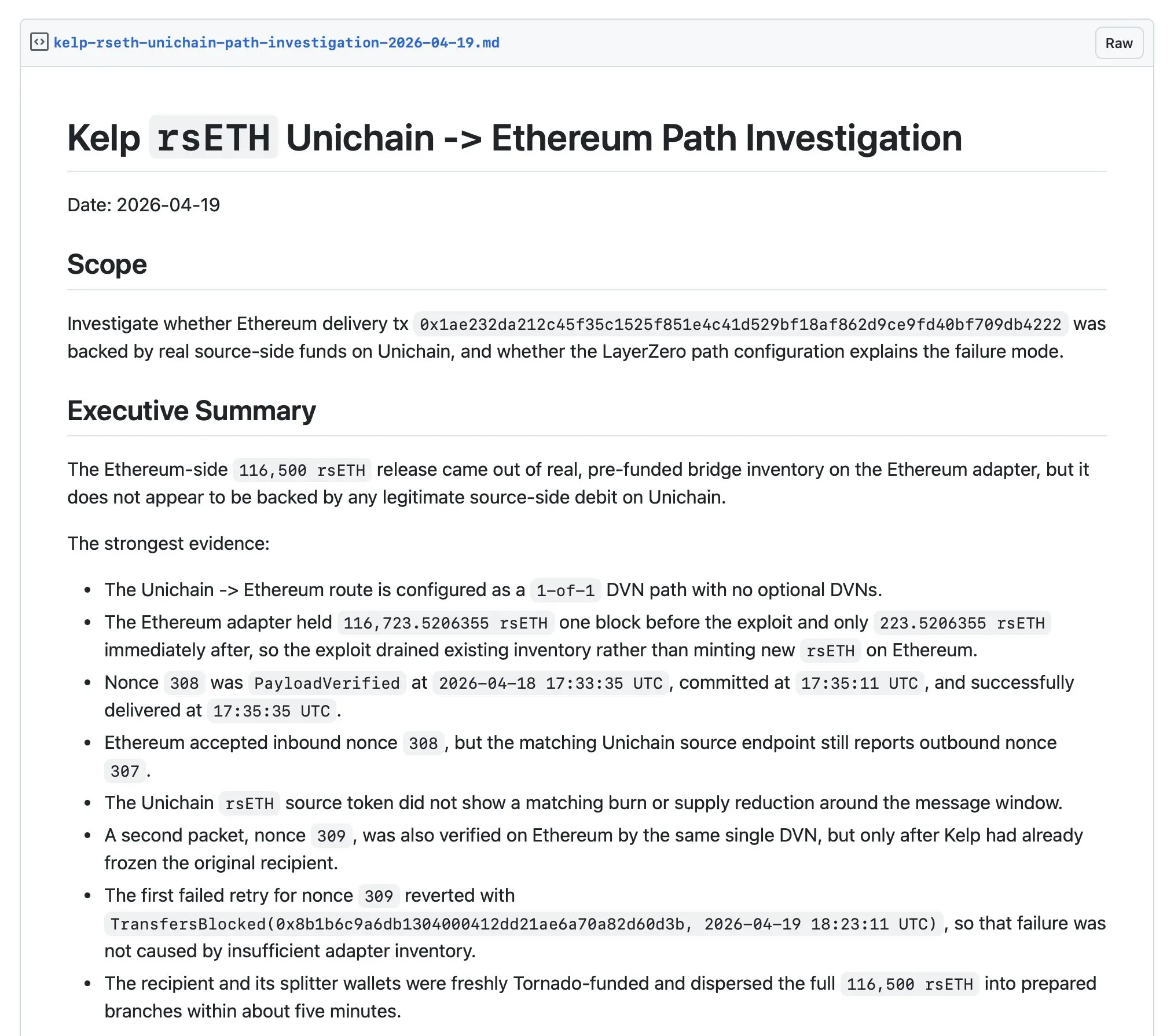 (Source: GitHub)
On Saturday, April 18, 2026, LayerZero bridge-related infrastructure associated with Kelp DAO was attacked. According to disclosures by blockchain security firm PeckShield, Aave locked the relevant market one hour earlier, and on-chain a transaction appeared showing 116,500 rsETH (at the time worth about $291 million) flowing into a new wallet.
Blockchain researcher Stacy Muur analyzed on X that this attack exploited a single point of failure: the attacker sent a “fake” message that prompted the Kelp DAO bridge to release rsETH on Ethereum, while not removing the corresponding amount of tokens from the Ethereum L2 network Unichain. Francesco Andreoli, Head of Developer Relations at Consensys and MetaMask, explained in an X post that the attacker did not directly transfer the stolen rsETH; instead, they used it to borrow ordinary funds from Aave, causing “massive bad debt.” Kelp DAO subsequently announced on X that it has paused rsETH contracts on the Ethereum mainnet and multiple L2 scaling networks.
Aave Liquidity Crisis: Data and Market Reaction
According to analysis published by on-chain analyst Yu Yan on April 20, 2026, since the attack occurred, deposits on the Aave platform fell from $45.8 billion to $35.7 billion, with outflows of about $10.1 billion; of that, stablecoin outflows were $4.5 billion. Aave’s stablecoin deposit interest rate remained at 13.4% for an entire day. Aavescan data shows that the attacker’s actions on Aave pushed the utilization rate of the core lending pool to 100%. Users who had previously deposited ETH and wETH had virtually no liquidity they could withdraw.
On X, DeFiLlama co-founder 0xngmi said that, as of early Sunday morning, Aave’s net withdrawals had reached $6.2 billion. Monetsupply.eth, alias strategy lead at Spark, pointed out in an X post that users borrowing against stablecoin collateral shows “negative secondary effects.” According to CoinGecko data, AAVE governance tokens fell to $90.13 on Sunday, down 16% from the previous day. In the same period, ETH fell 2% to $2,300. Tron founder Justin Sun also posted on X to address the attacker, asking “how much do you want?” and said the attack was not worth the damage inflicted on Aave and Kelp DAO.
Frequently Asked Questions
Which functions did the Reserve Protocol pause? Is redemption affected?
According to Reserve Protocol’s April 20, 2026 announcement on X, the scope of the pause includes eUSD minting, USD3 minting, rebalancing, and RSR redemption (unlock). The redemption feature remains normally open. ETH+ and bsdETH have zero risk assessment because they do not include rsETH collateral.
What are the loss amount and attack mechanism of the Kelp DAO rsETH attack?
According to PeckShield’s on-chain data, the attack involved 116,500 rsETH (worth about $291 million). Stacy Muur’s analysis on X indicated that the attacker sent a fake message via a single point of failure in the LayerZero bridge, released rsETH on Ethereum without corresponding burn, and used it to generate bad debt in Aave.
What data shows the impact of this attack on Aave’s liquidity?
According to Yu Yan’s analysis and Aavescan data, the utilization rate of Aave’s core lending pool reached 100% at one point; deposits fell from $45.8 billion to $35.7 billion, with outflows of about $10.1 billion. CoinGecko data shows that AAVE governance tokens dropped 16% on Sunday to $90.13.
Disclaimer: The information on this page may come from third parties and does not represent the views or opinions of Gate. The content displayed on this page is for reference only and does not constitute any financial, investment, or legal advice. Gate does not guarantee the accuracy or completeness of the information and shall not be liable for any losses arising from the use of this information. Virtual asset investments carry high risks and are subject to significant price volatility. You may lose all of your invested principal. Please fully understand the relevant risks and make prudent decisions based on your own financial situation and risk tolerance. For details, please refer to
Disclaimer.
Related Articles
Address Linked to Avi Eisenberg Shows New On-Chain Activity, Raising Security Concerns
Gate News message, April 26 — Blockchain analytics platform Arkham has identified renewed on-chain activity from an address believed to be connected to Avi Eisenberg, the attacker who profited approximately $110 million from the 2022 Mango Markets exploit. Eisenberg was previously sentenced to
GateNews1h ago
Sui DeFi lending protocol Scallop is hacked, with a vulnerability in the old contract leading to 150k SUI stolen
Scallop was attacked on the Sui chain, and the side contract involved led to the sSUI rewards pool being exploited. Approximately 150k SUI were stolen. The core contract is secure, and deposits and withdrawals have been restored. The official statement applies only to the deprecated rewards contract; users’ funds were not affected. Former NEAR developer Vadim said the vulnerability originated from an outdated V2 package from 17 months ago, where not initializing last_index caused rewards to accumulate starting in 2023. The fix requires adding a version field to the shared object and strengthening version checks to prevent risks caused by outdated packages.
ChainNewsAbmedia1h ago
Scallop Discovers sSUI Reward Pool Vulnerability, Suffers 150K SUI Loss but Pledges Full Reimbursement
Gate News message, April 26 — Scallop, a lending protocol in the Sui ecosystem, announced the discovery of a vulnerability in an auxiliary contract associated with its sSUI reward pool, resulting in a loss of approximately 150,000 SUI. The affected contract has been frozen, and Scallop confirmed
GateNews6h ago
Litecoin Undergoes Deep Chain Reorganization After MWEB Privacy Layer Zero-Day Exploit
Gate News message, April 26 — Litecoin experienced a deep chain reorganization on Saturday (April 26) after attackers exploited a zero-day vulnerability in its MimbleWimble Extension Block (MWEB) privacy layer, according to the Litecoin Foundation. The reorg spanned blocks 3,095,930 to 3,095,943 and
GateNews7h ago
Litecoin Sees First Privacy Layer Hack: MWEB Zero-Day Vulnerability Triggered 13-Block Reorganization
According to The Block, the Litecoin Foundation confirmed that the MWEB privacy layer suffered a zero-day vulnerability. The attacker used older nodes to make forged MWEB transactions appear valid, causing a rollback of 13 blocks on the main chain (about 3 hours), and performing double-spends against cross-chain exchanges; NEAR Intents exposed about $600k, and the mining pool was also hit with a DoS. A patched version has been released—please upgrade immediately. Main-chain balances are not affected, but it highlights the trade-off between reducing observability and increasing detection difficulty for the privacy layer.
ChainNewsAbmedia9h ago
Aave, Kelp, LayerZero Seek $71M Frozen ETH Release from Arbitrum DAO
Aave Labs, Kelp DAO, LayerZero, EtherFi, and Compound filed a Constitutional AIP on the Arbitrum forum Saturday morning requesting the network's DAO release approximately $71 million in frozen ETH to support rsETH recovery efforts following last week's $292 million Kelp DAO exploit. The proposal
CryptoFrontier10h ago


