Phantom Wallet experienced a malfunction during the airdrop period, causing incorrect price and balance displays. While users’ assets remained secure, it led to transaction losses and a crisis of trust.
A sudden malfunction during the airdrop period caused abnormal price and balance displays
On Monday evening, Phantom—one of the most popular wallets in the Solana ecosystem—suffered an unexpected service outage, resulting in abnormal token price and account balance displays within the platform. The malfunction occurred during a widely anticipated airdrop campaign, and with a surge in transaction demand, the issue quickly escalated.
According to the official statement, the abnormality mainly affected front-end data updates, preventing users from viewing the correct asset values in real time and even showing situations such as sharp price drops or assets displaying as zero. Although Phantom emphasized that “users’ asset security was not affected,” the incorrect information nonetheless materially disrupted market behavior.
Users couldn’t trade, leading to losses; the community demands full compensation
During the outage, multiple users reported that they were unable to successfully sell their tokens, missing out on opportunities from price fluctuations and even seeing book losses. Some users said on social platforms that within just 1.5 hours they lost about $450—around NT$14k—sparking panic that spread quickly.
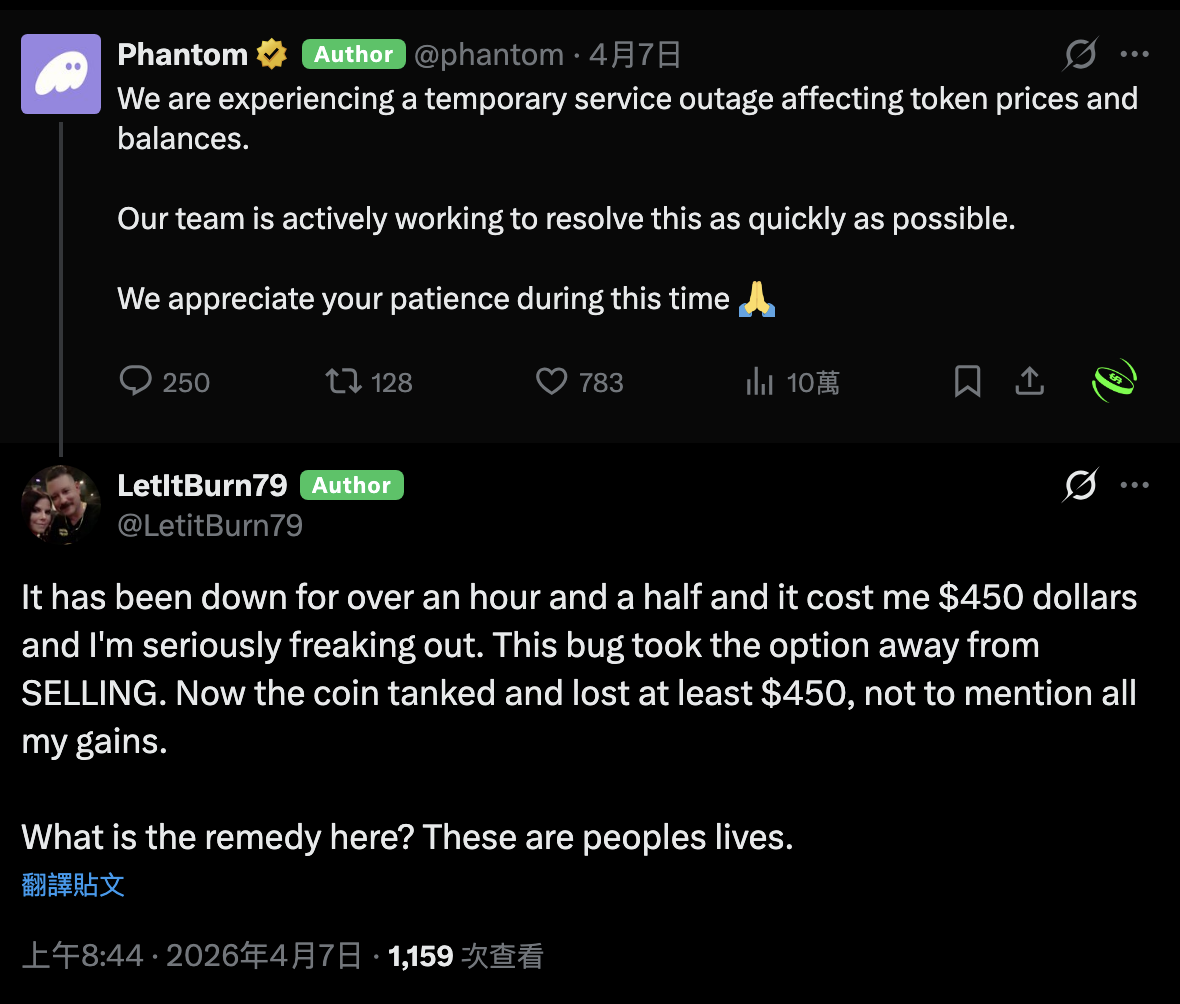
Image source: X/@LetitBurn79 Some users said on social platforms that within just 1.5 hours they lost about $450
As more loss cases emerged, some users have publicly demanded that Phantom provide a compensation mechanism, arguing that the platform failed to operate reliably during high-volatility periods—an issue that has already affected users’ trading decisions.
The incident also triggered discussion in the market about whether “front-end display errors should be held responsible,” especially in DeFi and self-custody wallet scenarios, where users typically have to bear operational risk themselves; the line of responsibility remains a gray area.
Security concerns rise as phishing attacks take advantage of the situation
During the service interruption, blockchain security firm PeckShield warned that bad actors may exploit the chaotic state to launch phishing attacks—tricking users into clicking malicious websites or signing suspicious transactions.
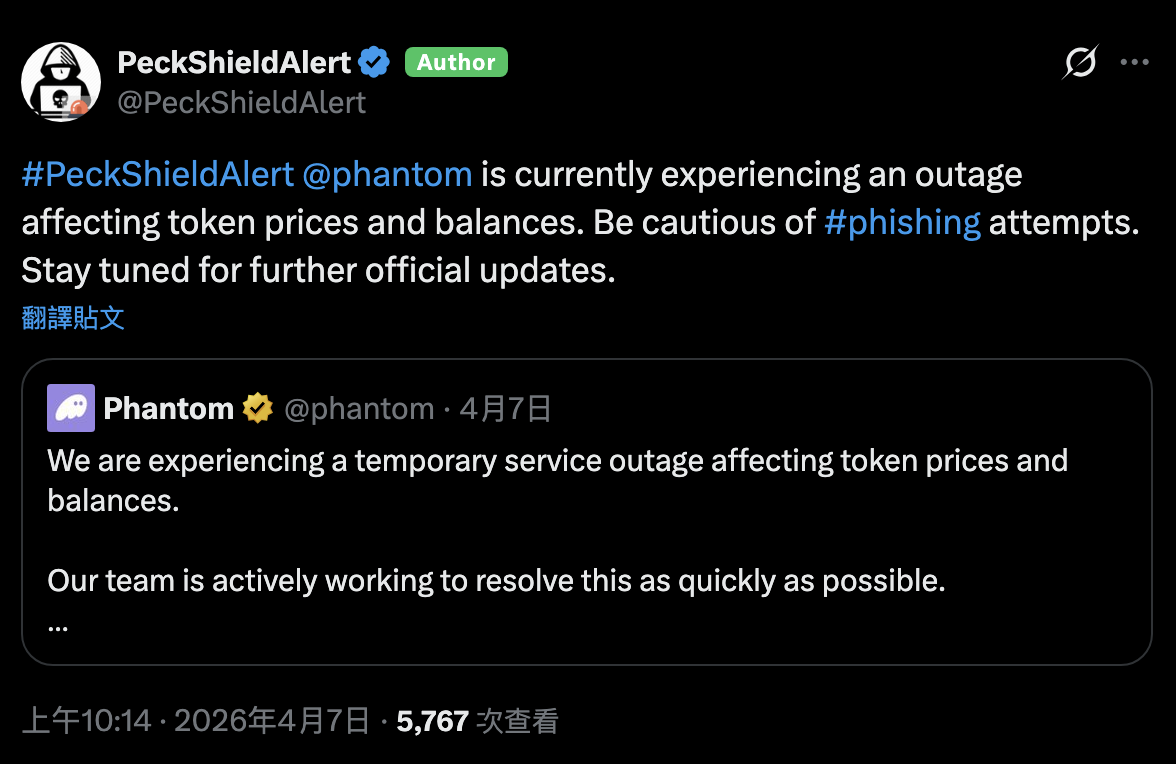
Image source: X/@PeckShieldAlert Blockchain security firm PeckShield warned that bad actors may exploit the chaotic state to launch phishing attacks—tricking users into clicking malicious websites or signing suspicious transactions
Past research has already pointed out that the Phantom wallet carries an “address pollution” risk: attackers can confuse users’ addresses by sending fake transactions, further inducing users to mistakenly transfer assets. This incident once again amplified related security concerns.
Experts remind users that when anomalies appear at the application layer, they should verify their asset status through an on-chain explorer, rather than relying solely on the wallet’s displayed information.
Technical issues have been fixed, but the trust crisis remains to be observed
Phantom later announced within a few hours that the problem had been fixed and advised any users still experiencing abnormalities to contact customer support for assistance. The official has not yet disclosed the specific cause, but industry generally believes this incident may have stemmed from data aggregation issues or delayed API updates—rather than a malfunction of the blockchain itself.
In fact, Phantom has also previously experienced similar balance-display delay issues, suggesting that even in scenarios involving high-frequency trading and large-scale simultaneous usage, the front-end infrastructure still faces bottlenecks.
This incident highlights that although self-custody wallets emphasize asset ownership, they still face challenges similar to those of centralized exchanges in terms of user experience and system stability. How to strike a balance between decentralization and reliability has become an important next step for the industry.
This article is generated by the Crypto Agent compiling information from various parties, and the review and editing are conducted by Crypto City. It is still in the training stage and may contain logical bias or information inaccuracies. The content is for reference only and should not be considered investment advice.
Disclaimer: The information on this page may come from third parties and does not represent the views or opinions of Gate. The content displayed on this page is for reference only and does not constitute any financial, investment, or legal advice. Gate does not guarantee the accuracy or completeness of the information and shall not be liable for any losses arising from the use of this information. Virtual asset investments carry high risks and are subject to significant price volatility. You may lose all of your invested principal. Please fully understand the relevant risks and make prudent decisions based on your own financial situation and risk tolerance. For details, please refer to
Disclaimer.
Related Articles
Scallop Discovers sSUI Reward Pool Vulnerability, Suffers 150K SUI Loss but Pledges Full Reimbursement
Gate News message, April 26 — Scallop, a lending protocol in the Sui ecosystem, announced the discovery of a vulnerability in an auxiliary contract associated with its sSUI reward pool, resulting in a loss of approximately 150,000 SUI. The affected contract has been frozen, and Scallop confirmed
GateNews4h ago
Litecoin Undergoes Deep Chain Reorganization After MWEB Privacy Layer Zero-Day Exploit
Gate News message, April 26 — Litecoin experienced a deep chain reorganization on Saturday (April 26) after attackers exploited a zero-day vulnerability in its MimbleWimble Extension Block (MWEB) privacy layer, according to the Litecoin Foundation. The reorg spanned blocks 3,095,930 to 3,095,943 and
GateNews5h ago
Litecoin Sees First Privacy Layer Hack: MWEB Zero-Day Vulnerability Triggered 13-Block Reorganization
According to The Block, the Litecoin Foundation confirmed that the MWEB privacy layer suffered a zero-day vulnerability. The attacker used older nodes to make forged MWEB transactions appear valid, causing a rollback of 13 blocks on the main chain (about 3 hours), and performing double-spends against cross-chain exchanges; NEAR Intents exposed about $600k, and the mining pool was also hit with a DoS. A patched version has been released—please upgrade immediately. Main-chain balances are not affected, but it highlights the trade-off between reducing observability and increasing detection difficulty for the privacy layer.
ChainNewsAbmedia7h ago
Aave, Kelp, LayerZero Seek $71M Frozen ETH Release from Arbitrum DAO
Aave Labs, Kelp DAO, LayerZero, EtherFi, and Compound filed a Constitutional AIP on the Arbitrum forum Saturday morning requesting the network's DAO release approximately $71 million in frozen ETH to support rsETH recovery efforts following last week's $292 million Kelp DAO exploit. The proposal
CryptoFrontier8h ago
Litecoin Suffers Deep Chain Reorganization After MWEB Zero-Day Exploit, Erasing Three Hours of History
Gate News message, April 26 — Litecoin experienced a deep chain reorganization (reorg) on Saturday after attackers exploited a zero-day vulnerability in its MimbleWimble Extension Block (MWEB) privacy layer, according to the Litecoin Foundation. The bug allowed mining nodes running older software to
GateNews14h ago
Apecoin Insider Turns $174K Into $2.45M in One Day With 14x Trade on Both Sides of 80% Surge
An anonymous wallet with no prior trading history turned $174,000 worth of ether into $2.45 million by trading Apecoin on both sides of an 80% price surge in a single day.
Key Takeaways:
Wallet 0x0b8a converted $174,000 in ETH into a leveraged Apecoin long, exiting near the top for a $1.79M
Coinpedia14h ago


