On Threads, rumors claim that someone calling themselves an accountant will get Taiwan’s special act to ban USDT; in fact, it’s fear-based marketing. The draft clearly stipulates that overseas stablecoins can be traded with the approval of the competent authority. The public is urged not to believe the rumors, not to turn to illegal underground crypto dealers, and instead to choose licensed exchanges to avoid scams.
Someone calling themselves an accountant spreads rumors: “The special act will pass and USDT will be banned”
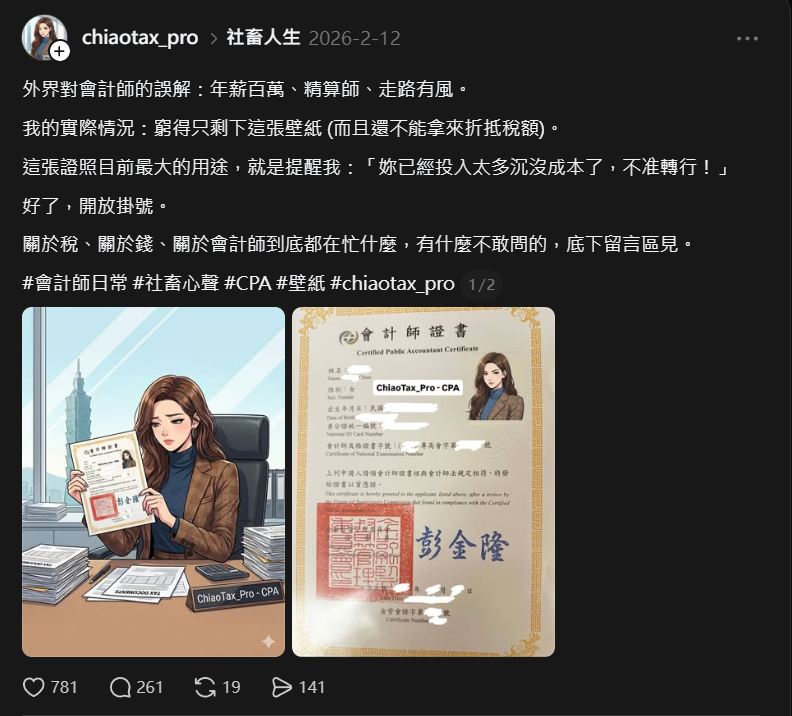
Yesterday (4/8), on Threads, an anonymous user who claimed to hold a CPA accounting license posted sensational remarks regarding the draft of the “Virtual Asset Services Act,” which the Executive Yuan recently passed.
The user claimed that Articles 34 and 35 of the new law explicitly provide that stablecoins must be approved by the competent authority and consulted with the central bank, and it also says that the conservative central bank will never allow Tether (USDT) to circulate legally in Taiwan. Once the regulations take effect, all legal trading platforms in Taiwan will comprehensively prohibit providing trading services; $USDT will soon become an out-of-standard “blacklisted account.” At present, the post has already received 20,000 views.
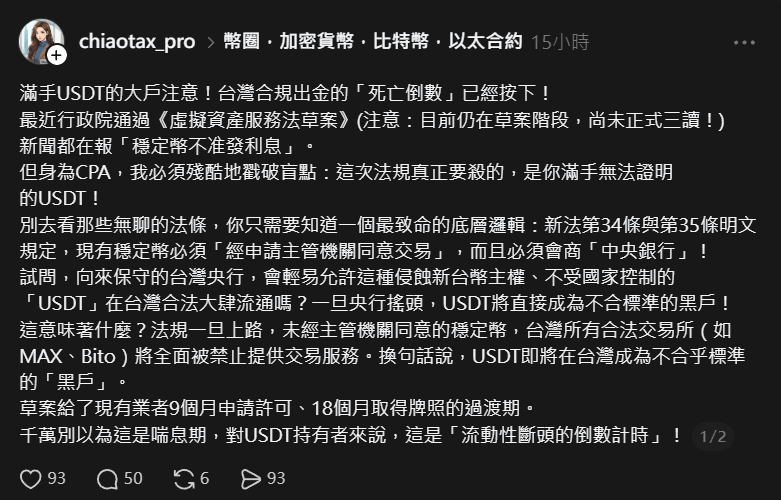
Image source: Threads
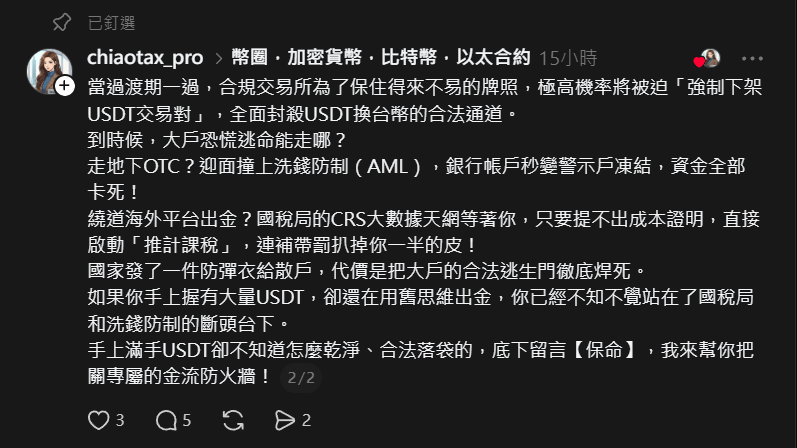
Image source: Threads
《Crypto City》editor-in-chief Max responded to this. The fear-based marketing in this piece is done well, but the interpretation of the regulations is off by a wide margin. The value of compliant expertise is to help funds find legal and workable paths. By magnifying the blurred gray area of the draft and describing it as a lifeline escape hatch that has been completely welded shut, the analysis completely departs from the essence of professional review.
Max emphasized that the core of the draft is the admission requirements and risk-control mechanisms for virtual asset service providers. The assets themselves are not directly what the regulations target. Deducing “liquidity rupture” by directly deriving from the possibility of delisting trading pairs is overly linear, and packaging the draft provisions in a doomsday narrative style is extremely irresponsible and unprofessional.
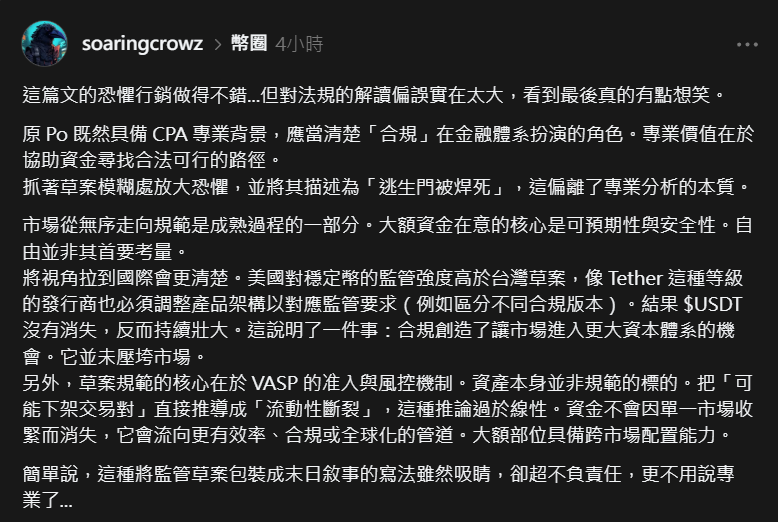
Image source: Threads
Also, judging from the pinned post of that account, it seems they have been cultivating an accountant persona for some time. However, the names on their CPA certificate have been redacted, and their profile picture is AI-generated. It’s hard not to wonder: if they really want to operate their own real human accountant business, would they really hide their identity like this?
Review Article 35 of the special-act draft to debunk the misinformation
By actually reviewing Article 35 of the draft of the “Virtual Asset Services Act” approved by the Executive Yuan, you can easily refute the user’s absurd reasoning.
In the “Explanatory Notes” section of draft Article 35, it is written in plain text:
If a virtual asset service provider’s services involve stablecoins, they shall be limited to stablecoins issued in our country with the approval of the competent authority, or stablecoins that are not issued in our country but are agreed to for trading in our country with the approval of the competent authority.
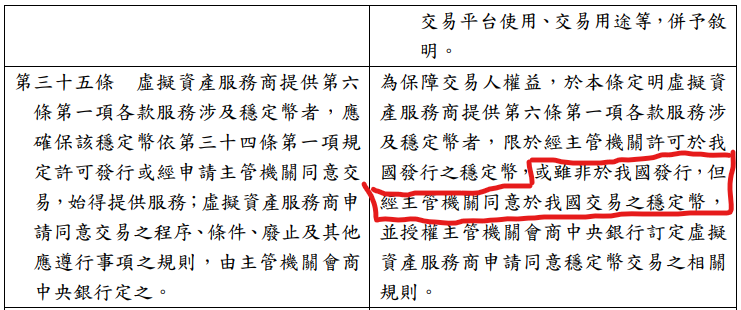
Image source: Draft “Virtual Asset Services Act” provisions
This clause clearly indicates that for overseas stablecoins that are not issued in Taiwan, the regulation has already established a mechanism for applying for and obtaining approval to trade.
The logical fallacy of this Threads user is that they presuppose, without any basis, that once the special act passes, the central bank will definitely reject all overseas stablecoins across the board—and treat this imagined assumption as established fact to spread alarmist claims.
In reality, the purpose of the regulation is to bring the market under oversight. It requires platform operators, before offering the relevant trading pairs, to have comprehensive assessment and application procedures in place. Sliding “the establishment of review and compliance mechanisms” directly into “a comprehensive crackdown on USDT” simply cannot stand up logically.
Dissect the rumor-mongering playbook in the community: shoot first, then draw the target
Looking back at recent panic posts on social media about Taiwan exchange deposits and withdrawals, it becomes clear that these rumor posts share very similar writing structures and tactics. Most of them have a strong “AI vibe,” and they will either explicitly state at the end or imply that you need to find other withdrawal channels.
Let me break down the structure of these posts:
- First, the post will use extremely sensational headlines to create panic that Taiwan’s crypto deposits and withdrawals are being cut off like an execution.
- Next, it will amplify recent upgrades to risk control at legitimate exchanges, hacker incidents, or even wording from the draft, completely denying the official deposit and withdrawal channels.
- Finally, at the end of the article, it will guide readers to DM, or require them to leave specific keywords to obtain an exclusive “life-saving channel.”
The core purpose of these posts is simply to destroy the public’s trust in legitimate platforms, and thereby redirect traffic and funds to the underground exchange-and-currency groups privately operated by the poster.
Related reports:
TWD deposit/withdrawal out of control? Be careful of being told not to use exchanges—it’s actually promoting their own personal coin dealer
Huge number of AI matrix accounts on Threads! Directing traffic to illegal coin dealers—Coinbase also responded
Don’t panic when regulation goes live; stay away from illegal underground crypto dealers
At present, the government has clearly stated that virtual asset service providers must complete anti-money-laundering measures and service capacity registration. Any individual coin dealer that operates without registering as required by law is engaged in illegal operations and, at the worst, may face up to 2 years imprisonment or a fine of up to NT$5 million.
The draft of the “Virtual Asset Services Act” also provides that operating without permission or issuing stablecoins will be punishable by up to seven years imprisonment and may result in a fine of up to 1 hundred million yuan.
According to information from the Criminal Investigation Bureau, since new rules took effect at the end of 2024, police have gradually carried out inspection and arrest actions targeting illegal street coin dealers, and have seized large amounts of funds.
- **Related report:****Taipei—3 crypto currency face-to-face handoff robbery incidents in 4 days! Fee-free “script” deceives the public; police urge use of legitimate exchanges **
Use legal coin dealers to avoid ending up with black U or scams
Although Threads sometimes has posts like this, it’s rare that this time it directly claims that it has an accountant’s identity.
When dealing with these community panic posts, you should remain rational. If you are influenced by the article and then DM the anonymous user, you may be lured into using illegal coin dealers, or fall into scam traps with an unclear source.
If you want to trade cryptocurrencies, you must choose legitimate providers announced by the Financial Supervisory Commission (FSC), and use normal channels that can leave transaction flow records—such as bank transfers. Do not let your own funds be exposed to extremely high risks in underground markets just because of greed for temporary convenience or because you believe online rumors.
Below are the legal virtual asset service providers (VASP) in Taiwan at present, listed in stroke order:
- Hoya Digital Technology (HOYA BIT)
- Expanding Digital Technology (ZONE Wallet)
- Modern Wealth Technology (MaiCoin, MAX Exchange)
- KryptoGO (Weight Technology)
- Fusheng Digital Technology (TWEX)
- Cross-chain Technology (Chainss)
- BitoPro Technology (BitoPro)
- Linko Co., Ltd. (XREX Exchange)
Disclaimer: The information on this page may come from third parties and does not represent the views or opinions of Gate. The content displayed on this page is for reference only and does not constitute any financial, investment, or legal advice. Gate does not guarantee the accuracy or completeness of the information and shall not be liable for any losses arising from the use of this information. Virtual asset investments carry high risks and are subject to significant price volatility. You may lose all of your invested principal. Please fully understand the relevant risks and make prudent decisions based on your own financial situation and risk tolerance. For details, please refer to
Disclaimer.


