Record stablecoin supply and $10T volume show liquidity is rising but still partly parked on the sidelines.
Stablecoin liquidity is expanding again as recent reports point to renewed capital circulation across crypto markets. Transfer activity has accelerated sharply, while total supply now sits at record levels. On-chain settlement appears to be regaining structural momentum.
Stablecoin Market Rebounds to New Highs, DEXs Capture 56% of Activity
As per data from Dune Analytics, the combined stablecoin balance stands at about $329.6 billion. Last month alone, the sector pulled in over $10 trillion in transfer volume, the strongest monthly reading since April 2022. Decentralized exchanges made up 56% of all stablecoin activity during that time.
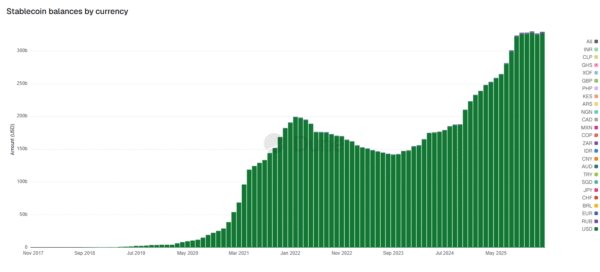
_Image Source: _Dune Analytics
In recent years, the stablecoin supply has moved through three main phases. From 2020 to 2022, balances grew quickly and reached nearly $200 billion. During the 2022–2023 market drop, supply slid to around $140–150 billion.
However, growth returned in the succeeding year. And now balances have climbed above $320 billion, setting a new record.
Stablecoins pegged to USD continued activities within the sector. In comparison, its non-USD counterparts account for just over $2 billion combined. For context, this figure is less than 1% of the total stablecoin supply.
Data Reveals Billions Flowing In and Out as Positioning Shifts
Data from Kaiko gives a clearer view of market trends by looking at Bitcoin, Ethereum, and stablecoin dominance. During the market downturn, many investors moved into stablecoins for safety. And in turn, this increased their share of the market.
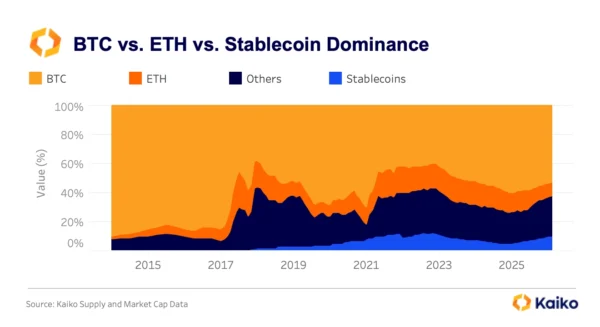
_Image Source: _Kaiko
As confidence slowly returned, some of that money rotated back into risk assets like Bitcoin and Ethereum. Even so, stablecoins still hold a larger share of the market compared to earlier cycles.
Current positioning implies liquidity is present but not fully committed.
- Significant capital remains parked in stablecoins.
- Risk rotation has resumed but remains measured.
- Speculative allocation has not reached prior extremes.
- Ample “dry powder” still sits on the sidelines.
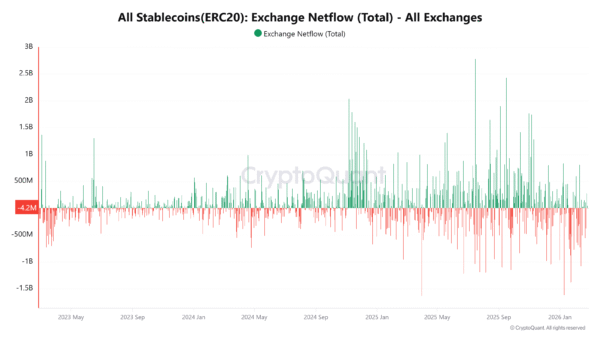
_Image Source: _CryptoQuant
According to CryptoQuant, daily inflows of $1–2.5 billion occurred frequently over the past two years. Oftentimes, these large inflows happen before traders open spot or futures positions. At the same time, heavy outflow days exceeding $1 billion reflect rapid capital relocation.
Stablecoins Shift On-Chain as DEX Activity Rises and $80B Sits on CEXs
Recent data shows that stablecoins are steadily leaving centralized exchanges, while activity on DEXs continues to rise. This suggests funds are moving on-chain rather than leaving the crypto market.
Even so, centralized exchanges still hold around $80 billion in stablecoins. That represents significant sidelined buying power. With total supply at record highs, overall market liquidity remains solid.
Stablecoin velocity now matches supply growth, with $10 trillion in monthly transfers confirming faster capital turnover. Even more, rising DEX participation suggests structural evolution in how liquidity circulates.
Disclaimer: The information on this page may come from third parties and does not represent the views or opinions of Gate. The content displayed on this page is for reference only and does not constitute any financial, investment, or legal advice. Gate does not guarantee the accuracy or completeness of the information and shall not be liable for any losses arising from the use of this information. Virtual asset investments carry high risks and are subject to significant price volatility. You may lose all of your invested principal. Please fully understand the relevant risks and make prudent decisions based on your own financial situation and risk tolerance. For details, please refer to
Disclaimer.
Related Articles
Is Injective (INJ) a Dead Coin or the Next 2800% Opportunity? Here’s What The Chart Is Saying
The Injective price has fallen sharply from its previous all-time high, leading some traders to question whether the project has lost its momentum.
However, a recent technical analysis shared by top analyst Crypto Patel suggests that the recent decline may actually represent a typical
CaptainAltcoin1h ago
CFX 4-hour chart reaches a new high for the phase, with approximately 14% increase over 24 hours
Gate News: On March 15, market data shows that CFX reached a new phase high on the 4-hour K-line chart, with prices touching approximately 0.06282 USDT at their peak, representing a 24-hour gain of around 14%. Some community members believe this rally may be related to recent macroeconomic catalysts. Earlier, media outlets citing sources reported that Iran is considering allowing certain tankers to pass through the Strait of Hormuz on the condition that petroleum transport be settled in Chinese yuan. Related discussions have once again sparked market attention toward yuan stablecoins and cross-border payment narratives.
GateNews2h ago
After the network upgrade: What prospects await SOL?
The official approval of protocol SIMD-0266 aims to optimize computing efficiency on the Solana network by introducing p-tokens, simplifying transaction processing. This upgrade, set for April, has prompted increased buying activity and could lead to significant cost reductions and performance improvements.
TapChiBitcoin3h ago
Track FET's journey to the $0.24 milestone as the AI cryptocurrency sector records its most positive trading week in months
The cryptocurrency industry related to AI has recently recorded an impressive performance. According to data from CoinMarketCap, the total market capitalization of this sector has grown 16% in just the past week. Many leading tokens in this category have also achieved significant growth, attracting
TapChiBitcoin3h ago
DeFi enters a "winter of yields": liquidity stagnation, leverage contraction, and the disappearance of arbitrage opportunities
Since September 2025, the DeFi market has entered a "interest rate winter," with the annualized deposit yields of mainstream stablecoins dropping to lows, and supply and demand imbalances causing excess liquidity. As borrowing demand declines, stablecoin lending rates have also decreased, and the reduced risk appetite in the crypto market has led investors to shift toward more stable assets. Some protocols, such as Sky, offer stable returns through real-world assets, but the overall trend still indicates a period of adjustment and structural reform in DeFi.
区块客3h ago


