
The market value of tokenized U.S. Treasuries has risen from $8.9 billion on January 1, 2026, to over $10.8 billion, an increase of more than $1 billion year-to-date. Data from Token Terminal shows that since 2024, the tokenized U.S. debt market has grown over 50 times, mainly benefiting from BlackRock’s launch of the USD Institutional Digital Liquidity Fund (BUIDL) in March 2024.
Growth Trajectory of Tokenized U.S. Treasuries: From $4 Billion to $10.8 Billion
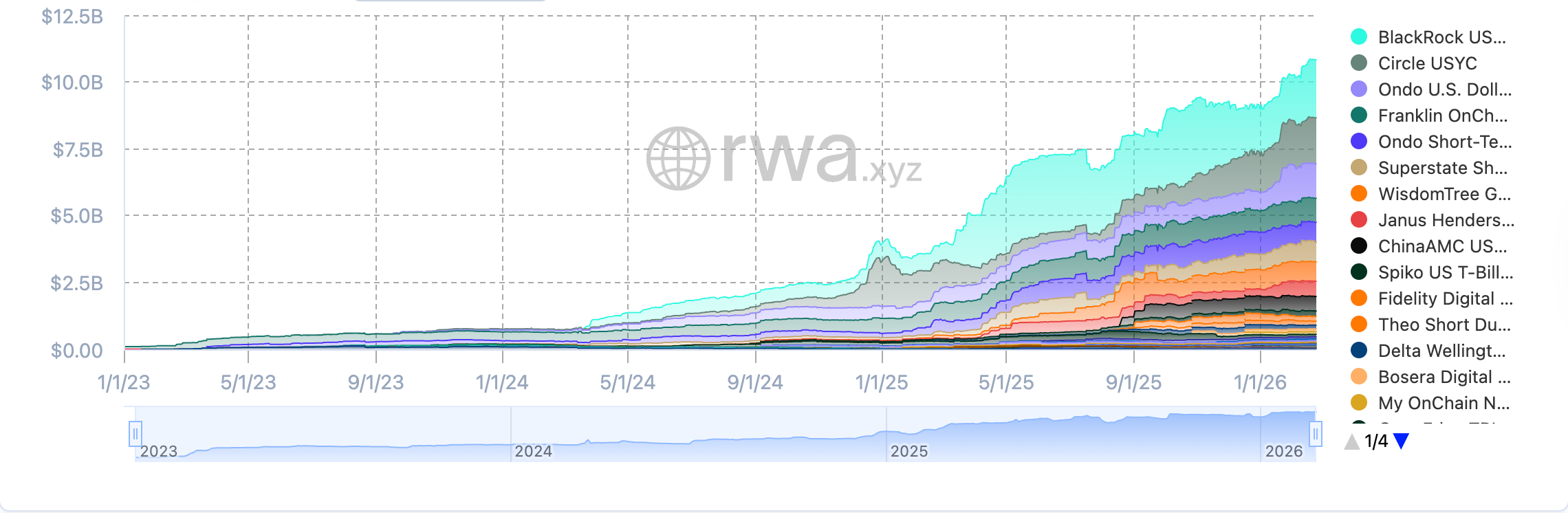
(Source: RWA.xyz)
The expansion of the tokenized U.S. Treasuries market has far exceeded expectations. In early 2025, the total market cap was less than $4 billion; by early 2026, it surpassed $10.8 billion, achieving a 50-fold explosive growth within two years.
This growth is especially remarkable against the backdrop of the overall crypto market downturn. Since October 2025, the cryptocurrency market has experienced a broad correction, with Bitcoin dropping over 40% from its all-time high, yet the market cap of tokenized U.S. Treasuries continued to reach new highs, demonstrating a growth logic that is fundamentally different from the broader crypto market.
Key Factors Driving the Growth of Tokenized U.S. Treasuries
BlackRock BUIDL Fund as a Demonstration Effect: The entry of the world’s largest asset manager established an institutional-grade compliance framework, providing a reference model for subsequent participants. Currently, BUIDL’s market cap exceeds $1.2 billion.
Short-term Treasuries as Institutional Cash Alternatives: Short-term U.S. Treasuries under one year are regarded as “near-cash” in global capital markets. Tokenization enables companies and institutions to directly allocate and transfer these assets on-chain.
On-Chain Revenue Demand from Crypto-native Institutions: The stable yields of government bonds combined with blockchain’s 24/7 liquidity offer an efficiency advantage for on-chain fund management that traditional cash management cannot match.
Blockchain Revenue Outlook: The surge in tokenized U.S. Treasuries generates ongoing transaction fee income for the public blockchain networks that mint these assets, actively encouraging multiple chains to develop RWA (Real-World Asset) tracks.
DTCC Official Entry: The Largest Clearing House Accelerates Tokenization Strategy
In December 2025, DTCC announced plans to launch asset tokenization services, with U.S. Treasuries as the first targeted asset class. DTCC is the world’s largest clearinghouse, with transaction settlements totaling $3.7 quadrillion in 2024. Its involvement fundamentally changes the credibility and scale expectations of the tokenization market.
Frank La Salla, CEO of DTCC, stated that after tokenizing U.S. Treasuries on the Canton network, ETF and stock tokenization will follow. La Salla confirmed that DTCC’s ultimate goal is to expand tokenization services to a “broad” range of asset classes.
This strategic decision by DTCC signifies a shift of core clearing infrastructure in traditional finance from a “spectator” role to an active builder of the tokenized market, providing critical trust backing for large-scale institutional entry into the RWA sector.
Frequently Asked Questions
How is tokenized U.S. Treasuries different from holding regular U.S. Treasuries?
Tokenized Treasuries are represented as blockchain tokens of traditional U.S. government debt, allowing holders to transfer, use as collateral, or integrate into DeFi protocols 24/7. Traditional U.S. Treasuries settle within limited hours and cannot operate directly on-chain. The tokenized version retains the creditworthiness of the underlying asset while adding blockchain’s liquidity and programmability features.
Why is BlackRock’s BUIDL Fund so important to the tokenized U.S. Treasuries market?
BUIDL is BlackRock’s tokenized USD institutional liquidity fund, launched in March 2024. Its debut marked a key turning point for explosive growth in the tokenized RWA market. BUIDL’s participation brought over $1.2 billion in actual capital and, more importantly, established an institutional-grade regulatory compliance framework, alleviating many institutional investors’ concerns and triggering subsequent institutional follow-on.
What does DTCC’s entry into the tokenization space mean for ordinary crypto investors?
DTCC’s involvement signifies that the core infrastructure of the global financial market recognizes the long-term viability of tokenization. For the crypto market, DTCC’s participation could accelerate the flow of institutional funds into regulated tokenized channels, especially supporting the fundamentals of public blockchains (like Ethereum, Canton network, etc.) that carry RWA tokenization businesses.
Disclaimer: The information on this page may come from third parties and does not represent the views or opinions of Gate. The content displayed on this page is for reference only and does not constitute any financial, investment, or legal advice. Gate does not guarantee the accuracy or completeness of the information and shall not be liable for any losses arising from the use of this information. Virtual asset investments carry high risks and are subject to significant price volatility. You may lose all of your invested principal. Please fully understand the relevant risks and make prudent decisions based on your own financial situation and risk tolerance. For details, please refer to
Disclaimer.
Related Articles
Vitalik calls for a rethinking of Ethereum's application layer: assuming there are no users, how would the white paper be rewritten?
Ethereum co-founder Vitalik Buterin recently called on the community to be more bold in innovating at the application layer while maintaining core values. He believes that the security and principles of the base layer should remain unshaken, but the application layer should be more disruptive and experimental. He explored the future design of privacy technologies and DeFi, and advocated for rethinking Ethereum's applications, even suggesting that if there were no users, developers should consider how to rewrite the application section of the white paper from scratch to face future challenges.
ChainNewsAbmedia14m ago
U.S. Bitcoin reserves expand to enter the top 20 globally, Tinder founder increases purchase by 1.8 million shares
American Bitcoin Company (ABTC) Bitcoin reserves increase to 6,500 coins, ranking among the top 20 publicly listed companies worldwide. Despite stock price fluctuations, the reserve news prompted an 11.7% rise in stock price. ABTC is expanding its mining machine hash rate and plans to invest in reducing Bitcoin acquisition costs. Board member Tinder founder recently increased his holdings by purchasing 1.8 million shares.
ChainNewsAbmedia1h ago
Doppler expands its token issuance platform to the Solana network
PANews March 6 News, according to The Block, the token issuance platform Doppler, which supports most new token launches on the Base chain, announced its expansion to the Solana network. Doppler stated that this migration is not simply a port or fork, but a native implementation tailored to Solana's unique architecture, constraints, programming model, and economic mechanisms. Doppler noted that it has been operating on multiple EVM chains and has integrated applications such as Zora and Bankr.
GateNews1h ago
Revolut applies for a U.S. banking license for the second time, with a new CEO leading nationwide expansion
Fintech company Revolut has submitted a national bank charter application to the Office of the Comptroller of the Currency (OCC) and the FDIC, planning to establish "Revolut Bank US, NA." This is its second attempt after being blocked in 2021, with the move to a federal application aimed at optimizing the regulatory framework and expanding business capabilities, such as direct access to payment systems and FDIC insured deposits. Revolut currently has over 70 million customers and operates in 40 markets.
MarketWhisper2h ago
MetaDAO community votes to approve the "Liquidate Ranger Finance" proposal
MetaDAO community voting approved the proposal to liquidate Ranger Finance, remove RNGR/USDC liquidity, and transfer the USDC reserve to MetaDAO, to be distributed proportionally to unlocked token holders. Additionally, the intellectual property of Futarchy governance will be returned to Glint House PTE. LTD. The snapshot will be taken on March 13.
GateNews2h ago


