


Bitcoin drops below $64,000, Ethereum holds steady at $1,800! The three major US stock indices and IBM plummet 13%, dragging the crypto market down again.
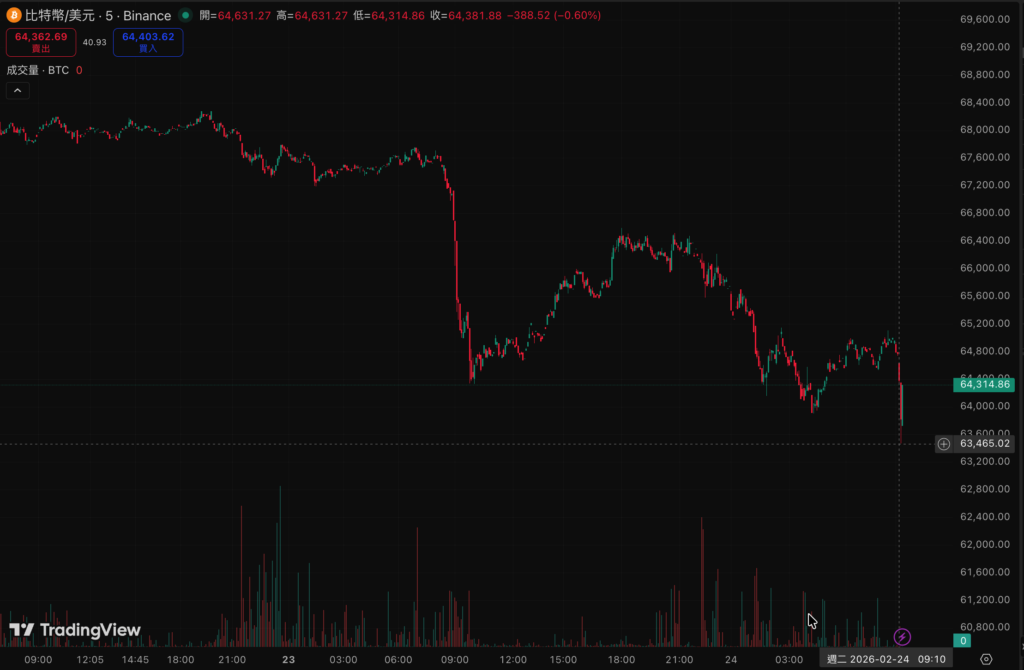
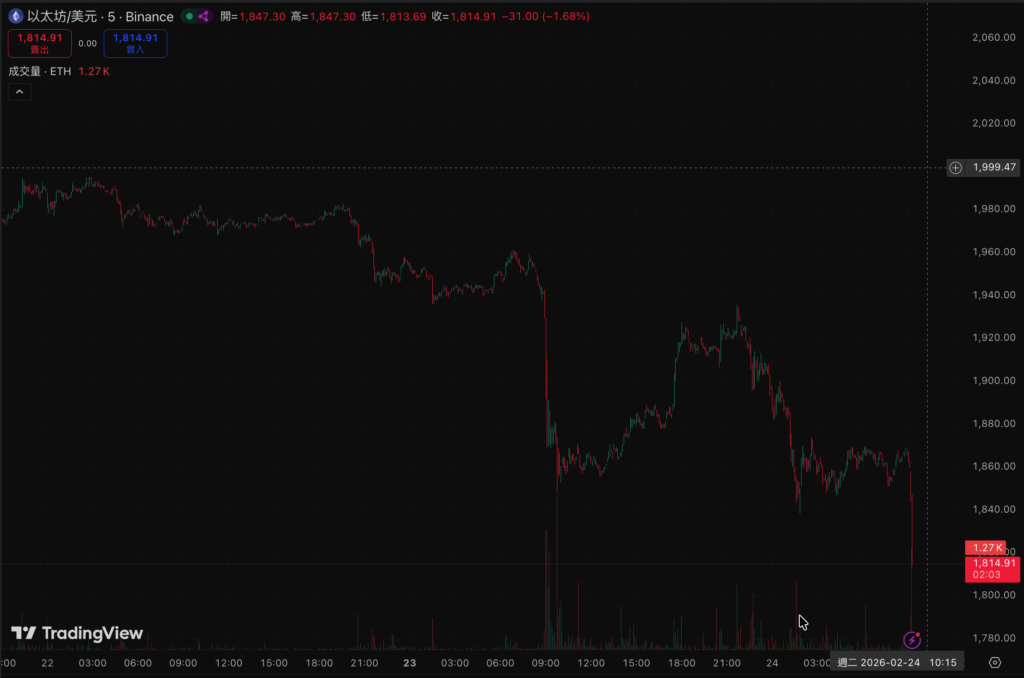
Bitcoin this morning (24th) briefly fell below the $64,000 mark following a sharp decline in U.S. stocks, but has now stabilized around $64,770. Ethereum experienced a smaller drop, briefly touching $1,843 before rebounding to $1,859. U.S. stocks opened lower and continued to decline on Monday, with the Dow down 1.66%, the S&P 500 down 1.04%, and the Nasdaq down 1.13%, with tech stocks bearing the brunt of the losses.
(Background: Bitcoin plunged to $50,000, Ethereum fell below $1,900, and the entire February market was in extreme panic.)
(Additional context: Is Bitcoin a software stock? $1 trillion of U.S. stock market value evaporated, and BTC is following suit.)
Table of Contents
Toggle
- U.S. tech stocks hit hard, IBM plunges 13%
- Bitcoin’s correlation with U.S. stocks continues to rise
- Worst start to 2026, market remains in extreme panic
Bitcoin briefly dropped below $64,000 around 4 a.m. today following the sharp decline in U.S. stocks on Monday (2/24) after the market closed, with a low of $63,465. It is currently trading at $64,314. Overall market sentiment remains in a state of “extreme panic,” with the Fear & Greed Index lingering at low levels.
Ethereum’s decline was relatively modest; after dipping to $1,813, it held the $1,800 support level and is now trading at $1,830.
U.S. Tech Stocks Hit Hard, IBM Plunges 13%
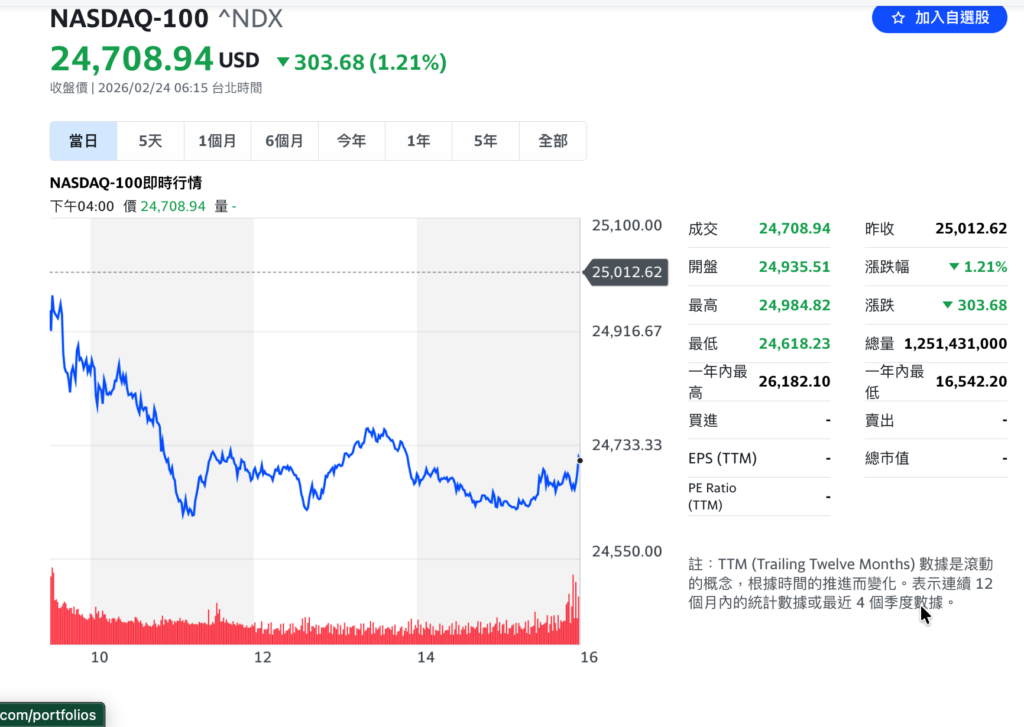
U.S. stocks closed lower across the board on Monday, with the Dow down 1.66%, the S&P 500 down 1.04%, and the Nasdaq down 1.13%.
Tech stocks led the decline, with IBM dropping 13% in a single day—the largest one-day drop since 2000. Additionally, Adobe and Oracle fell about 4.6%, Salesforce declined 3.7%, and Microsoft dropped 3.2%. The software and information technology services sectors led the declines, reflecting increasing selling pressure on tech stocks.
Notably, precious metals and non-ferrous metals sectors rose against the trend, indicating that funds are accelerating out of risk assets into safe-haven assets. The Nasdaq China Golden Dragon Index also fell nearly 1%.
Bitcoin’s Correlation with U.S. Stocks Continues to Rise
Bitcoin again demonstrated a high correlation with U.S. tech stocks during this decline. Previously reported by Dynamic Zone, the 30-day rolling correlation between Bitcoin and U.S. software ETF (IGV) has surged to 0.73, with volatility correlation reaching 0.88, the highest in history.
This means that when U.S. tech stocks are sold off, Bitcoin almost simultaneously comes under pressure. Given the current global liquidity tightening, BTC may face further downside risks in the short term.
Worst Start to 2026, Market Remains in Extreme Panic
In the first 50 trading days of this year, Bitcoin has fallen about 23%, marking the worst start in history. Throughout February, the cryptocurrency Fear & Greed Index has remained in the “extreme panic” zone, reflecting severe market confidence issues.
Going forward, the market will closely watch U.S. stock movements, Federal Reserve policy signals, and whether Bitcoin can hold the key support level of $63,000. If U.S. stocks continue to weaken, BTC may further test the $60,000 psychological level.

Related Articles
In the past 24 hours, the total liquidation on the entire network's contracts reached $311 million, mainly from long positions.
Ethereum Foundation Formalizes DeFi Strategy With New Protocol Support Unit
Whale "0x4A2" Deposits Additional $2M USDC to HyperLiquid, Expands ETH and SOL Long Positions
A whale deposits 2 million USDC into Hyperliquid to increase long positions in ETH and SOL.