
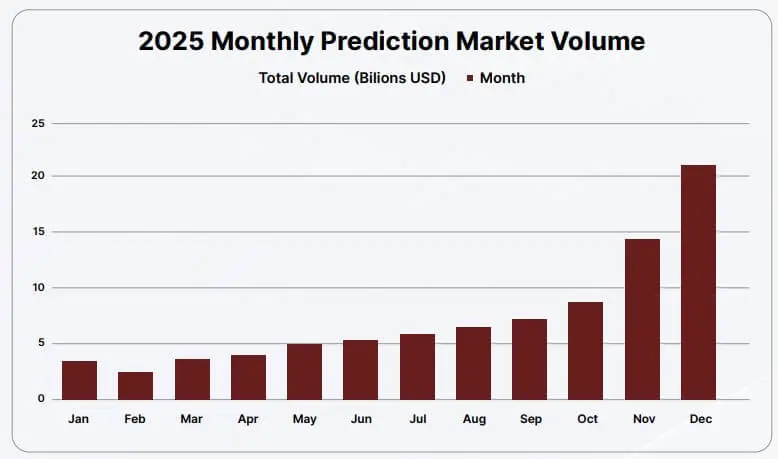
CertiK’s report indicates that the total predicted market trading volume is projected to grow from $15.8 billion in 2024 to $63.5 billion in 2025, representing a fourfold increase that extends into January 2026. The week of January 18 set a record with $6 billion in trading volume. However, the three major platforms—Kalshi, Polymarket, and Opinion—dominate 95% of the market, creating systemic risks, with fake trades reaching up to 60% during airdrop peaks.
From $15.8B to $63.5B: The Fourfold Explosive Growth of Prediction Markets
(Source: CertiK)
According to a new report by blockchain security firm CertiK, prediction markets are expected to reach mainstream adoption by 2025, with annual trading volume increasing fourfold as a few platforms consolidate control over this rapidly expanding, institution-grade product. The report states that the industry’s total trading volume will rise from $15.8 billion in 2024 to $63.5 billion in 2025, and activity will remain high after the US election cycle concludes, extending into January 2026.
This sustained growth is significant because it suggests that election-related trading is less a one-time spike and more an acquisition event that attracts new users to repeat behavior. Conventional wisdom holds that prediction markets are mainly driven by major events like elections, with trading volume sharply declining afterward. However, data from 2025 shows that prediction markets not only did not shrink post-election but continued to grow into early 2026. This indicates that once users are attracted during elections, they discover prediction markets in sports, entertainment, finance, and other areas are equally engaging, leading to long-term retention.
Notably, the report highlights that during the week ending January 18, the nominal trading volume hit approximately $6 billion, reflecting a rapid shift from niche crypto products to high-volume trading venues. Analyzing this peak, the weekly volume equates to an annualized $312 billion, far exceeding the $63.5 billion annual total. Such peaks may be linked to major events (e.g., NFL playoffs, political developments), demonstrating the explosive potential of prediction markets during event-driven periods.
In terms of industry maturity, an annual volume of $63.5 billion surpasses many mid-sized crypto exchanges. This scale indicates that prediction markets are no longer fringe products but have become part of mainstream fintech. However, CertiK’s core concern is that next-stage growth conflicts with an integrity issue—less about smart contract vulnerabilities and more about governance of registration processes, the true meaning of trading volume, and mechanisms that determine reward distribution.
95% Monopoly by Three Giants: Systemic Risks of Single Points of Failure
(Source: CertiK)
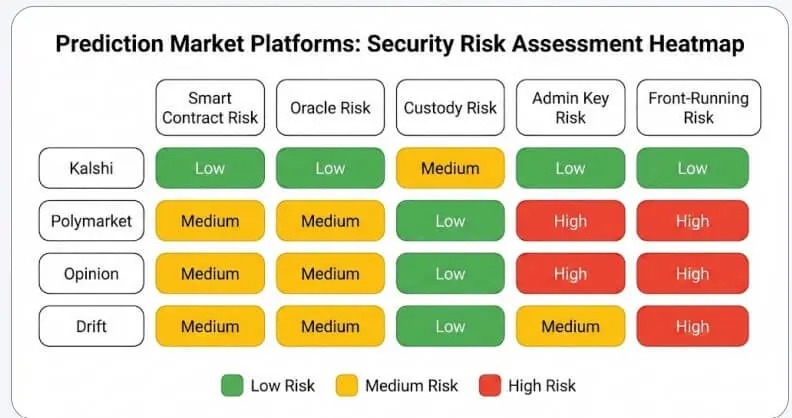
CertiK states that over 95% of the global prediction market volume is controlled by three platforms, each pursuing different dominant positions. Kalshi is a regulated US-based exchange prioritizing compliance. Polymarket captures the largest share among crypto-native and international users. Meanwhile, Opinion is the fastest-growing new entrant, leveraging ecosystem incentives to grow from nearly zero to about 30% market share within months.
This concentration transforms operational issues into systemic risks. The failure of any major trading venue is no longer an isolated event but a trust shock across the entire market, potentially affecting liquidity pools, data sources, and user balances—especially as brokers and mainstream dealers begin to treat prediction probabilities as a new type of information product.
Comparison of the Three Major Prediction Platforms
Kalshi: US-regulated, compliance-first, mainly serving institutional clients
Polymarket: Crypto-native, international user base, decentralized narrative
Opinion: Fast-growing dark horse, token incentives, reached 30% market share in months
This oligopoly poses risks of lack of redundancy and competition. If any one of these platforms suffers a major security breach, regulatory crackdown, or technical failure, the entire prediction industry could face a trust crisis. Users have limited alternatives, with capital and liquidity highly concentrated.
Magic.link Incident: The Fatal Flaw of Web2.5 Login
CertiK highlights that the December 2025 incident involving third-party identity provider Magic.link for Polymarket exposes a critical vulnerability in the industry. Accounts using Web2-style login methods (such as email or social authentication) were compromised, risking user funds, even though on-chain settlement layers remain secure.
Within CertiK’s framework, this is an identity verification failure, not a settlement failure. It underscores the trade-offs of “Web2.5” registration: smoother user experience at the expense of centralized failure points. For an industry that champions decentralization, this lesson is troubling. Prediction markets could support fully on-chain, collateralized settlement while still inheriting traditional fintech risks—identity verification, account recovery, and platform-level access controls.
Magic.link offers “passwordless login” via email links or social accounts, eliminating the need to remember complex private keys or seed phrases. While this convenience attracts many Web2 users, it also creates a centralized attack surface. When Magic.link’s system is compromised, all Polymarket users relying on it face potential fund theft.
Ironically, user funds are actually stored on-chain, with fully decentralized and secure settlement. But because login authentication is controlled centrally, hackers can compromise user accounts through Magic.link, authorizing transfers. This hybrid architecture—“decentralized settlement + centralized authentication”—inherits vulnerabilities from both models rather than advantages.
Fake Trades and Oracle Manipulation: Dual Threats to Governance
The report also distinguishes two often-confused concepts in crypto markets: trading volume as a measure of adoption, and probability outputs as a measure of information content. It notes that incentive schemes can boost market activity but do not necessarily improve the quality of predictive signals. CertiK states that fake trades remain prevalent, citing research estimating that during airdrop hype peaks, fake trade volume on some platforms can reach 60%.
A 60% fake trade ratio means that over half of the trades are driven by token rewards rather than genuine prediction demand. This distortion can mislead outsiders—including potential institutional users—about liquidity depth and organic participation. However, CertiK emphasizes that a more critical issue is whether these noisy probability signals remain useful. While fake trades inflate volume metrics, they have not yet compromised price accuracy, and probability outputs remain reliable for predictions.
If there is a single tail risk that runs through the entire industry’s growth, it is settlement—the step of converting probabilities into cash. CertiK describes oracle manipulation as a primary attack vector, since market resolution mechanisms directly control fund distribution. The report also notes that ambiguous market definitions have led to disputes on all major platforms in 2025, especially when political or controversial official results create gray areas.
It depicts the main resolution models used by mainstream platforms. Polymarket employs UMA’s optimistic oracle, which automatically resolves unless challenged within a window, with disputes escalating to UMA token holder voting. Kalshi uses centralized arbitration, with human arbitrators resolving disputes based on authoritative sources. Opinion relies on consensus oracles, where designated parties must agree on the outcome.
Comparison of Three Oracle Models and Their Risks
Optimistic Oracle (Polymarket): Fast resolution but large traders can manipulate votes during disputes
Centralized Arbitration (Kalshi): Predictable but requires full trust in platform operators’ fairness
Consensus Oracle (Opinion): Decentralized authority but depends on incentivized, honest designated resolvers
As prediction market scale expands, these trade-offs become harder to ignore. If these were merely niche crypto phenomena, occasional disputes might be tolerable. But once market probabilities appear in mainstream media or are used by institutions for risk decisions, governance crises could emerge.
From a technical perspective, ideal prediction markets would be fully decentralized end-to-end: decentralized identity, decentralized trade execution, and decentralized oracle resolution. Currently, all major platforms compromise decentralization at some point to improve user experience or meet compliance. Whether these compromises will hinder mainstream adoption remains to be seen.


