Author: YQ, Crypto KOL;
Translation: Jin Cai Financial
Since 2015, I have been deeply engaged in research on scalability solutions. From sharding technology, Plasma, application chains to Rollup, I have personally witnessed the iteration of all technical routes. In 2021, I founded AltLayer, focusing on app Rollup and Rollup-as-a-Service solutions, maintaining close cooperation with all mainstream Rollup tech stacks and teams within the ecosystem. Therefore, when Vitalik proposed fundamentally restructuring our understanding of L2, I naturally paid close attention. His recent article marks a milestone in this regard.
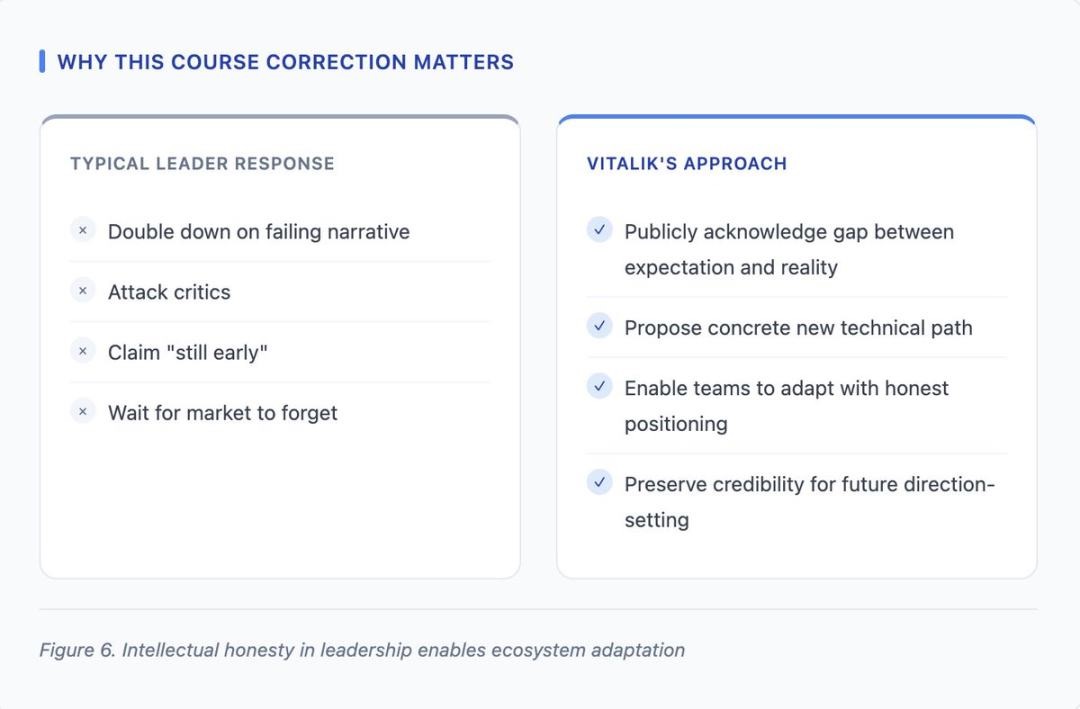
What Vitalik has done is not easy. Acknowledging that the core assumptions of 2020 did not materialize as expected—this honest attitude is something most leaders lack. The roadmap centered on Rollup was built on the premise that “L2 will serve as Ethereum-branded sharding.” Four years of market data, however, paint a different picture: L2 has evolved into autonomous platforms with independent economic incentives; the scalability of Ethereum L1 has exceeded expectations; the original framework is now disconnected from the current reality.
Continuing to defend the old narrative would be easier. Continuing to push teams to chase visions that have been disproven by the market is also simpler. But true leadership should not be so. Admitting the gap between expectations and reality, proposing new paths, and moving toward a brighter future—that is the responsibility we should bear. And Vitalik’s discourse exemplifies this approach.
- What is reality?
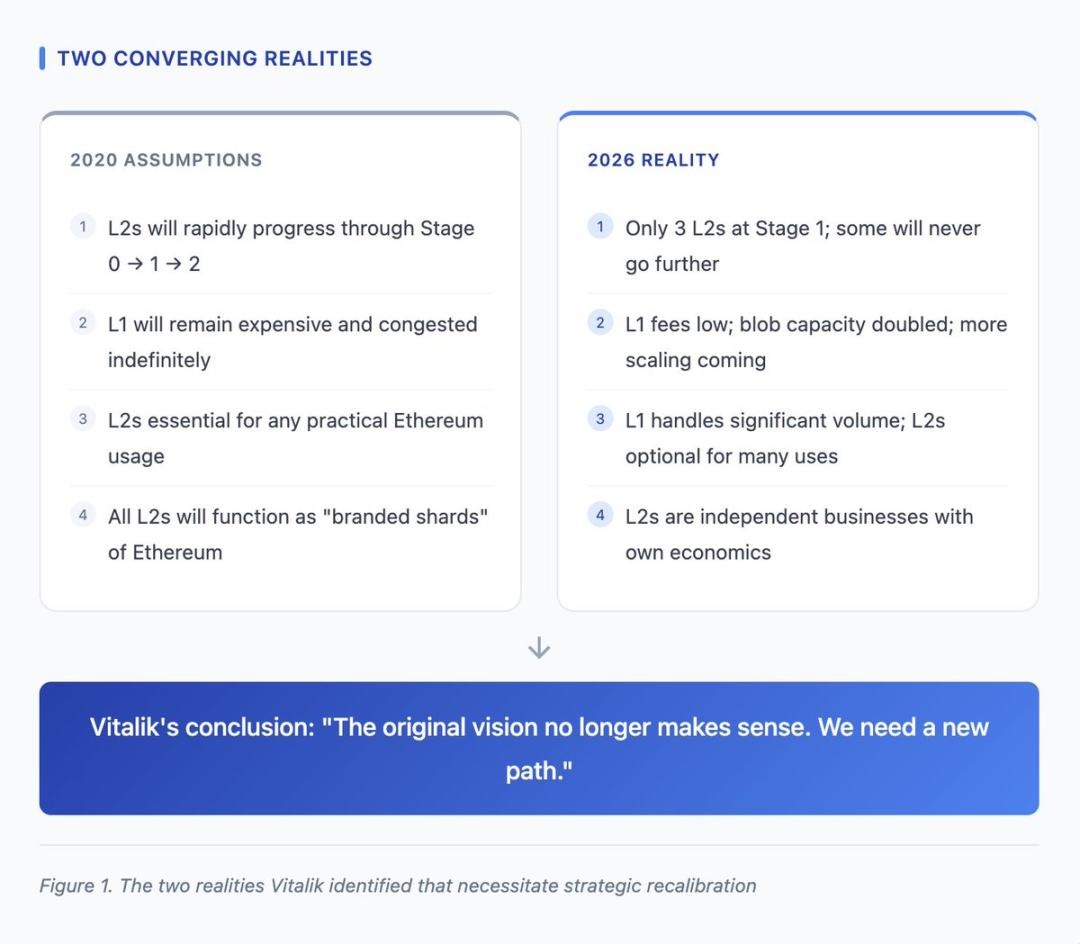
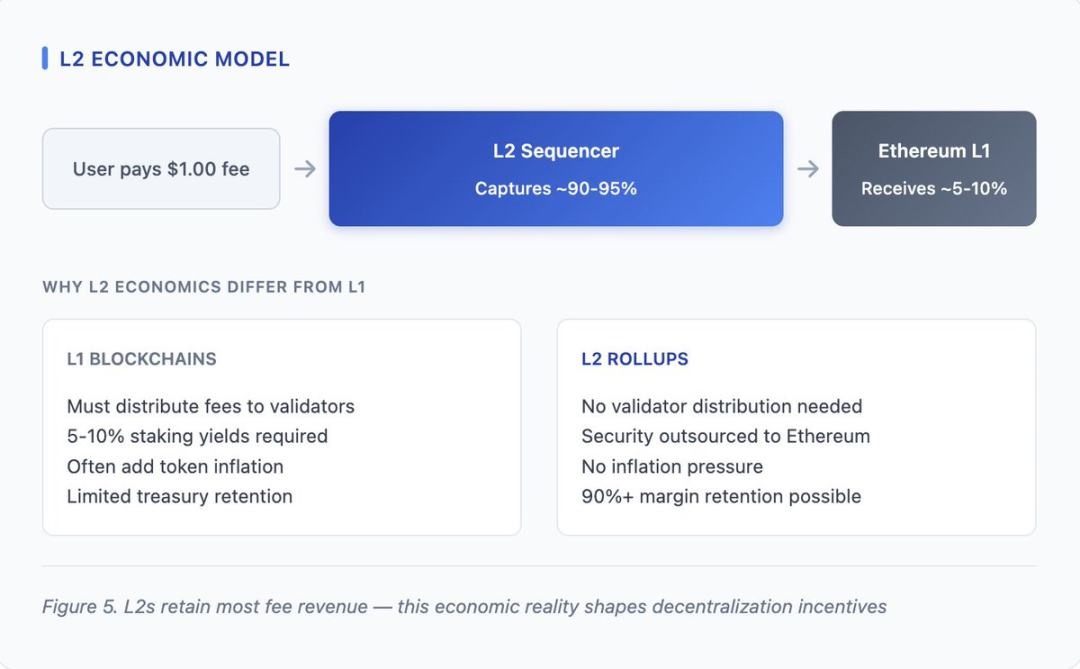
Vitalik points out two intertwined realities that together necessitate strategic adjustments. First, the decentralization process of L2 is slower than expected. Currently, only three major L2s (Arbitrum, OP Mainnet, Base) have reached the first stage of decentralization, and some L2 teams have explicitly stated that due to regulatory requirements or business model constraints, they may never pursue full decentralization. This is not a moral flaw but reflects the economic reality that sequencers’ revenue is the primary business model for L2 operators.
Second, Ethereum L1 has achieved substantial scalability. Transaction fees are low, the Pectra upgrade doubled data block capacity, and the gas limit will continue to increase before 2026. When the original Rollup roadmap was designed, L1 costs were high and congestion was severe, but that premise no longer holds. L1 can now handle a large volume of transactions at reasonable costs, changing the value proposition of L2: from “a necessity for guaranteed availability” to “an option for specific scenarios.”
- Reconstructing the trust spectrum
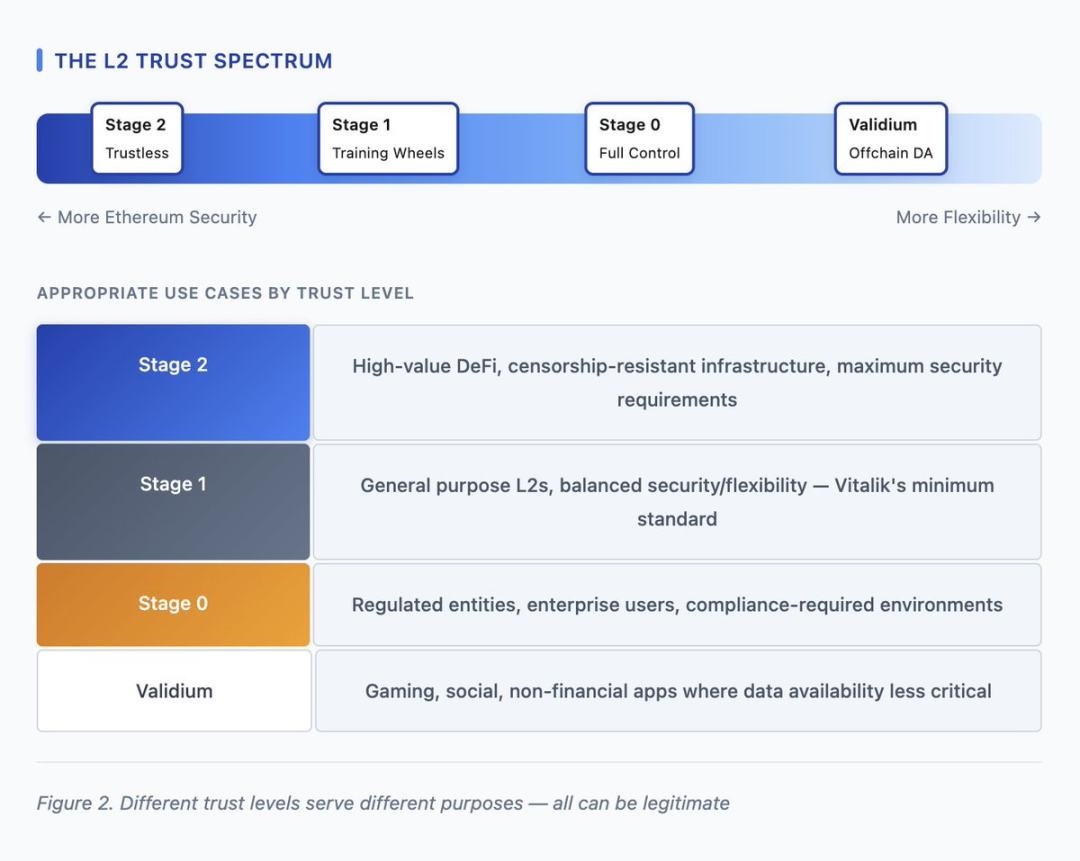
Vitalik’s core theoretical contribution is redefining L2 as existing on a continuous spectrum rather than as a single category with a unified obligation. The metaphor of “branded sharding” once implied that all L2s should pursue the second stage of decentralization and operate as extensions of Ethereum’s value and security guarantees. The new framework, however, recognizes that different L2s serve different goals; for projects with specific needs, stages 0 or 1 can be entirely reasonable endpoints.
This reconstruction has significant strategic implications because it eliminates the implicit judgment that “L2s that do not pursue full decentralization are failures.” An institution serving clients requiring asset freezing, or a regulated L2, is not a defective version of Arbitrum but a differentiated product tailored to different markets. By legitimizing this spectrum-based existence, Vitalik allows L2s to honestly position themselves without making decentralization promises lacking economic incentives.
- Native Rollup pre-compile proposals
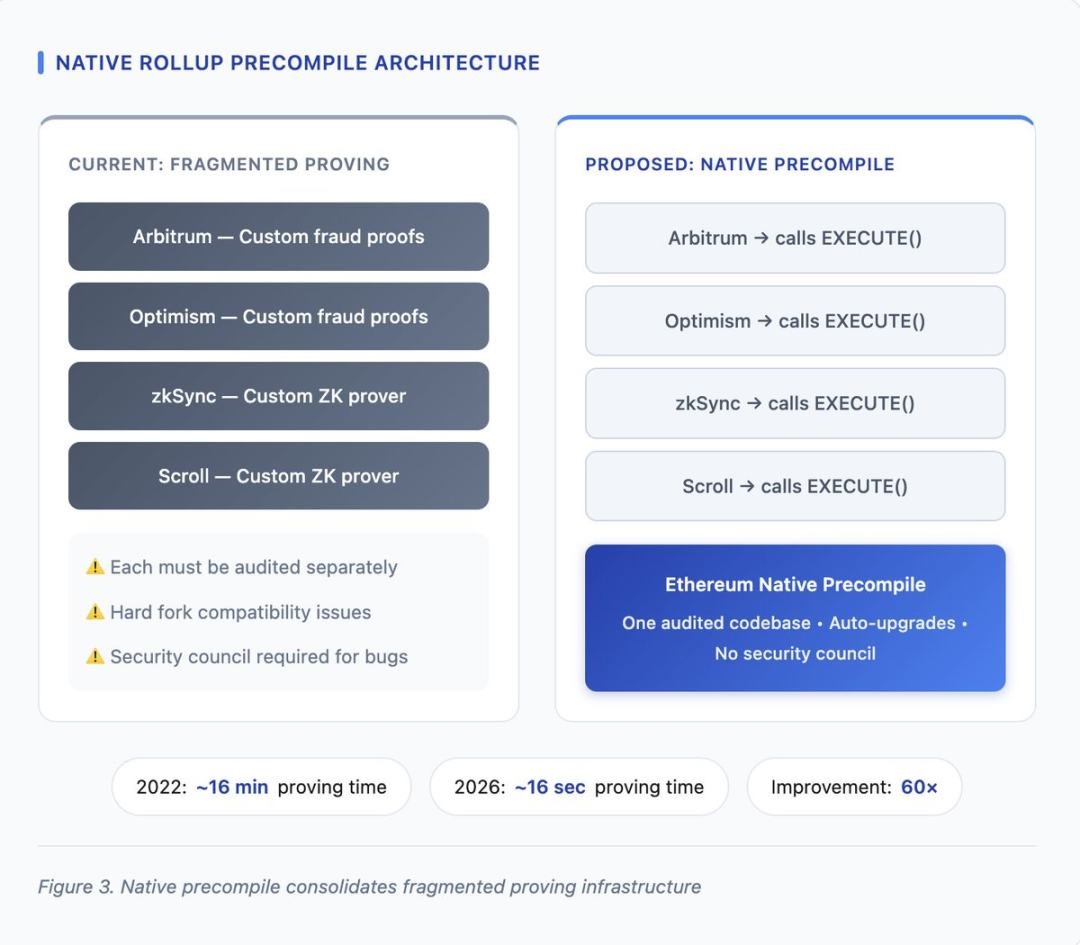
The technical core of Vitalik’s article lies in native Rollup pre-compile solutions. Currently, each L2 has built its own system to prove state transitions to Ethereum: Optimistic Rollup uses fraud proofs with a 7-day challenge period, ZK Rollup relies on validity proofs with custom circuits. Each implementation requires independent auditing, may hide vulnerabilities, and must be upgraded synchronously when Ethereum hard forks change EVM behavior. This fragmentation poses security risks and maintenance burdens for the entire ecosystem.
Native Rollup pre-compiles would be embedded directly into the EVM as verification functions for Ethereum’s native execution. Each Rollup would no longer need to maintain custom proof systems but could simply call this shared infrastructure. This approach offers significant advantages: replacing dozens of independent implementations with a single audited codebase, automatically maintaining compatibility with Ethereum upgrades, and potentially removing the security committee once pre-compile features are proven in practice.
- Synchronous composability vision
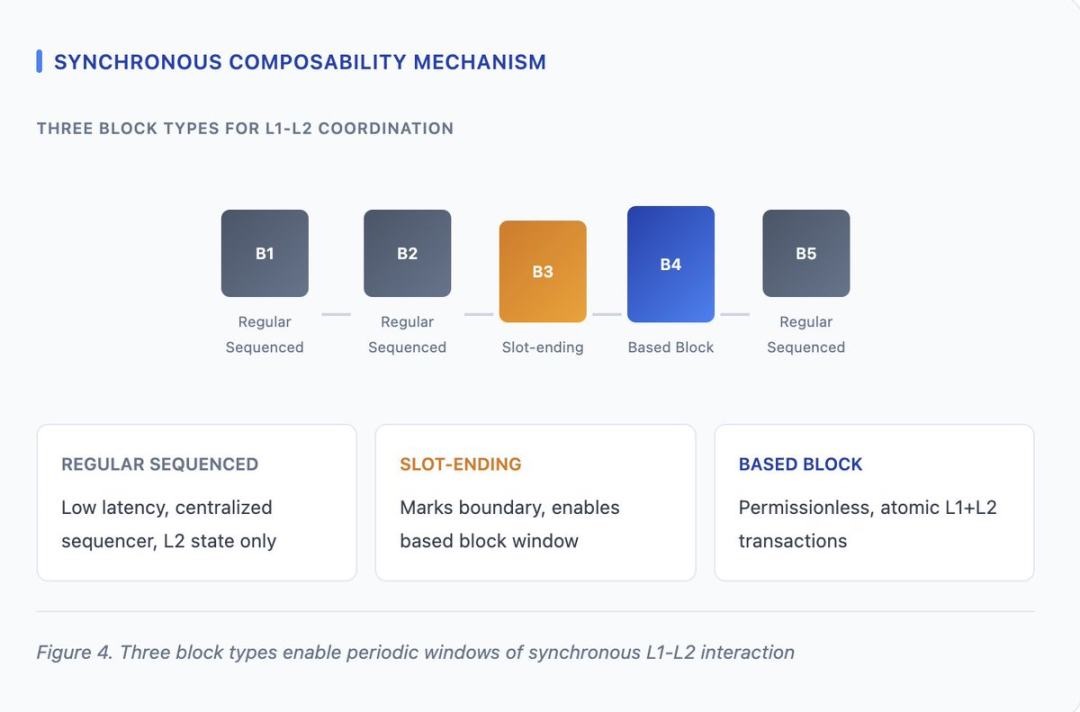
A detailed post on ethresear.ch elaborates on mechanisms to achieve synchronous composability between L1 and L2. Currently, transferring assets or executing logic across L1 and L2 boundaries requires waiting for finality (7 days for optimistic rollups, hours for ZK rollups) or relying on fast cross-chain bridges with counterparty risk. Synchronous composability would enable atomic calls across L1 and L2 states within a single transaction, ensuring either complete success or full rollback.
The proposal designs three types of blocks: regular ordering blocks for low-latency L2 transactions, boundary blocks marking slot ends, and based blocks that can be built without permission after boundary blocks. During this window, any builder can create blocks that interact with both L1 and L2 states simultaneously.
- Responses from L2 teams
Within hours, major L2 teams responded, demonstrating healthy strategic diversification. This aligns with the trust spectrum framework Vitalik proposed: different teams can pursue differentiated positioning without creating the illusion that “everyone is on the same path to the same endpoint.”
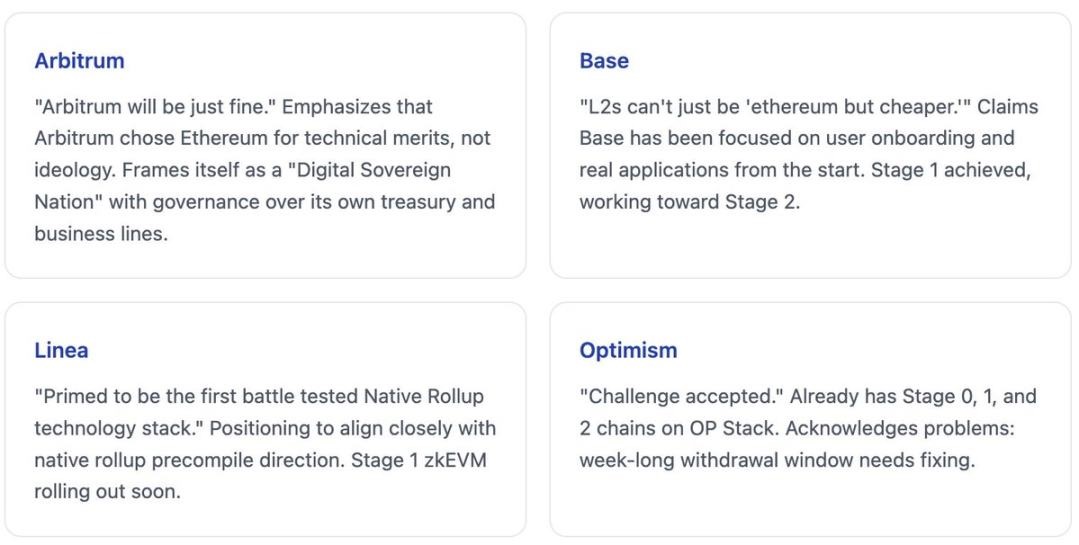
Diverse responses reflect a healthy market. Arbitrum positions itself as an independent ecosystem, Base focuses on applications and user experience, Linea closely follows Vitalik’s native Rollup direction, and Optimism openly acknowledges challenges while emphasizing progress. These strategic choices are neither right nor wrong; they represent differentiated strategies targeting various market segments—legitimacy granted by the trust spectrum framework.
- Vitalik’s deep understanding of economic realities
One of the most important insights in Vitalik’s article is the implicit acknowledgment of L2’s economic models. When he points out that some L2s may never surpass stage 1 due to “regulatory requirements” and “ultimate control considerations,” he is recognizing that L2s as commercial entities have legitimate economic interests, which differ fundamentally from the idealized “branded sharding” model. Sequencer revenue is a real business need, and regulatory compliance is an unavoidable reality. Expecting L2s to abandon these interests for ideological purity is inconsistent with commercial logic.
- Vitalik’s forward-looking plan
Vitalik’s discourse is constructive rather than merely diagnostic. He points out several concrete directions for L2s that wish to maintain value amid ongoing L1 scalability. These are not rigid rules but differentiated development suggestions—when “a cheaper Ethereum” is no longer enough as a selling point, L2s can leverage these strategies to build their own advantages.
- Conclusion
Vitalik Buterin’s article published in February 2026 marks a strategic recalibration of Ethereum’s L2 approach. Its core insight is that L2 has evolved into an independent platform with reasonable economic incentives, rather than an obligatory “branded sharding” of Ethereum. Vitalik does not oppose this trend but advocates accepting reality by establishing a trust spectrum that recognizes multiple pathways, providing native Rollup infrastructure to enhance L1-L2 integration, and designing cross-layer synchronous composability mechanisms.
The responses from the L2 ecosystem demonstrate healthy diversity. Arbitrum emphasizes independence, Base focuses on applications, Linea aligns with the native Rollup direction, and Optimism continues to improve while acknowledging challenges. This diversity is exactly the expected outcome of the trust spectrum framework: different teams can follow different strategies without pretending everyone is on the same road.
For Ethereum, this route correction, by acknowledging reality rather than defending outdated assumptions, preserves its credibility. With mature ZK-EVM technology, related proposals are feasible. The strategic proposals also create space for healthy ecosystem evolution. This embodies adaptive leadership in technology: recognizing environmental changes and proposing new paths forward, rather than stubbornly clinging to old strategies after market choices have been made.
Having researched scalability solutions for over a decade and operated a Rollup infrastructure company for four years, I have seen too many crypto leaders refuse to adapt when reality diverges from expectations, with poor outcomes. Vitalik’s approach is difficult—publicly admitting that the 2020 vision needs adjustment. But it is the right decision. Clinging to a narrative that no longer aligns with the market is unhelpful for anyone. Today’s path forward is becoming clearer each day, and that alone holds great value.
Disclaimer: The information on this page may come from third parties and does not represent the views or opinions of Gate. The content displayed on this page is for reference only and does not constitute any financial, investment, or legal advice. Gate does not guarantee the accuracy or completeness of the information and shall not be liable for any losses arising from the use of this information. Virtual asset investments carry high risks and are subject to significant price volatility. You may lose all of your invested principal. Please fully understand the relevant risks and make prudent decisions based on your own financial situation and risk tolerance. For details, please refer to
Disclaimer.
Related Articles
Bitwise donates $100,000 to Ethereum open-source developers
Bitwise Asset Management announces a $100,000 donation to Ethereum open-source developers to support Protocol Guild and PBS Foundation. This is part of Bitwise's annual support for open-source developers, which previously included a $233,000 donation to Bitcoin developers.
GateNews9m ago
Bit Digital: As of the end of February, Ethereum holdings increased to 155,434.4 ETH, valued at over $305 million
ChainCatcher News, according to PRNewswire, the Nasdaq-listed Ethereum treasury company Bit Digital released a holdings update report. As of today, the company's Ethereum holdings have increased to 155,434.4 ETH, valued at approximately $305.4 million, with an average purchase price of $3,045. Additionally, the company disclosed that as of today, a total of 138,2696 ETH have been staked, accounting for about 89% of its total holdings, generating approximately 313.9 ETH in staking rewards.
GateNews12m ago
The market declines again, and the whale that rebounded and accumulated $14.54 million worth of ETH on 02.26 is now reducing its holdings.
Odaily Planet Daily reports that according to Ai Aunt monitoring, the market has declined again, and the large whale who rebounded and accumulated on 02.26 with 14.54 million USD worth of ETH is reducing their holdings. An hour ago, they sold 4,000 ETH on-chain at an average price of 2077.39 USD (valued at 8.309 million USD), with a previous one-week accumulation price of 2075.45 USD. Therefore, this sale only yielded a profit of 7,760 USD. Currently, they still hold 3,008 ETH on-chain.
GateNews39m ago
ETH short-term upward movement of 0.99%: Driven by whale inflows and external capital transfers, a structural rebound
From 01:30 to 01:45 (UTC) on March 6, 2026, ETH achieved a return of +0.99% within 15 minutes, with a price range of 2065.42 to 2088.57 USDT, and an amplitude of 1.12%. The volatility during this window was significantly higher than the daily average, increasing short-term market attention. Liquidity was relatively low, and some large transactions drove the trading volume upward.
The main driver of this abnormal movement was the concentrated inflow of whale funds into decentralized exchanges and large transfers. On-chain monitoring detected multiple large ETH fund inflows into DeFi protocols and trading platforms, effectively pushing
GateNews43m ago
Data: In the past 24 hours, the entire network has been liquidated by $252 million, with long positions liquidated by $170 million and short positions liquidated by $81.7741 million.
ChainCatcher message, according to Coinglass data, in the past 24 hours, the entire network experienced liquidations of $252 million, with long positions liquidated at $170 million and short positions at $81.77 million. Among them, Bitcoin long positions liquidated at $69.2463 million, Bitcoin short positions at $27.4732 million, Ethereum long positions at $36.4551 million, and Ethereum short positions at $22.6325 million.
GateNews1h ago


