River is a cross-chain stablecoin system designed around the concept of Chain Abstraction. Its goal is to address liquidity fragmentation across multiple blockchains. With satUSD and the Omni-CDP architecture, users can deposit collateral on one chain and mint a stablecoin natively on another chain, without relying on cross-chain bridges, wrapped assets, or manual network switching. The design aims to reduce operational friction for cross-chain capital movement in multi-chain ecosystems.
As DeFi expands across more networks, assets and stablecoin liquidity often remain siloed on separate chains, while cross-chain movement depends heavily on bridging protocols and wrapped representations. These constraints reduce capital efficiency and can limit application scale. River approaches the problem at the level of capital structure, using a stablecoin as the central coordination asset. It integrates cross-chain collateralization, yield distribution, and user contribution into a single system so that assets can move across chains and circulate across modules, with the goal of improving liquidity utilization and system scalability.
This article explains what River is, its chain abstraction design logic, and how Omni-CDP, satUSD, yield bearing stablecoins, social contribution, and vault modules form a cross-chain capital circulation system. It also explains the $RIVER token model, positioning, and potential challenges, helping readers understand River’s role in a multi-chain environment and what this design implies for a stablecoin system positioned as infrastructure.
What Is River?

(Source: RiverdotInc)
River is a stablecoin system built on Chain Abstraction, designed to reduce liquidity fragmentation across chains and enable native capital movement between blockchains. Through satUSD and the Omni-CDP architecture, users can deposit collateral on one chain and mint a stablecoin directly on another chain. The process does not require a bridge, wrapped assets, or manual network switching. In practical terms, River is designed to make cross-chain stablecoin issuance feel closer to a single unified workflow.
Why Is River Needed?
Although DeFi has grown quickly, capital remains highly fragmented across networks:
- Assets are distributed across different chains and are difficult to coordinate efficiently
- Stablecoin liquidity is separated and is not easily redeployed across chains
- Moving capital often depends on bridges and wrapped assets
- Yield can concentrate in a limited number of protocols, limiting broad user participation
The result is lower capital efficiency, rigid liquidity, and constrained stablecoin use cases.
River is designed to address not only a single feature gap, but the broader way DeFi capital is organized and moved in multi-chain settings.
River Operating Mechanism And Core Design Logic
River is not a single protocol. It is a stablecoin capital circulation system that integrates three elements into one loop: cross-chain collateralized minting, stablecoin yield distribution, and value return tied to user behavior and contribution. In River, capital is intended to circulate across modules rather than remaining deployed in one isolated position.
1. Omni-CDP
Omni-CDP is River’s infrastructure module for cross-chain collateral and minting.
Users can:
- Deposit collateral such as BTC, ETH, BNB, or LST on one chain
- Mint satUSD natively on another chain
- Complete the process without bridges or wrapped assets
Omni-CDP is built on LayerZero‘s OApp and OFT standards to synchronize cross-chain position state.
2. satUSD And satUSD+
(Source: docs.river)
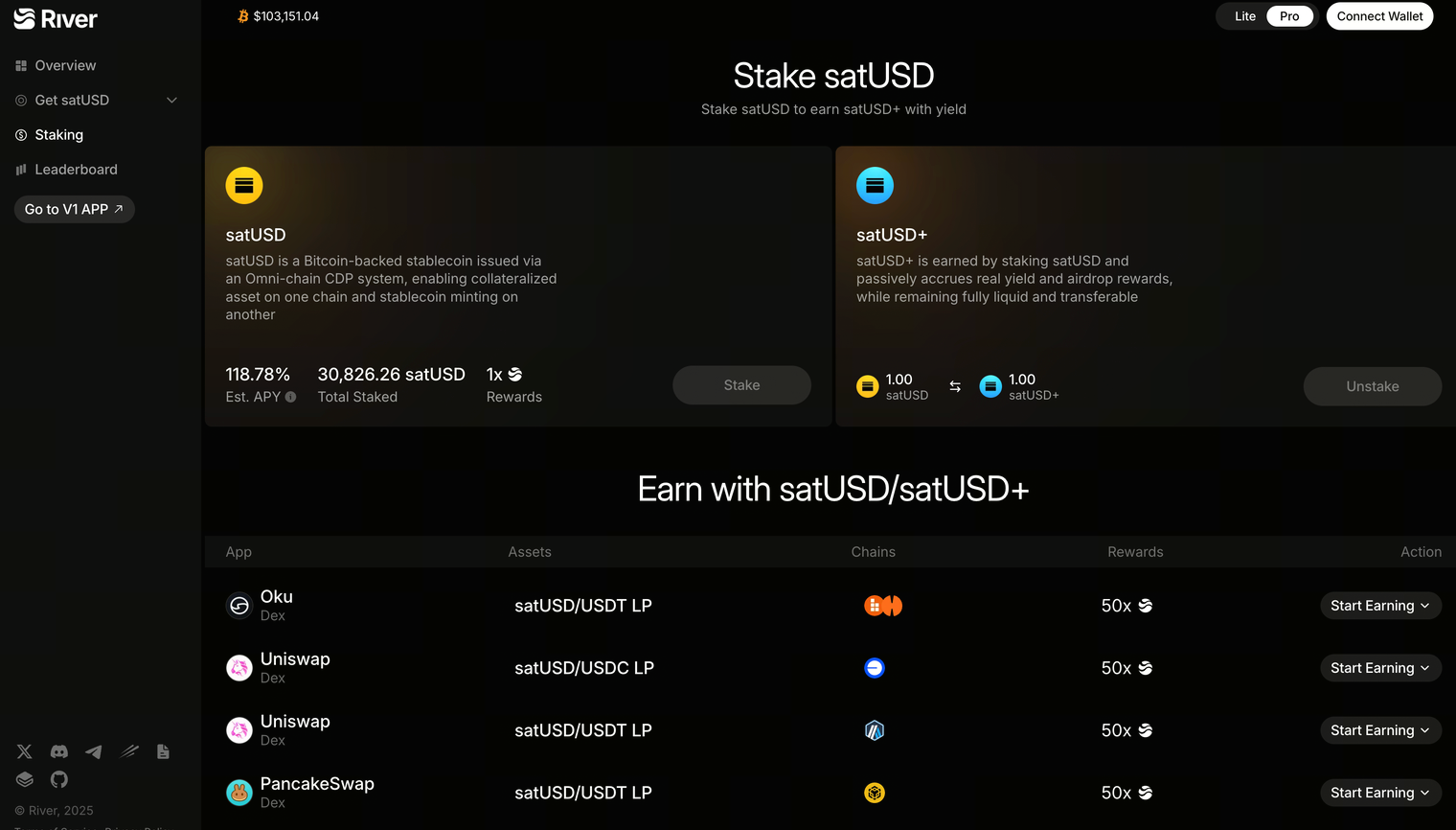
satUSD is River’s overcollateralized stablecoin, and satUSD+ is its yield bearing version.
The role of satUSD
- Backed by collateral such as BTC, ETH, BNB, and LST
- Can be minted natively across chains
- Functions as the system’s primary settlement and circulation asset
The role of satUSD+
Users can stake satUSD to receive satUSD+:
- Protocol income accrues automatically
- No manual claiming or compounding is required
- It can be used in other DeFi protocols
Yield for satUSD+ is described as coming from system usage, including minting, redemption, and liquidation fees, rather than from inflationary token emissions.
3. River4FUN
(Source: docs.river)
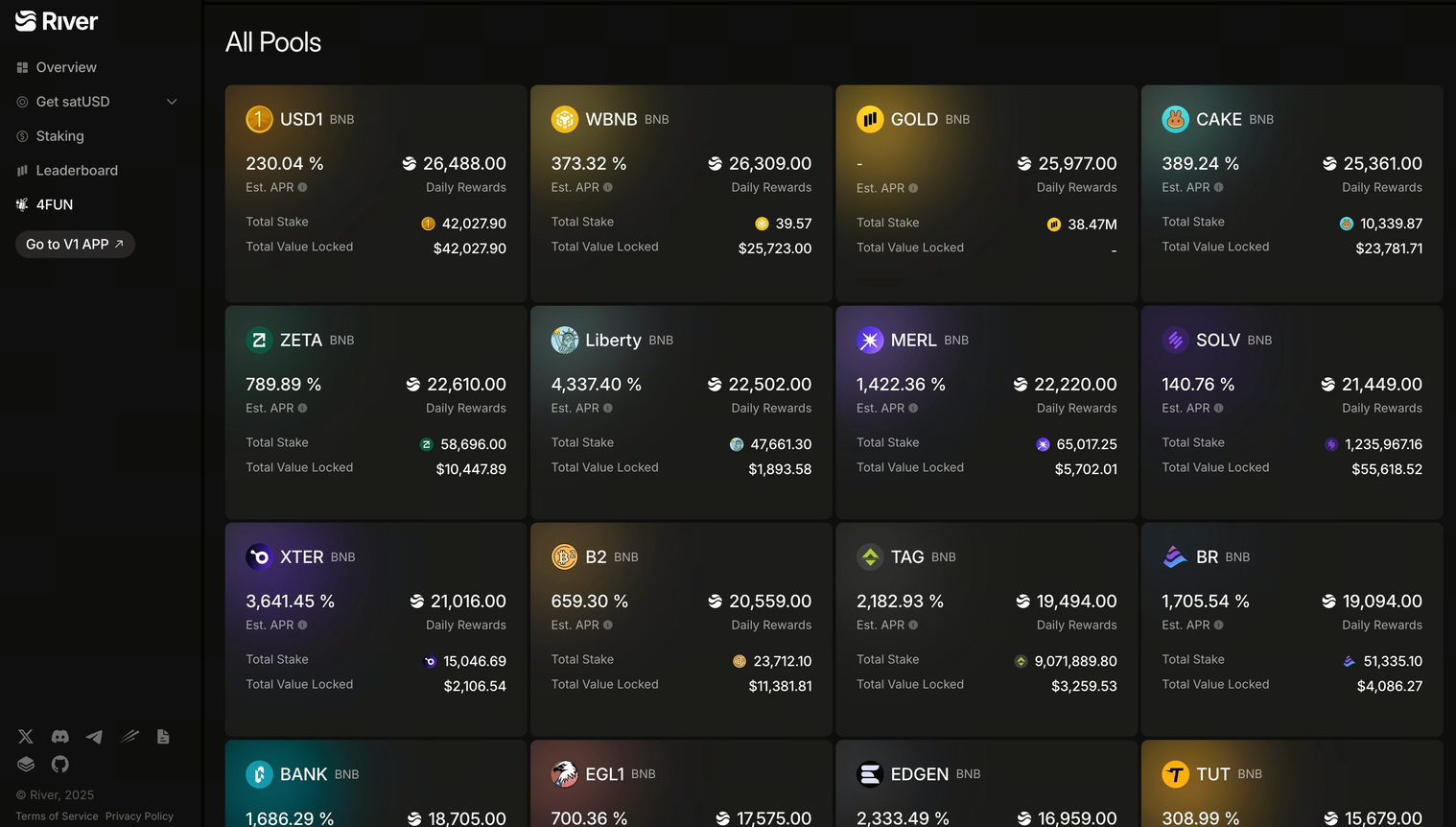
River4FUN is the social and contribution module. It is designed to incorporate community activity into value distribution.
Users can:
- Link an X (Twitter) account
- Publish content related to River or partner projects
- Earn River Points based on reach, engagement, and consistency
River Points are described as convertible into $RIVER at the token generation event (TGE).
This module is positioned as part of a broader loop: minting → staking → content contribution → governance token distribution.
4. Smart Vault
Smart Vault is a one click yield module positioned around avoiding liquidation risk. The module is described as addressing common issues in DeFi yield strategies, such as collateral ratio risk, forced liquidations, and the need for frequent manual monitoring.
Smart Vault is described as providing:
- No liquidation risk
- Automated strategy deployment
- Ongoing yield mechanism
- 1:1 withdrawal availability
In this design, assets are minted into satUSD by the system and deployed into staking pools, while the user is described as not holding a direct debt position.
5. Prime Vault
Prime Vault is presented as an institutional version designed for higher capital users.
Key characteristics include:
- Assets held by a regulated custodian
- No smart contract risk
- No liquidation risk
- Predictable yield model
satUSD is described as operating only inside the system and not entering the user’s wallet, while institutional users hold principal plus yield rights.
6. Swap Module
The Swap module acts as an entry mechanism for satUSD, allowing users to exchange USDT or USDC for satUSD at 1:1.
Its stated purposes include:
- Supporting satUSD’s peg to the US dollar
- Providing a low friction liquidity entry point
- Expanding satUSD usage scenarios
Stablecoins in the Swap Vault are described as being managed by the protocol for liquidity and risk control.
What Is The Utility And Token Model Of $RIVER?
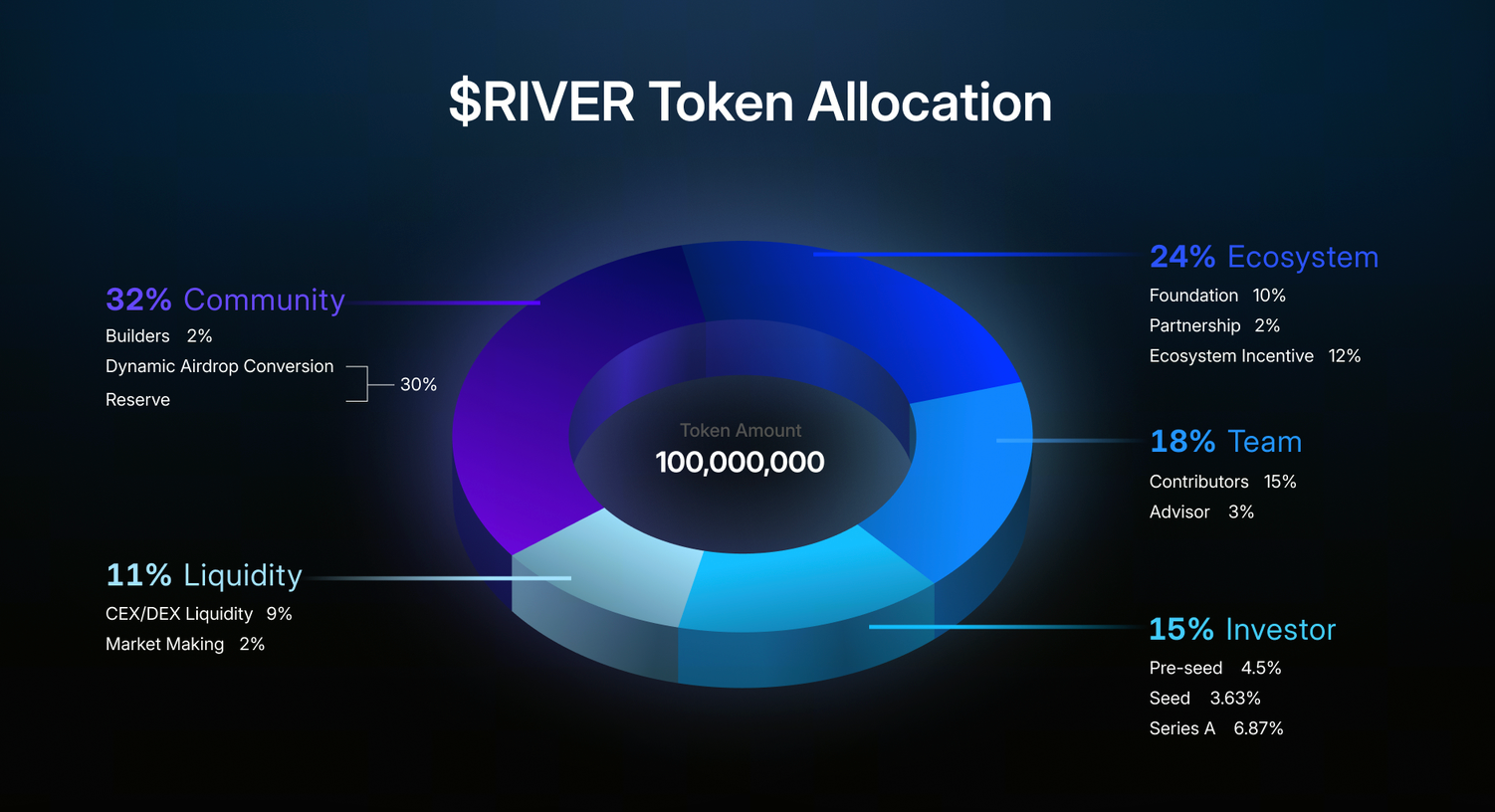
$RIVER is described as River’s governance and incentive token, with a fixed total supply of 100 million.
The allocation structure is described as:
- Community: 32%
- Liquidity: 11%
- Ecosystem: 24%
- Team: 18%
- Investors: 15%
(Source: docs.river)
$RIVER is positioned as a mechanism that places participants within the system’s value distribution structure.
Token utility
As the functional token in the River ecosystem, $RIVER is described as serving governance participation, yield enhancement, and incentive alignment.
By staking $RIVER, holders can participate in governance voting on parameters such as collateral asset types and risk settings within Omni-CDP, staking coefficients for Smart Vault and Prime Vault, cross-chain deployment strategy, the incentive emission schedule for satUSD, and directions for treasury and ecosystem grants. $RIVER is also described as providing yield enhancement through a veRIVER mechanism, increasing satUSD+ yield weight and adjusting reward distribution for liquidity providers and long-term participants. In modules such as River4FUN, staking may unlock higher contribution multipliers.
In addition, $RIVER staking is described as providing protocol-level fee benefits such as reduced minting, redemption, and swap fees, priority access to limited-time activities with additional rewards, and possible eligibility for governance-related distributions. Overall, the model is described as binding governance rights, value accumulation, and incentives so that token holders, contributors, and the protocol operate within a single economic framework.
Market Cap And Trading Volume

(Source: CoinMarketCap)
At the time of writing, CoinMarketCap data is cited as showing an approximate market capitalization of $277,445,310 and a 24 hour trading volume of approximately $5.72 million, indicating a level of market liquidity and attention.
River Positioning
River is presented not as a single stablecoin, but as a cross-chain capital operating system.
Within this system:
- Assets can move natively across chains
- The stablecoin functions as the capital hub
- Yield is described as coming from real economic activity
- Community influence can be reflected in governance participation
River is positioned as addressing capital operations in a multi-chain environment rather than only a single DeFi feature.
Ecosystem Competition And Potential Challenges
River is expected to face competition from DeFi protocols and from systems that control underlying assets, particularly in areas related to LST integration. Compared with LST products that primarily provide passive yield while assets remain locked, satUSD is positioned around making collateral liquidity available while still enabling DeFi participation. Whether this advantage is sustainable depends on whether River can deliver a low-friction cross-chain user experience with minimal user-perceived operational overhead.
As L1 performance increases and transaction costs trend lower, dependence on cross-chain infrastructure may decline in some contexts. If River cannot provide a sufficiently smooth abstraction layer and a unified operating experience across chains, its claimed structural advantage will be tested under real multi-chain usage conditions.
Summary
River is positioned as more than a new stablecoin product. It is an attempt to redesign how capital operates in a multi-chain environment. Through a Chain Abstraction architecture, River integrates cross-chain minting, yield circulation, and community contribution into one system. This design aims to remove chain-specific constraints on asset movement and to position the stablecoin as a capital hub rather than only a transaction medium. If the model scales across a broader ecosystem, River may function as a stablecoin protocol with infrastructure-level relevance in multi-chain DeFi.
FAQ
What Is The Difference Between River And Common Stablecoins Such As USDT Or USDC?
River is described as more than a stablecoin issuer. It is a cross-chain capital system where users can deposit collateral on one chain and mint satUSD natively on another chain through Omni-CDP, without using bridges or wrapped assets.
What Is The Difference Between satUSD And satUSD+?
satUSD is an overcollateralized stablecoin used as the system’s circulation asset. satUSD+ is a yield bearing version obtained by staking satUSD, where protocol income accrues automatically and is described as coming from usage fees rather than inflationary emissions.
What Is The Practical Utility Of The $RIVER Token?
$RIVER is described as a governance and incentive token that enables participation in protocol voting and, through staking, may increase yield weight, provide fee benefits, and align long-term contributors with ecosystem reward distribution.







