US Regulators Move Forward With Stablecoin Oversight Framework

Beginner
Quick Reads
Last Updated 2026-03-27 06:59:50
Reading Time: 1m
Travis Hill, Acting Chairman of the Federal Deposit Insurance Corporation (FDIC), announced that the initial draft regulations for stablecoin oversight will be published by the end of December. This development signifies the GENIUS Act’s transition into its substantive implementation phase.

US Stablecoin Regulation Enters Substantive Advancement Phase

(Source: Congress)

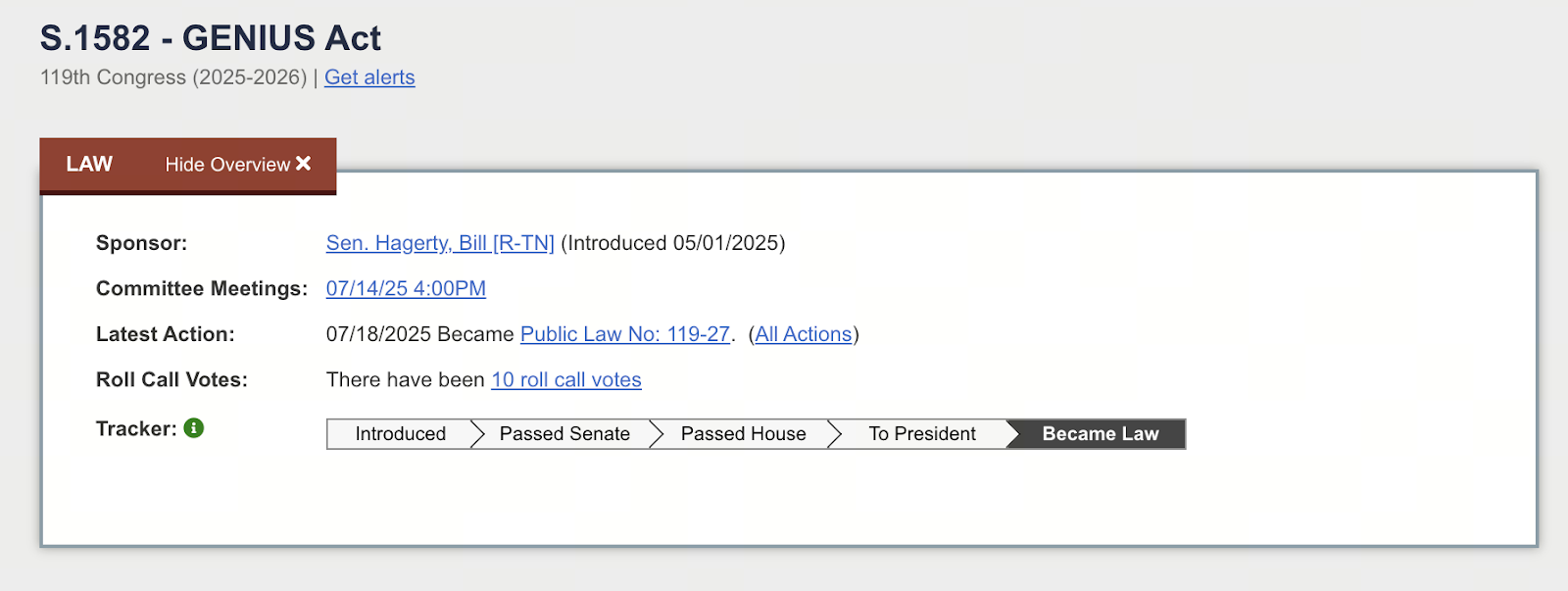
Travis Hill, Acting Chairman of the Federal Deposit Insurance Corporation (FDIC), will soon testify before the House Financial Services Committee and has already provided an update on recent developments: The first set of draft rules for stablecoin regulation is expected to be formally introduced by the end of December. This milestone signifies the transition of the GENIUS Act (Guiding and Establishing National Innovation for U.S. Stablecoins) from the legislative stage to implementation, with multiple federal and state agencies collaborating on its rollout.

Establishing the Application Framework for Stablecoin Issuers

According to Hill’s prepared testimony, the FDIC has started developing a comprehensive review process for stablecoin issuers. This process includes:

  • Procedures for applying for federal regulatory oversight
  • Evaluation criteria and review framework
  • Core compliance requirements for issuers

The draft will be released to the public this month for open feedback from stakeholders and the general public.

Capital, Liquidity, and Reserve Management Requirements

After the application framework is established, the FDIC will draft more detailed regulatory provisions, including:

  • Minimum capital requirements for issuers
  • Liquidity standards
  • Rules on the composition and quality of stablecoin reserves

These provisions are expected to be introduced in a separate draft early next year, establishing clear supervisory guidelines for banks and other regulated entities issuing stablecoins.

Treasury and Federal Reserve Advance in Parallel

The responsibility for implementing the GENIUS Act does not rest solely with the FDIC. The US Treasury and other departments are also developing related regulations. In her prepared testimony, Federal Reserve Vice Chair Michelle Bowman noted that the Fed is working, as required by the Act, to establish:

  • Capital standards for stablecoin issuers
  • Liquidity management standards
  • Asset diversification requirements

Together, these measures will form a comprehensive US stablecoin regulatory framework.

Regulatory Positioning of Tokenized Deposits

Hill further noted that, in response to the President’s Working Group (PWG) report on the digital asset market, the FDIC is developing additional guidance to clarify:

  • The regulatory status of tokenized deposits
  • Their role within the current banking system
  • Legal distinctions between tokenized deposits and stablecoins

This effort aims to provide banks with clearer guidelines for engaging with tokenized financial products.

If you’d like to learn more about Web3, register here: https://www.gate.com/

Summary

With the FDIC, Federal Reserve, and other agencies clarifying their positions, the US is now gradually establishing a concrete regulatory framework under the GENIUS Act. From the application process for issuers and requirements for liquidity and reserves, to the regulatory treatment of tokenized deposits, these actions show the US is moving toward a more systematic stablecoin framework. If enacted, these rules will provide long-awaited transparency to the stablecoin market, fostering a more predictable environment for financial institutions and the Web3 industry.

Author: Allen
Disclaimer
* The information is not intended to be and does not constitute financial advice or any other recommendation of any sort offered or endorsed by Gate.
* This article may not be reproduced, transmitted or copied without referencing Gate. Contravention is an infringement of Copyright Act and may be subject to legal action.

Related Articles

Gold Price Forecast for the Next Five Years: 2026–2030 Trend Outlook and Investment Implications, Could It Reach $6,000?
Beginner

Gold Price Forecast for the Next Five Years: 2026–2030 Trend Outlook and Investment Implications, Could It Reach $6,000?

Analyze current gold price trends alongside authoritative five-year forecasts, integrating an evaluation of market risks and opportunities. This gives investors insight into the potential trajectory of gold prices and the main drivers expected to shape the market over the next five years.
2026-03-25 18:13:30
AI-Native Settlement Layers: How United Stables Is Building the Next Financial Rail
Beginner

AI-Native Settlement Layers: How United Stables Is Building the Next Financial Rail

Stablecoins were originally designed as dollar substitutes within exchanges, primarily used for asset pricing and trade settlement. As on-chain financial ecosystems have matured, their role has expanded beyond simple payments to include collateral assets, cross-chain liquidity mediums, and unified settlement units. In particular, as AI systems and automated agents begin to participate directly in economic activity, demand has risen sharply for programmable value units capable of instant settlement. This shift is pushing stablecoins toward the role of foundational financial infrastructure.
2026-03-25 03:16:17
Aster vs Hyperliquid: Which Perp DEX Will Prevail?
Beginner

Aster vs Hyperliquid: Which Perp DEX Will Prevail?

Aster and Hyperliquid are the two representative protocols of the "purpose-built L1 path" within the current decentralized perpetual exchange (Perp DEX) sector. As a pioneer in the field, Hyperliquid has built a deep liquidity moat through its highly mature order book architecture and strong community consensus. Conversely, Aster, as a rising challenger, seeks to leapfrog the competition in high-performance trading through more aggressive multi-chain aggregation logic, private transaction modules, and an underlying execution environment optimized for 2026 market demands.
2026-03-24 11:58:33
DePIN Identity Network and Real World Applications: How Humanity Protocol Brings on-chain Identity Into the Physical World
Beginner

DePIN Identity Network and Real World Applications: How Humanity Protocol Brings on-chain Identity Into the Physical World

Most Web3 identity systems remain confined to on-chain environments and struggle to achieve meaningful adoption in real world settings. Through a DePIN architecture and physical verification hardware, Humanity Protocol aims to bring decentralized identity into access control systems, hospitality, public services, and offline events, allowing on-chain identity to function not just as a digital credential, but as foundational infrastructure for real world access.
2026-03-25 07:40:53
Aerodrome Tokenomics: How ve(3,3) Powers Base's Most Profitable DEX
Beginner

Aerodrome Tokenomics: How ve(3,3) Powers Base's Most Profitable DEX

AERO is the native token of Aerodrome Finance, a core decentralized exchange and liquidity protocol in the Base ecosystem. It is primarily used for liquidity incentives and ecosystem operations. veAERO is a governance NFT that users receive by locking AERO, representing both voting power and the right to share protocol revenue. Through a dual track structure of AERO as a utility token and veAERO as a governance credential, Aerodrome separates liquidity usage value from long term governance power, allowing participants to act as liquidity providers, governance decision makers, and revenue sharers within the same system.
2026-03-25 06:40:31
How Does Kite Work? An In-Depth Look at Kite's Identity and Programmable Permission Architecture
Beginner

How Does Kite Work? An In-Depth Look at Kite's Identity and Programmable Permission Architecture

Kite is an EVM compatible Layer 1 blockchain network that runs on proof of stake. It is designed to give AI agents verifiable identity, programmable permissions, and real time settlement in an on-chain execution environment. In Kite's design, AI is no longer only a tool that follows instructions. It becomes an economic participant with independent on-chain identity and direct control over assets. Within secure and auditable infrastructure, an AI agent can complete payments, call services, and coordinate tasks autonomously, making Kite a foundational layer for the emerging agent economy.
2026-03-25 06:02:34