GateUser-f2fa7d33

vip
Age 0.6 Yıl
Peak Tier 0
No content yet
MarcusCorvinusvip
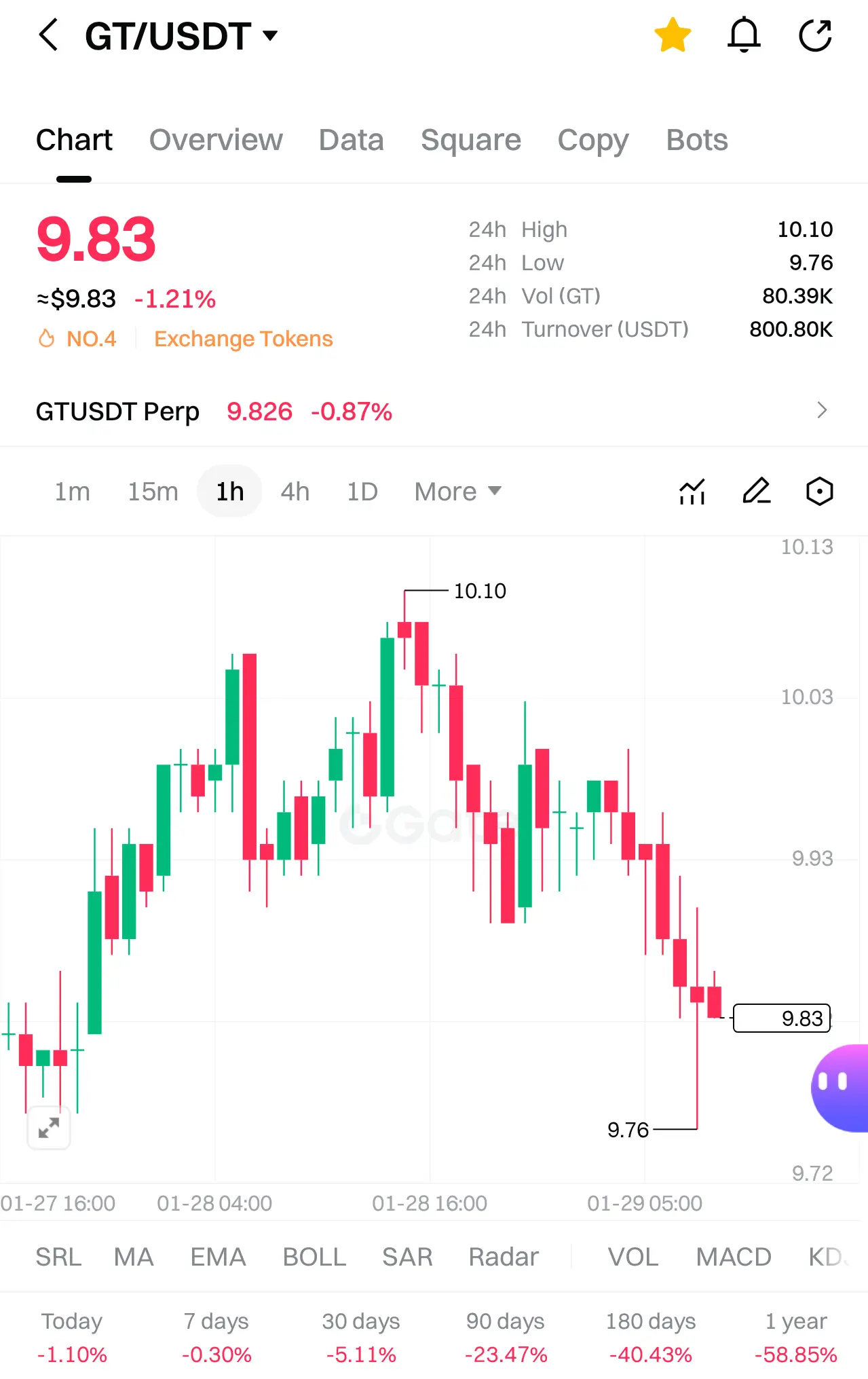
$GT is pulling back after failing to hold above the $10.10 rejection zone, and I’m seeing this move as a liquidity-driven retrace, not a breakdown. Price swept short-term lows around $9.76, grabbed liquidity, and bounced slightly. That tells me sellers are exhausting and this zone deserves attention.
I’m watching the 1H structure and I can see a clear descending move slowing down into a strong reaction area. This level acted as support before and price is now compressing after the sweep. I’m not chasing highs, I’m interested where risk is controlled.
Entry Point
I’m planning my entry between $9.70 – $9.85. This is the liquidity sweep zone and demand reaction area. I want price to hold above the lows and stabilize here.
Target Point
TP1: $10.05 – first resistance and quick recovery level
TP2: $10.40 – previous distribution zone
TP3: $10.85 – trend extension if momentum flips
Stop Loss
My stop is below $9.55. A clean break below this level means demand failed and I step out instantly.
How it’s possible
I’m taking this trade because liquidity has already been taken, downside momentum is weakening, and price is sitting at a strong historical support. If buyers defend this zone, a rotation back toward the highs becomes very natural. Risk is small, structure is clear, and reward is solid.
I’m staying disciplined, following structure, and letting the setup come to me.
Let’s go and Trade now $GT ‌
repost-content-media
  • Reward
  • Comment
  • Repost
  • Share
#CryptoMarketWatch
The current cryptocurrency market is in a cautious balance, influenced by the tug-of-war between macroeconomic pressures and the increasingly strong crypto-native fundamentals. Bitcoin has consolidated around key psychological levels, while overall market sentiment remains divided.
This is not an euphoric bull phase nor a full-blown bear capitulation. Instead, we are navigating a volatile transition period where the direction is determined less by narratives and more by liquidity, macro signals, and institutional behavior.
As a result, adopting an aggressive bullish or be
BTC3,35%
ETH2,95%
View Original
  • Reward
  • Comment
  • Repost
  • Share
Crypto_Expervip
#ETHTrendWatch
Ethereum Market Structure: Compression Phase, Risk Control, and Opportunity Mapping
Ethereum (ETH) is currently trading in a compressed price environment where volatility exists, but directional conviction remains limited. Price has been rotating within a clearly defined band, reflecting a market that is active — yet deliberately cautious. This behavior suggests positioning rather than trend expansion.
Over recent weeks, ETH has respected a broader range roughly spanning the low $3,000 area up toward the mid-$3,000s. Buyers have shown willingness to step in on pullbacks, while sellers continue to defend higher levels. The result is a market defined by balance, not momentum.
Technical Structure in Focus
Support interest has repeatedly emerged near psychologically and technically relevant zones, where short-term averages and historical reactions converge. These areas continue to attract responsive buying, indicating that downside pressure lacks follow-through.
On the upside, rallies have struggled to maintain traction beyond upper resistance bands, where liquidity consistently thins and profit realization increases. This ceiling has capped advances and prevented sustained trend continuation, reinforcing the current range-bound regime.
Importantly, Ethereum remains positioned above its long-term structural trend benchmarks, including the 200-week moving average. This placement preserves the broader bullish framework, even as shorter-timeframe price action remains indecisive.
Volume and Participation Dynamics
Volume behavior aligns with a controlled consolidation narrative. Activity expands near support zones, signaling accumulation, while advances toward resistance encounter distribution rather than breakout acceleration. This pattern typically precedes a larger directional move — but timing remains unresolved.
There are no signs of panic or speculative excess. Instead, participation appears measured, suggesting professional positioning rather than emotional flow.
Macro and Cross-Market Influence
Ethereum’s price action continues to be closely linked to Bitcoin’s directional bias and global liquidity expectations. In periods of improving risk appetite, ETH historically exhibits relative strength. Conversely, tightening conditions favor compression and sideways discovery — a dynamic currently in play.
As long as macro signals remain mixed, Ethereum is likely to remain reactive rather than impulsive.
Strategy by Market Horizon
Short-term participants are watching for confirmation beyond upper resistance zones, seeking momentum alignment through tools like RSI, MACD, and volume expansion. A confirmed breakout would shift focus toward higher continuation targets.
Range-focused traders continue to operate within defined boundaries, emphasizing precision entries, reduced leverage, and disciplined exits.
Long-term holders may view this phase as constructive consolidation. Ethereum’s role across DeFi infrastructure, Layer-2 ecosystems, staking economics, and on-chain utility supports a gradual accumulation thesis rather than aggressive timing.
Risk Considerations
Failure to hold key support levels would alter the current structure and expose ETH to deeper corrective phases. Capital preservation remains critical — position sizing, stop placement, and macro awareness should guide execution at all times.
Closing Perspective
Ethereum is not trending — but it is not weak. The market is compressing, storing potential energy while awaiting confirmation from liquidity conditions, Bitcoin direction, and technical resolution. Until those elements align, success depends less on prediction and more on structure-based decision making.
Traders and investors who respect the range, manage risk, and stay aligned with macro signals will be best positioned for Ethereum’s next decisive phase — whether it resolves upward through expansion or downward into a higher-quality accumulation zone.
repost-content-media
  • Reward
  • Comment
  • Repost
  • Share
Crypto_Expervip
#ETHTrendWatch
Ethereum Market Structure: Compression Phase, Risk Control, and Opportunity Mapping
Ethereum (ETH) is currently trading in a compressed price environment where volatility exists, but directional conviction remains limited. Price has been rotating within a clearly defined band, reflecting a market that is active — yet deliberately cautious. This behavior suggests positioning rather than trend expansion.
Over recent weeks, ETH has respected a broader range roughly spanning the low $3,000 area up toward the mid-$3,000s. Buyers have shown willingness to step in on pullbacks, while sellers continue to defend higher levels. The result is a market defined by balance, not momentum.
Technical Structure in Focus
Support interest has repeatedly emerged near psychologically and technically relevant zones, where short-term averages and historical reactions converge. These areas continue to attract responsive buying, indicating that downside pressure lacks follow-through.
On the upside, rallies have struggled to maintain traction beyond upper resistance bands, where liquidity consistently thins and profit realization increases. This ceiling has capped advances and prevented sustained trend continuation, reinforcing the current range-bound regime.
Importantly, Ethereum remains positioned above its long-term structural trend benchmarks, including the 200-week moving average. This placement preserves the broader bullish framework, even as shorter-timeframe price action remains indecisive.
Volume and Participation Dynamics
Volume behavior aligns with a controlled consolidation narrative. Activity expands near support zones, signaling accumulation, while advances toward resistance encounter distribution rather than breakout acceleration. This pattern typically precedes a larger directional move — but timing remains unresolved.
There are no signs of panic or speculative excess. Instead, participation appears measured, suggesting professional positioning rather than emotional flow.
Macro and Cross-Market Influence
Ethereum’s price action continues to be closely linked to Bitcoin’s directional bias and global liquidity expectations. In periods of improving risk appetite, ETH historically exhibits relative strength. Conversely, tightening conditions favor compression and sideways discovery — a dynamic currently in play.
As long as macro signals remain mixed, Ethereum is likely to remain reactive rather than impulsive.
Strategy by Market Horizon
Short-term participants are watching for confirmation beyond upper resistance zones, seeking momentum alignment through tools like RSI, MACD, and volume expansion. A confirmed breakout would shift focus toward higher continuation targets.
Range-focused traders continue to operate within defined boundaries, emphasizing precision entries, reduced leverage, and disciplined exits.
Long-term holders may view this phase as constructive consolidation. Ethereum’s role across DeFi infrastructure, Layer-2 ecosystems, staking economics, and on-chain utility supports a gradual accumulation thesis rather than aggressive timing.
Risk Considerations
Failure to hold key support levels would alter the current structure and expose ETH to deeper corrective phases. Capital preservation remains critical — position sizing, stop placement, and macro awareness should guide execution at all times.
Closing Perspective
Ethereum is not trending — but it is not weak. The market is compressing, storing potential energy while awaiting confirmation from liquidity conditions, Bitcoin direction, and technical resolution. Until those elements align, success depends less on prediction and more on structure-based decision making.
Traders and investors who respect the range, manage risk, and stay aligned with macro signals will be best positioned for Ethereum’s next decisive phase — whether it resolves upward through expansion or downward into a higher-quality accumulation zone.
repost-content-media
  • Reward
  • Comment
  • Repost
  • Share
letss
SmokingCigarettesAndDrinkingvip
Ethereum's current price has rebounded from $2,803** to** $2,906, indicating a short-term rally after testing a key support level. The current trend results from intense competition between bullish and bearish factors.
📊 Current Core Bull and Bear Power Analysis
To give you a quick overview of the market landscape, here is the current comparison of major bullish and bearish forces:
🟢 Bullish Forces (Rebound Momentum)
· Whales continue buying: An off-chain whale has purchased over 70,000 ETH in 5 days (worth over $200 million), while exchange ETH reserves are decreasing, indicating long-term optimistic capital.
· Strong on-chain fundamentals: Ethereum active addresses hit a record high, with robust real usage demand, creating a bullish divergence with sideways price movement.
· Technical rebound demand: Previous price declines have pushed indicators into the “oversold” zone, indicating a technical need for a rebound correction.
🔴 Bearish Forces (Downward Pressure)
· ETF funds significantly outflow: Last week, global crypto ETPs saw outflows of $1.73 billion, with Ethereum ETFs outflowing $611 million, the largest weekly outflow since November 2025, creating substantial selling pressure.
· “Massive supply wall” suppression: The $3,490-$3,510 range contains approximately $4.1 billion in dense holdings, forming a huge resistance, which was the main reason for previous failed rebounds.
· Whales and early holders selling: Some whales bought high and sold low; another early whale, dormant for 9 years, transferred 50,000 ETH, suspected profit-taking, intensifying volatility.
📍 Updated Key Position References
Given the price rebound, key levels have also shifted upward:
· Immediate resistance: $2,920 - $2,950. The current price is within this zone; a successful breakout could test the next resistance at $3,000.
· Critical support: $2,840 - $2,860 and $2,773**. If it falls below** $2,860, it may threaten the weekly bullish structure; if the daily close drops below $2,773, a downtrend could be confirmed, leading to deeper corrections.
💡 Comprehensive Strategy Perspective
Operational considerations at current levels require more nuanced weighing:
Short-term rebound play
· Approach: Light positions near support zones, attempting to capitalize on technical rebounds.
· Key: Treat $2,840 - $2,860 as an important defense line; if broken, stop-loss is necessary. Initial rebound targets can be around $2,950.
Waiting for trend clarity
· Approach: Given the fierce bullish-bearish battle and unclear direction, it’s more suitable to wait and see.
· Key: Wait for a breakout above key levels. A confirmed move above $3,046** or** $3,180 may signal an end to correction; conversely, if it cannot break through $2,950** and falls below** $2,840, the downtrend may continue.
Long-term perspective
· Bearish risk: Bloomberg analysts believe that, amid stock market volatility, Ethereum’s risk of falling below $2,000 is higher than the possibility of returning to $4,000.
· Bullish potential: Some long-term technical analyses indicate that if a bullish ascending triangle pattern on the monthly chart confirms, higher targets could be seen in 2026. However, this requires time to validate.
✍️ Summary and Core Focus
In summary, the current market contradiction involves positive on-chain fundamentals and whale buying fighting against ETF outflows and massive technical resistance.
For traders, the core decision logic is:
1. Risk Identification: The current market is mainly driven by capital flows (ETF outflows) and technical resistance (supply walls), rather than on-chain fundamentals.
2. Positioning: $2,906** is in a short-term “battle zone,” with initial resistance at **$2,920-2,950** and key support at $2,840-2,860.
3. Direction Confirmation: The market is in a weak rebound pattern in the short term; observing price behavior near key levels is crucial to determine which force will prevail. #感谢关注︱互动︱评论︱转发
repost-content-media
  • Reward
  • Comment
  • Repost
  • Share
yo
ChainGuestSouthColorvip
The default rate of leveraged loans in the US has been continuously above 4% for 22 months, matching the record set during the 2008–2009 financial crisis, and this period is still ongoing. Historically, this phenomenon has only occurred during three periods: once during the financial crisis, once during the COVID-19 pandemic shock in 2020, and now the third time. Additionally, the first two instances both triggered recessions.
The most noteworthy point here is not the absolute level of the single-month default rate, but the prolonged duration of high default levels. This indicates that the current problem is not due to a one-time liquidity shock but rather a sustained squeeze on corporate cash flows and refinancing ability under a high-interest-rate environment.
Leveraged loans typically correspond to companies with lower credit quality and higher debt ratios, and are the most sensitive part of the entire credit system to interest rate changes. When the default rate of such assets remains high for an extended period, it often means that companies can no longer self-repair through operational improvements or refinancing, and can only passively deplete existing cash flows.
Unlike 2008, this round is not primarily under pressure from the banking system but is more concentrated in private equity, CLOs, and the non-bank credit system. The risk is not concentrated in a sudden outbreak but is released in a slower, more dispersed manner. This is also why macroeconomic data may still appear relatively stable on the surface, but credit pressures are continuously accumulating.
From a cyclical perspective, credit is always a leading indicator. When the leveraged loan default rate remains high for a long time, it usually indicates that corporate investment, mergers and acquisitions, and capital expenditures are being suppressed, which will gradually transmit to employment and consumption. Therefore, this chart does not mean the market has entered a recession, but rather signals that if the high-interest-rate environment persists, the probability of an economic downturn is increasing.
In plain language, if the Federal Reserve does not implement high-interest-rate adjustments, the probability of an economic downturn or even a recession will significantly rise.
Against this backdrop, the market’s pricing of risk assets will become more selective, and strategies that do not rely on direction but focus on cash flow and structural yields will be given higher weight. For example, the current AI boom is based on this logic—its popularity has led to higher sales, better financing, and a larger market.
However, relatively speaking, $BTC or cryptocurrencies are more dependent on liquidity, harder to generate cash flow, and more affected by liquidity and policy. Of course, I still believe that BTC and tech stocks are strongly correlated; otherwise, BTC’s price would have already halved, $BTC ##加密市场小幅回暖
repost-content-media
  • Reward
  • Comment
  • Repost
  • Share
  • Reward
  • Comment
  • Repost
  • Share
  • Pin

Trade Crypto Anywhere Anytime
qrCode
Scan to download Gate App
Community
  • 简体中文
  • English
  • Tiếng Việt
  • 繁體中文
  • Español
  • Русский
  • Français (Afrique)
  • Português (Portugal)
  • Bahasa Indonesia
  • 日本語
  • بالعربية
  • Українська
  • Português (Brasil)