Dragon_fly3

vip
Age 0.1 Yıl
Peak Tier 0
No content yet
#CanaryFilesSpotPEPEETF
In the evolving architecture of modern digital markets, certain narratives begin as speculation, mature into liquidity events, and eventually transform into structural instruments that reshape how capital moves across ecosystems. The current wave surrounding Canary Files and the Spot PEPE ETF narrative sits precisely at that intersection—where meme-driven digital assets, institutional curiosity, and regulatory experimentation begin to overlap in ways that traditional finance did not anticipate.
What is emerging here is not simply another crypto headline. It is a reflec
dragon_fly2
#CanaryFilesSpotPEPEETF
In the evolving architecture of modern digital markets, certain narratives begin as speculation, mature into liquidity events, and eventually transform into structural instruments that reshape how capital moves across ecosystems. The current wave surrounding Canary Files and the Spot PEPE ETF narrative sits precisely at that intersection—where meme-driven digital assets, institutional curiosity, and regulatory experimentation begin to overlap in ways that traditional finance did not anticipate.
What is emerging here is not simply another crypto headline. It is a reflection of a deeper shift in how markets interpret value creation, community-driven assets, and the growing appetite for packaged exposure to volatile yet highly liquid digital instruments. The idea of a Spot PEPE ETF, regardless of its current stage of formalization or regulatory acceptance, represents a conceptual bridge between decentralized cultural finance and centralized investment vehicles.
To understand the significance of this narrative, it is necessary to separate three layers that often get conflated in public discourse: the asset itself, the market structure around it, and the institutional packaging of exposure.
PEPE as an asset class began as a meme-driven token, born from internet culture rather than fundamental utility in the traditional sense. Yet what distinguishes PEPE from countless forgotten meme tokens is not only its liquidity or exchange presence, but its ability to sustain attention cycles. In digital markets, attention is not just sentiment—it is a measurable form of capital flow. Every cycle of attention creates order book depth, derivatives activity, and secondary market expansion.
This is where Canary Files enters the narrative lens. The term itself, whether interpreted as a conceptual filing framework or a symbolic reference to early-stage institutional monitoring, reflects how market participants track emerging financial structures before they become mainstream. In traditional finance, “canary” systems often represent early warning signals or early adoption indicators. Applied to crypto, it becomes a metaphor for institutional curiosity testing the boundaries of what assets can be structured into regulated instruments.
A Spot PEPE ETF, if ever fully realized, would represent a radical normalization of meme assets within regulated financial ecosystems. ETFs historically serve as abstraction layers. They convert complex, often volatile underlying assets into simplified, tradable exposure instruments for broader investor bases. Bitcoin ETFs already established the precedent that digital-native assets can be repackaged into traditional finance wrappers. Ethereum followed closely behind in conceptual discussions. The introduction of a meme-based ETF narrative pushes this boundary further into cultural finance.
This is not just about PEPE. It is about what PEPE represents in market psychology. Meme coins are often dismissed as irrational speculation, yet they function as real-time sentiment engines. They reflect liquidity conditions, retail participation cycles, and speculative risk appetite more accurately than many traditional indicators. In that sense, PEPE is not merely a token; it is a behavioral index.
The ETF narrative, therefore, implies something deeper: the institutionalization of collective behavior as a tradable asset class.
However, the path from narrative to execution is not linear. Regulatory frameworks remain cautious about assets lacking intrinsic cash flow, governance structure, or utility-based valuation models. A Spot PEPE ETF would need to confront fundamental questions: What exactly is being tracked? Is it liquidity? Market capitalization? Exchange volume across venues? Or simply price discovery in an unregulated sentiment-driven environment?
These questions highlight a larger transformation happening in global capital markets. The definition of “eligible underlying asset” is slowly expanding. Where once only commodities, equities, and sovereign-backed instruments qualified, digital-native assets are gradually being evaluated under new criteria such as liquidity resilience, market depth, and decentralized distribution.
The Canary Files narrative, in this context, symbolizes early-stage institutional mapping of these possibilities. It suggests that certain entities are monitoring meme assets not as jokes, but as structured volatility instruments that could be wrapped, hedged, and distributed to different risk profiles.
From a market structure perspective, the introduction of any ETF tied to a highly speculative asset like PEPE would trigger several cascading effects.
First, liquidity fragmentation would begin to consolidate. Currently, PEPE liquidity exists across multiple centralized exchanges, decentralized exchanges, and derivative platforms. An ETF wrapper would likely aggregate exposure through regulated liquidity pools, indirectly affecting spot demand across fragmented venues.
Second, volatility transmission would become more structured. Instead of purely retail-driven spikes, ETF-linked flows would introduce institutional rebalancing cycles, creating predictable liquidity injections or withdrawals based on fund inflows and outflows.
Third, narrative legitimacy would increase significantly. In financial markets, perception often precedes adoption. The mere discussion of ETF eligibility elevates an asset from speculative obscurity into institutional consideration, regardless of immediate approval outcomes.
Yet risks remain structurally significant. Meme assets are inherently reflexive. Their value is tightly coupled with attention cycles rather than fundamental valuation anchors. Introducing ETF structures could amplify both upside liquidity and downside cascading risk. In stress conditions, redemption-driven selling could accelerate price dislocations more aggressively than in unstructured markets.
This duality is what makes the Canary Files Spot PEPE ETF narrative both compelling and controversial. It represents innovation at the edge of financial engineering, but also exposes systemic questions about how far abstraction layers can be extended before they detach completely from underlying value frameworks.
From an investor psychology standpoint, this narrative also reflects a broader behavioral shift. Retail participants are no longer passive observers of institutional products. They are early creators of liquidity conditions that institutions eventually package. In previous market cycles, institutions led innovation and retail followed. In the current digital asset cycle, the order is often reversed.
Memes become markets. Markets become instruments. Instruments become benchmarks. And eventually, benchmarks become components of structured financial products.
The Canary Files framing suggests that we may be in the earliest phase of this transformation for meme-based assets. Whether or not a Spot PEPE ETF ever reaches regulatory approval is almost secondary to the fact that such a concept is now being discussed seriously within market ecosystems.
It indicates that the boundary between cultural assets and financial instruments is dissolving faster than traditional regulatory frameworks can adapt.
For Gate Square participants and digital market observers, the key insight is not to focus solely on the approval probability of such an ETF, but to understand the signaling effect it generates across liquidity networks. Every mention of ETF structuring introduces reflexive feedback loops into the underlying asset. Traders anticipate institutional flows, liquidity providers adjust spreads, and narrative traders position ahead of perceived structural shifts.
In this environment, information itself becomes a tradable asset class. The Canary Files narrative is not just about filings or documents—it is about early detection of where capital attention may migrate next.
Ultimately, the Spot PEPE ETF concept sits at the frontier of financial experimentation. It challenges assumptions about what deserves institutional packaging and what remains in the speculative periphery. It forces a reevaluation of whether value must be derived from utility or whether sustained collective attention is sufficient to justify structured exposure.
If history of financial innovation is any guide, markets tend to expand definitions rather than restrict them. Commodities became futures. Stocks became ETFs. Volatility became an asset class. And now, cultural memes are being discussed as potential structured instruments.
The Canary Files Spot PEPE ETF narrative is therefore not an endpoint—it is a signal phase. A marker of how far digital markets have already evolved, and how much further they may still extend.
In the coming cycles, the real question will not be whether such products exist, but how many layers of abstraction markets are willing to build between cultural origin and institutional exposure.

repost-content-media
  • Reward
  • Comment
  • Repost
  • Share
#MetaReleasesMuseSpark
Meta is executing one of the most strategically significant transformations in the modern artificial intelligence landscape, signaling a decisive shift from incremental model improvements toward a full-stack, infrastructure-backed superintelligence strategy. The introduction of Muse Spark under the Meta Superintelligence Labs (MSL) umbrella represents not just a new model release, but a structural redefinition of how Meta intends to compete in the global AI race over the next decade.
At the foundation of this shift lies an aggressive and long-horizon infrastructure expa
dragon_fly2
#MetaReleasesMuseSpark
Meta is executing one of the most strategically significant transformations in the modern artificial intelligence landscape, signaling a decisive shift from incremental model improvements toward a full-stack, infrastructure-backed superintelligence strategy. The introduction of Muse Spark under the Meta Superintelligence Labs (MSL) umbrella represents not just a new model release, but a structural redefinition of how Meta intends to compete in the global AI race over the next decade.
At the foundation of this shift lies an aggressive and long-horizon infrastructure expansion strategy. Meta’s deepening compute agreements, extending into multi-year, multi-billion-dollar commitments, reflect a clear recognition of the central truth driving the AI era: intelligence is constrained by compute. By securing sustained access to high-density GPU clusters and next-generation accelerator systems, Meta is effectively insulating itself from short-term supply bottlenecks and positioning itself for continuous model training at frontier scale. This approach enables uninterrupted iteration cycles, larger parameter exploration, and faster deployment of increasingly complex multimodal systems.
Muse Spark is the first visible outcome of this restructured strategy. Developed under the direction of Meta’s AI leadership at MSL, the model marks a deliberate departure from the earlier Llama-centric open model philosophy toward a more vertically integrated and product-oriented intelligence framework. Rather than optimizing solely for openness or research distribution, Muse Spark is designed as a tightly engineered system aimed at real-world utility, scalable deployment, and long-term ecosystem embedding across Meta’s global platforms.
At its core, Muse Spark is built as a natively multimodal reasoning system. Unlike earlier architectures that treated text, image, and audio as loosely connected modalities, Muse Spark integrates them into a unified reasoning space. This allows the model to interpret complex inputs holistically, drawing connections across visual context, linguistic structure, and auditory signals simultaneously. The result is a more coherent understanding of real-world scenarios where information rarely exists in a single format.
One of the most significant architectural innovations in Muse Spark is its agentic decomposition framework. Instead of relying on a single monolithic inference pathway, the model is capable of deploying multiple specialized internal agents that collaborate to solve complex tasks. These sub-agents can independently evaluate different aspects of a problem, cross-check outputs, and refine answers iteratively. This structure significantly improves reliability in high-complexity domains such as mathematical reasoning, scientific analysis, strategic planning, and multi-step problem solving.
A defining feature of Muse Spark is its “Contemplating mode,” a structured reasoning process that allows the system to expand intermediate thought chains before delivering a final response. This is particularly important for tasks requiring deeper analytical accuracy rather than instant summarization. In practice, this creates a more deliberate and transparent reasoning flow, reducing superficial outputs and increasing the depth of generated insights.
Meta has already integrated Muse Spark into its consumer-facing ecosystem at scale. The model powers experiences within the Meta AI assistant across platforms including messaging, social media, and wearable devices. Its deployment across WhatsApp, Instagram, Facebook, Messenger, and Ray-Ban smart glasses reflects Meta’s unique advantage: unlike standalone AI companies, it controls a global distribution network spanning billions of active users. This enables immediate real-world testing, feedback loops, and iterative refinement at an unprecedented scale.
In parallel, Meta has opened a controlled API preview for selected enterprise partners. This signals a more strategic and selective commercialization approach compared to earlier open-source releases. Instead of broad unrestricted access, Meta appears to be prioritizing high-value integration environments where Muse Spark can be embedded into enterprise workflows, productivity systems, and domain-specific applications. This shift indicates a growing emphasis on monetization, control, and ecosystem lock-in as the technology matures.
Early internal evaluations suggest that Muse Spark significantly narrows the performance gap with leading frontier models developed by competing AI labs. Strengths are particularly notable in multimodal comprehension, contextual reasoning, and natural language generation quality. While certain specialized areas such as advanced software engineering and deep code synthesis may still lag behind best-in-class systems, the overall trajectory indicates rapid convergence toward frontier parity.
More importantly, Meta’s stated development philosophy emphasizes iterative scaling with rigorous validation at each stage. Rather than pursuing uncontrolled scaling, the company is implementing structured evaluation gates, ensuring that each successive model generation is measured against safety, performance, and reliability benchmarks before deployment. This method reflects a more mature stance on frontier AI development, balancing ambition with controlled risk management.
Alongside the model release, Meta introduced its Advanced AI Scaling Framework 2.0, a governance structure designed to evolve in parallel with increasing model capability. This framework expands evaluation coverage into high-risk domains such as cybersecurity vulnerability, biological and chemical misuse potential, adversarial robustness, and alignment stability. It also incorporates layered mitigation strategies including data filtering, post-training reinforcement, and system-level behavioral constraints.
Importantly, Meta reports strong refusal behaviors in high-risk scenarios and emphasizes the absence of autonomous capabilities that could lead to catastrophic misuse. The framework is positioned not only as a safety mechanism but also as an enabling layer, allowing models like Muse Spark to scale responsibly without introducing uncontrolled systemic risk.
From a market perspective, these developments reinforce the ongoing thesis that artificial intelligence is entering a sustained infrastructure-driven investment cycle. The primary constraint is no longer conceptual innovation, but rather access to compute, energy, and advanced silicon supply chains. Companies that secure long-term infrastructure capacity are increasingly positioned to dominate downstream model capabilities and ecosystem influence.
Following the announcement, market reactions reflected renewed confidence in Meta’s AI positioning, with its valuation showing upward momentum. Infrastructure partners and compute-focused companies also experienced positive sentiment shifts, highlighting the interconnected nature of the AI value chain. The signal is clear: AI leadership is no longer defined solely by model intelligence, but by control over the full stack from silicon to application.
Muse Spark therefore represents more than a product release. It is a strategic inflection point in Meta’s long-term AI roadmap. The company is no longer operating as a social platform layering AI features on top, but as a vertically integrated intelligence provider embedding agentic systems across every user touchpoint. This includes communication, content creation, augmented reality, and potentially enterprise productivity ecosystems in the near future.
The broader implication is a tightening competitive landscape in which AI systems are converging toward multimodal, agent-based architectures, while differentiation shifts toward scale, distribution, and infrastructure control. Meta’s approach suggests a future where personal AI assistants are not standalone tools but deeply integrated, continuously learning systems embedded into daily digital life.
For the Gate Square community, this development raises several strategic questions. How will the rise of proprietary multimodal systems reshape competition among global AI providers? Will distribution advantage outweigh open-source innovation in the next phase of AI evolution? And which segments of the semiconductor, cloud infrastructure, and energy sectors will capture the most value as demand for compute continues to accelerate?
What is becoming increasingly clear is that the AI race is no longer a race of models alone. It is a race of ecosystems, infrastructure dominance, and long-term capital deployment strategies. Muse Spark is one of the clearest signals yet that the industry has entered its next phase: industrial-scale intelligence systems designed not just to respond, but to integrate, reason, and operate across every layer of digital interaction.
#MetaReleasesMuseSpark #MuseAI #AISuperintelligence
#Gate广场四月发帖挑战 Complete details and official rules are here:
https://www.gate.com/announcements/article/50520
repost-content-media
  • Reward
  • Comment
  • Repost
  • Share
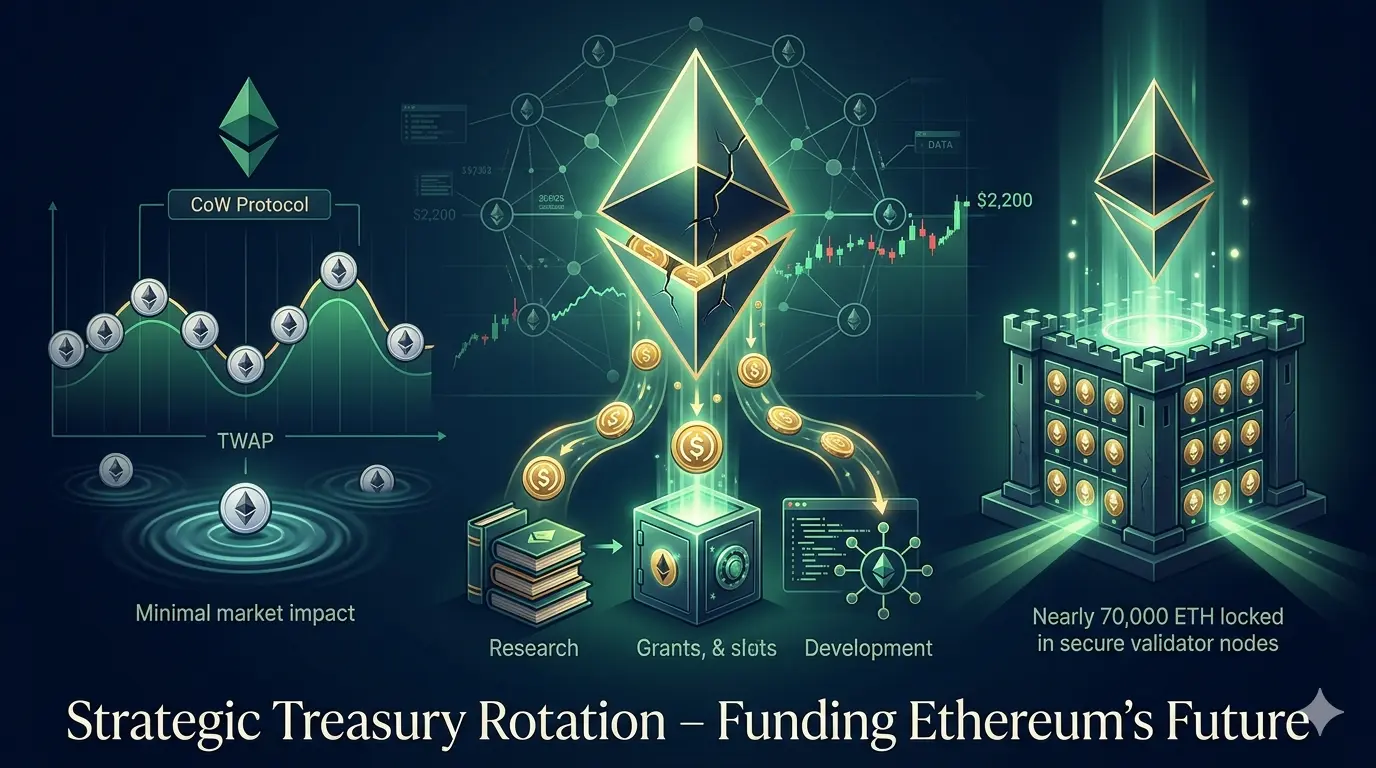
#EthereumFoundationSells3750ETH The Ethereum Foundation has executed a calculated treasury rebalancing, converting 3,750 ETH into stablecoins at an average price of $2,214 per ETH, raising approximately $8.3 million. This forms the majority of a planned 5,000 ETH conversion, with roughly 1,250 ETH remaining in the schedule. The transactions were carried out in small, controlled batches of approximately 416.67 ETH each using time-weighted average price (TWAP) orders via the CoW Protocol — a transparent, decentralized mechanism explicitly chosen to minimize slippage and market disruption.
This i
ETH2,98%
COW4,26%
dragon_fly2
#EthereumFoundationSells3750ETH The Ethereum Foundation has executed a calculated treasury rebalancing, converting 3,750 ETH into stablecoins at an average price of $2,214 per ETH, raising approximately $8.3 million. This forms the majority of a planned 5,000 ETH conversion, with roughly 1,250 ETH remaining in the schedule. The transactions were carried out in small, controlled batches of approximately 416.67 ETH each using time-weighted average price (TWAP) orders via the CoW Protocol — a transparent, decentralized mechanism explicitly chosen to minimize slippage and market disruption.
This is not a retreat from Ethereum. It is a textbook demonstration of sophisticated institutional treasury management. The Foundation has simultaneously advanced its staking program, reaching its publicly stated target of nearly 70,000 ETH staked. This substantial commitment not only generates consistent yield to support operations but also directly bolsters the security and decentralization of Ethereum’s proof-of-stake network. By maintaining such a large staked position while selectively rotating a modest portion of holdings into stable assets, the Foundation achieves a balanced portfolio that aligns long-term conviction with immediate operational requirements.
The proceeds are directed toward high-impact areas that have defined Ethereum’s success: frontier research and development, ecosystem grants, public goods funding, protocol improvements, and donations that sustain the developer community. In an industry where many organizations manage capital with limited visibility or accountability, the Ethereum Foundation’s approach stands apart — leveraging DeFi-native tools, providing clear communication, and executing with precision. This level of discipline reinforces trust and sets a benchmark for responsible stewardship in crypto.
Short-term, the sale has added measurable but contained selling pressure, contributing to ETH trading within the $2,150–$2,250 zone amid broader market dynamics. Yet reducing the narrative to “the Foundation is selling” misses the deeper strategic reality. Every stablecoin secured here extends the runway for innovation that keeps Ethereum at the forefront of decentralized computing, smart contracts, and global settlement infrastructure. These investments compound over years, strengthening the network’s technological edge, user adoption, and overall resilience.
Experienced market participants understand that true conviction is revealed not by never selling, but by how and why capital is allocated. The Ethereum Foundation continues to demonstrate alignment with Ethereum’s core principles — transparency, decentralization, and sustainable growth. This rotation does not weaken the ecosystem; it equips it with the liquidity needed to navigate development cycles effectively while preserving significant ETH exposure through staking.
In a space prone to emotional reactions and headline-driven volatility, such methodical treasury operations merit careful study rather than reflexive concern. They signal maturity, foresight, and a commitment to Ethereum’s multi-year trajectory over short-term price noise. For those building or investing with a long horizon, this reinforces the foundational strength of the Ethereum ecosystem and the professionalism guiding its primary steward.
#ETH #CryptoStrategy #TreasuryManagement
#GateSquareAprilPostingChallenge
Take action now and post your first plaza message in April!
👉️ https://www.gate.com/post
🗓 Deadline: April 15th
Details: https://www.gate.com/announcements/article/50520
repost-content-media
  • Reward
  • Comment
  • Repost
  • Share
Here’s the truth most people will miss while watching WLFI today:
The price didn’t drop 10.75% because of news. It dropped because of expectation.
And expectation is always smarter than reaction.
World Liberty Financial is now standing at a critical structural moment. Not because of hype, not because of headlines, but because of something far more powerful in markets — supply uncertainty.
Let’s break this down without emotion.
WLFI distributed tokens to early participants between $0.015 and $0.05 across late 2024 into early 2025. A controlled 20% unlock already happened months ago. That part i
WLFI-4,28%
dragon_fly2
Here’s the truth most people will miss while watching WLFI today:
The price didn’t drop 10.75% because of news. It dropped because of expectation.
And expectation is always smarter than reaction.
World Liberty Financial is now standing at a critical structural moment. Not because of hype, not because of headlines, but because of something far more powerful in markets — supply uncertainty.
Let’s break this down without emotion.
WLFI distributed tokens to early participants between $0.015 and $0.05 across late 2024 into early 2025. A controlled 20% unlock already happened months ago. That part is not the problem. The real pressure has been building silently in the remaining 80% — locked, inactive, but never forgotten.
For nearly seven months, that supply has existed in a state of ambiguity. No schedule. No clarity. No defined release structure.
And markets hate one thing more than bad news — they hate uncertainty without a timeline.
Now suddenly, a governance proposal is announced. Not released. Not voted. Just announced.
And the market reacts immediately.
That reaction tells you everything.
Because smart capital does not wait for confirmation. It positions ahead of possibility.
Right now, the circulating supply sits at 31.76 billion tokens out of a total 100 billion. That leaves over two-thirds of the supply still locked. This is not a small overhang. This is a structural weight sitting above price, waiting for a trigger.
Even a gradual vesting model introduces a new dynamic: not “if supply enters the market” — but when and how fast.
And that distinction changes behavior completely.
Early participants are not one unified group. Those who entered at $0.015 are still sitting on significant multiples, even after the drop. Their incentives are very different from those who entered closer to $0.05, who are now near psychological break-even levels.
This creates a fragmented pressure zone: some holders are patient, some are defensive, and some are simply waiting for liquidity to exit.
That mix is where volatility is born.
So what you’re seeing today is not panic. It’s positioning.
Not fear. But anticipation.
The market is beginning to price in a future where locked supply becomes active capital. And until there is precise clarity — numbers, timelines, cliffs — that uncertainty will continue to carry weight.
This is where most participants get it wrong.
They focus on the proposal itself.
But the real signal is what happens before the proposal even exists in detail.
Because markets don’t move on announcements. They move on interpretation.
And right now, the interpretation is clear: supply is coming, timing is unknown, and risk is being adjusted in advance.
Whether this becomes a controlled transition or a pressure event depends entirely on how that vesting structure is designed.
Until then, every move is speculation anchored to one core question:
How much supply is too much, too soon?
Watch closely. This isn’t just a price movement.
It’s a stress test of structure, liquidity, and investor psychology in real time.
#WLFI #CryptoNews #Gate广场四月发帖挑战#GateSquareAprilPostingChallenge
Full rules, terms, and exact reward structure:
https://www.gate.com/announcements/article/50520
repost-content-media
  • Reward
  • Comment
  • Repost
  • Share
#GateSquareAprilPostingChallenge
April 2026 is not a month that rewards noise — it rewards clarity. What we are witnessing in the crypto market right now, particularly with Bitcoin at its core, is not randomness or weakness. It is controlled compression. A phase where volatility contracts on the surface, but internally the market is actively redistributing liquidity, rebalancing positioning, and preparing for expansion.
Most traders misunderstand this environment because they are conditioned to chase movement. When price slows down, they assume opportunity disappears. In reality, this is wher
BTC0,71%
dragon_fly2
#GateSquareAprilPostingChallenge
April 2026 is not a month that rewards noise — it rewards clarity. What we are witnessing in the crypto market right now, particularly with Bitcoin at its core, is not randomness or weakness. It is controlled compression. A phase where volatility contracts on the surface, but internally the market is actively redistributing liquidity, rebalancing positioning, and preparing for expansion.
Most traders misunderstand this environment because they are conditioned to chase movement. When price slows down, they assume opportunity disappears. In reality, this is where the most important structural shifts occur.
Bitcoin is currently operating inside a defined equilibrium range. Price is not trending — it is rotating. Every push above resistance is met with selling pressure, and every breakdown below support is absorbed by buyers. This creates a cycle of liquidity sweeps where both longs and shorts are repeatedly trapped. The market is not failing to move — it is deliberately removing weak positioning before committing to a direction.
This behavior reflects a mature market phase. It signals that large participants are active, not through aggressive breakouts, but through controlled accumulation and distribution. Instead of chasing price, they are harvesting liquidity from both sides of the order book. That is why we see frequent stop hunts, sharp reversals, and lack of follow-through after breakout attempts.
Volume adds another layer to this picture. Expansion candles appear, but they lack consistency. Moves that seem strong at first are quickly absorbed. This indicates that volatility spikes are being used as execution opportunities rather than directional confirmation. Smart money is not entering impulsively — it is positioning strategically.
On the derivatives side, the environment is equally unforgiving. Funding rates continue to flip between positive and negative, while liquidation events alternate between long squeezes and short squeezes. This creates a hostile environment for leverage. Traders relying on high exposure are consistently punished, as the market systematically clears imbalanced positions.
The key takeaway here is simple: leverage amplifies mistakes in a compression phase.
At the macro level, uncertainty continues to influence behavior. Liquidity expectations, interest rate outlook, and broader risk sentiment are not aligned. This lack of clarity prevents sustained trends from forming. Bitcoin remains highly reactive to shifts in liquidity perception — when optimism increases, it attempts expansion; when uncertainty returns, it compresses again.
This constant push and pull keeps the market in a state of tension.
And that tension is important.
Because the longer the market stays compressed, the more powerful the eventual expansion becomes. Compression is not stagnation — it is energy being stored. Every failed breakout, every sweep of highs and lows, every moment of indecision is building pressure within the structure.
Eventually, that pressure resolves.
But here is where most traders fail: they try to predict the resolution instead of preparing for it.
Prediction has no edge in this environment. Bias becomes a liability. The market is not rewarding conviction — it is rewarding reaction. Traders who enter with fixed expectations are consistently caught on the wrong side of liquidity sweeps. Meanwhile, those who wait for confirmation, who adapt to structure, and who respect the range are the ones preserving capital.
And capital preservation right now is not passive — it is strategic dominance.
This phase is not about maximizing profits. It is about minimizing mistakes.
Execution must become selective. Position sizes must shrink. Overtrading must be eliminated. Every trade taken without clear confirmation increases exposure to a market that is specifically designed to punish impatience.
Discipline becomes the primary edge.
The traders who succeed in this environment are not the most active. They are the most controlled. They understand that doing nothing is often the highest quality decision when conditions are unclear.
As we move forward, one reality becomes increasingly certain: expansion is coming.
The longer Bitcoin remains within this compression structure, the more aggressive the breakout will be. But direction is not something to guess — it is something to confirm. A true breakout will come with sustained volume, continuation, and acceptance outside the range. Until then, every move remains part of the broader accumulation-distribution cycle.
This is where awareness matters.
Every liquidity sweep is information. Every failed move is data. Every reaction within the range is a signal about where pressure is building. The market is communicating constantly — but only to those who are patient enough to observe it without forcing action.
That is the real challenge of April.
Not profitability, but composure.
Not prediction, but precision.
Not activity, but awareness.
Because in the end, the market will reveal its direction. It always does. The question is not whether opportunity will come — it is whether you will still have the capital, the discipline, and the clarity to take advantage of it when it does.
And that is where the real edge lies.
#GateSquareAprilPostingChallenge
Take action now and post your first plaza message in April!
👉️ https://www.gate.com/post
🗓 Deadline: April 15th
Details: https://www.gate.com/announcements/article/50520
repost-content-media
  • Reward
  • Comment
  • Repost
  • Share
#GateSquareAprilPostingChallenge The biggest mistake you can make in today’s crypto market…
is believing that price is still the main story.
It isn’t.
Price is now the surface-level reflection of something far more powerful —
a system that is being quietly redesigned in real time.
As of April 2026, the market is no longer shaped by a single dominant force.
It is being constructed through the interaction of institutional capital, financial engineering, and regulatory integration.
And most participants are still trying to navigate it
using outdated assumptions.
There was a time when crypto moved
dragon_fly2
#GateSquareAprilPostingChallenge The biggest mistake you can make in today’s crypto market…
is believing that price is still the main story.
It isn’t.
Price is now the surface-level reflection of something far more powerful —
a system that is being quietly redesigned in real time.
As of April 2026, the market is no longer shaped by a single dominant force.
It is being constructed through the interaction of institutional capital, financial engineering, and regulatory integration.
And most participants are still trying to navigate it
using outdated assumptions.
There was a time when crypto moved on belief.
Retail sentiment, narratives, hype cycles — these were the primary engines of volatility.
Markets reacted quickly, often irrationally, but they were at least transparent in their chaos.
That phase is ending.
What we are witnessing now is not a reduction in volatility —
it is a transformation of its source.
Volatility has not disappeared.
It has become strategic.
Large players are no longer entering the market simply to gain exposure.
They are entering to design outcomes.
Through ETFs, derivatives, and structured products, they are building frameworks where:
Risk can be redistributed
Liquidity can be directed
Exposure can be scaled without direct ownership
And narratives can be reinforced through capital flows
This is a fundamental shift.
Because when exposure replaces ownership,
the relationship between price and reality begins to weaken.
Assets no longer need organic demand to move.
They need structured positioning.
This is why ETF developments — even those centered around unconventional or meme-driven assets — should not be dismissed.
They are not about validating the asset.
They are about expanding the system.
Every new ETF application represents another layer of abstraction —
another step away from raw market dynamics
and closer to a fully financialized ecosystem.
Crypto is no longer operating outside the system.
It is being repackaged to function within it.
And this brings us to the most underestimated shift of all:
Regulation.
The market once feared regulation as a force of restriction.
Bans, crackdowns, uncertainty — these were the dominant concerns.
But the current phase is far more sophisticated.
Regulation is no longer confrontational.
It is adaptive.
Instead of limiting the market, it is shaping it in ways that align with institutional participation.
This creates a new reality:
A system where growth is allowed —
but only within defined structural boundaries.
This is not decentralization in its original form.
This is controlled expansion.
And within controlled systems, opportunity does not disappear —
it becomes selective.
At the same time, market psychology is evolving.
The emotional cycles of fear and greed still exist,
but they are no longer the dominant drivers.
Participants are becoming more aware, more analytical, more patient.
The key question is no longer:
“What will pump next?”
It has become:
“Who is positioning behind this… and why?”
This shift sounds like progress.
And in many ways, it is.
But it also introduces a new layer of complexity —
because a more professional market is not necessarily a more fair one.
It is simply a more strategically controlled one.
In this environment:
Price movements can be engineered
Liquidity can be concentrated or withdrawn with precision
Narratives can be amplified or suppressed
And timing becomes more important than direction
This creates an uncomfortable truth:
The market is no longer just a place of opportunity.
It is a system of influence.
And those who do not recognize this…
become part of the liquidity that fuels it.
So the real divide in 2026 is not between bulls and bears.
It is between:
Those who react to price
And those who understand positioning
Because speed is no longer the ultimate advantage.
Information is everywhere.
Execution is accessible.
But interpretation —
understanding what is actually happening beneath the surface —
that is where the edge now exists.
Early entry still matters.
But early understanding matters more.
Because in a market defined by structure rather than spontaneity,
being early without awareness is no longer a guarantee of success.
And this leads to the only question that truly defines outcomes in this cycle:
Are you participating in the market…
or are you navigating a system that has already anticipated your behavior?
Because the crypto market is not slowing down.
It is evolving.
But this evolution is not neutral.
It is directional.
It is structured.
And above all, it is selective.
Not everyone will win in this version of the market.
Only those who can see beyond the chart
and recognize the architecture behind it
will have a chance to stay ahead.
If you read this far, you’re already ahead of most.
But reading is not enough anymore.
Understanding is the new edge.
Complete details and official rules are here:
https://www.gate.com/announcements/article/50520#Gate广场四月发帖挑战
repost-content-media
  • Reward
  • Comment
  • Repost
  • Share
let's check ✅
dragon_fly2
[Ended] Regulation Nears Reality: SEC Warns of Immediate Implementation.
live-cover
  • Reward
  • Comment
  • Repost
  • Share
#GateSquareAprilPostingChallenge April Isn’t Bullish or Bearish — It’s Selective. Most Will Get It Wrong.
The biggest mistake traders are making right now is trying to label April as a “bullish continuation” or a “correction phase.”
That mindset is outdated.
April 2026 is not rewarding direction.
It is rewarding precision.
We are no longer in a market driven by simple narratives like halving hype or retail momentum. Those edges have already been absorbed. The current environment is defined by something far more complex—and far less forgiving:
Liquidity positioning and capital rotation.
This is
dragon_fly2
#GateSquareAprilPostingChallenge April Isn’t Bullish or Bearish — It’s Selective. Most Will Get It Wrong.
The biggest mistake traders are making right now is trying to label April as a “bullish continuation” or a “correction phase.”
That mindset is outdated.
April 2026 is not rewarding direction.
It is rewarding precision.
We are no longer in a market driven by simple narratives like halving hype or retail momentum. Those edges have already been absorbed. The current environment is defined by something far more complex—and far less forgiving:
Liquidity positioning and capital rotation.
This is where most participants fall behind.
They watch price.
Professionals watch liquidity.
Global M2 expansion is stabilizing, not aggressively expanding. Central banks are holding rates instead of cutting aggressively. This creates a controlled environment where capital does not flood markets blindly—it moves selectively.
That means not everything will rise together.
And that is where opportunity—and risk—both increase.
The Dollar Index (DXY) is now one of the most important signals to watch. A sustained move below the 102 level is not just a technical breakdown—it is a shift in global risk appetite. When the dollar weakens, capital looks for yield elsewhere. Crypto becomes a target.
But here is the part most people ignore:
Even in favorable conditions, capital does not move equally.
It concentrates.
Right now, two sectors are absorbing that concentration:
Real World Assets (RWA)
This is no longer a narrative—it is infrastructure. Tokenized treasuries crossing multi-billion TVL signals institutional acceptance, not speculation. Smart money is not chasing volatility here. It is positioning for stability with yield.
AI-Driven On-Chain Systems
Not hype tokens. Not empty branding. Actual autonomous agents interacting with smart contracts, generating activity and value. The difference between winners and losers in this category is simple: execution vs noise. If there is no real development activity behind it, it will not survive.
This is where most retail traders make a critical mistake.
They chase visibility instead of validation.
A trending token is not a strong token.
A loud narrative is not a durable one.
And in a selective market, weak positioning gets exposed quickly.
Now comes the part that decides whether you stay in the game or get removed from it:
Risk Management.
Not as a suggestion. As a requirement.
If you are risking large portions of your portfolio in a high-volatility, liquidity-sensitive environment, you are not trading—you are gambling.
Professionals think differently:
Capital preservation comes before profit
Position sizing is controlled, not emotional
Exposure is calculated, not reactive
A single trade should never have the power to damage your portfolio. Because survival is the first edge. Without it, no strategy matters.
Volatility is also no longer random. It is event-driven.
Macroeconomic triggers like CPI releases and FOMC decisions are now acting as volatility catalysts across both traditional and crypto markets. This creates predictable windows of expansion and contraction.
Smart participants prepare before the move.
Unprepared participants react after it.
And reaction is always more expensive than preparation.
Execution also separates amateurs from professionals.
Entering positions impulsively increases slippage, reduces efficiency, and exposes you to unnecessary risk. Advanced order strategies such as TWAP and Iceberg are not just tools—they are advantages. They allow you to enter and exit positions without revealing intent or disrupting price.
This is how controlled capital operates.
So understand the reality of April:
This is not a month where everyone wins.
This is a phase where the market quietly filters participants.
Those who rely on hype will overextend.
Those who ignore risk will get caught in volatility.
Those who fail to adapt will slowly disappear.
But those who understand liquidity, respect structure, and execute with discipline will not just survive—they will position themselves ahead of the next expansion phase.
Because in this market, success is no longer about being early.
It is about being accurate.
And accuracy is what most people never develop.
Now the real question:
Are you following narratives—
or are you following where capital is actually moving?
#GateSquareAprilPostingChallenge
Complete details and official rules are here:
https://www.gate.com/announcements/article/50520
#Gate广场四月发帖挑战
#CryptoStrategy
#smartmoney
repost-content-media
  • Reward
  • Comment
  • Repost
  • Share
#GateSquareAprilPostingChallenge, Gate Square April Feature Post: “The Silent Advantage Nobody Talks About”
There is a stage in every digital ecosystem where people believe success is decided by luck.
They think some posts “go viral randomly,” while others “die randomly.”
They assume visibility is unpredictable, engagement is unfair, and growth is reserved for those already lucky or already known.
But inside structured platforms like Gate Square, something very different is happening underneath the surface.
Something most users never take time to understand.
And the moment you understand it, y
dragon_fly2
#GateSquareAprilPostingChallenge, Gate Square April Feature Post: “The Silent Advantage Nobody Talks About”
There is a stage in every digital ecosystem where people believe success is decided by luck.
They think some posts “go viral randomly,” while others “die randomly.”
They assume visibility is unpredictable, engagement is unfair, and growth is reserved for those already lucky or already known.
But inside structured platforms like Gate Square, something very different is happening underneath the surface.
Something most users never take time to understand.
And the moment you understand it, you stop posting like a participant…
and start posting like a strategist.
Because attention is not random.
It is conditional.
And conditions can be learned, influenced, and eventually mastered.

At the beginning, every user experiences what looks like opportunity.
A new post gets attention. A reaction appears. A small boost happens.
And the mind immediately builds a conclusion:
“I just need to post more like this.”
But that conclusion is incomplete.
Because early engagement is not a reward for effort.
It is a calibration phase.
The system is testing three things at once:
How fast people react to you
How long they stay with your content
And whether your presence creates continuation or silence
Most users never realize they are being measured in real time.
They think they are “posting content.”
But in reality, they are entering a feedback loop.
And that feedback loop decides everything that follows.

There is a hidden pattern that separates visible accounts from invisible ones.
It is not posting frequency.
It is not content length.
It is not even quality in the traditional sense.
It is response density over time.
If your posts consistently produce micro-reactions—likes, comments, saves, shares—the system begins to classify your content as “alive.”
If your posts consistently produce silence, even if they are well-written, the system begins to classify your content as “background.”
And here is the uncomfortable truth most people avoid:
Background content is not punished.
It is simply ignored.
Silently.
Automatically.
And consistently.

This is where most users make their first fatal mistake.
They increase output instead of increasing impact.
They post more frequently into silence.
They repeat the same structure expecting a different outcome.
They confuse activity with progress.
But the system does not reward activity.
It rewards reaction.
And reaction is not created by repetition.
It is created by interruption.

Interruption is the most powerful force in digital attention.
It is the moment your content breaks expectation.
It is the sentence that makes someone stop scrolling without realizing why.
It is the idea that feels slightly more important than everything around it.
And interruption does not require aggression.
It requires precision.
A shift in framing.
A contrast in thought.
A depth that forces the reader to pause for half a second longer than usual.
That half second is the entire game.
Because attention is not lost in minutes.
It is lost in milliseconds.

Once you understand interruption, your strategy changes.
You stop asking:
“How often should I post?”
And you start asking:
“What makes someone stop here instead of scrolling away?”
That question alone separates amateurs from operators.
Because frequency builds habit.
But interruption builds memory.
And memory is what the algorithm ultimately amplifies.

There is another layer most people never see.
Platforms do not just track engagement.
They track consistency of engagement patterns.
If your content produces scattered reactions—one post hits, five don’t—the system treats you as unstable.
If your content produces no reactions, the system treats you as irrelevant.
But if your content produces even small, consistent reactions, something shifts.
You enter a category called “predictably engaging.”
And that category is where distribution begins to open.
Not dramatically.
Not instantly.
But structurally.
Step by step.
Post by post.

This is why one post can change everything.
Not because it goes viral.
But because it resets perception.
A single post that generates comments after a long silence is not just engagement.
It is reactivation.
It tells the system:
“This account still produces response.”
And once that signal is sent, everything that follows has a higher chance of visibility.
That is the real mechanics behind growth most people never see.

Now let’s talk about the psychological layer.
Audiences are not neutral.
They build expectations unconsciously.
If they see your content repeatedly without interaction, they begin to assume your content is not worth interacting with.
Not because it is bad.
But because nothing has trained them to respond.
And once that expectation forms, it becomes self-reinforcing.
Silence teaches silence.
Engagement teaches engagement.
That is the cycle.

So what actually breaks it?
Not more posting.
Not louder content.
Not emotional exaggeration.
But controlled disruption.
A post that slightly breaks your previous pattern.
A post that feels more direct.
More structured.
More intentional.
More “worth pausing for” than anything before it.
That is how perception resets.
And perception is the real currency of visibility.

There is also a critical misunderstanding about growth platforms.
People believe they are competing against others.
In reality, they are competing against inertia.
The natural tendency of users to scroll, ignore, and move on.
If your content cannot interrupt inertia, it disappears.
If it can interrupt inertia, it spreads.
It is that simple—and that unforgiving.

And finally, the truth most users resist:
The platform does not decide your reach first.
The audience does.
The algorithm only reflects what the audience already did.
So if your content is ignored, it is not a system error.
It is a reflection of response behavior.
And if your content is engaged with, it is not luck.
It is alignment.

This is what the #GateSquareAprilPostingChallenge really reveals.
Not who posts the most.
Not who stays the longest.
But who understands how attention actually works under repetition.
Because once you understand attention, you stop chasing visibility…
and start engineering it.

And in that moment, everything changes:
Your posts are no longer just content.
They become triggers.
Your words are no longer just information.
They become interruptions.
And your presence is no longer ignored.
It becomes anticipated.

That is the silent advantage.
Not seen.
Not announced.
But always deciding who gets remembered.
#GateSquareAprilPostingChallenge。
Full rules, terms, and exact reward structure:
https://www.gate.com/announcements/article/50520
repost-content-media
  • Reward
  • Comment
  • Repost
  • Share
#GateSquareAprilPostingChallenge, Gate Square April Challenge: The Habit of Being Ignored
April on Gate Square begins with a sense of momentum that feels almost effortless. You join the #GateSquareAprilPostingChallenge, you publish your first post, and immediately there is a response. Visibility feels natural, engagement appears within reach, and for a brief moment it seems like the system is working entirely in your favor. That initial reward creates a powerful psychological effect. It builds confidence. It gives the impression that consistency alone may be enough to guarantee growth.
But dig
dragon_fly2
#GateSquareAprilPostingChallenge, Gate Square April Challenge: The Habit of Being Ignored
April on Gate Square begins with a sense of momentum that feels almost effortless. You join the #GateSquareAprilPostingChallenge, you publish your first post, and immediately there is a response. Visibility feels natural, engagement appears within reach, and for a brief moment it seems like the system is working entirely in your favor. That initial reward creates a powerful psychological effect. It builds confidence. It gives the impression that consistency alone may be enough to guarantee growth.
But digital environments rarely sustain early momentum in a linear way.
What begins as encouragement slowly transforms into a silent test.
You post again. The response is weaker. You post once more, and the reaction becomes almost invisible. No comments. No meaningful engagement. Sometimes not even impressions that match your expectation. At first, it feels like randomness, like timing issues or algorithm fluctuation. But as the pattern continues, a deeper reality starts to reveal itself.
You are not failing.
You are being trained into invisibility.
This is where most participants misunderstand the system. They assume that the solution is to increase output. More posts. More frequency. More repetition. But what they do not realize is that repetition without impact does not build visibility. It builds familiarity without attention. And familiarity without attention slowly evolves into disregard.
A habit begins to form.
Not your habit of posting.
But the audience’s habit of ignoring.
Once that habit is established, it becomes self-reinforcing. People begin to scroll past your content without hesitation. The brain learns that your posts do not require attention. Even before reading, the decision is already made. This is not personal. It is behavioral conditioning inside digital environments. Every platform amplifies patterns, not intentions.
And when your content repeatedly produces no engagement, it sends a silent message into the system: this content is not worth prioritizing.
That is the real turning point.
Because at that stage, posting more inside the same structure does not fix the issue. It deepens it. Each additional post without interaction confirms the existing pattern. It strengthens the assumption that your content does not generate response. Over time, your reach compresses further. Your visibility becomes shorter. Your opportunity window narrows.
Not because you stopped trying.
But because nothing interrupted the pattern.
This is the part most users fail to recognize.
The system does not punish inactivity as much as it deprioritizes irrelevance.
And relevance is not defined by effort. It is defined by reaction.
To break this cycle, volume is not the answer. Adjustment is.
A single post that generates even minimal engagement can disrupt the entire trajectory. One like is not just a metric. It is a signal that reverses the pattern. One comment is not just interaction. It is proof of presence. These signals do more than increase visibility temporarily. They reset the behavioral expectation of your content.
When that reset occurs, the system reassesses how your posts should be distributed. Your content is no longer categorized as “ignored by default.” It re-enters the attention cycle. Even small engagement changes the distribution path.
This is why some posts outperform others dramatically, even from the same creator, with similar reach potential. It is not randomness. It is interruption versus continuation.
Engagement, in this context, is not just interaction.
It is correction.
It is a recalibration of how your content is perceived by both the algorithm and the audience.
There is another layer that must be understood.
Visibility alone does not guarantee attention. Many posts appear in front of users without ever being mentally registered. The human mind filters content faster than any algorithm distributes it. This means that even if reach is achieved, connection is still the deciding factor.
A post that does not connect is not remembered.
And what is not remembered cannot generate future engagement.
This is where the real distinction between average participation and impactful participation emerges. Average participation focuses on repetition. Impactful participation focuses on interruption. It is not about how often you appear. It is about how differently you appear when you do.
That difference determines whether the habit of ignoring continues or breaks.
Consistency still matters, but not in isolation. Consistency without adaptation becomes background noise. And background noise is the most easily ignored form of communication in any digital ecosystem. The goal is not to simply remain active. The goal is to remain noticeable.
To achieve that, content must evolve in structure, tone, and emotional trigger. It must create enough cognitive friction to force a pause. That pause is where attention is captured. Without it, the scroll continues uninterrupted.
The system itself is neutral.
It does not favor individuals.
It responds to patterns.
If your pattern signals low interaction, it reduces your distribution. If your pattern signals engagement, it expands it. The platform is essentially a reflection mechanism, not a promotion mechanism. It mirrors audience behavior back to you in amplified form.
That is why blaming the system leads nowhere.
The system is not blocking visibility.
It is reflecting expectation.
And expectation is built over time through repeated outcomes.
There is also a structural requirement that remains constant regardless of performance. Without completing verification requirements such as KYC, rewards and certain system benefits cannot be accessed. No matter how strong the content becomes or how much engagement is achieved, verification remains a non-negotiable layer of access. This ensures that outcomes are tied not only to performance but also to authenticity within the platform.
However, even with all structural conditions met, one principle remains dominant above everything else.
Attention must be earned in real time.
It cannot be stored from previous success. It cannot be assumed from participation. It must be re-established with every meaningful post that breaks through silence.
This is why the #GateSquareAprilPostingChallenge is not simply about posting frequency. It is about learning how visibility actually behaves under repetition, and how quickly attention decays without reinforcement.
The real challenge is not creating content.
The real challenge is preventing your content from becoming invisible by default.
Once you understand that, your approach changes completely.
You stop measuring success by output alone.
You start measuring it by interruption, reaction, and reset.
Because in environments like this, the difference between being seen and being ignored is not effort.
It is impact.
And once that habit of being ignored is broken, even slightly, everything changes in sequence. Reach expands more naturally. Engagement becomes more stable. Visibility lasts longer. The system begins to treat your content as worth distributing again.
Not because it was forced.
But because it finally proved itself different.
And that is where growth actually begins.
#GateSquareAprilPostingChallenge
Take action now and post your first plaza message in April!
👉️ https://www.gate.com/post
🗓 Deadline: April 15th
Details: https://www.gate.com/announcements/article/50520
repost-content-media
  • Reward
  • Comment
  • Repost
  • Share
#GateSquareAprilPostingChallenge, Gate Square April Challenge: The System Does Not Reward Activity, It Rewards Impact
April on Gate Square does not test how often you post.
It tests what your post is worth in a system that is constantly deciding whether you deserve attention or silence.
At the surface, the #GateSquareAprilPostingChallenge looks simple. You participate, you publish content, and you expect progress to follow effort. For many users, the beginning confirms that belief. The first interaction feels rewarding. The first visibility feels encouraging. The first reward creates a psychol
dragon_fly2
#GateSquareAprilPostingChallenge, Gate Square April Challenge: The System Does Not Reward Activity, It Rewards Impact
April on Gate Square does not test how often you post.
It tests what your post is worth in a system that is constantly deciding whether you deserve attention or silence.
At the surface, the #GateSquareAprilPostingChallenge looks simple. You participate, you publish content, and you expect progress to follow effort. For many users, the beginning confirms that belief. The first interaction feels rewarding. The first visibility feels encouraging. The first reward creates a psychological illusion that the system is designed to support consistent effort.
But that illusion is temporary.
Because what comes after the first phase is where the actual structure of the platform begins to reveal itself.
Silence appears.
Not immediate failure. Not rejection. Not visible punishment.
Just silence.
You post, and the system does not respond in the way you expect. You post again, and again there is no meaningful reaction. Numbers may still appear, impressions may still register, but nothing moves. No engagement. No feedback loop. No confirmation that your content is alive in the ecosystem.
This is where most participants misinterpret reality.
They assume they are still “building presence.”
But in truth, they are entering the evaluation layer of the system.
Because platforms like Gate Square do not reward activity itself. They reward interaction density. They reward resonance. They reward content that forces response instead of content that simply exists.
This is the point most people never recognize.
They confuse output with impact.
Output is easy. Anyone can post. Anyone can participate. Anyone can increase frequency.
Impact is different. Impact is what breaks silence.
Silence is the most important metric you are not shown directly.
It is the gap between publishing and response.
If a post enters the system and returns nothing, it does not mean the system is broken. It means the content failed to cross the threshold where attention converts into engagement.
That threshold is invisible, but it is strict.
Most content never reaches it.
And so most posts remain trapped in the same state: visible but inactive, present but not alive.
This creates a false perception of progress.
Users see numbers increasing and assume growth is happening. But growth without interaction is not movement. It is accumulation without activation.
And accumulation without activation eventually collapses into irrelevance.
Because the system is not designed to sustain passive content.
It filters it out naturally.
The algorithm does not need to delete your content. It simply stops responding to it.
And when response stops, visibility decays.
This is why the silence between numbers matters more than the numbers themselves.
Numbers only show that something was delivered.
They do not confirm that anything was received.
Reception is the real currency.
A single reaction changes everything because it breaks the isolation loop.
The post is no longer alone in the system. It is now connected to behavior. That connection is what the algorithm recognizes as relevance.
Relevance is not declared. It is proven through interaction.
One engagement creates a signal.
Multiple signals create momentum.
Momentum creates distribution.
Distribution creates visibility.
Visibility creates opportunity.
But none of that begins without breaking silence.
This is the core misunderstanding behind most failed participation strategies in challenges like this.
People focus on repetition.
They believe more posts will compensate for weak response.
But repetition without engagement only multiplies silence. It does not reduce it. It reinforces it.
Ten posts with no reaction do not equal progress. They equal ten confirmations that the content is not connecting.
The system reads that pattern clearly even if the user does not.
There is another layer that most participants underestimate: visibility tools such as hashtags, links, and challenge tags.
These are not engines of growth.
They are access points.
They allow your content to enter the environment, but they do not guarantee interaction within it.
Entry is not the same as impact.
Many users assume that adding the correct hashtag or participating in the correct event automatically increases success probability. In reality, these elements only position the content. They do not activate it.
Activation depends entirely on whether the content generates a reaction once it is seen.
That reaction is the only signal that matters at scale.
And that is where strategy becomes important.
Content that survives in this environment is not necessarily the most frequent. It is the most responsive.
It creates friction. It creates curiosity. It creates enough psychological weight that the viewer cannot scroll past without registering some form of engagement.
Without that, the post dissolves into silence regardless of quality perception.
And this is where most participants face their hardest realization.
Effort is not the differentiator.
Alignment is.
Effort produces volume. Alignment produces response.
And only response produces growth.
There is also a structural requirement that sits outside content performance entirely.
No matter how strong your posts are, no matter how consistent your participation is, without completing verification (KYC), rewards cannot be claimed.
This is the final checkpoint of the system. It ensures that even if attention is earned, it is also validated at identity level. Many participants ignore this step until it becomes a limitation, not realizing that the system is not only measuring engagement but also eligibility.
So the structure is complete and uncompromising.
First, access through participation.
Then, evaluation through silence.
Then, breakthrough through engagement.
Then, validation through verification.
Each layer depends on the previous one. Missing one breaks the chain entirely.
Most people never move beyond the second stage.
They remain inside silence without realizing it is not a temporary state. It is a filter.
A filter that separates content that exists from content that performs.
And performance is the only language the system understands.
This is why the challenge is not about increasing numbers.
It is about converting numbers into responses.
Because numbers alone are passive.
Responses are active.
And only what is active moves forward.
At the end of every cycle, the system does not remember how much you posted.
It remembers what made people react.
That is the only record that matters.
Everything else is noise inside silence.
And the difference between winning and disappearing is decided in that silence long before the results ever appear.
Full rules, terms, and exact reward structure:
https://www.gate.com/announcements/article/50520
repost-content-media
  • Reward
  • Comment
  • Repost
  • Share
#CanaryFilesSpotPEPEETF
In the evolving architecture of modern digital markets, certain narratives begin as speculation, mature into liquidity events, and eventually transform into structural instruments that reshape how capital moves across ecosystems. The current wave surrounding Canary Files and the Spot PEPE ETF narrative sits precisely at that intersection—where meme-driven digital assets, institutional curiosity, and regulatory experimentation begin to overlap in ways that traditional finance did not anticipate.
What is emerging here is not simply another crypto headline. It is a reflec
dragon_fly2
#CanaryFilesSpotPEPEETF
In the evolving architecture of modern digital markets, certain narratives begin as speculation, mature into liquidity events, and eventually transform into structural instruments that reshape how capital moves across ecosystems. The current wave surrounding Canary Files and the Spot PEPE ETF narrative sits precisely at that intersection—where meme-driven digital assets, institutional curiosity, and regulatory experimentation begin to overlap in ways that traditional finance did not anticipate.
What is emerging here is not simply another crypto headline. It is a reflection of a deeper shift in how markets interpret value creation, community-driven assets, and the growing appetite for packaged exposure to volatile yet highly liquid digital instruments. The idea of a Spot PEPE ETF, regardless of its current stage of formalization or regulatory acceptance, represents a conceptual bridge between decentralized cultural finance and centralized investment vehicles.
To understand the significance of this narrative, it is necessary to separate three layers that often get conflated in public discourse: the asset itself, the market structure around it, and the institutional packaging of exposure.
PEPE as an asset class began as a meme-driven token, born from internet culture rather than fundamental utility in the traditional sense. Yet what distinguishes PEPE from countless forgotten meme tokens is not only its liquidity or exchange presence, but its ability to sustain attention cycles. In digital markets, attention is not just sentiment—it is a measurable form of capital flow. Every cycle of attention creates order book depth, derivatives activity, and secondary market expansion.
This is where Canary Files enters the narrative lens. The term itself, whether interpreted as a conceptual filing framework or a symbolic reference to early-stage institutional monitoring, reflects how market participants track emerging financial structures before they become mainstream. In traditional finance, “canary” systems often represent early warning signals or early adoption indicators. Applied to crypto, it becomes a metaphor for institutional curiosity testing the boundaries of what assets can be structured into regulated instruments.
A Spot PEPE ETF, if ever fully realized, would represent a radical normalization of meme assets within regulated financial ecosystems. ETFs historically serve as abstraction layers. They convert complex, often volatile underlying assets into simplified, tradable exposure instruments for broader investor bases. Bitcoin ETFs already established the precedent that digital-native assets can be repackaged into traditional finance wrappers. Ethereum followed closely behind in conceptual discussions. The introduction of a meme-based ETF narrative pushes this boundary further into cultural finance.
This is not just about PEPE. It is about what PEPE represents in market psychology. Meme coins are often dismissed as irrational speculation, yet they function as real-time sentiment engines. They reflect liquidity conditions, retail participation cycles, and speculative risk appetite more accurately than many traditional indicators. In that sense, PEPE is not merely a token; it is a behavioral index.
The ETF narrative, therefore, implies something deeper: the institutionalization of collective behavior as a tradable asset class.
However, the path from narrative to execution is not linear. Regulatory frameworks remain cautious about assets lacking intrinsic cash flow, governance structure, or utility-based valuation models. A Spot PEPE ETF would need to confront fundamental questions: What exactly is being tracked? Is it liquidity? Market capitalization? Exchange volume across venues? Or simply price discovery in an unregulated sentiment-driven environment?
These questions highlight a larger transformation happening in global capital markets. The definition of “eligible underlying asset” is slowly expanding. Where once only commodities, equities, and sovereign-backed instruments qualified, digital-native assets are gradually being evaluated under new criteria such as liquidity resilience, market depth, and decentralized distribution.
The Canary Files narrative, in this context, symbolizes early-stage institutional mapping of these possibilities. It suggests that certain entities are monitoring meme assets not as jokes, but as structured volatility instruments that could be wrapped, hedged, and distributed to different risk profiles.
From a market structure perspective, the introduction of any ETF tied to a highly speculative asset like PEPE would trigger several cascading effects.
First, liquidity fragmentation would begin to consolidate. Currently, PEPE liquidity exists across multiple centralized exchanges, decentralized exchanges, and derivative platforms. An ETF wrapper would likely aggregate exposure through regulated liquidity pools, indirectly affecting spot demand across fragmented venues.
Second, volatility transmission would become more structured. Instead of purely retail-driven spikes, ETF-linked flows would introduce institutional rebalancing cycles, creating predictable liquidity injections or withdrawals based on fund inflows and outflows.
Third, narrative legitimacy would increase significantly. In financial markets, perception often precedes adoption. The mere discussion of ETF eligibility elevates an asset from speculative obscurity into institutional consideration, regardless of immediate approval outcomes.
Yet risks remain structurally significant. Meme assets are inherently reflexive. Their value is tightly coupled with attention cycles rather than fundamental valuation anchors. Introducing ETF structures could amplify both upside liquidity and downside cascading risk. In stress conditions, redemption-driven selling could accelerate price dislocations more aggressively than in unstructured markets.
This duality is what makes the Canary Files Spot PEPE ETF narrative both compelling and controversial. It represents innovation at the edge of financial engineering, but also exposes systemic questions about how far abstraction layers can be extended before they detach completely from underlying value frameworks.
From an investor psychology standpoint, this narrative also reflects a broader behavioral shift. Retail participants are no longer passive observers of institutional products. They are early creators of liquidity conditions that institutions eventually package. In previous market cycles, institutions led innovation and retail followed. In the current digital asset cycle, the order is often reversed.
Memes become markets. Markets become instruments. Instruments become benchmarks. And eventually, benchmarks become components of structured financial products.
The Canary Files framing suggests that we may be in the earliest phase of this transformation for meme-based assets. Whether or not a Spot PEPE ETF ever reaches regulatory approval is almost secondary to the fact that such a concept is now being discussed seriously within market ecosystems.
It indicates that the boundary between cultural assets and financial instruments is dissolving faster than traditional regulatory frameworks can adapt.
For Gate Square participants and digital market observers, the key insight is not to focus solely on the approval probability of such an ETF, but to understand the signaling effect it generates across liquidity networks. Every mention of ETF structuring introduces reflexive feedback loops into the underlying asset. Traders anticipate institutional flows, liquidity providers adjust spreads, and narrative traders position ahead of perceived structural shifts.
In this environment, information itself becomes a tradable asset class. The Canary Files narrative is not just about filings or documents—it is about early detection of where capital attention may migrate next.
Ultimately, the Spot PEPE ETF concept sits at the frontier of financial experimentation. It challenges assumptions about what deserves institutional packaging and what remains in the speculative periphery. It forces a reevaluation of whether value must be derived from utility or whether sustained collective attention is sufficient to justify structured exposure.
If history of financial innovation is any guide, markets tend to expand definitions rather than restrict them. Commodities became futures. Stocks became ETFs. Volatility became an asset class. And now, cultural memes are being discussed as potential structured instruments.
The Canary Files Spot PEPE ETF narrative is therefore not an endpoint—it is a signal phase. A marker of how far digital markets have already evolved, and how much further they may still extend.
In the coming cycles, the real question will not be whether such products exist, but how many layers of abstraction markets are willing to build between cultural origin and institutional exposure.

repost-content-media
  • Reward
  • Comment
  • Repost
  • Share
#MetaReleasesMuseSpark
Meta is executing one of the most strategically significant transformations in the modern artificial intelligence landscape, signaling a decisive shift from incremental model improvements toward a full-stack, infrastructure-backed superintelligence strategy. The introduction of Muse Spark under the Meta Superintelligence Labs (MSL) umbrella represents not just a new model release, but a structural redefinition of how Meta intends to compete in the global AI race over the next decade.
At the foundation of this shift lies an aggressive and long-horizon infrastructure expa
dragon_fly2
#MetaReleasesMuseSpark
Meta is executing one of the most strategically significant transformations in the modern artificial intelligence landscape, signaling a decisive shift from incremental model improvements toward a full-stack, infrastructure-backed superintelligence strategy. The introduction of Muse Spark under the Meta Superintelligence Labs (MSL) umbrella represents not just a new model release, but a structural redefinition of how Meta intends to compete in the global AI race over the next decade.
At the foundation of this shift lies an aggressive and long-horizon infrastructure expansion strategy. Meta’s deepening compute agreements, extending into multi-year, multi-billion-dollar commitments, reflect a clear recognition of the central truth driving the AI era: intelligence is constrained by compute. By securing sustained access to high-density GPU clusters and next-generation accelerator systems, Meta is effectively insulating itself from short-term supply bottlenecks and positioning itself for continuous model training at frontier scale. This approach enables uninterrupted iteration cycles, larger parameter exploration, and faster deployment of increasingly complex multimodal systems.
Muse Spark is the first visible outcome of this restructured strategy. Developed under the direction of Meta’s AI leadership at MSL, the model marks a deliberate departure from the earlier Llama-centric open model philosophy toward a more vertically integrated and product-oriented intelligence framework. Rather than optimizing solely for openness or research distribution, Muse Spark is designed as a tightly engineered system aimed at real-world utility, scalable deployment, and long-term ecosystem embedding across Meta’s global platforms.
At its core, Muse Spark is built as a natively multimodal reasoning system. Unlike earlier architectures that treated text, image, and audio as loosely connected modalities, Muse Spark integrates them into a unified reasoning space. This allows the model to interpret complex inputs holistically, drawing connections across visual context, linguistic structure, and auditory signals simultaneously. The result is a more coherent understanding of real-world scenarios where information rarely exists in a single format.
One of the most significant architectural innovations in Muse Spark is its agentic decomposition framework. Instead of relying on a single monolithic inference pathway, the model is capable of deploying multiple specialized internal agents that collaborate to solve complex tasks. These sub-agents can independently evaluate different aspects of a problem, cross-check outputs, and refine answers iteratively. This structure significantly improves reliability in high-complexity domains such as mathematical reasoning, scientific analysis, strategic planning, and multi-step problem solving.
A defining feature of Muse Spark is its “Contemplating mode,” a structured reasoning process that allows the system to expand intermediate thought chains before delivering a final response. This is particularly important for tasks requiring deeper analytical accuracy rather than instant summarization. In practice, this creates a more deliberate and transparent reasoning flow, reducing superficial outputs and increasing the depth of generated insights.
Meta has already integrated Muse Spark into its consumer-facing ecosystem at scale. The model powers experiences within the Meta AI assistant across platforms including messaging, social media, and wearable devices. Its deployment across WhatsApp, Instagram, Facebook, Messenger, and Ray-Ban smart glasses reflects Meta’s unique advantage: unlike standalone AI companies, it controls a global distribution network spanning billions of active users. This enables immediate real-world testing, feedback loops, and iterative refinement at an unprecedented scale.
In parallel, Meta has opened a controlled API preview for selected enterprise partners. This signals a more strategic and selective commercialization approach compared to earlier open-source releases. Instead of broad unrestricted access, Meta appears to be prioritizing high-value integration environments where Muse Spark can be embedded into enterprise workflows, productivity systems, and domain-specific applications. This shift indicates a growing emphasis on monetization, control, and ecosystem lock-in as the technology matures.
Early internal evaluations suggest that Muse Spark significantly narrows the performance gap with leading frontier models developed by competing AI labs. Strengths are particularly notable in multimodal comprehension, contextual reasoning, and natural language generation quality. While certain specialized areas such as advanced software engineering and deep code synthesis may still lag behind best-in-class systems, the overall trajectory indicates rapid convergence toward frontier parity.
More importantly, Meta’s stated development philosophy emphasizes iterative scaling with rigorous validation at each stage. Rather than pursuing uncontrolled scaling, the company is implementing structured evaluation gates, ensuring that each successive model generation is measured against safety, performance, and reliability benchmarks before deployment. This method reflects a more mature stance on frontier AI development, balancing ambition with controlled risk management.
Alongside the model release, Meta introduced its Advanced AI Scaling Framework 2.0, a governance structure designed to evolve in parallel with increasing model capability. This framework expands evaluation coverage into high-risk domains such as cybersecurity vulnerability, biological and chemical misuse potential, adversarial robustness, and alignment stability. It also incorporates layered mitigation strategies including data filtering, post-training reinforcement, and system-level behavioral constraints.
Importantly, Meta reports strong refusal behaviors in high-risk scenarios and emphasizes the absence of autonomous capabilities that could lead to catastrophic misuse. The framework is positioned not only as a safety mechanism but also as an enabling layer, allowing models like Muse Spark to scale responsibly without introducing uncontrolled systemic risk.
From a market perspective, these developments reinforce the ongoing thesis that artificial intelligence is entering a sustained infrastructure-driven investment cycle. The primary constraint is no longer conceptual innovation, but rather access to compute, energy, and advanced silicon supply chains. Companies that secure long-term infrastructure capacity are increasingly positioned to dominate downstream model capabilities and ecosystem influence.
Following the announcement, market reactions reflected renewed confidence in Meta’s AI positioning, with its valuation showing upward momentum. Infrastructure partners and compute-focused companies also experienced positive sentiment shifts, highlighting the interconnected nature of the AI value chain. The signal is clear: AI leadership is no longer defined solely by model intelligence, but by control over the full stack from silicon to application.
Muse Spark therefore represents more than a product release. It is a strategic inflection point in Meta’s long-term AI roadmap. The company is no longer operating as a social platform layering AI features on top, but as a vertically integrated intelligence provider embedding agentic systems across every user touchpoint. This includes communication, content creation, augmented reality, and potentially enterprise productivity ecosystems in the near future.
The broader implication is a tightening competitive landscape in which AI systems are converging toward multimodal, agent-based architectures, while differentiation shifts toward scale, distribution, and infrastructure control. Meta’s approach suggests a future where personal AI assistants are not standalone tools but deeply integrated, continuously learning systems embedded into daily digital life.
For the Gate Square community, this development raises several strategic questions. How will the rise of proprietary multimodal systems reshape competition among global AI providers? Will distribution advantage outweigh open-source innovation in the next phase of AI evolution? And which segments of the semiconductor, cloud infrastructure, and energy sectors will capture the most value as demand for compute continues to accelerate?
What is becoming increasingly clear is that the AI race is no longer a race of models alone. It is a race of ecosystems, infrastructure dominance, and long-term capital deployment strategies. Muse Spark is one of the clearest signals yet that the industry has entered its next phase: industrial-scale intelligence systems designed not just to respond, but to integrate, reason, and operate across every layer of digital interaction.
#MetaReleasesMuseSpark #MuseAI #AISuperintelligence
#Gate广场四月发帖挑战 Complete details and official rules are here:
https://www.gate.com/announcements/article/50520
repost-content-media
  • Reward
  • Comment
  • Repost
  • Share
#EthereumFoundationSells3750ETH The Ethereum Foundation has executed a calculated treasury rebalancing, converting 3,750 ETH into stablecoins at an average price of $2,214 per ETH, raising approximately $8.3 million. This forms the majority of a planned 5,000 ETH conversion, with roughly 1,250 ETH remaining in the schedule. The transactions were carried out in small, controlled batches of approximately 416.67 ETH each using time-weighted average price (TWAP) orders via the CoW Protocol — a transparent, decentralized mechanism explicitly chosen to minimize slippage and market disruption.
This i
ETH2,98%
COW4,26%
dragon_fly2
#EthereumFoundationSells3750ETH The Ethereum Foundation has executed a calculated treasury rebalancing, converting 3,750 ETH into stablecoins at an average price of $2,214 per ETH, raising approximately $8.3 million. This forms the majority of a planned 5,000 ETH conversion, with roughly 1,250 ETH remaining in the schedule. The transactions were carried out in small, controlled batches of approximately 416.67 ETH each using time-weighted average price (TWAP) orders via the CoW Protocol — a transparent, decentralized mechanism explicitly chosen to minimize slippage and market disruption.
This is not a retreat from Ethereum. It is a textbook demonstration of sophisticated institutional treasury management. The Foundation has simultaneously advanced its staking program, reaching its publicly stated target of nearly 70,000 ETH staked. This substantial commitment not only generates consistent yield to support operations but also directly bolsters the security and decentralization of Ethereum’s proof-of-stake network. By maintaining such a large staked position while selectively rotating a modest portion of holdings into stable assets, the Foundation achieves a balanced portfolio that aligns long-term conviction with immediate operational requirements.
The proceeds are directed toward high-impact areas that have defined Ethereum’s success: frontier research and development, ecosystem grants, public goods funding, protocol improvements, and donations that sustain the developer community. In an industry where many organizations manage capital with limited visibility or accountability, the Ethereum Foundation’s approach stands apart — leveraging DeFi-native tools, providing clear communication, and executing with precision. This level of discipline reinforces trust and sets a benchmark for responsible stewardship in crypto.
Short-term, the sale has added measurable but contained selling pressure, contributing to ETH trading within the $2,150–$2,250 zone amid broader market dynamics. Yet reducing the narrative to “the Foundation is selling” misses the deeper strategic reality. Every stablecoin secured here extends the runway for innovation that keeps Ethereum at the forefront of decentralized computing, smart contracts, and global settlement infrastructure. These investments compound over years, strengthening the network’s technological edge, user adoption, and overall resilience.
Experienced market participants understand that true conviction is revealed not by never selling, but by how and why capital is allocated. The Ethereum Foundation continues to demonstrate alignment with Ethereum’s core principles — transparency, decentralization, and sustainable growth. This rotation does not weaken the ecosystem; it equips it with the liquidity needed to navigate development cycles effectively while preserving significant ETH exposure through staking.
In a space prone to emotional reactions and headline-driven volatility, such methodical treasury operations merit careful study rather than reflexive concern. They signal maturity, foresight, and a commitment to Ethereum’s multi-year trajectory over short-term price noise. For those building or investing with a long horizon, this reinforces the foundational strength of the Ethereum ecosystem and the professionalism guiding its primary steward.
#ETH #CryptoStrategy #TreasuryManagement
#GateSquareAprilPostingChallenge
Take action now and post your first plaza message in April!
👉️ https://www.gate.com/post
🗓 Deadline: April 15th
Details: https://www.gate.com/announcements/article/50520
repost-content-media
  • Reward
  • Comment
  • Repost
  • Share
#GateLaunchesPreIPOS
Gate Digital Pre-IPO: A Structural Shift in How Retail Investors Access Pre-Public Markets**
For decades, the opportunity to invest in a company before its initial public offering was a privilege locked behind institutional gates, accredited investor regulations, geographical eligibility filters, and six-figure minimum capital requirements. The average retail investor, regardless of how informed, motivated, or strategically positioned they were, simply had no seat at the table during the most value-generating phase of a company's growth. Gate's newly launched Digital Pre-
dragon_fly2
#GateLaunchesPreIPOS
Gate Digital Pre-IPO: A Structural Shift in How Retail Investors Access Pre-Public Markets**
For decades, the opportunity to invest in a company before its initial public offering was a privilege locked behind institutional gates, accredited investor regulations, geographical eligibility filters, and six-figure minimum capital requirements. The average retail investor, regardless of how informed, motivated, or strategically positioned they were, simply had no seat at the table during the most value-generating phase of a company's growth. Gate's newly launched Digital Pre-IPO product changes this dynamic in a meaningful and structurally significant way.
Gate has officially introduced its digitalized Pre-IPO participation model and opened the reservation access to its Pre-IPO market. The mechanism allows global individual investors to directly subscribe to shares of top pre-IPO companies using platform-native stablecoins, with no complex procedures, no prohibitive capital thresholds, and no reliance on geographic eligibility. The workflow closely mirrors the primary over-the-counter market model, dramatically reducing friction while expanding access to high-quality global assets that were previously reserved for institutional players and private equity networks. This is not a speculative feature add. It is a deliberate architectural extension of what Gate has been building through its TradFi segment, which already supports digitalized metals, stocks, indices, forex, and commodities across both spot and futures product lines. The Pre-IPO layer adds a new dimension to that ecosystem by capturing the pre-listing phase of corporate growth, which is historically where the most asymmetric upside tends to reside. Gate has also already launched SPACEXUSDT perpetual contracts for pre-market trading, with leverage from 1x to 10x, based on SpaceX's current Pre-IPO valuation. This demonstrates the depth and seriousness of infrastructure already in place.
**On the unicorn question:** The single most compelling candidate for a Gate Pre-IPO, in my assessment, is SpaceX. The company is already accessible in pre-market contract form on the platform, which signals real institutional-grade data pipelines and valuation frameworks being applied. Beyond SpaceX, the two most interesting names would be Stripe and Databricks. Stripe remains the largest privately held fintech by valuation globally and has resisted a public listing while continuing to grow payment volume aggressively across global markets. A digitalized Pre-IPO access mechanism for Stripe would attract enormous interest from both crypto-native users and traditional finance crossover participants. Databricks, as the dominant player in the enterprise AI data infrastructure space, represents the intersection of two of the most powerful investment themes of this decade. Any platform that can provide early access to these kinds of names while the institutional investor community is still negotiating term sheets holds a genuinely differentiated value proposition.
**On the advantages over traditional IPOs:** The comparison is not close. Traditional IPO participation for retail investors is effectively a lottery system. By the time an underwriter prices the deal, allocates shares to institutional book-runners, and the stock opens on exchange, the majority of the first-day premium has already been absorbed by entities that had access during the bookbuilding phase. Retail investors buy at or above the listing price and assume all the post-listing volatility. Gate's digital participation model restructures this entirely. Subscription uses stablecoins, meaning there is no currency conversion friction, no brokerage custody requirement, no account eligibility review beyond the platform's own KYC process, and no lockout based on your country of residence or net worth certification. The settlement architecture, being digitally native, also eliminates the multi-day clearance windows inherent in traditional equity markets. Beyond pure mechanics, the token-stock linkage model introduces a secondary layer of utility: the ability for the digital representation of a pre-IPO position to interact with the broader on-chain ecosystem, including potential collateralization, trading, and integration with DeFi-adjacent instruments, none of which traditional brokerage IPO allocations can support.
**On portfolio integration of the token-stock linkage model:** Absolutely, and the reasoning is not based on novelty but on portfolio construction logic. A well-structured multi-asset portfolio benefits from uncorrelated or low-correlation exposure across asset classes. Pre-IPO equity, particularly in high-growth sectors like aerospace, AI infrastructure, and fintech, has historically shown a different return profile from both public equities and crypto-native assets. The token-stock linkage model compounds this by adding the liquidity and composability of digital assets to an asset class that was previously completely illiquid until the IPO event itself. That change in liquidity profile alone alters the risk-adjusted return calculation significantly. Including this product in an allocation framework as a defined percentage of a diversified portfolio, not as a speculative moonshot but as a calculated exposure to pre-public growth, is a rational and defensible strategy. The key discipline, as with any higher-risk instrument, is position sizing. The pre-IPO market carries real risks including valuation uncertainty, execution risk before a public listing materializes, and platform-specific counterparty considerations. These should be understood clearly before committing capital. Gate provides this access but explicitly does not make any commitment regarding future market performance. That transparency matters and should be taken seriously.
What Gate is building with the Pre-IPO product is not a novelty feature for user acquisition. It is a coherent extension of a multi-year strategy to bridge traditional financial markets with digital asset infrastructure, making instruments accessible that the existing financial system was structurally unwilling to democratize. That ambition, executed at the platform depth Gate has already demonstrated with TradFi, is worth watching closely.
#GatePreIPO #DigitalIPO #PreIPO #GateTradFi使用体验
repost-content-media
  • Reward
  • Comment
  • Repost
  • Share
Here’s the truth most people will miss while watching WLFI today:
The price didn’t drop 10.75% because of news. It dropped because of expectation.
And expectation is always smarter than reaction.
World Liberty Financial is now standing at a critical structural moment. Not because of hype, not because of headlines, but because of something far more powerful in markets — supply uncertainty.
Let’s break this down without emotion.
WLFI distributed tokens to early participants between $0.015 and $0.05 across late 2024 into early 2025. A controlled 20% unlock already happened months ago. That part i
WLFI-4,28%
dragon_fly2
Here’s the truth most people will miss while watching WLFI today:
The price didn’t drop 10.75% because of news. It dropped because of expectation.
And expectation is always smarter than reaction.
World Liberty Financial is now standing at a critical structural moment. Not because of hype, not because of headlines, but because of something far more powerful in markets — supply uncertainty.
Let’s break this down without emotion.
WLFI distributed tokens to early participants between $0.015 and $0.05 across late 2024 into early 2025. A controlled 20% unlock already happened months ago. That part is not the problem. The real pressure has been building silently in the remaining 80% — locked, inactive, but never forgotten.
For nearly seven months, that supply has existed in a state of ambiguity. No schedule. No clarity. No defined release structure.
And markets hate one thing more than bad news — they hate uncertainty without a timeline.
Now suddenly, a governance proposal is announced. Not released. Not voted. Just announced.
And the market reacts immediately.
That reaction tells you everything.
Because smart capital does not wait for confirmation. It positions ahead of possibility.
Right now, the circulating supply sits at 31.76 billion tokens out of a total 100 billion. That leaves over two-thirds of the supply still locked. This is not a small overhang. This is a structural weight sitting above price, waiting for a trigger.
Even a gradual vesting model introduces a new dynamic: not “if supply enters the market” — but when and how fast.
And that distinction changes behavior completely.
Early participants are not one unified group. Those who entered at $0.015 are still sitting on significant multiples, even after the drop. Their incentives are very different from those who entered closer to $0.05, who are now near psychological break-even levels.
This creates a fragmented pressure zone: some holders are patient, some are defensive, and some are simply waiting for liquidity to exit.
That mix is where volatility is born.
So what you’re seeing today is not panic. It’s positioning.
Not fear. But anticipation.
The market is beginning to price in a future where locked supply becomes active capital. And until there is precise clarity — numbers, timelines, cliffs — that uncertainty will continue to carry weight.
This is where most participants get it wrong.
They focus on the proposal itself.
But the real signal is what happens before the proposal even exists in detail.
Because markets don’t move on announcements. They move on interpretation.
And right now, the interpretation is clear: supply is coming, timing is unknown, and risk is being adjusted in advance.
Whether this becomes a controlled transition or a pressure event depends entirely on how that vesting structure is designed.
Until then, every move is speculation anchored to one core question:
How much supply is too much, too soon?
Watch closely. This isn’t just a price movement.
It’s a stress test of structure, liquidity, and investor psychology in real time.
#WLFI #CryptoNews #Gate广场四月发帖挑战#GateSquareAprilPostingChallenge
Full rules, terms, and exact reward structure:
https://www.gate.com/announcements/article/50520
repost-content-media
  • Reward
  • Comment
  • Repost
  • Share
#GateSquareAprilPostingChallenge
April 2026 is not a month that rewards noise — it rewards clarity. What we are witnessing in the crypto market right now, particularly with Bitcoin at its core, is not randomness or weakness. It is controlled compression. A phase where volatility contracts on the surface, but internally the market is actively redistributing liquidity, rebalancing positioning, and preparing for expansion.
Most traders misunderstand this environment because they are conditioned to chase movement. When price slows down, they assume opportunity disappears. In reality, this is wher
BTC0,71%
dragon_fly2
#GateSquareAprilPostingChallenge
April 2026 is not a month that rewards noise — it rewards clarity. What we are witnessing in the crypto market right now, particularly with Bitcoin at its core, is not randomness or weakness. It is controlled compression. A phase where volatility contracts on the surface, but internally the market is actively redistributing liquidity, rebalancing positioning, and preparing for expansion.
Most traders misunderstand this environment because they are conditioned to chase movement. When price slows down, they assume opportunity disappears. In reality, this is where the most important structural shifts occur.
Bitcoin is currently operating inside a defined equilibrium range. Price is not trending — it is rotating. Every push above resistance is met with selling pressure, and every breakdown below support is absorbed by buyers. This creates a cycle of liquidity sweeps where both longs and shorts are repeatedly trapped. The market is not failing to move — it is deliberately removing weak positioning before committing to a direction.
This behavior reflects a mature market phase. It signals that large participants are active, not through aggressive breakouts, but through controlled accumulation and distribution. Instead of chasing price, they are harvesting liquidity from both sides of the order book. That is why we see frequent stop hunts, sharp reversals, and lack of follow-through after breakout attempts.
Volume adds another layer to this picture. Expansion candles appear, but they lack consistency. Moves that seem strong at first are quickly absorbed. This indicates that volatility spikes are being used as execution opportunities rather than directional confirmation. Smart money is not entering impulsively — it is positioning strategically.
On the derivatives side, the environment is equally unforgiving. Funding rates continue to flip between positive and negative, while liquidation events alternate between long squeezes and short squeezes. This creates a hostile environment for leverage. Traders relying on high exposure are consistently punished, as the market systematically clears imbalanced positions.
The key takeaway here is simple: leverage amplifies mistakes in a compression phase.
At the macro level, uncertainty continues to influence behavior. Liquidity expectations, interest rate outlook, and broader risk sentiment are not aligned. This lack of clarity prevents sustained trends from forming. Bitcoin remains highly reactive to shifts in liquidity perception — when optimism increases, it attempts expansion; when uncertainty returns, it compresses again.
This constant push and pull keeps the market in a state of tension.
And that tension is important.
Because the longer the market stays compressed, the more powerful the eventual expansion becomes. Compression is not stagnation — it is energy being stored. Every failed breakout, every sweep of highs and lows, every moment of indecision is building pressure within the structure.
Eventually, that pressure resolves.
But here is where most traders fail: they try to predict the resolution instead of preparing for it.
Prediction has no edge in this environment. Bias becomes a liability. The market is not rewarding conviction — it is rewarding reaction. Traders who enter with fixed expectations are consistently caught on the wrong side of liquidity sweeps. Meanwhile, those who wait for confirmation, who adapt to structure, and who respect the range are the ones preserving capital.
And capital preservation right now is not passive — it is strategic dominance.
This phase is not about maximizing profits. It is about minimizing mistakes.
Execution must become selective. Position sizes must shrink. Overtrading must be eliminated. Every trade taken without clear confirmation increases exposure to a market that is specifically designed to punish impatience.
Discipline becomes the primary edge.
The traders who succeed in this environment are not the most active. They are the most controlled. They understand that doing nothing is often the highest quality decision when conditions are unclear.
As we move forward, one reality becomes increasingly certain: expansion is coming.
The longer Bitcoin remains within this compression structure, the more aggressive the breakout will be. But direction is not something to guess — it is something to confirm. A true breakout will come with sustained volume, continuation, and acceptance outside the range. Until then, every move remains part of the broader accumulation-distribution cycle.
This is where awareness matters.
Every liquidity sweep is information. Every failed move is data. Every reaction within the range is a signal about where pressure is building. The market is communicating constantly — but only to those who are patient enough to observe it without forcing action.
That is the real challenge of April.
Not profitability, but composure.
Not prediction, but precision.
Not activity, but awareness.
Because in the end, the market will reveal its direction. It always does. The question is not whether opportunity will come — it is whether you will still have the capital, the discipline, and the clarity to take advantage of it when it does.
And that is where the real edge lies.
#GateSquareAprilPostingChallenge
Take action now and post your first plaza message in April!
👉️ https://www.gate.com/post
🗓 Deadline: April 15th
Details: https://www.gate.com/announcements/article/50520
repost-content-media
  • Reward
  • Comment
  • Repost
  • Share
#GateSquareAprilPostingChallenge The biggest mistake you can make in today’s crypto market…
is believing that price is still the main story.
It isn’t.
Price is now the surface-level reflection of something far more powerful —
a system that is being quietly redesigned in real time.
As of April 2026, the market is no longer shaped by a single dominant force.
It is being constructed through the interaction of institutional capital, financial engineering, and regulatory integration.
And most participants are still trying to navigate it
using outdated assumptions.
There was a time when crypto moved
dragon_fly2
#GateSquareAprilPostingChallenge The biggest mistake you can make in today’s crypto market…
is believing that price is still the main story.
It isn’t.
Price is now the surface-level reflection of something far more powerful —
a system that is being quietly redesigned in real time.
As of April 2026, the market is no longer shaped by a single dominant force.
It is being constructed through the interaction of institutional capital, financial engineering, and regulatory integration.
And most participants are still trying to navigate it
using outdated assumptions.
There was a time when crypto moved on belief.
Retail sentiment, narratives, hype cycles — these were the primary engines of volatility.
Markets reacted quickly, often irrationally, but they were at least transparent in their chaos.
That phase is ending.
What we are witnessing now is not a reduction in volatility —
it is a transformation of its source.
Volatility has not disappeared.
It has become strategic.
Large players are no longer entering the market simply to gain exposure.
They are entering to design outcomes.
Through ETFs, derivatives, and structured products, they are building frameworks where:
Risk can be redistributed
Liquidity can be directed
Exposure can be scaled without direct ownership
And narratives can be reinforced through capital flows
This is a fundamental shift.
Because when exposure replaces ownership,
the relationship between price and reality begins to weaken.
Assets no longer need organic demand to move.
They need structured positioning.
This is why ETF developments — even those centered around unconventional or meme-driven assets — should not be dismissed.
They are not about validating the asset.
They are about expanding the system.
Every new ETF application represents another layer of abstraction —
another step away from raw market dynamics
and closer to a fully financialized ecosystem.
Crypto is no longer operating outside the system.
It is being repackaged to function within it.
And this brings us to the most underestimated shift of all:
Regulation.
The market once feared regulation as a force of restriction.
Bans, crackdowns, uncertainty — these were the dominant concerns.
But the current phase is far more sophisticated.
Regulation is no longer confrontational.
It is adaptive.
Instead of limiting the market, it is shaping it in ways that align with institutional participation.
This creates a new reality:
A system where growth is allowed —
but only within defined structural boundaries.
This is not decentralization in its original form.
This is controlled expansion.
And within controlled systems, opportunity does not disappear —
it becomes selective.
At the same time, market psychology is evolving.
The emotional cycles of fear and greed still exist,
but they are no longer the dominant drivers.
Participants are becoming more aware, more analytical, more patient.
The key question is no longer:
“What will pump next?”
It has become:
“Who is positioning behind this… and why?”
This shift sounds like progress.
And in many ways, it is.
But it also introduces a new layer of complexity —
because a more professional market is not necessarily a more fair one.
It is simply a more strategically controlled one.
In this environment:
Price movements can be engineered
Liquidity can be concentrated or withdrawn with precision
Narratives can be amplified or suppressed
And timing becomes more important than direction
This creates an uncomfortable truth:
The market is no longer just a place of opportunity.
It is a system of influence.
And those who do not recognize this…
become part of the liquidity that fuels it.
So the real divide in 2026 is not between bulls and bears.
It is between:
Those who react to price
And those who understand positioning
Because speed is no longer the ultimate advantage.
Information is everywhere.
Execution is accessible.
But interpretation —
understanding what is actually happening beneath the surface —
that is where the edge now exists.
Early entry still matters.
But early understanding matters more.
Because in a market defined by structure rather than spontaneity,
being early without awareness is no longer a guarantee of success.
And this leads to the only question that truly defines outcomes in this cycle:
Are you participating in the market…
or are you navigating a system that has already anticipated your behavior?
Because the crypto market is not slowing down.
It is evolving.
But this evolution is not neutral.
It is directional.
It is structured.
And above all, it is selective.
Not everyone will win in this version of the market.
Only those who can see beyond the chart
and recognize the architecture behind it
will have a chance to stay ahead.
If you read this far, you’re already ahead of most.
But reading is not enough anymore.
Understanding is the new edge.
Complete details and official rules are here:
https://www.gate.com/announcements/article/50520#Gate广场四月发帖挑战
repost-content-media
  • Reward
  • Comment
  • Repost
  • Share
#GateSquareAprilPostingChallenge
You’re Not Losing Because the Platform
Is Hard — You’re Losing Because You’re Replaceable
Read that again carefully.
Most people in the #GateSquareAprilPostingChallenge are not failing because they lack effort. They are failing because their content has no reason to be remembered.
And in a system driven by attention, being forgettable is the fastest way to disappear.
Every time you post, you are not entering a creative space—you are entering a competitive filter where hundreds of posts are fighting for the same few seconds of human focus. The platform does no
dragon_fly2
#GateSquareAprilPostingChallenge
You’re Not Losing Because the Platform
Is Hard — You’re Losing Because You’re Replaceable
Read that again carefully.
Most people in the #GateSquareAprilPostingChallenge are not failing because they lack effort. They are failing because their content has no reason to be remembered.
And in a system driven by attention, being forgettable is the fastest way to disappear.
Every time you post, you are not entering a creative space—you are entering a competitive filter where hundreds of posts are fighting for the same few seconds of human focus. The platform does not slow down for you. The audience does not wait for you. If your content does not create an immediate interruption, it is skipped without thought.
This is the reality most people avoid.
They believe consistency will save them.
They believe effort will eventually pay off.
They believe posting more increases their chances.
It doesn’t.
Because the system is not counting how many times you show up.
It is measuring how often you make people stop.
That difference is everything.
A weak post does not fail loudly. It fails invisibly. It receives no resistance, no criticism, no signal—just silence. And silence is the clearest feedback the system can give: you were not worth the attention.
On the other hand, strong content behaves differently. It creates friction. It interrupts scrolling. It forces a reaction—agreement, disagreement, curiosity, or tension. That reaction is what the system detects, and that is what expands your reach.
This means your real job is not to “post.”
Your job is to engineer reaction.
Look at your content honestly.
Does your first line stop someone who wasn’t planning to stop?
Does your structure hold attention, or does it slowly lose it?
Does your message challenge the reader, or does it comfort them?
If it comforts, it will be ignored.
Because comfort does not create engagement.
Tension does.
There is also a harsh truth most participants never accept:
the system quickly learns who is consistently ignored.
If your posts repeatedly fail to generate interaction, your future posts start from a weaker position. Visibility becomes harder, not easier. You are not just competing in the present—you are carrying the weight of your past performance.
This is why adaptation is not optional. It is survival.
At the same time, there are structural advantages that must not be ignored. Using the correct event hashtag and link places your content within active distribution channels. This increases your chances of being seen—but it does not make you worth watching.
That part is entirely on you.
And even if you succeed—if your posts start gaining traction, if attention begins to follow you—there is still one final condition that decides whether any of it matters.
KYC.
Without verification, all visibility becomes meaningless. You can win attention and still lose the outcome. The system does not reward potential. It rewards completion.
So understand this clearly:
This challenge is not about posting.
It is not about effort.
It is not about hoping to be noticed.
It is about becoming impossible to ignore in a system designed to ignore most people.
Because in the end, the platform does not decide your success.
The audience does.
And the audience has no reason to choose you—
unless you give them one.
#Gate广场四月发帖挑战
#AttentionIsPower
#ContentThatWins
Post your first Gate Square post this April now!👉 https://www.gate.com/post
🗓 Deadline: April 15
Details: https://www.gate.com/announcements/article/50520
repost-content-media
  • Reward
  • Comment
  • Repost
  • Share
Global Tension: A Night Where the World Holds Its Breath
There are nights when markets move on data, and there are nights when markets move on perception. But there is a deeper category that most commentary fails to distinguish: nights when perception itself becomes unstable because geopolitical signals do not arrive in isolation, but in synchronized clusters that force global participants to reassess risk in real time.
This is one of those nights—not because any single headline is historically decisive on its own, but because multiple geopolitical inputs are entering the system simultaneously
dragon_fly2
Global Tension: A Night Where the World Holds Its Breath
There are nights when markets move on data, and there are nights when markets move on perception. But there is a deeper category that most commentary fails to distinguish: nights when perception itself becomes unstable because geopolitical signals do not arrive in isolation, but in synchronized clusters that force global participants to reassess risk in real time.
This is one of those nights—not because any single headline is historically decisive on its own, but because multiple geopolitical inputs are entering the system simultaneously, creating a compounding uncertainty effect that cannot be reduced to any one narrative.
1. Geopolitical Signals Are Not Equal in Weight
The first analytical mistake in surface-level interpretation is to treat all geopolitical developments as equivalent risk factors. They are not.
A statement attributed to Vladimir Putin regarding a ceasefire, for example, should not be interpreted as directional peace signal, but rather as a strategic signaling mechanism that may serve multiple functions: external diplomatic positioning, internal narrative control, or tactical de-escalation framing without structural resolution.
History repeatedly shows that in prolonged conflicts, “ceasefire language” often represents repositioning rather than resolution, meaning markets should not price it as terminal stability but as temporary volatility compression.
At the same time, political warnings from figures such as Donald Trump operate in a different category of influence. They are not direct policy actions, but they shape expectation regimes, especially in already fragile macro environments. Their impact is less about immediate consequence and more about altering probability distributions in market psychology.
Meanwhile, Houthi movement threats represent a third tier entirely: localized in origin but global in transmission, primarily through energy corridors, shipping risk premiums, and insurance cost recalibration.
The key insight is this:
These are not parallel events—they are different layers of the global risk architecture.
2. The Real Market Mechanism Is Not Fear — It Is Repricing of Probability
The mistake most commentary makes is assuming markets react emotionally.
They do not.
Markets reprice:
shipping risk
energy supply stability
monetary policy expectations
geopolitical tail risk
What feels like fear is actually statistical repricing under uncertainty compression.
When multiple geopolitical signals arrive together, the system does not simply become “more afraid.” It becomes less confident in assigning probabilities. That is far more dangerous than fear itself, because liquidity providers begin widening spreads not due to events, but due to model instability.
3. Simultaneity Is the Real Shock, Not the Events
Individually, none of these developments are system-breaking.
But simultaneity changes everything.
When geopolitical events cluster:
correlation assumptions break
hedging models fail
risk parity systems rebalance aggressively
volatility becomes self-reinforcing
This is where your original intuition was correct—but underdeveloped.
The real story is not:
“There are many tensions”
The real story is:
“The global system is experiencing synchronized uncertainty inputs faster than its pricing mechanisms can stabilize.”
4. The Psychological Layer: Why Humans Misread These Nights
Human cognition is not designed for multi-source uncertainty.
When faced with:
incomplete information
overlapping narratives
high-stakes ambiguity
The brain defaults to:
scenario inflation (imagining worse outcomes)
This is not irrational—it is evolutionary.
But in markets, this creates a feedback loop:
uncertainty increases
positioning becomes defensive
liquidity drops
volatility rises
which further increases perceived uncertainty
This is why such nights feel “heavier” than they structurally are.
5. The Deeper Paradox: Information Does Not Reduce Uncertainty Anymore
In theory, more information should reduce uncertainty.
In modern geopolitics and markets, the opposite often happens.
Why?
Because:
information is fragmented
narratives compete
signals contradict each other
timing is asymmetric
So instead of clarity, we get cognitive overload dressed as insight.
And that is the true modern condition:
over-informed, under-confident global decision-making systems.
Conclusion: What Actually Matters Here
The real analytical takeaway is not emotional.
It is structural:
Markets are not reacting to “events”
They are reacting to instability in event interpretation
And instability in interpretation is what creates volatility regimes
So nights like this are not about predicting escalation or resolution.
They are about recognizing:
when the market transitions from information-driven pricing to uncertainty-driven repricing.
#GlobalRiskRepricing
#GeopoliticalVolatility
#MacroShift
#GateSquareInsights
repost-content-media
  • Reward
  • Comment
  • Repost
  • Share
  • Pin