GateUser-928d764b

vip
Age 1.1 Yıl
Peak Tier 5
No content yet
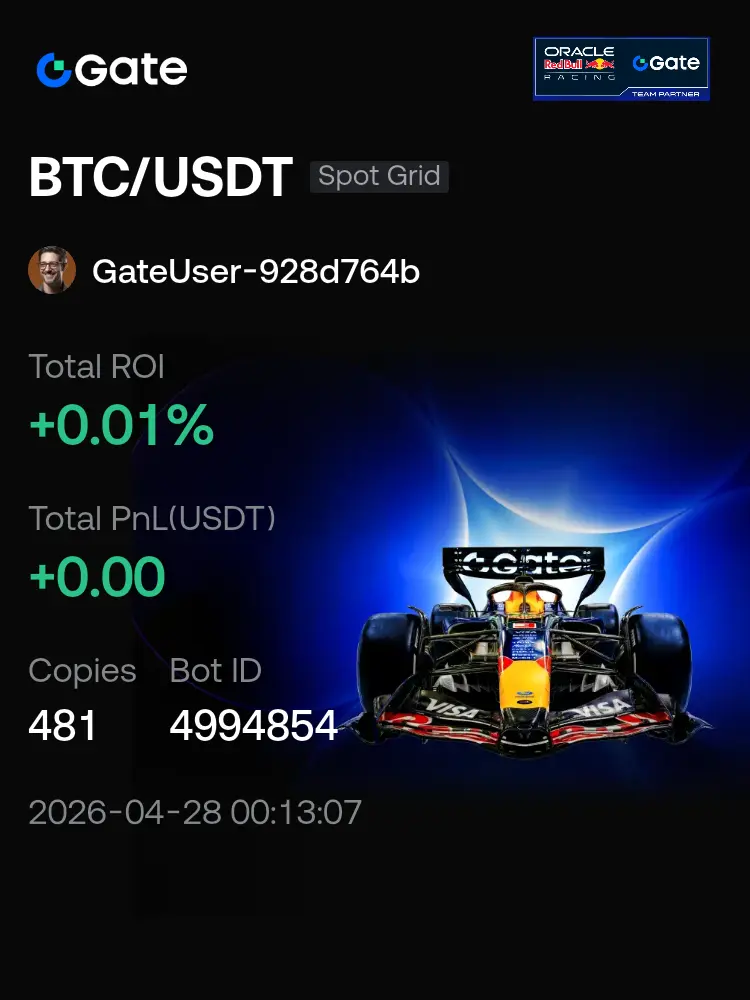
#Bots#I'm trading BTC/USDT with the Spot Grid bot on Gate. Join me!
BTC-1,72%
post-image
What price will Bitcoin hit in April?
↓ 75,000
1.79x
56%
↑ 80,000
1.92x
52%
$2.85M post.polymarket.volpost.polymarket.more
  • Reward
  • Comment
  • Repost
  • Share
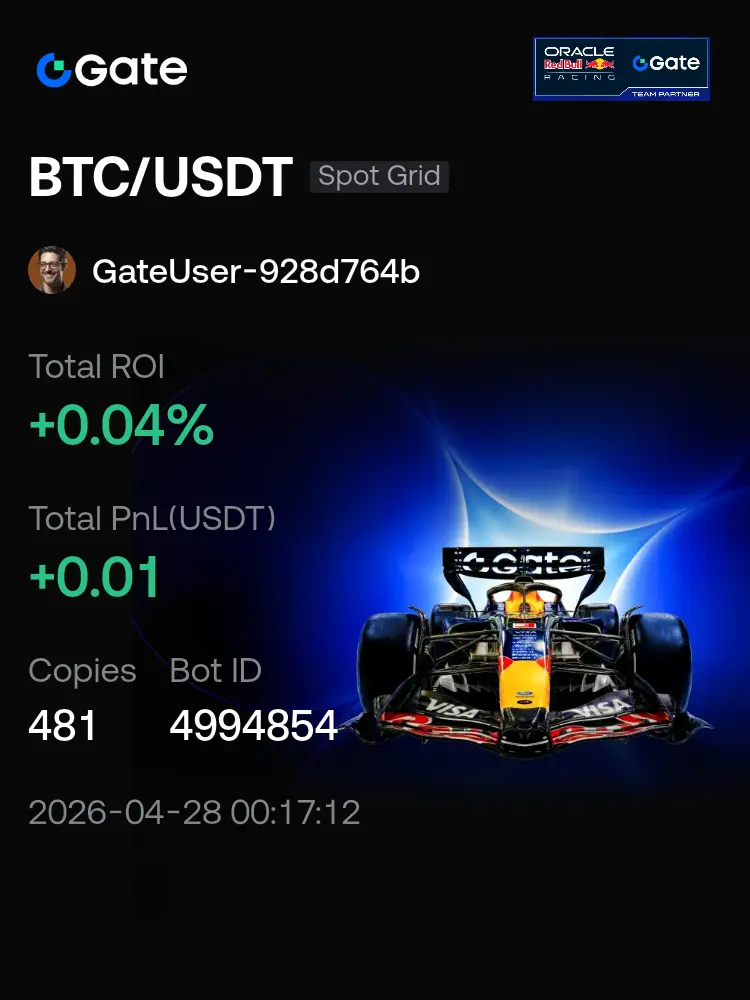
#Bots#I'm trading BTC/USDT with the Spot Grid bot on Gate. Join me!
BTC-1,72%
post-image
  • Reward
  • Comment
  • Repost
  • Share
I've joined WCTC S8. Join me now to compete and share 8,000,000 USDT. Trade beyond limits and conquer the future. https://www.gate.com/competition/wctc-s8?ref=VLURBGGKVG&ref_type=165&utm_cmp=qK2FsaYI
post-image
  • Reward
  • Comment
  • Repost
  • Share
ETH-3,37%
speakjustly
gate card links with google pay for fast daily payments, making commuting and spending with digital assets more seamless
#GT #BTC #ETH #SOL #gate
repost-content-media
  • Reward
  • Comment
  • Repost
  • Share
  • Reward
  • Comment
  • Repost
  • Share
  • Reward
  • Comment
  • Repost
  • Share
#TradingStrategiesInChoppyMarkets#
Dubai_Prince
#TradingStrategiesInChoppyMarkets
Trading Strategies in Choppy Markets: The Safe Harbor Plan for Defense, Survival, and Psychological Mastery
The cryptocurrency market is widely known for its volatility, but what truly tests a trader is not always sharp trends—it is the slow, frustrating, sideways movement where price oscillates within a range and creates the illusion of opportunity without delivering real direction. These choppy conditions often trap traders into overtrading, emotional decisions, and unnecessary losses. This comprehensive guide merges practical strategy with psychological discipline to help you not just survive, but operate intelligently in such markets
Understanding the Nature of Sideways Markets
Sideways markets occur when price moves between clearly defined support and resistance levels without forming a sustained trend. Price action becomes noisy, unpredictable, and filled with fake breakouts. What makes this phase dangerous is not the lack of movement, but the deceptive nature of small moves that appear meaningful but quickly reverse. Many traders misinterpret these minor fluctuations as trend beginnings, leading to repeated losses.
The key realization is simple: survival in these conditions depends less on activity and more on restraint. The best traders are not the most active—they are the most selective.
The Safe Harbor Plan: A Framework for Stability
The Safe Harbor Plan is built on one principle: capital preservation comes before profit. In choppy markets, your goal shifts from aggressive growth to controlled survival. This requires a structured defense system built on risk management, precision, and emotional control.
1. Defense Position: Protecting Capital First
Your defense level is your most important tool. It defines how much you are willing to lose and when you step away.
Reduced Risk Exposure:
In trending markets, risking 2–3% per trade might be acceptable. In sideways markets, this should drop to 1% or less, with total daily exposure capped around 3%. This ensures that a series of losses does not damage your account significantly.
Volatility-Based Position Sizing:
Using ATR (Average True Range), position sizes should adjust dynamically. Higher volatility means smaller positions. Lower volatility signals caution, as breakouts may be approaching.
Cooling-Off Rule:
After two consecutive losses, step away for at least two hours. After three losses, stop trading for the day. This rule alone prevents most emotional damage.
Technical Defense Levels:
Always define invalidation points before entering a trade. In range conditions, these should align with confirmed breaks of support or resistance—not random price levels.
Time-Based Exit Strategy:
If a trade does not move within 24–48 hours, exit. Sideways markets punish patience in stagnant positions.
Psychological Defense:
Know when to step away mentally. If frustration builds, your edge disappears. Walking away is not weakness—it is strategy.
2. Avoiding Wick Traps and False Moves
Wick traps are one of the biggest threats in choppy markets. These sudden spikes trigger stop losses before reversing direction.
Volatility Buffer Strategy:
Instead of placing stop losses exactly at support or resistance, use a buffer:
Bitcoin: ~2× ATR
Altcoins: ~2–3× ATR
This allows natural movement without premature stop-outs.
Multi-Timeframe Confirmation:
Always check higher, entry, and lower timeframes. A setup that looks valid on a small timeframe may be noise on a larger one.
Avoid Market Orders Near Key Levels:
Liquidity hunts are common. Use limit orders within the range instead of chasing breakouts.
Volume Confirmation:
Real breakouts come with strong volume. Weak volume often signals a fake move.
Patience-Based Entry:
Wait for breakout attempts to fail, then enter on retests. This reduces risk and increases probability.
Position Scaling:
Enter trades in parts rather than full size. This reduces exposure and improves flexibility.
3. Managing Anxiety Without Trading
The hardest part of sideways markets is doing nothing. The urge to trade becomes psychological pressure.
Reframing Mindset:
View sideways markets as recovery phases, not missed opportunities.
Engagement Without Risk:
Use paper trading, journaling, and backtesting instead of real trades.
Physical Reset:
Exercise, walking, and movement reduce stress and improve clarity.
Creative and Social Balance:
Engage in non-trading activities and connect with others to reduce isolation.
Process-Based Success:
Measure discipline, not profits. Winning in choppy markets means losing less.
Pre-Planned No-Trade Rules:
Define conditions where you will not trade before the week begins.
Urge Control:
Observe the impulse to trade without acting on it—it fades faster than you think.
Final Integration: The Real Edge
Defense, execution, and psychology must work together. Smaller risk allows wider stops, reducing unnecessary losses. Better mindset improves decision-making. Strong discipline ensures consistency.
The goal in choppy markets is not profit—it is survival.
Traders who protect capital during uncertain phases are the ones who capitalize when strong trends return. Markets constantly shift between trending and sideways conditions. Mastering both is what separates consistent traders from emotional ones.
Conclusion: The Safe Harbor Mindset
Choppy markets are not a barrier—they are a training ground. They expose weaknesses in discipline, patience, and emotional control. But they also offer an opportunity to refine your system and strengthen your mindset.
The Safe Harbor Plan teaches you when to act and when to stay still. It reminds you that not trading is a valid and often powerful decision. It transforms you from a reactive trader into a strategic one
In the end, success in trading is not about catching every move—it is about surviving every phase. Those who learn to navigate uncertainty with control and patience build the foundation for long-term profitability.
  • Reward
  • Comment
  • Repost
  • Share
#rsETHAttackUpdate#WCTCTradingKingPK
CryptoSuperMan
#rsETHAttackUpdate
THE BIGGEST DEFI HACK OF 2026 AND WHAT IT MEANS FOR ALL OF US
On April 18, 2026, the decentralized finance world woke up to a crisis that nobody wanted to believe was possible at this scale, but deep down everyone who has been in this space long enough knew was only a matter of time. KelpDAO, one of the most integrated liquid restaking protocols in the Ethereum ecosystem, was hit with an exploit so precise, so calculated, and so devastating in its downstream effects that it has fundamentally changed how the entire industry needs to think about cross-chain infrastructure, bridge security, and the hidden risks buried inside DeFi composability.
This is not just a story about one protocol losing money. This is a story about structural vulnerabilities that exist across the entire ecosystem, and every serious participant in this space needs to understand exactly what happened, how it happened, and what it means for the way you interact with DeFi going forward.
---
WHAT ACTUALLY HAPPENED ON APRIL 18
A major security breach hit Kelp DAO when an attacker drained 116,500 rsETH tokens from its LayerZero-powered cross-chain bridge, netting approximately 292 million dollars and claiming roughly 18 percent of rsETH's entire circulating supply, making this the largest decentralized finance exploit recorded in 2026.
To understand how this happened you need to understand what rsETH actually is and what role the bridge was playing. KelpDAO is a liquid restaking protocol that allows users to stake ETH and receive rsETH in return, a token that represents their staked position and can be used as collateral across lending protocols, earning yield while remaining usable across the broader DeFi ecosystem.
To move rsETH between different blockchains, KelpDAO relied on a bridge mechanism that locks tokens on one chain while issuing corresponding copies on another. An attacker exploited that setup by forging a transfer message that appeared valid, causing the system to approve the transfer even though the tokens were never actually taken out of the sending chain. In simple terms, new tokens were created without real backing.
---
THE TECHNICAL FLAW THAT MADE IT ALL POSSIBLE
This was not a brute force hack or a private key leak. The attacker exploited a flaw in the bridge configuration, specifically a 1 of 1 verification setup that acted as a single point of failure.
This meant the entire system trusted one validator to confirm whether cross-chain messages were legitimate. Once that trust was compromised, the attacker could forge instructions that the system accepted as real.
The contracts themselves worked exactly as designed. The failure was in what they were designed to trust.
---
HOW THE ATTACK UNFOLDED
The breach occurred rapidly, and although emergency controls were eventually activated, the response came too late to stop the damage.
Instead of dumping the stolen tokens on the market, the attacker used them as collateral on lending protocols, borrowing large amounts of ETH and other assets. This allowed them to extract real value without immediately crashing the price of the compromised asset.
By the time defensive measures were taken, the system was already holding collateral that had no real backing.
---
THE CONTAGION THAT SPREAD ACROSS DEFI
What makes this attack especially dangerous is how quickly it spread across the ecosystem. Lending protocols froze affected markets, other platforms paused related operations, and even protocols with no direct exposure took precautionary actions.
This is the reality of DeFi composability. Systems are deeply interconnected, and when one piece fails, the effects ripple outward rapidly.
The same structure that creates opportunity also creates systemic risk.
---
AAVE'S EXPOSURE AND THE BAD DEBT PROBLEM
One of the biggest impacts was on lending markets, where the attacker used unbacked rsETH as collateral to borrow significant amounts of real assets.
This created a situation where protocols were left holding liabilities backed by compromised collateral. Even though their systems functioned correctly, they were still exposed to losses.
Emergency freezes helped contain further damage, but they could not undo what had already happened.
---
WHAT USERS AND PROTOCOLS MUST LEARN
This attack highlights a critical truth: DeFi risk is not just about price volatility. It is about infrastructure risk.
Users must understand that holding or using assets in DeFi exposes them to risks in bridges, collateral systems, and protocol design.
Protocols must enforce stronger validation systems, eliminate single points of failure, and adopt more conservative risk management practices when integrating complex assets.
---
THIS IS NOT THE END OF DEFI, BUT IT IS A TURNING POINT
Every major exploit tests the strength of the ecosystem. Some failures break systems. Others force them to evolve.
The rsETH attack is severe, but it is also a moment of reckoning. The future of DeFi depends on whether builders and users take these lessons seriously.
Because this was not just a 292 million dollar exploit. It was a warning.
And what happens next will determine whether the next incident is smaller… or even bigger.
#rsETHAttackUpdate
  • Reward
  • Comment
  • Repost
  • Share
To further reward high-quality content, Gate Square has officially upgraded its Content Mining mechanism and launched the “Content Mining Revamp × Double Rewards” public beta. During the beta period, creators who publish content on Gate Square and drive real trades can share trading fee rebates of up to 60%, turning content into long-term income. Whether you’re a new trader, a content creator, or an active existing user, post content, drive trades, and earn ongoing rewards.
  • Reward
  • Comment
  • Repost
  • Share
To further reward high-quality content, Gate Square has officially upgraded its Content Mining mechanism and launched the “Content Mining Revamp × Double Rewards” public beta. During the beta period, creators who publish content on Gate Square and drive real trades can share trading fee rebates of up to 60%, turning content into long-term income. Whether you’re a new trader, a content creator, or an active existing user, post content, drive trades, and earn ongoing rewards.
CryptoEye
  • Reward
  • Comment
  • Repost
  • Share
Gate广场_Official
Traditional Finance Entry Gift Campaign
Complete tasks to unlock rewards, with a maximum of 1,020 USDT per person
🎉 Triple rewards are continuously available:
🪪 Open a TradFi trading account to receive 10 USDT
💱 Complete your first TradFi trade to receive another 10 USDT
🏆 Reach trading volume targets to share a 50,000 USDT prize pool
Seize market opportunities and easily allocate global assets 🌍
👉 Join now: https://www.gate.com/campaigns/4602
📢 Learn more: https://www.gate.com/announcements/article/50785
#Gate #TradFi
repost-content-media
  • Reward
  • 1
  • Repost
  • Share
BeautifulDay:
To The Moon 🌕
  • Pin