ShanxiFreeBrother

vip
Age 2.1 Yıl
Web3 Creator
No content yet
Let’s talk about the US-Iran situation: oil prices are steady as Mount Tai—behind the scenes, everyone is holding a big move
First, let’s talk about oil prices. Brent crude has again returned to above $100. Don’t be fooled by reports—circulating tonight or tomorrow—of a breakthrough in US-Iran negotiations; the market simply isn’t buying it at all. Why? Because the real standoff hasn’t stopped: Iran has just collected the first toll for passage through the Strait of Hormuz, and Trump immediately ordered warships to clear mines. The U.S. military has also claimed that it has deployed the strong
BTC-0,34%
ETH0,38%
View Original
  • Reward
  • Comment
  • Repost
  • Share
U.S.-Iran Situation and Federal Reserve Movements
1. U.S.-Iran Situation: Ceasefire Extended, Neither Side Wants to Fight
Trump announced an indefinite extension of the ceasefire with Iran, citing the need for internal Iran to unify its plans. The actual meaning is: as long as Iran doesn't propose a plan, the ceasefire remains in place. Iran also hinted that lifting the maritime blockade might be a prerequisite for negotiations.
Key points:
Both sides don't want to fight, but won't easily make concessions.
Iran's "denuclearization" is basically settled; the real game is the survival
BTC-0,34%
View Original
  • Reward
  • Comment
  • Repost
  • Share
Today's US-Iran situation has become tense again!
The US continues to apply pressure: the United States insists on not lifting the maritime blockade before reaching an "agreement," and may resort to force after the ceasefire expires. Trump also tweeted, "I am winning this war with overwhelming advantage, the military is performing perfectly"—but the public generally doesn't believe it.
Iran stands firm and refuses to back down: Supreme Leader Khamenei reiterated three points—demanding war reparations, pushing the Strait of Hormuz into a new management phase, and not abandoning the resistance f
BTC-0,34%
ETH0,38%
  • Reward
  • Comment
  • Repost
  • Share
Breaking! U.S. and Iran clash in the Gulf of Oman, commercial ships seized, drones retaliate, negotiations deadlocked
Just in the past 24 hours, U.S.-Iran tensions have sharply escalated:
1. Direct maritime conflict: A large cargo ship flying the Iranian flag, the "TUSKA" (departed from Zhuhai, China, carrying 80k tons of industrial goods and daily necessities), attempted to break through the U.S. military blockade in the Gulf of Oman. After six hours of persuasion without success, the U.S. forces opened fire and seized the ship. Iran's Revolutionary Guard promptly launched drone attacks on mu
BTC-0,34%
ETH0,38%
View Original
  • Reward
  • Comment
  • Repost
  • Share
The Middle East drama is more exciting than a TV series
On Friday, news broke that Israel and Lebanon had a temporary ceasefire, Hezbollah was willing to gradually disarm, and Iran announced the opening of the Strait of Hormuz. Brent crude oil instantly plummeted from $99 to $86, and the world breathed a sigh of relief.
As a result, Iran turned around and accused the U.S. of betrayal, re-blocking the strait. Trump exploded: Iran fired on British and French ships, threatening to destroy their power plants and bridges. Losing $500 million a day, neither side can bear it.
Interestingly, there are
BTC-0,34%
View Original
  • Reward
  • Comment
  • Repost
  • Share
The Strait of Hormuz Flips Overnight: It Was Just Announced as Open, Then It Was Blocked Again
Last night, the international crude oil market experienced a rollercoaster ride. Iran’s foreign minister announced that the Strait of Hormuz was open for passage, causing international oil prices to plummet by 13.3% in an instant. Trump issued multiple statements right after, celebrating the victory. But today the story has reversed—Iran’s military announced that, due to the US breaking its promises, control of the strait has been restored to the previous state, and strict controls are back in place.
BTC-0,34%
View Original
  • Reward
  • Comment
  • Repost
  • Share
The U.S. stock market hit new highs again, and the Iran situation also showed subtle changes.
First, let’s talk about U.S. stocks. The Nasdaq fell for three months, but within half a month, it surged back and set a new high. Why can U.S. stocks always climb back? The core isn’t the dollar or the U.S. military, but three underlying logics:
1. Global long-term inflation + population growth → the total consumption keeps rising, and most of the core companies in U.S. stocks do business worldwide, so their profits naturally rise with the tide.
2. A strong batch of the world’s top tech, consum
BTC-0,34%
View Original
  • Reward
  • Comment
  • Repost
  • Share
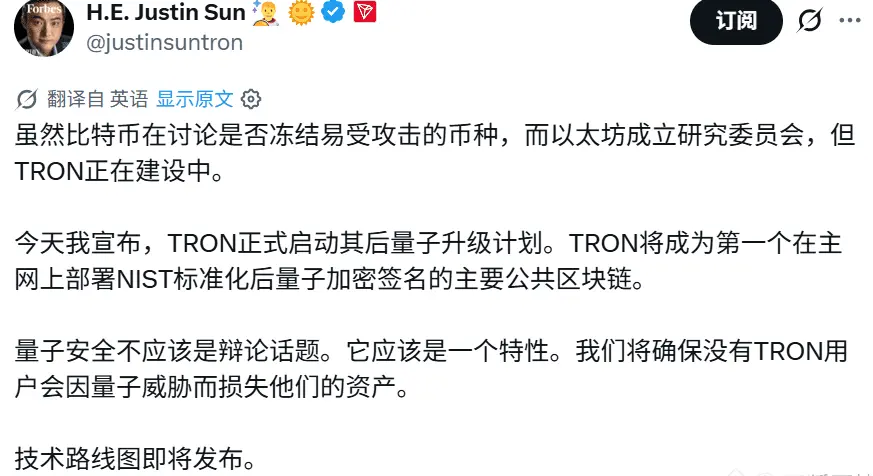
BTC/ETH is still arguing, TRON has already taken action
Bitcoin: Should we freeze vulnerable addresses? Start a three-month meeting first
Ethereum: Establish a research committee first, release a report next year
Tron: Quantum resistance upgrade officially launched, post-NIST standard quantum signatures, mainnet is live
Is this another replication of Brother Sun's past operational rhythm? Those who understand know. Has quantum security been adopted?
There’s a high probability that someone will shout “all scams,” but every time Brother Sun makes a move, smart money on the chain always pre-posit
BTC-0,34%
ETH0,38%
TRX-1,33%
View Original
post-image
  • Reward
  • Comment
  • Repost
  • Share
The "Spear" and "Shield" of US-Iran Negotiations: Will Iran Abandon the Arc of Resistance?
Recently, the US and Iran held talks in Oman and Islamabad, ostensibly about nuclear issues, but in fact hiding a more critical underlying thread—the Arc of Resistance.
First, let's talk about compensation. Iran demands reparations from five countries: Bahrain, Saudi Arabia, Qatar, the UAE, and Jordan, but not Kuwait. Some are curious, so they looked into it: during Iran's retaliatory bombings, Kuwait was hit the hardest. When both sides did the math, it roughly offset each other, which is quite interest
ETH0,38%
View Original
  • Reward
  • Comment
  • Repost
  • Share
Dissection of Global Geopolitical Wars
1. The number of U.S. military bases is indeed astonishing: 750-800 (including temporary facilities), covering over 80 countries. This is no longer just military presence but a global control network. Many believe that U.S. deployment around Iran is normal, but in reality, very few countries can exert comprehensive military pressure on a major power thousands of miles away.
2. The U.S. has itself facilitated Iran's rise: Bush Jr. overthrowing Saddam was like pulling out a nail from Iran's western flank. Originally, Iran and Iraq restrained each other; now
BTC-0,34%
ETH0,38%
View Original
  • Reward
  • Comment
  • Repost
  • Share
WLFI and Justin Sun have a falling out!
WLFI said that Justin Sun habitually uses the "playing the victim" tactic to cover up issues, claiming to have contracts and evidence, and will see him in court.
Justin Sun responded in kind: accusing WLFI of secretly implanting backdoors, arbitrarily freezing user funds, and treating the community as an ATM, demanding the other party come forward with real names and take responsibility as the largest investor.
Both sides are speaking quite harshly, one claims to have "evidence," the other calls themselves the "victim + major backer."
Who is real
WLFI-2,91%
TRX-1,33%
View Original
  • Reward
  • Comment
  • Repost
  • Share
The core logic of the Iran-U.S. conflict:
1. The nuclear issue is a deadlock: Iran wants the right to enrich uranium for civilian use, but the U.S. (especially Israel and Sunni neighboring countries) will never allow Shia to develop nuclear potential. This is the biggest disagreement in negotiations; the killing of Soleimani was also related to this.
2. The Strait of Hormuz is the chessboard: the U.S. wants to "co-manage" or blockade it, Iran wants to charge tolls for passage. From the U.S. perspective, maintaining Iran's threat to the Gulf monarchs but keeping it controllable best serves its
BTC-0,34%
View Original
  • Reward
  • Comment
  • Repost
  • Share
The negotiation situation between Iran and the U.S. in Islamabad can be summarized into these key points:
1. The negotiation process has been unpredictable: Initially, the two sides did not even meet face-to-face, with Pakistan acting as an intermediary, and each session lasting 1-2 hours. But later, CCTV reported that both sides are "sitting at the same table" and beginning direct talks.
2. Iran set tough preconditions: Iran proposed non-negotiable demands, including full control of the Strait of Hormuz, unconditional unfreezing of all frozen assets by the U.S., payment of war reparations, an
ZEC9,46%
View Original
  • Reward
  • 1
  • Repost
  • Share
GoldLove:
DYOR 🤓
Iran’s hardline message: If you don’t pay, then the strait is blocked
Iran’s recent statement has a pretty intense tone, with three key points:
1. Demand compensation—seek war reparations and the blood-debt of martyrs from the invaders; in plain terms, it’s about making the opponent pay.
2. Take control of the strait— the Strait of Hormuz is entering a new phase; it likely means more forceful control over this global oil lifeline.
3. Huddle up and act together— all resistance fronts unify to settle accounts, not fighting alone.
Don’t want to fight, but don’t mess with me; pay compens
XAU0,29%
View Original
  • Reward
  • Comment
  • Repost
  • Share
These past few days, the news has been overwhelming, with reports of a US-Iran ceasefire, the reopening of the Strait of Hormuz, Israel's intense strikes on Hezbollah, and Trump talking about joint management of the strait... The information explosion is intense. I'll briefly sort through it and share some of my own judgments.
1. The ceasefire is real, but extremely fragile
On Wednesday morning at 8 a.m., the US and Iran reached a 14-day temporary ceasefire, and Hormuz agreed to reopen. The global markets took a big breath of relief, and oil prices also fell. But before that breath was even ta
BTC-0,34%
View Original
  • Reward
  • Comment
  • Repost
  • Share
1. How did the ceasefire come about? Mainly because Pakistan desperately mediated, and finally China stepped in at a critical moment, leading Iran to agree to a two-week ceasefire. Even Trump acknowledged that China played a major role.
2. Iran announced a "victory," listing 8 demands, such as the US paying compensation, withdrawing from the Middle East, lifting all sanctions, and recognizing Iran's control of the Strait... But honestly, the US probably won't agree to any of these conditions, and Iran is just shouting slogans internally.
3. Israel is unhappy, wanting to continue bombing, feeli
BTC-0,34%
XTIUSD5,23%
View Original
  • Reward
  • Comment
  • Repost
  • Share
Tonight at 8 PM Eastern Time, the verdict will be out, and oil prices might surge first
Brothers, this final ultimatum from Iran and the U.S. is no joke
XTI-1,98%
View Original
  • Reward
  • Comment
  • Repost
  • Share
Everyone's first reaction to rising oil prices is that inflation is coming, and the central bank will raise interest rates.
This oil price shock isn't due to excessive demand but rather supply being blocked (like the Strait of Hormuz).
While central bank rate hikes can suppress demand, they can't increase oil supply. In fact, high oil prices are essentially a tax increase on households and businesses, which will drag down consumption and investment.
Historically, in 1973, 2008, and 2011, there were similar patterns: central banks focused on rising oil prices and raised rates, only to be quickl
XTI-1,98%
View Original
  • Reward
  • Comment
  • Repost
  • Share
🇮🇷🇺🇸 Last 48 hours of the Iran situation: Just one breath away—fight or talk?
Key Turning Points
Trump’s “10-day ultimatum” was originally set to expire today, with plans to bomb Iran’s infrastructure on April 6.
But he suddenly said, “A ceasefire might be reached,” pushing it back to April 7—final clarity will come in the last 24 hours.
Ceasefire Proposal: Islamabad Agreement (pushed by Pakistan)
Phase 1: Immediate ceasefire + Iran opens the Strait of Hormuz + the US and Israel stop bombing
Phase 2: Face-to-face negotiations within 15–20 days to swap for a long-term ceasefire
Th
View Original
  • Reward
  • Comment
  • Repost
  • Share
72 Transformations! The US-Iran Situation
First, the main point: someone is mediating a ceasefire.
Pakistan has proposed a plan, aiming for both sides to cease fire first, reopen the Strait of Hormuz, and then negotiate a final agreement within 15 to 20 days—probably Iran promises not to develop nuclear weapons in exchange for the US lifting sanctions and unfreezing assets.
But Iran immediately “dampened the enthusiasm”:
They won’t accept a deadline, and don’t expect pressure.
They won’t open the strait just for a “temporary ceasefire.”
They openly state that the US is not ready for a “permane
BTC-0,34%
ETH0,38%
View Original
  • Reward
  • Comment
  • Repost
  • Share
  • Pin