#USMilitaryMaduroBettingScandal
The US Military Maduro Betting Scandal and Its Crypto Market Shockwaves:
The so-called US Military Maduro Betting Scandal has rapidly evolved into one of the most controversial intersections of geopolitics, military intelligence, decentralized prediction markets, and cryptocurrency speculation, raising not only legal and ethical questions but also forcing the entire crypto ecosystem to confront a difficult reality: what happens when real-world classified information collides with permissionless financial systems that never sleep.
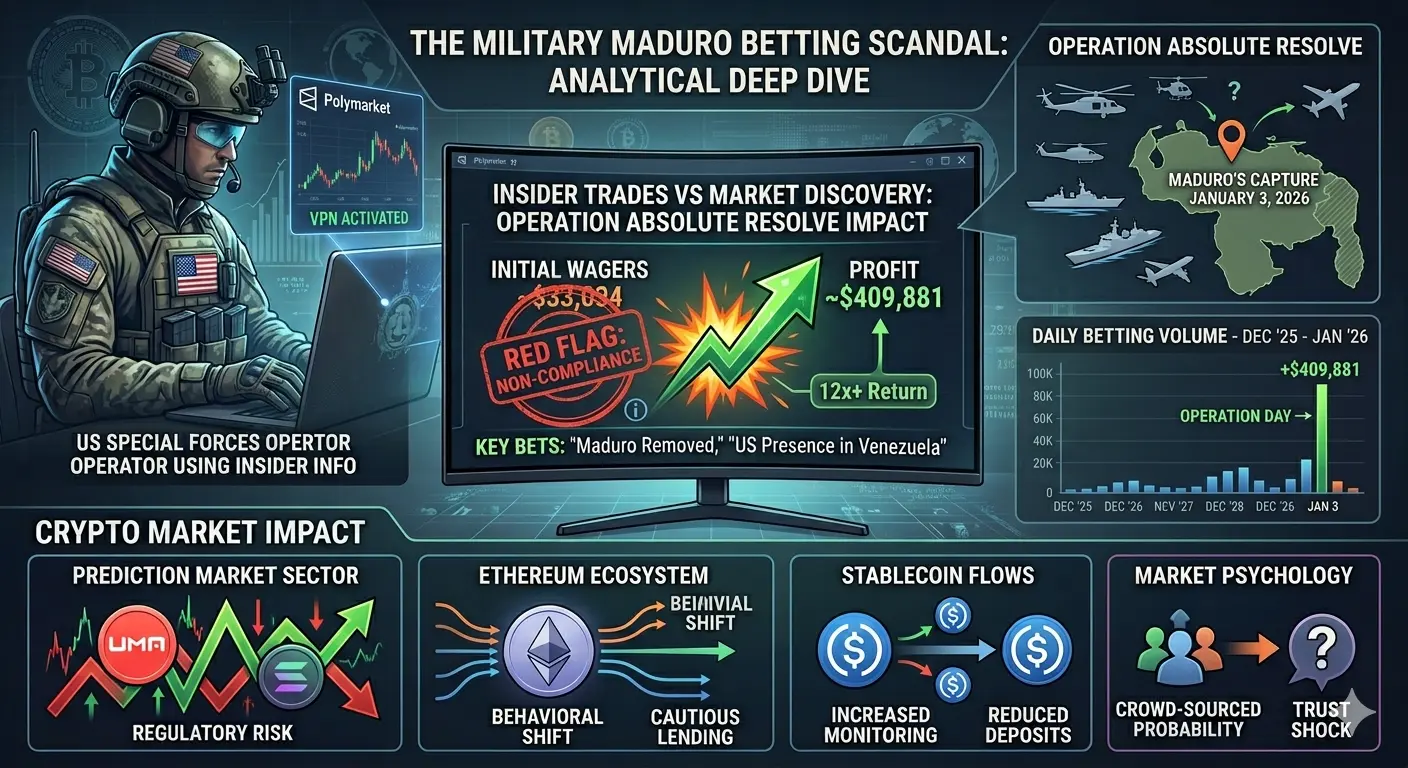
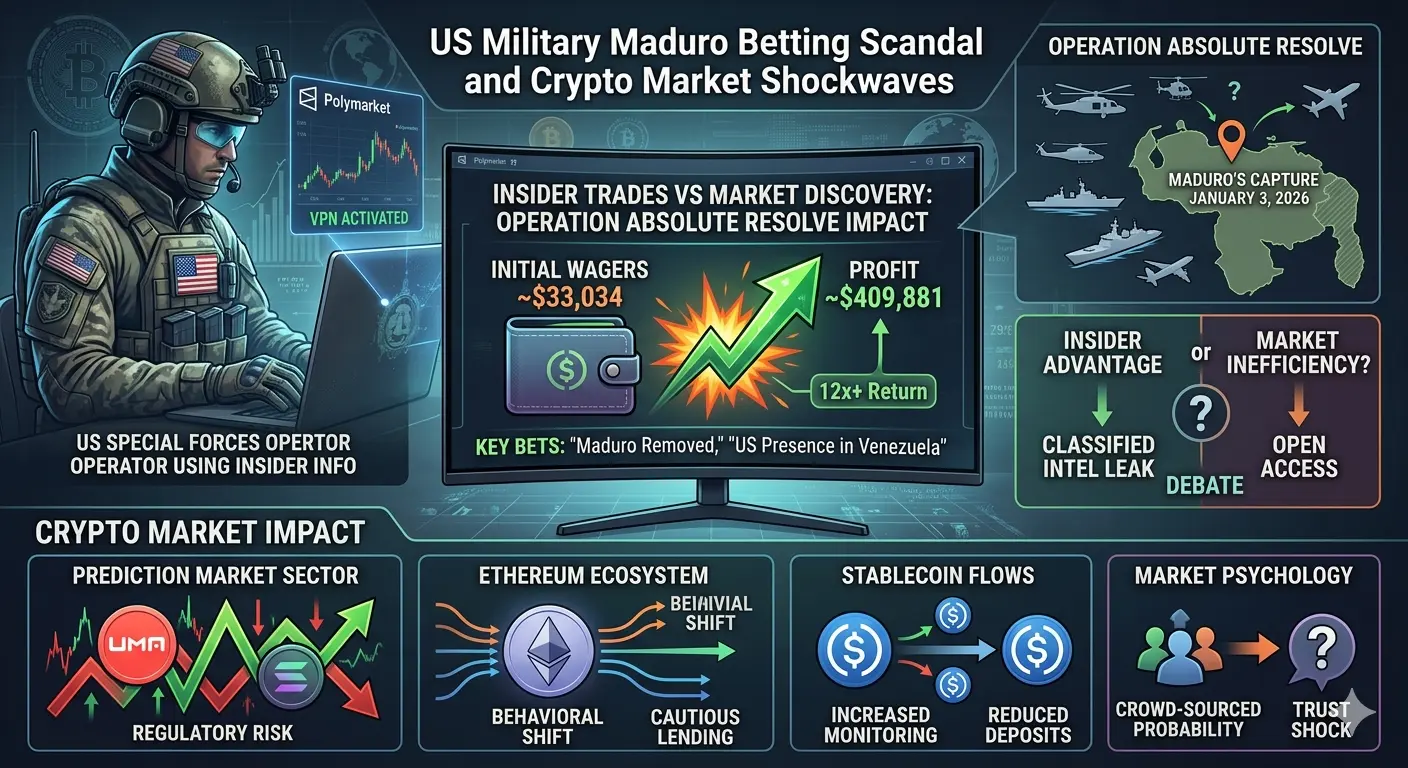
At the center of the controversy lies an extraordinary allegation that a U.S. Special Forces soldier allegedly transformed approximately $33,034 in total wagers into nearly $409,881 in profit, by placing strategic bets on a crypto-based prediction platform (Polymarket) linked to geopolitical outcomes surrounding a covert military operation against Venezuelan President Nicolás Maduro.
1. The Core Event: From Classified Operation to Market Catalyst
The turning point of this entire narrative begins with Operation Absolute Resolve, a highly sensitive and coordinated U.S. military mission reportedly executed on January 3, 2026, involving elite units such as Special Forces, Delta Force, Navy SEALs, Marines, Air Force support, cyber warfare teams, and intelligence divisions, operating in a synchronized, multi-domain strike environment involving more than 150 aircraft and advanced electronic warfare systems.
The mission allegedly resulted in the swift capture and extraction of Nicolás Maduro and Cilia Flores, a development that was later publicly acknowledged at the highest political level, immediately reshaping geopolitical expectations and triggering shockwaves across both traditional financial markets and crypto-native prediction platforms.
However, the scandal does not revolve around the military operation itself, but rather what allegedly happened before the operation became public knowledge.
2. The Alleged Betting Structure and Exact Financial Exposure
According to investigative filings, Master Sergeant Gannon Ken Van Dyke allegedly accessed non-public operational intelligence and used it to place approximately 13 separate trades on prediction markets between late December 2025 and January 2026.
The financial structure of these trades is critical:
Total capital deployed: ~$33,034
Platform: Polymarket (via VPN and multiple accounts)
Strategy: concentrated “YES” positions on low-probability geopolitical outcomes
Key contracts reportedly included:
“Maduro removed by January 31, 2026”
“U.S. military presence in Venezuela confirmed”
“U.S. invasion-related probability markets”
“War Powers authorization involving Venezuela”
At the time of entry, these markets were priced with extremely low implied probabilities—some reportedly near 6% or even lower, meaning YES shares were heavily discounted and only profitable under rare or extreme geopolitical escalation.
When the operation succeeded and markets resolved accordingly, the outcome was explosive:
Total payout: ~$442,915
Net profit: ~$409,881
Return multiple: approximately 12x to 13x+ overall capital efficiency
This kind of return is rare even in crypto markets, and almost unheard of in traditional finance, which is why it immediately triggered both fascination and regulatory alarm.
3. The Core Debate: Insider Advantage or Market Inefficiency?
This is where the controversy becomes intellectually and financially complex.
One argument suggests:
If prediction markets are truly efficient, then any correct foresight—regardless of source—should be rewarded by price discovery.
However, the opposing argument is far stronger from a regulatory standpoint:
If the foresight comes from classified military intelligence, then the market is no longer reflecting public probability—it is reflecting privileged access, which destroys fairness and market integrity.
This creates a fundamental contradiction in decentralized systems:
Crypto ideology promotes open access and permissionless participation
Regulatory frameworks demand fairness and equal information distribution
When these two collide, as allegedly seen in this case, the entire structure becomes legally and ethically unstable.
4. Crypto Market Impact: Beyond Prediction Markets
While the scandal did not directly crash Bitcoin or Ethereum, it created secondary ripple effects across the crypto ecosystem, particularly in sentiment-sensitive and infrastructure-related assets.
A. Prediction Market Sector Pressure
Tokens and protocols associated with decentralized forecasting systems, including governance and dispute-resolution layers such as UMA, experienced increased volatility pressure as traders began pricing in regulatory intervention risk and potential legal restructuring of event-based markets.
Even without direct selling pressure, valuation models shifted because investors started discounting future adoption assumptions, replacing them with uncertainty premiums linked to compliance risk.
B. Ethereum Ecosystem Reaction
Since most prediction markets operate on Ethereum-based infrastructure, the broader ETH ecosystem experienced a subtle behavioral shift:
Reduced speculative flow into high-risk event trading
Temporary slowdown in aggressive on-chain betting activity
Slight reallocation of liquidity toward more stable DeFi strategies
Ethereum itself remained structurally stable, but the risk appetite layer of the ecosystem clearly contracted, showing how narrative shocks can influence capital behavior without triggering price collapse.
C. Stablecoin Flow Disruption
A less visible but highly important effect occurred in stablecoin circulation patterns, particularly USDC-based betting flows.
Reduced deposits into prediction markets
More cautious capital deployment into geopolitical contracts
Increased monitoring of transaction flows by compliance teams
This reflects a broader structural truth:
Prediction markets are not isolated gambling tools—they are liquidity sinks connected to the entire crypto settlement layer.
5. Market Psychology Shift: The Trust Shock
Perhaps the most important impact was not price-based but psychological.
Before the scandal:
Traders treated prediction markets as crowd-sourced probability engines
Risk was primarily seen as volatility-driven
After the scandal:
Traders began questioning whether probabilities are truly “crowd-derived”
Fear of hidden informational advantages increased
Confidence in fairness of geopolitical contracts weakened
This shift changes behavior permanently because crypto markets are heavily narrative-driven, and once trust assumptions break, they are difficult to restore.
6. Wider Regulatory and Structural Consequences
Regulators across multiple jurisdictions responded rapidly:
Increased scrutiny from the CFTC
Legal disputes between federal and state authorities in the U.S.
Brazil blocking 27 prediction platforms, restricting political and war-related contracts
Global push toward tighter KYC, geofencing, and contract restrictions
This suggests a future where prediction markets may evolve into:
Highly regulated forecasting tools
Or fragmented offshore speculative ecosystems
The direction depends on whether regulators prioritize innovation or risk containment.
7. Final Analytical Debate: Innovation vs Control
This scandal forces the crypto industry into a deep philosophical conflict:
On one side:
Prediction markets are powerful truth engines
They transform information into price discovery
They democratize forecasting globally
On the other side:
They are vulnerable to insider asymmetry
They can be influenced by non-public intelligence
They may unintentionally monetize classified knowledge
The Maduro betting case becomes a real-world stress test of this contradiction.
8. Conclusion
The alleged transformation of ~$33,034 into ~$409,881 profit is not just a financial anomaly—it is a symbolic event representing the collision of three systems:
Military intelligence operations
Decentralized crypto prediction markets
Global regulatory enforcement frameworks
While Bitcoin and Ethereum did not experience direct structural shocks, the broader crypto ecosystem absorbed a clear sentiment shift toward caution, compliance awareness, and reduced appetite for politically sensitive speculation.
Ultimately, this case demonstrates a critical truth about modern crypto markets:
In decentralized systems, information is no longer just power—it is liquidity, and when that information is asymmetric at a state level, even “free markets” begin to lose their definition of fairness.
The US Military Maduro Betting Scandal and Its Crypto Market Shockwaves:
The so-called US Military Maduro Betting Scandal has rapidly evolved into one of the most controversial intersections of geopolitics, military intelligence, decentralized prediction markets, and cryptocurrency speculation, raising not only legal and ethical questions but also forcing the entire crypto ecosystem to confront a difficult reality: what happens when real-world classified information collides with permissionless financial systems that never sleep.
At the center of the controversy lies an extraordinary allegation that a U.S. Special Forces soldier allegedly transformed approximately $33,034 in total wagers into nearly $409,881 in profit, by placing strategic bets on a crypto-based prediction platform (Polymarket) linked to geopolitical outcomes surrounding a covert military operation against Venezuelan President Nicolás Maduro.
1. The Core Event: From Classified Operation to Market Catalyst
The turning point of this entire narrative begins with Operation Absolute Resolve, a highly sensitive and coordinated U.S. military mission reportedly executed on January 3, 2026, involving elite units such as Special Forces, Delta Force, Navy SEALs, Marines, Air Force support, cyber warfare teams, and intelligence divisions, operating in a synchronized, multi-domain strike environment involving more than 150 aircraft and advanced electronic warfare systems.
The mission allegedly resulted in the swift capture and extraction of Nicolás Maduro and Cilia Flores, a development that was later publicly acknowledged at the highest political level, immediately reshaping geopolitical expectations and triggering shockwaves across both traditional financial markets and crypto-native prediction platforms.
However, the scandal does not revolve around the military operation itself, but rather what allegedly happened before the operation became public knowledge.
2. The Alleged Betting Structure and Exact Financial Exposure
According to investigative filings, Master Sergeant Gannon Ken Van Dyke allegedly accessed non-public operational intelligence and used it to place approximately 13 separate trades on prediction markets between late December 2025 and January 2026.
The financial structure of these trades is critical:
Total capital deployed: ~$33,034
Platform: Polymarket (via VPN and multiple accounts)
Strategy: concentrated “YES” positions on low-probability geopolitical outcomes
Key contracts reportedly included:
“Maduro removed by January 31, 2026”
“U.S. military presence in Venezuela confirmed”
“U.S. invasion-related probability markets”
“War Powers authorization involving Venezuela”
At the time of entry, these markets were priced with extremely low implied probabilities—some reportedly near 6% or even lower, meaning YES shares were heavily discounted and only profitable under rare or extreme geopolitical escalation.
When the operation succeeded and markets resolved accordingly, the outcome was explosive:
Total payout: ~$442,915
Net profit: ~$409,881
Return multiple: approximately 12x to 13x+ overall capital efficiency
This kind of return is rare even in crypto markets, and almost unheard of in traditional finance, which is why it immediately triggered both fascination and regulatory alarm.
3. The Core Debate: Insider Advantage or Market Inefficiency?
This is where the controversy becomes intellectually and financially complex.
One argument suggests:
If prediction markets are truly efficient, then any correct foresight—regardless of source—should be rewarded by price discovery.
However, the opposing argument is far stronger from a regulatory standpoint:
If the foresight comes from classified military intelligence, then the market is no longer reflecting public probability—it is reflecting privileged access, which destroys fairness and market integrity.
This creates a fundamental contradiction in decentralized systems:
Crypto ideology promotes open access and permissionless participation
Regulatory frameworks demand fairness and equal information distribution
When these two collide, as allegedly seen in this case, the entire structure becomes legally and ethically unstable.
4. Crypto Market Impact: Beyond Prediction Markets
While the scandal did not directly crash Bitcoin or Ethereum, it created secondary ripple effects across the crypto ecosystem, particularly in sentiment-sensitive and infrastructure-related assets.
A. Prediction Market Sector Pressure
Tokens and protocols associated with decentralized forecasting systems, including governance and dispute-resolution layers such as UMA, experienced increased volatility pressure as traders began pricing in regulatory intervention risk and potential legal restructuring of event-based markets.
Even without direct selling pressure, valuation models shifted because investors started discounting future adoption assumptions, replacing them with uncertainty premiums linked to compliance risk.
B. Ethereum Ecosystem Reaction
Since most prediction markets operate on Ethereum-based infrastructure, the broader ETH ecosystem experienced a subtle behavioral shift:
Reduced speculative flow into high-risk event trading
Temporary slowdown in aggressive on-chain betting activity
Slight reallocation of liquidity toward more stable DeFi strategies
Ethereum itself remained structurally stable, but the risk appetite layer of the ecosystem clearly contracted, showing how narrative shocks can influence capital behavior without triggering price collapse.
C. Stablecoin Flow Disruption
A less visible but highly important effect occurred in stablecoin circulation patterns, particularly USDC-based betting flows.
Reduced deposits into prediction markets
More cautious capital deployment into geopolitical contracts
Increased monitoring of transaction flows by compliance teams
This reflects a broader structural truth:
Prediction markets are not isolated gambling tools—they are liquidity sinks connected to the entire crypto settlement layer.
5. Market Psychology Shift: The Trust Shock
Perhaps the most important impact was not price-based but psychological.
Before the scandal:
Traders treated prediction markets as crowd-sourced probability engines
Risk was primarily seen as volatility-driven
After the scandal:
Traders began questioning whether probabilities are truly “crowd-derived”
Fear of hidden informational advantages increased
Confidence in fairness of geopolitical contracts weakened
This shift changes behavior permanently because crypto markets are heavily narrative-driven, and once trust assumptions break, they are difficult to restore.
6. Wider Regulatory and Structural Consequences
Regulators across multiple jurisdictions responded rapidly:
Increased scrutiny from the CFTC
Legal disputes between federal and state authorities in the U.S.
Brazil blocking 27 prediction platforms, restricting political and war-related contracts
Global push toward tighter KYC, geofencing, and contract restrictions
This suggests a future where prediction markets may evolve into:
Highly regulated forecasting tools
Or fragmented offshore speculative ecosystems
The direction depends on whether regulators prioritize innovation or risk containment.
7. Final Analytical Debate: Innovation vs Control
This scandal forces the crypto industry into a deep philosophical conflict:
On one side:
Prediction markets are powerful truth engines
They transform information into price discovery
They democratize forecasting globally
On the other side:
They are vulnerable to insider asymmetry
They can be influenced by non-public intelligence
They may unintentionally monetize classified knowledge
The Maduro betting case becomes a real-world stress test of this contradiction.
8. Conclusion
The alleged transformation of ~$33,034 into ~$409,881 profit is not just a financial anomaly—it is a symbolic event representing the collision of three systems:
Military intelligence operations
Decentralized crypto prediction markets
Global regulatory enforcement frameworks
While Bitcoin and Ethereum did not experience direct structural shocks, the broader crypto ecosystem absorbed a clear sentiment shift toward caution, compliance awareness, and reduced appetite for politically sensitive speculation.
Ultimately, this case demonstrates a critical truth about modern crypto markets:
In decentralized systems, information is no longer just power—it is liquidity, and when that information is asymmetric at a state level, even “free markets” begin to lose their definition of fairness.