
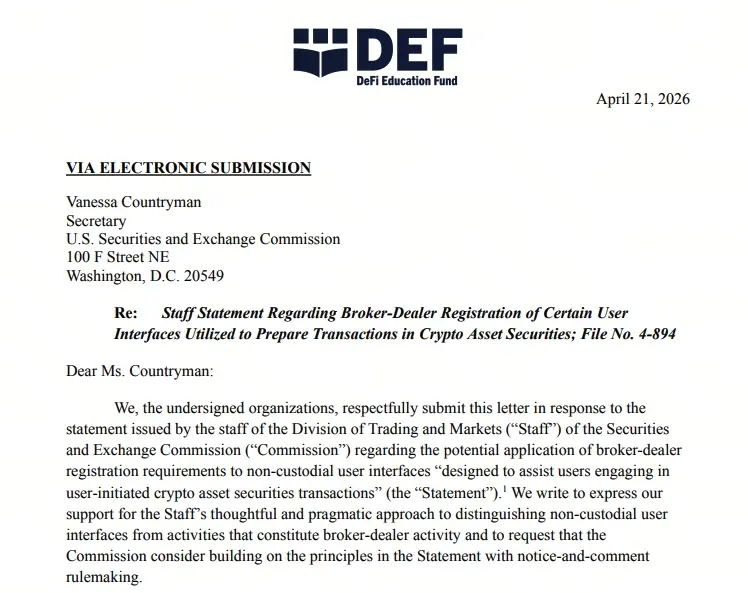
The DeFi Education Fund, together with more than 30 crypto industry organizations, on April 21 submitted a joint letter to the U.S. Securities and Exchange Commission (SEC), urging the SEC to adopt a formal rulemaking process under the “notice-and-comment” framework, converting the current staff statements regarding decentralized tools into official rules with lasting effect.
Key demands of the joint letter
(Source: DeFi Education Fund)
According to the joint letter submitted by the DeFi Education Fund on April 21, the coalition asks the SEC, based on the existing staff statements, to adopt a principles-based framework and set clear, objective standards for how the definition of “broker” applies in decentralized markets.
The letter directly quotes: “Therefore, we hereby urge the Commission to adopt a rulemaking process under the ‘notice-and-comment’ framework, further refining the applicable rules based on the statement.”
The letter further adds: “Specifically, the Commission should consider adopting a principles-based framework to provide clear, objective standards on what activities fall within the scope of the ‘broker’ definition, and to further refine the standards mentioned in the statement.”
At the conclusion of the letter, the coalition calls on the SEC to establish a “durable and technically neutral” regulatory framework, and warns in the letter that current regulatory ambiguity will stifle blockchain innovation and reduce the efficiency with which investors enter the market.
Relevant regulatory framework: Dispute over the “broker” definition and the regulatory subject
According to the joint letter, the core of the dispute is the boundary of how the term “broker” in the Securities Exchange Act applies in decentralized markets. The coalition argues that infrastructure providers—such as validators, data service providers, and communications network providers—should be clearly distinguished in the regulatory sense from intermediary entities that actively participate in trade matching.
In the letter, the coalition emphasizes that the current staff guidance lacks the lasting force of formal rules. The SEC should provide long-term regulatory certainty to the industry through a formal rulemaking process and limit the scope for reinterpreting the relevant provisions in the future.
SEC Commissioner Peirce’s public stance
Based on the SEC Commissioner Hester Peirce’s public statement, she is calling for permanent reform of the “broker” rules to reflect the market structure realities of decentralized technology. Commissioner Peirce noted that the current traditional “broker” definition may lead to the misclassification of software providers and participants in blockchain infrastructure.
Frequently asked questions
What is the specific date of the DeFi Education Fund’s letter to the SEC, and how many organizations signed on?
According to the letter, the DeFi Education Fund (DeFi Education Fund) submitted a joint letter to the SEC on April 21, 2026. More than 30 organizations signed on, covering businesses and organizations in the crypto industry, while the remaining organizations signed as independent supporters.
What procedure does the letter ask the SEC to use to convert DeFi guidance into formal rules?
According to the joint letter, the coalition explicitly requires the SEC to adopt a formal rulemaking process under “notice-and-comment,” to replace the current statements that are only advisory in nature and lack lasting effect.
What is Commissioner Peirce’s public position on the DeFi regulatory framework?
According to Commissioner Peirce’s public statement, she supports permanent reform of the “broker” definition to better adapt to decentralized technology, and指出 that the current definition may lead to incorrect regulatory classifications of software providers and blockchain infrastructure providers.
Disclaimer: The information on this page may come from third parties and does not represent the views or opinions of Gate. The content displayed on this page is for reference only and does not constitute any financial, investment, or legal advice. Gate does not guarantee the accuracy or completeness of the information and shall not be liable for any losses arising from the use of this information. Virtual asset investments carry high risks and are subject to significant price volatility. You may lose all of your invested principal. Please fully understand the relevant risks and make prudent decisions based on your own financial situation and risk tolerance. For details, please refer to
Disclaimer.
Related Articles
Declare Your Crypto or Face Jail: South Africa’s Aggressive New Capital Flow Rules
South Africa’s proposed capital flow management regulations 2026 introduce strict new requirements for travelers entering or leaving South Africa with cryptocurrency.
Key Takeaways
South African Treasury draft rules require visitors to declare crypto or face up to 5 years in prison.
New 2026 cap
Coinpedia7h ago
U.S. OCC Sets Draft Framework for Stablecoin Issuers Under GENIUS Act Framework
OCC draft sets federal rules for stablecoin issuers and custody services, focusing on safety and regulatory compliance.
Proposal excludes AML and sanctions rules, leaving those areas for separate coordination with Treasury agencies.
Framework marks initial step in multi-agency
CryptoFrontNews9h ago
Tether freezes $344 million in USDT on the Tron network: OFAC collaboration, two addresses implicated in sanctions evasion
According to a Decrypt 4/23 report, stablecoin issuer Tether froze two wallets on the Tron chain that day, totaling $344 million USDT—one of the largest single-instance freezing actions in Tether’s history. The entity coordinating the action did so in conjunction with the U.S. Treasury Department’s Office of Foreign Assets Control (OFAC) and U.S. law enforcement agencies. The two addresses were marked as allegedly involved in sanctions evasion, criminal networks, or other illegal activities.
Two Tron addresses total $344 million USDT frozen
Decrypt cites Tether data, saying that this freeze was concentrated on the Tron network, broken down into the following two transactions:
Address (prefix) Frozen amount Chain TNiq9…QZH81 About $213 million USDT Tron
ChainNewsAbmedia9h ago
JPMorgan: DeFi hackers are increasingly common, and interest in compression mechanisms to address TVL stagnation is drawing capital into USDT
JPMorgan Chase’s report believes that DeFi continues to face ongoing vulnerabilities, cross-chain bridge and oracle attacks are frequent, causing TVL to stagnate and weakening institutional investors’ willingness to invest, with capital shifting to USDT that is traceable and can be frozen. The KelpDAO and Rhea Finance attacks reveal risk-management risks; centralized stablecoins and custodial solutions are more favored. In the long run, improving this will require going beyond insurance and governance. DeFi will not be able to return to the 2021 era of high TVL, and stablecoins will become even more concentrated.
ChainNewsAbmedia9h ago
Tether Freezes $344M in USDT on Tron Blockchain in Coordination with OFAC
Gate News message, April 23 — Tether froze two large whale wallets on the Tron blockchain holding a combined $344 million in USDT on Wednesday in coordination with the U.S. Treasury's Office of Foreign Assets Control (OFAC) and U.S. law enforcement. The two addresses held approximately $131.3 millio
GateNews11h ago


