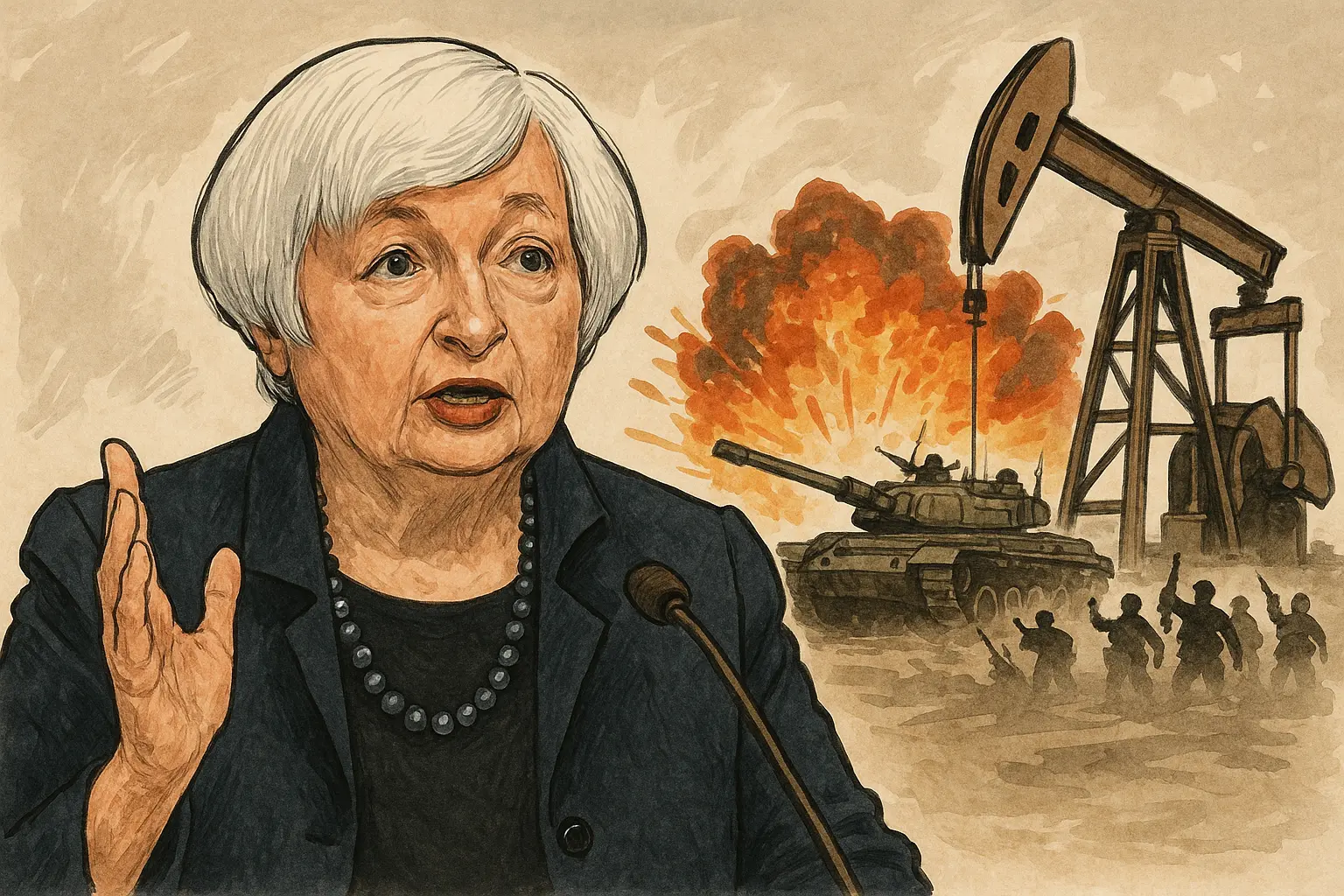
U.S. Treasury Secretary and former Federal Reserve Chair Janet Yellen (Janet Yellen) said on April 15 at the HSBC Global Investment Summit in Hong Kong that she still believes it is “entirely possible” for the Federal Reserve to cut interest rates later this year, despite ongoing supply shocks triggered by six weeks of the Iran war, which are creating upward pressure on the outlook for inflation. Yellen also issued a strong warning about the Trump administration’s political pressure on the Federal Reserve, saying, “I have never seen such a serious threat against the Federal Reserve.”
Yellen’s Rate-Cut Forecast: “Most Likely” by Year-End, But With Many Variables
In her speech, Yellen said that if she had to make a prediction at the next Federal Open Market Committee (FOMC) meeting, her guess would be that a rate cut could be rolled out later this year. “I think it’s entirely possible, and it’s also the most likely scenario. But a lot of things can happen.”
At present, the Federal Reserve’s benchmark interest rate remains in the target range of 3.50% to 3.75%. Most officials at the March FOMC meeting believe it would be appropriate to cut rates at least once this year. However, the market stance has shifted dramatically—traders have largely pulled back their bets on rate cuts for this year, a stark contrast to the expectations of about two cuts earlier this year. Yellen’s forecast diverges from current market sentiment. She believes that stable long-term inflation expectations keep the need for rate hikes quite low, but the biggest uncertainty in the inflation outlook lies in the direction of the Iran war.
Supply Shocks from the Iran War: Impact Far Beyond the Energy Sector
Yellen clearly defined the Iran war as the most significant supply-side disruption in the current macro environment, emphasizing that the impact goes far beyond the energy sector, creating what she described as “broad-based supply shocks.”
Key Transmission Channels of the Iran War to U.S. Inflation
Energy: The six-week conflict has driven crude oil prices up by more than 30%, pushing U.S. March CPI to its highest increase in nearly four years; gasoline and diesel prices have hit record highs
Liquefied Natural Gas (LNG) and Fertilizer: Rising energy costs ripple through the upstream and downstream supply chains of agriculture and industry
Food: The pass-through of fertilizer and energy costs ultimately shows up in sustained upward movement in food prices
Shipping Costs: The regional conflict affects shipping routes in the Middle East, and logistics expenses rise in tandem
Semiconductor Supply Chain: Yellen specifically pointed to semiconductors, indicating that the conflict’s impact has extended into global high-tech supply chains
Trump Pressures the Federal Reserve: Yellen Says the Threat Is Unprecedented
Yellen issued a strong warning about the White House’s political pressure, saying that Trump is “looking for every possible path” to influence the Federal Reserve, and based on her historical perspective as a former Federal Reserve chair (tenure 2014 to 2018), said directly: “I have never seen such a serious threat to the Federal Reserve.”
Trump has repeatedly publicly criticized Powell for not cutting rates aggressively enough, and announced the nomination of Kevin Walsh to replace him, claiming he will carry out the promise of major rate cuts. The central bank faces political pressure in its interest-rate decisions, which financial markets have long viewed as a systemic risk that affects long-term financial stability. Yellen’s unusually strong criticism further underscores how politically sensitive the issue of Federal Reserve independence is.
Yellen also commented on U.S.-China relations, clearly opposing decoupling, saying, “I don’t want to see the U.S. decouple from China,” and stressing that the deep trade and investment relationship between the two benefits both countries.
Frequently Asked Questions
How likely does Yellen think a Federal Reserve rate cut this year is?
Yellen said a rate cut is the scenario she considers “entirely possible” and “most likely,” which amounts to expressing a baseline forecast of one rate cut before year-end. But she also emphasized that the outcome depends on the inflation outlook—especially how the Iran war supply shock evolves—and did not rule out the low-probability possibility of not cutting rates, or even raising rates.
How does the Iran war affect U.S. inflation and Federal Reserve policy?
The six-week Iran conflict has driven oil prices up by more than 30%, pushing U.S. March CPI to its highest level in nearly four years. Yellen noted that the impact has spread across multiple supply-chain areas, including liquefied natural gas, fertilizer, food, shipping, and semiconductors, forming “broad-based supply shocks,” which is a key macroeconomic reason for the Federal Reserve to remain cautious.
How is the risk of Trump pressuring the Federal Reserve assessed?
In her prior role as Federal Reserve chair, Yellen made an unusually public statement that she had “never seen” such serious threats from Trump against the Federal Reserve. Trump’s criticism of Powell and a series of actions pushing for leadership changes have been viewed by financial markets as a systemic risk to central bank independence, and central bank independence is precisely an important foundation for the market’s confidence in long-term interest-rate and exchange-rate stability.
Disclaimer: The information on this page may come from third parties and does not represent the views or opinions of Gate. The content displayed on this page is for reference only and does not constitute any financial, investment, or legal advice. Gate does not guarantee the accuracy or completeness of the information and shall not be liable for any losses arising from the use of this information. Virtual asset investments carry high risks and are subject to significant price volatility. You may lose all of your invested principal. Please fully understand the relevant risks and make prudent decisions based on your own financial situation and risk tolerance. For details, please refer to
Disclaimer.
Related Articles
Fed Chair Nominee Kevin Warsh Confirmation Hearing Scheduled for April 21
The U.S. Senate Banking Committee will hold a confirmation hearing for Federal Reserve chair nominee Kevin Warsh on April 21. Political uncertainty surrounds his nomination due to Senator Tom Tillis's opposition. Key macroeconomic data releases are also expected this week.
GateNews12h ago
Does the Financial Supervisory Commission plan to distribute dividends in US dollars? Foreign investors holding companies such as TSMC emerge as the biggest winners
Taiwan is evaluating whether to allow publicly listed companies to pay dividends directly in U.S. dollars, which is expected to reduce foreign investors’ currency-exchange costs and help stabilize the exchange rate, but the timing of the policy remains unclear. This change would benefit foreign investment firms, especially TSMC, but local investors face operational inconveniences, and the regulatory support still needs to be improved. The measure is intended to enhance the appeal of Taiwan’s stock market to keep pace with competition in global capital markets.
ChainNewsAbmedia13h ago
Japan's 40-Year Government Bond Yield Falls 7 Basis Points to 3.775%
Japan's 40-year government bond yield dropped to 3.775%, down 7 basis points, while the 20-year bond yield decreased to 3.230%, falling by 3.5 basis points.
GateNews16h ago
TradFi Rise Alert: USDCLP (US Dollar vs Chile Peso) Rises Over 1.5%
Gate News: According to the latest Gate TradFi data, USDCLP (US Dollar vs Chile Peso) has surged by 1.5% in a short period. Current volatility is significantly higher than recent averages, indicating increased market
GateNews18h ago
War severely hurts Dubai’s tourism and financial standing, WSJ: The United Arab Emirates is seeking U.S. financial assistance
Dubai, as the economic core of the United Arab Emirates, is facing wartime challenges. Since the end of February, it has been hit by large numbers of drone and missile attacks, affecting tourism and oil trade. This has led to fewer international flights and concerns about capital outflows, as the UAE is actively negotiating with the United States on a currency swap mechanism to address potential liquidity crises.
ChainNewsAbmedia21h ago
Canada PM Carney Says U.S. Trade Shift Has Turned Canadian Advantages into Disadvantages
Canadian Prime Minister Carney addressed changing Canada-U.S. relations, noting past advantages have become disadvantages due to the U.S. raising tariffs. He urged for diversifying trade to mitigate reliance on the U.S. and emphasized the need for strategic planning over hope.
GateNews23h ago


