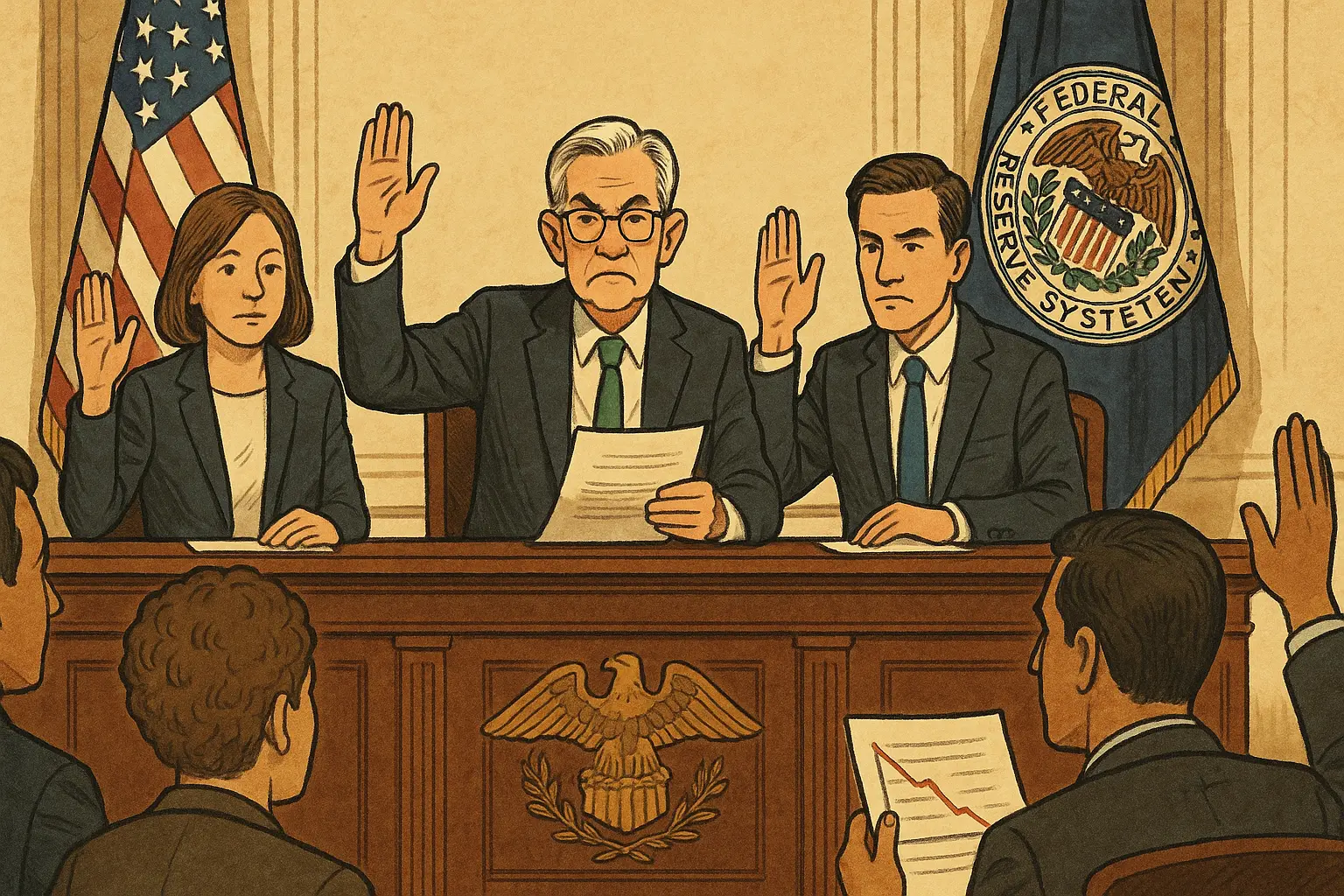
The U.S. Federal Reserve Board released the minutes of the discount rate meetings on February 9 and March 18, confirming that all 12 Federal Reserve Banks unanimously approved the decision at both meetings, keeping the primary credit rate unchanged at 3.75%. At the joint meeting on March 18 with the Federal Open Market Committee (FOMC), officials also simultaneously maintained the target range for the federal funds rate at 3.5% to 3.75%, while the interest rate on reserve balances remained at 3.65%.
Key observations behind keeping rates unchanged
Regional reports from the Federal Reserve Banks reveal the specific reasons officials chose to hold steady:
Four key bases for the Fed to maintain interest rates
The labor market is stable but shows structural divergence: In most regions, overall hiring remains constrained and employee turnover is low, while wage growth is moderate; however, hiring for certain specialized positions such as healthcare continues to be difficult, indicating imbalances within the labor market
AI investment keeps expanding, but its impact on employment is currently limited: Companies generally increase their investment in technology and artificial intelligence, yet officials explicitly noted that AI’s direct impact on the labor market is still limited and is not enough to change the policy direction
Tariff-related pressure eases, but non-labor costs keep rising: Price pressures related to tariffs have been somewhat relieved compared with the prior assessment, but non-labor costs in healthcare and energy areas are still increasing, suggesting that structural inflation pressures remain
The credit rate framework stays tight: The secondary credit rate remains at 4.25%, which is 50 basis points higher than the primary credit rate; the overall credit environment has not loosened
Policy signals from meeting attendance and voting consistency
Board member Christopher Waller and Steven Miran were absent from the February meeting, but both attended and participated in the March voting, and the result was again unanimous approval. Both meetings ended with 100% consistency; no member raised any view on adjusting interest rates, sending the market a clear signal of a highly stable policy stance and no expectation of a sudden shift in the near term.
Rate-cut outlook: The Fed is cautious, and the market waits for inflation data
Although markets generally expect the Fed to begin rate cuts later in 2026, the core message of these meeting minutes is that the Fed remains cautious about further easing of monetary policy. The concerns of policymakers center on the fact that non-labor costs—such as those in healthcare and energy—are still rising, and that inflation pressure has not fully dissipated, making an early rate cut a risk.
Traders’ focus has now shifted to the inflation data that will be released soon. If inflation continues to cool, the probability that the FOMC will change its stance at subsequent meetings will rise; if structural cost pressures persist, the pattern of keeping rates unchanged may last longer.
Frequently asked questions
Why did the Fed keep rates unchanged in March 2026?
There are three core reasons: the labor market as a whole remains stable and there are no signals indicating an urgent need for stimulus; non-labor costs in healthcare and energy areas are still rising; and although tariff pressure has eased, there is still uncertainty due to structural inflation factors. Against this backdrop, officials consider the risk of an early rate cut not to be ignored.
What does unanimous approval by all 12 Federal Reserve Banks mean?
Unanimous consistency indicates a high degree of consensus within the Federal Reserve System on the current monetary policy stance, with no member raising objections to rate cuts. This typically sends the market a clear signal of short-term policy stability, reducing uncertainty; at the same time, it also means that more solid evidence of inflation cooling is needed before any rate cut.
Why didn’t the rapid growth in AI investment lead the Fed to cut rates?
In the meeting minutes, Fed officials clearly stated that although companies’ AI investment continues to expand, its measurable impact on employment and overall productivity is currently still limited and has not reached the macro threshold required to change the direction of monetary policy. Therefore, it does not constitute sufficient grounds for a rate cut.
Disclaimer: The information on this page may come from third parties and does not represent the views or opinions of Gate. The content displayed on this page is for reference only and does not constitute any financial, investment, or legal advice. Gate does not guarantee the accuracy or completeness of the information and shall not be liable for any losses arising from the use of this information. Virtual asset investments carry high risks and are subject to significant price volatility. You may lose all of your invested principal. Please fully understand the relevant risks and make prudent decisions based on your own financial situation and risk tolerance. For details, please refer to
Disclaimer.
Related Articles
TradFi Rise Alert: NZDCHF (NZD/CHF) Rises Over 0.5%
Gate News: According to the latest Gate TradFi data, NZDCHF (NZD/CHF) has surged by 0.5% in a short period. Current volatility is significantly higher than recent averages, indicating increased market activity.
GateNews2h ago
Fed Chair Nominee Kevin Warsh Confirmation Hearing Scheduled for April 21
The U.S. Senate Banking Committee will hold a confirmation hearing for Federal Reserve chair nominee Kevin Warsh on April 21. Political uncertainty surrounds his nomination due to Senator Tom Tillis's opposition. Key macroeconomic data releases are also expected this week.
GateNews17h ago
Does the Financial Supervisory Commission plan to distribute dividends in US dollars? Foreign investors holding companies such as TSMC emerge as the biggest winners
Taiwan is evaluating whether to allow publicly listed companies to pay dividends directly in U.S. dollars, which is expected to reduce foreign investors’ currency-exchange costs and help stabilize the exchange rate, but the timing of the policy remains unclear. This change would benefit foreign investment firms, especially TSMC, but local investors face operational inconveniences, and the regulatory support still needs to be improved. The measure is intended to enhance the appeal of Taiwan’s stock market to keep pace with competition in global capital markets.
ChainNewsAbmedia18h ago
Japan's 40-Year Government Bond Yield Falls 7 Basis Points to 3.775%
Japan's 40-year government bond yield dropped to 3.775%, down 7 basis points, while the 20-year bond yield decreased to 3.230%, falling by 3.5 basis points.
GateNews21h ago
TradFi Rise Alert: USDCLP (US Dollar vs Chile Peso) Rises Over 1.5%
Gate News: According to the latest Gate TradFi data, USDCLP (US Dollar vs Chile Peso) has surged by 1.5% in a short period. Current volatility is significantly higher than recent averages, indicating increased market
GateNews23h ago
War severely hurts Dubai’s tourism and financial standing, WSJ: The United Arab Emirates is seeking U.S. financial assistance
Dubai, as the economic core of the United Arab Emirates, is facing wartime challenges. Since the end of February, it has been hit by large numbers of drone and missile attacks, affecting tourism and oil trade. This has led to fewer international flights and concerns about capital outflows, as the UAE is actively negotiating with the United States on a currency swap mechanism to address potential liquidity crises.
ChainNewsAbmedia04-20 01:20


