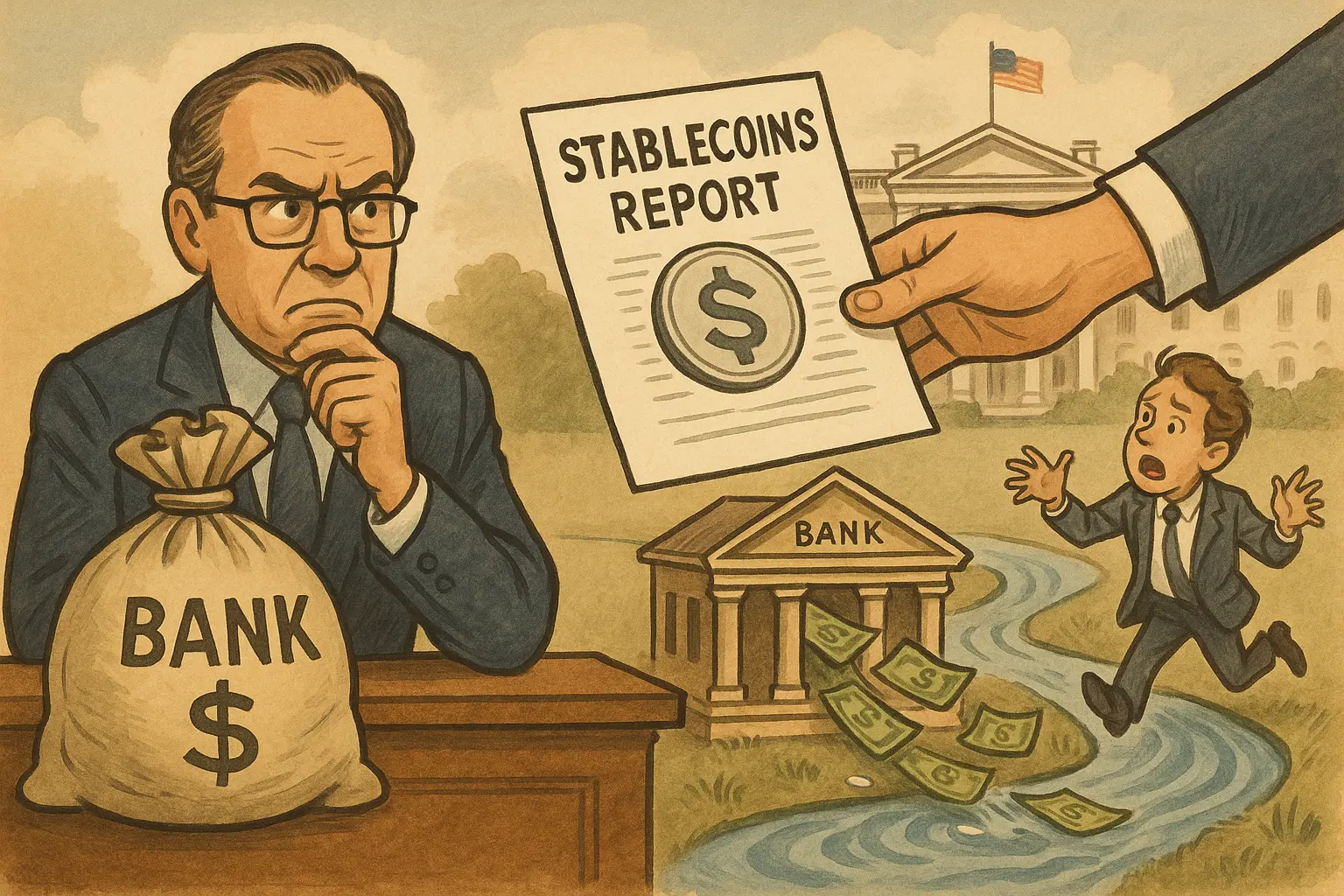
American Bankers Association (ABA) Chief Economist Sayee Srinivasan and Vice President of Research for Banking and the Economy Yikai Wang jointly criticized the White House’s stablecoin research on Monday, saying its core research framework has fundamental bias. The White House report claims that banning stablecoin yield in the baseline scenario would only increase bank loans by $2.1 billion, but the ABA says the core policy issue is whether “allowing stablecoin yield will trigger deposit outflows.”
The core claim of the White House report: the ban affects ‘virtually nothing’
The Council of Economic Advisers released a study titled 《The Effects of Banning Stablecoin Yield on Bank Lending》, concluding that banning stablecoin payments to yield recipients would only increase bank loans by $2.1 billion in the baseline scenario; relative to the overall banking system, that net increase is about 0.02%—meaning the ban would have almost no substantive impact on banking operations.
The ABA argues that such a research design logically sidesteps the real policy issue that needs to be addressed. By selecting a particular analytical perspective, it produces a seemingly harmless number on the surface, while overlooking the potential risks brought about by the existence of stablecoin yield rates.
ABA’s rebuttal: the problem framing determines the direction of the answer
The ABA’s two researchers emphasized that even if the total deposit size of the entire banking system remains unchanged, funds may still shift among institutions—from smaller community banks to larger institutions with more resources. This kind of internal redistribution is also destructive.
The four major structural risks facing community banks
Higher funding costs: Deposit outflows force community banks to turn to wholesale borrowing with higher costs, directly compressing profit margins
Reduced local lending capacity: Funding pressure will lead community banks to scale back credit to local businesses and individuals
Insufficient balance-sheet resilience: Small banks lack adequate buffer capacity to absorb outflows of funds and are more vulnerable to interest-rate shocks
Worsening competitive asymmetry: Large institutions can replenish liquidity through multiple channels, while community banks rely heavily on their deposit base
The ABA also acknowledges that households and businesses do have economic incentives to move funds into higher-yield stablecoins, showing that the banking industry has a clear-eyed understanding of this competitive pressure.
Legislative showdown: the $6.6 trillion outflow warning and the last mile of the stablecoin bill
This controversy has a direct legislative backdrop. The U.S. Senate is considering a bill on cryptocurrency regulation. Negotiations are underway between the crypto industry and banks over whether to allow terms for stablecoin payment yield, and the bill is expected to enter the review process this month.
The ABA’s position aligns with a research document from the U.S. Department of the Treasury in April 2025, which estimates that the broad adoption of stablecoins could trigger as much as $6.6 trillion in deposit outflows from the U.S. banking system.
On the other hand, Coinbase CEO Brian Armstrong criticized banks for maintaining deposit interest rates near zero for decades, arguing that legalizing stablecoin yield would effectively force banks to re-compete in a more fair competitive environment. Members represented by ABA include banking giants such as JPMorgan, Goldman Sachs, and Citigroup. Its stance is expected to have an important impact on subsequent legislative negotiations.
Frequently Asked Questions
What conclusions did the White House’s stablecoin yield report reach, and what are the disputes over the research methodology?
The study by the Council of Economic Advisers assessed “the impact of banning stablecoin payment yields on bank lending.” It concluded that such a ban would only increase bank loans by about $2.1 billion in the baseline scenario, with a net impact of about 0.02%. The ABA criticized this research design, saying it did not evaluate the most pressing policy issue, and therefore produced a misleadingly harmless conclusion.
Why does the ABA say the White House asked the ‘wrong question’?
The ABA points out that the core issue in policy discussions should be whether “allowing stablecoin payment yield will trigger deposit outflows,” not “how large the positive benefits are after the ban.” The former is the key question that truly affects the deposit base of community banks. The White House report’s framework cannot capture this risk, leading to a mismatch between the study’s conclusions and the actual policy concerns.
Why are Coinbase’s CEO and the banking industry taking sharply different positions?
Coinbase’s Brian Armstrong believes that the banking industry’s long-term maintenance of deposit interest rates near zero protects its interests through regulatory barriers, and that stablecoin yield rates are a legitimate market correction to this situation. The banking industry, however, worries that once stablecoin yield rates are legalized, capital will be transferred rapidly from community banks, weakening their local lending capacity and harming the financial service accessibility of the communities they serve.
Disclaimer: The information on this page may come from third parties and does not represent the views or opinions of Gate. The content displayed on this page is for reference only and does not constitute any financial, investment, or legal advice. Gate does not guarantee the accuracy or completeness of the information and shall not be liable for any losses arising from the use of this information. Virtual asset investments carry high risks and are subject to significant price volatility. You may lose all of your invested principal. Please fully understand the relevant risks and make prudent decisions based on your own financial situation and risk tolerance. For details, please refer to
Disclaimer.
Related Articles
Strait of Hormuz Daily Transit Hits New Low at Just 3 Vessels
A report by UK's Vimeo reveals that only 3 vessels passed through the Strait of Hormuz on April 19, setting a new low for recent transit levels.
GateNews4h ago
Bitcoin returns to $76k, and Trump is willing to “directly” negotiate with Iran’s leaders
After experiencing sharp volatility over the weekend triggered by heightened U.S.-Iran tensions, Bitcoin returned near $76,000 on April 21. U.S. President Trump said that any agreement that Iran and the U.S. are currently negotiating will be “better than” the 2015 Joint Comprehensive Plan of Action (JCPOA), and that he is willing to meet directly with Iran’s leadership. The remarks briefly boosted market sentiment. However, Brent crude oil continued to swing around $90 per barrel, keeping Bitcoin under cautious sentiment pressure.
MarketWhisper5h ago
Any prospects for U.S.-Iran talks? Bitcoin rebounds to 75K as MicroStrategy and ETF funds continue to pour in
The U.S.–Iran ceasefire agreement expires on Wednesday, and attention is focused on whether the two sides can resume negotiations. U.S. stocks fell amid heightened tensions, while bitcoin rebounded to $75K, driven mainly by institutional capital and ETF inflows, with MicroStrategy becoming the world’s largest bitcoin-holding institution.
ChainNewsAbmedia6h ago
Hungary's Fidesz Leader Orban Pledges to Unlock Frozen EU Funds Within Three Months
Peter Moaciur, head of Hungary's Fidesz party, announced plans to unblock EU funds by meeting key requirements within three months, focusing on anti-corruption, media freedom, and judicial independence to restore economic stability and investor confidence.
GateNews7h ago
BIS Warns Global Stablecoin Regulatory Fragmentation Will Fuel Arbitrage and Fragment Cross-Border Markets
The BIS's Pablo Hernandez de Cos warned that differing stablecoin regulations threaten cross-border markets and create arbitrage opportunities. He noted stablecoins' inadequacy for payments, potential market destabilization risks, and regulatory challenges linked to money laundering and sovereignty.
GateNews9h ago
Seven Israeli Officers Charged in Multimillion-Dollar Crypto Theft Ring
Israeli Security Forces Charged in Crypto Theft Case
Israeli authorities have charged seven military and police officers with running a multimillion-dollar theft and bribery ring involving cryptocurrency, marking the second crypto-related criminal case to hit the country's defence establishment in
CryptoFrontier10h ago


