
Musk’s artificial intelligence company, xAI, filed a lawsuit with the U.S. District Court in Colorado on Thursday, seeking to block Colorado Senate Bill 24-205 (SB 24-205) from taking effect as scheduled on June 30. The bill is intended to prevent AI systems from creating “algorithmic discrimination” in the employment, housing, and financial services sectors. xAI argues that the regulation forces Grok to output information according to political positions, violating free speech.
xAI’s Constitutional Claims: AI Output Is Protected Speech
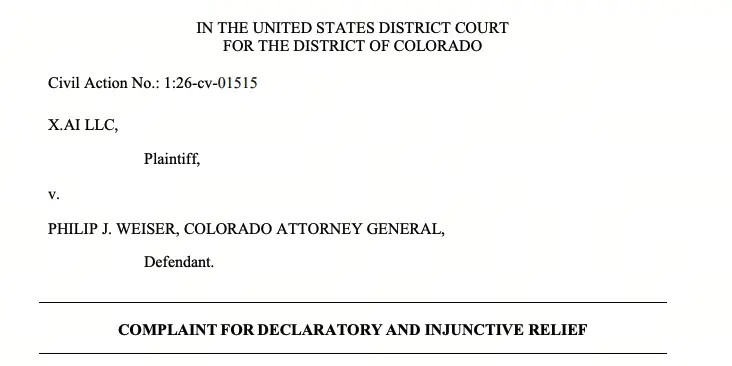 (Source: CourtListener)
In its court filings, xAI clearly states that Colorado has no power to compel changes to xAI’s information output simply because it wants to promote a particular viewpoint on highly politicized issues such as “fairness and equality.” The company also points out that SB 24-205 contains a fundamental logical contradiction: on the one hand, the law claims to eliminate historical discrimination and increase diversity; on the other hand, its internal provisions authorize “differential treatment,” which are moving in opposite directions.
This is not the first time xAI has taken legal action regarding AI regulation. In December 2025, xAI already filed a lawsuit over California’s “Generative AI Training Data Transparency Act,” arguing that California’s information disclosure requirements constitute compelled speech and involve the disclosure of trade secrets, violating the U.S. Constitution’s First and Fifth Amendments. Colorado’s lawsuit is the second federal-level legal action taken by xAI in the field of AI regulation.
Legislative Background and Key Controversies Surrounding SB 24-205
Colorado’s SB 24-205 is one of the first state-level AI anti-discrimination regulations in the United States. It requires developers of high-risk AI systems to take compliance measures to prevent their systems from having an unreasonable discriminatory impact on protected groups. Notably, before Colorado and California pushed forward with AI legislation in succession, there were accusations that Grok had previously made statements related to racism, sexism, and antisemitism; some lawmakers viewed this as one of the bases for advancing AI anti-discrimination rules.
Four Core Legal Claims Raised in xAI’s Lawsuit
Infringement on Free Speech: AI output is speech protected by the First Amendment; the state government cannot compel rules that specify the content of the speech
Embedding Political Viewpoints: The regulation requires Grok to adjust its output based on Colorado’s political positions, constituting government-driven content intervention
Internally Contradictory Logic: The regulation simultaneously claims to eliminate discrimination and authorizes differential treatment, and the internal provisions conflict with each other
Interference With Product Objectives: Forcing changes to the output will undermine Grok’s design intent to “seek the truth to the maximum extent”
White House Position: Promoting a Federal Unified Framework Instead of Patchwork Across States
David Sacks, an AI policy adviser to the White House, has long worked to push states to abandon making their own AI regulatory rules and to establish a single federal AI standard. In March, he publicly said, “With 50 different states regulating AI in 50 different ways, it creates confusion in the regulatory system, making it difficult for innovators to comply.” Sacks currently serves as co-chair of the newly formed Presidential Council of Advisors on Science and Technology, responsible for coordinating the advancement of a nationwide unified AI regulatory framework.
xAI’s lawsuit against Colorado aligns in direction with Sacks’s federal-priority stance, further intensifying the core policy dispute in the United States over whether AI regulatory sovereignty should belong to the federal government or to individual states.
Frequently Asked Questions
What specific AI behavior does Colorado’s SB 24-205 regulate?
SB 24-205 requires that high-risk AI systems deployed in areas such as employment screening, housing applications, and financial services must take measures to prevent unreasonable discriminatory impacts on protected groups; developers must provide the corresponding compliance documents. The regulation is expected to take effect on June 30, 2026.
What progress has there been in xAI’s prior lawsuit against California?
In December 2025, xAI filed a lawsuit against California’s “Generative AI Training Data Transparency Act,” arguing that its information disclosure requirements constitute compelled speech and involve the disclosure of trade secrets, violating the First and Fifth Amendments to the Constitution. As of now, the case is still pending in the United States federal court.
What long-term impact could this lawsuit have on the U.S. AI regulatory landscape?
If the court supports xAI’s First Amendment claims, it could weaken the legal foundation of states’ AI anti-discrimination regulations and clear the way for a unified federal-level AI regulatory framework. The outcome of this case will directly affect the legislative decisions of dozens of states that are considering drafting similar regulations.
Disclaimer: The information on this page may come from third parties and does not represent the views or opinions of Gate. The content displayed on this page is for reference only and does not constitute any financial, investment, or legal advice. Gate does not guarantee the accuracy or completeness of the information and shall not be liable for any losses arising from the use of this information. Virtual asset investments carry high risks and are subject to significant price volatility. You may lose all of your invested principal. Please fully understand the relevant risks and make prudent decisions based on your own financial situation and risk tolerance. For details, please refer to
Disclaimer.
Related Articles
Did Elon Musk acquire AI startup Cursor with a $60 billion premium? Strategic planning ahead of SpaceX’s IPO
SpaceX announced a major agreement with Cursor, planning to acquire Cursor for $6 billion, or to acquire its cooperation results for $1 billion. Cursor is valued at more than $5 billion, and is seeking $200 million in funding. Investors include Nvidia and Andreessen Horowitz. The move aligns with SpaceX and xAI’s upcoming merger and IPO, combining Cursor tooling with SpaceX’s computing power to boost code generation and automated development, or else could put pressure on OpenAI and Anthropic, potentially widening the technical gap.
ChainNewsAbmedia8m ago
OpenClaw Releases v2026.4.20 with Kimi K2.6 as Default Model
Gate News message, April 21 — OpenClaw, an open-source AI Agent platform, released v2026.4.20 on April 20, introducing significant updates to default model switching, plugin contract handling, and gateway storage optimization.
The release switches the default model for Moonshot's built-in
GateNews55m ago
OpenAI Launches ChatGPT Images 2.0 Model with Enhanced Visual Task Capabilities
Gate News message, April 21 — OpenAI unveiled ChatGPT Images 2.0 on April 22, significantly enhancing complex visual task processing capabilities. The model improves instruction understanding, object placement and relationship expression, and high-density
GateNews1h ago
SpaceX Agrees to Acquire AI Startup Cursor for Over $50 Billion
Gate News message, April 21 — According to The New York Times, SpaceX has agreed to acquire Cursor, a fast-growing artificial intelligence startup focused on code-writing software, for over $50 billion. The deal comes as SpaceX prepares for what could be one of the largest initial public offerings i
GateNews1h ago
Unauthorized Users Access Anthropic's Mythos AI Model, Company Confirms Investigation
Gate News message, April 22 — A small group of unauthorized users accessed Anthropic's new Mythos AI model on the same day the company announced plans to release it to select organizations for testing, Bloomberg News reported. The users, part of a private online forum, gained access to Mythos and
GateNews1h ago
Silicon Valley’s ‘monitoring the situation’ MTS meme becomes a 24/7 news machine delivered by a16z
a16z is backing "Monitoring the Situation," a 24/7 X livestream born from Polymarket meme culture, as tech VCs build their own news-industrial complex.
Summary
Andreessen Horowitz has helped launch "Monitoring the Situation" (MTS), a 24/7 livestream show on X, leaning into crypto-prediction mar
Cryptonews4h ago


