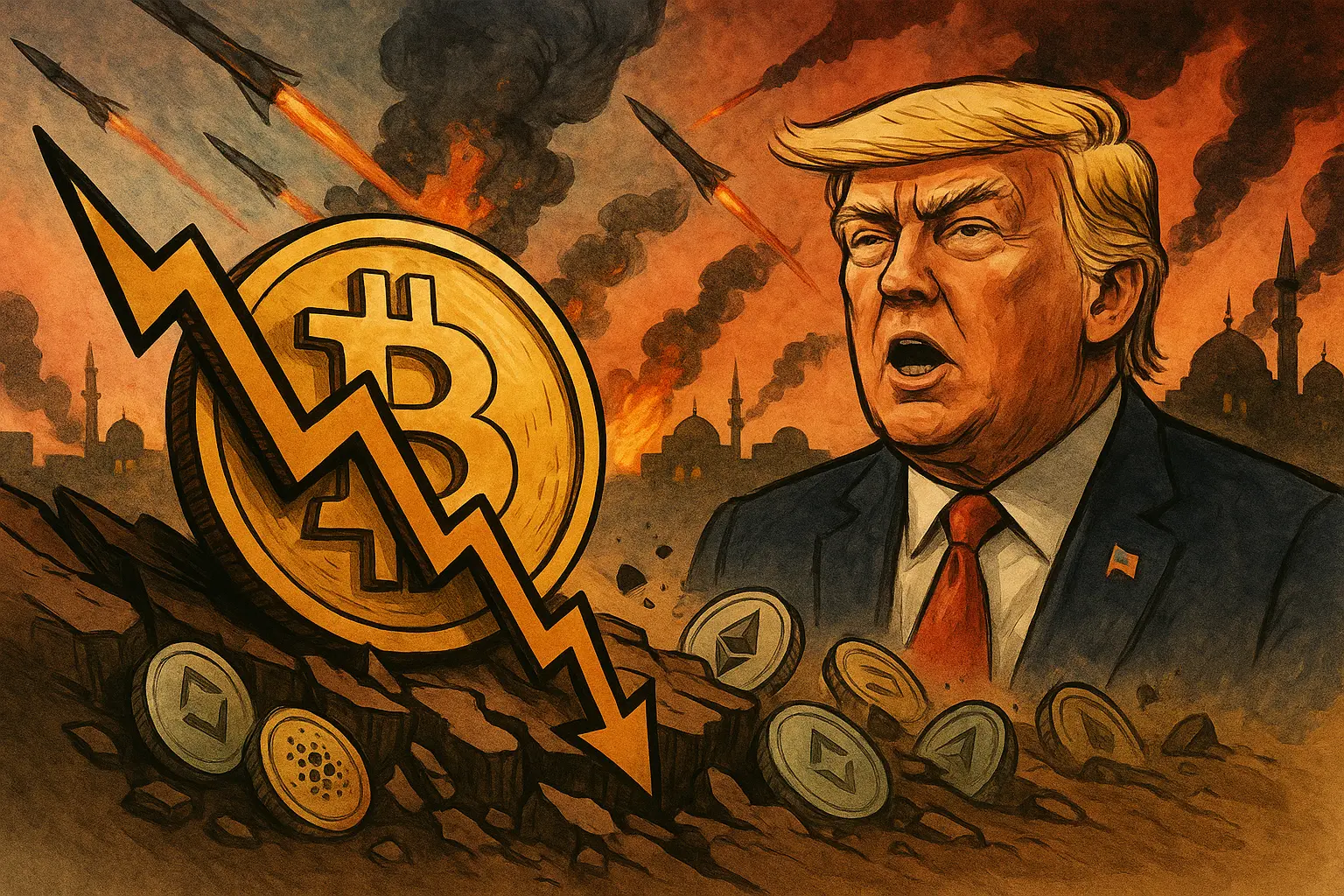
Bitcoin plunged to $62,800 after Israel launched preemptive attacks against Iran, with US President Trump confirming American involvement. Altcoins bled heavily with Ethereum dropping to $1,850, Solana falling below $80, and XRP losing 9%. Total crypto market capitalization erased over $100 billion in 24 hours.
Bitcoin Iran Tensions Trigger Weekend Crypto Crash
(Source: Trading View)
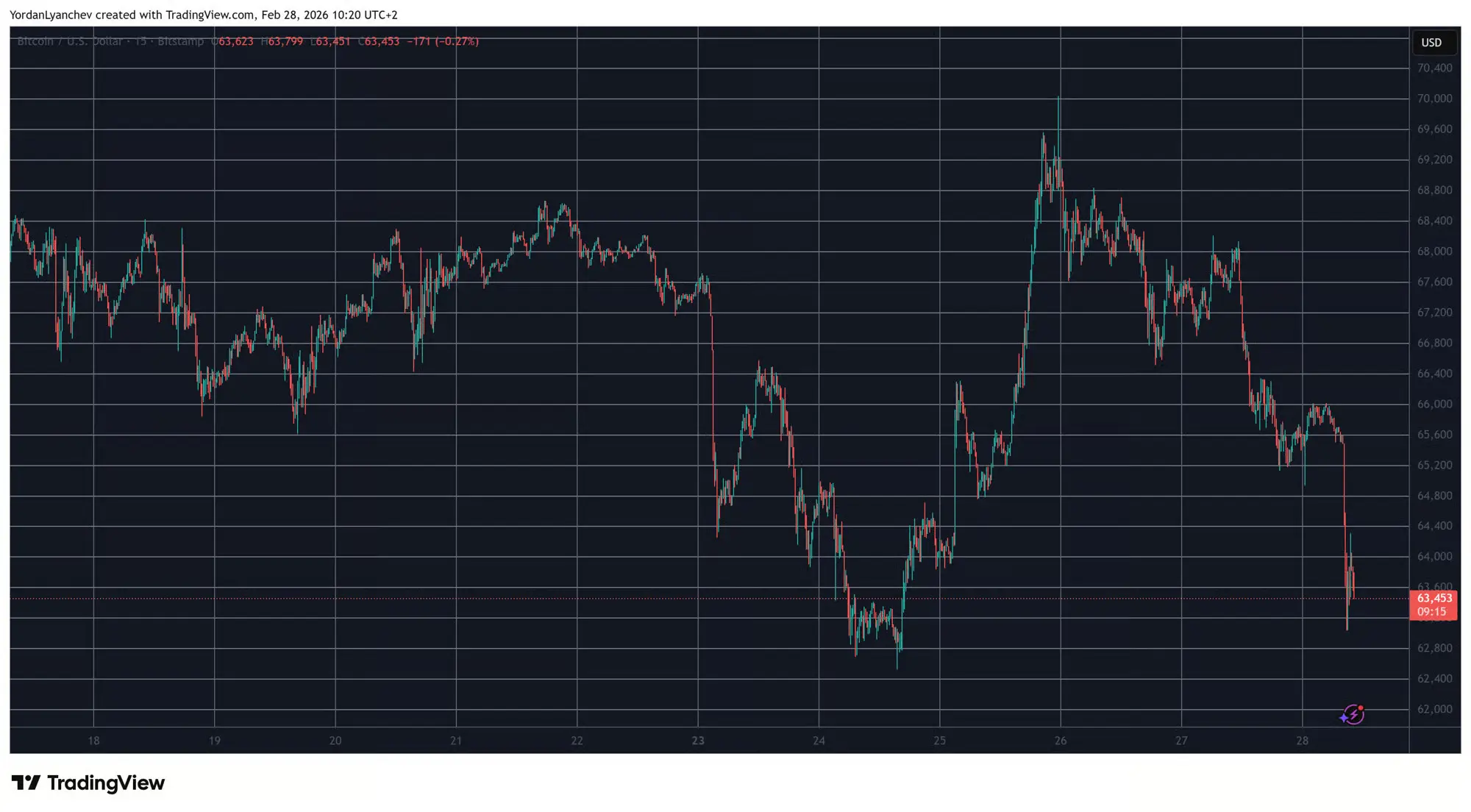
Bitcoin’s price moves took another turn for worse in past hours after Israel attacked Iran, and US President Trump confirmed his country was also involved. It was already highly volatile trading week for the primary cryptocurrency as bears seemed in full control by Tuesday. At the time, they pushed the asset south to multi-week low of $62,500.
However, bitcoin rebounded almost immediately and skyrocketed by several thousand dollars to $70,000 on Wednesday. Many analysts speculated whether this was typical dead-cat bounce, which turned out to be case. At first, BTC slipped to around $68,000, where it spent most of Thursday and Friday trading sessions, showing temporary stabilization before next leg down.
The situation worsened once again on Saturday morning when Israel launched “preemptive” attack against Iran and issued state of emergency. In minutes, BTC plunged to under $62,800 before it recovered some ground to $63,400 as of press time. This rapid intraday swing demonstrates how sensitive bitcoin markets remain to geopolitical developments, particularly conflicts involving major oil-producing regions.
US President Donald Trump confirmed that United States was also involved in attacks against Iran, and more volatility is expected as situation unravels. The combination of Israeli military action and American confirmation creates escalation risk that crypto markets are pricing in through risk-off positioning. As of now, bitcoin’s market cap has slid to $1.275 trillion, while its dominance over alts is below 56%.
Bitcoin Price Movement Timeline
Tuesday: Dropped to multi-week low of $62,500 as bearish pressure intensified
Wednesday: Rebounded sharply to $70,000 in apparent dead-cat bounce
Thursday-Friday: Stabilized around $68,000 creating temporary consolidation
Saturday: Israel’s Iran attack triggered crash to $62,800, recovered to $63,400
Altcoins Suffer Double-Digit Bloodbath
(Source: QuantifyCrypto)
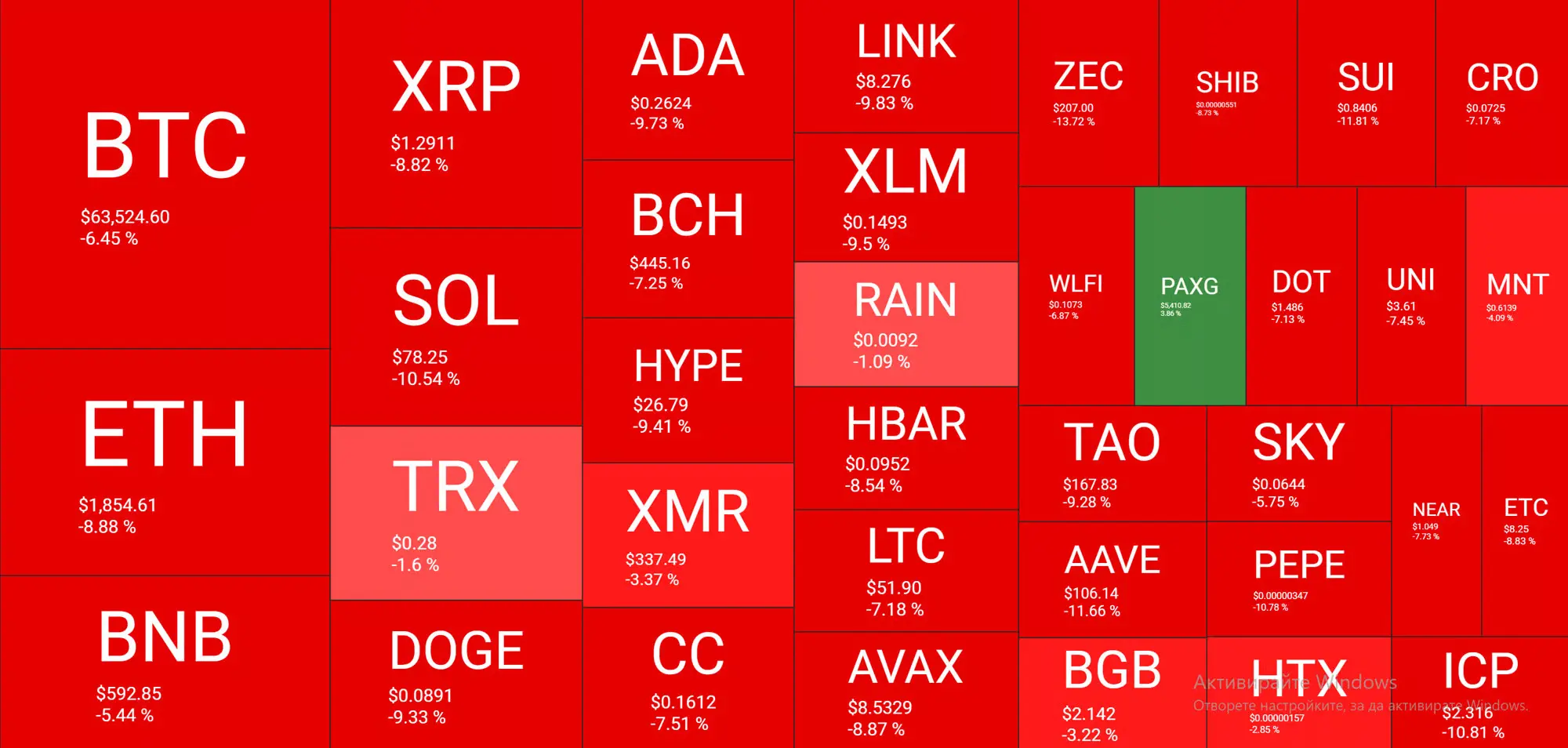
The graph of altcoin performance shows painful reality in which almost all assets are deep in red. Ethereum has plunged by $200 in past few days to $1,850, testing critical support levels not seen since early 2025. This decline represents roughly 10% correction from recent local highs, with ETH/BTC ratio also weakening as Bitcoin dominance increases during risk-off periods.
XRP was surpassed by BNB after 9% drop, marking significant shift in market cap rankings. Binance Coin’s resilience during bitcoin Iran crisis demonstrates its relative strength as exchange-native utility token that benefits from increased trading volatility. XRP’s fall to fourth place reverses recent gains that followed regulatory clarity and ETF speculation.
Solana has slumped by double digits to under $80, approaching psychologically critical support level. The high-beta Layer-1 blockchain typically amplifies Bitcoin’s movements in both directions, making SOL particularly vulnerable during geopolitical risk-off events. Network fundamentals remain strong with transaction activity stable, but price action reflects pure risk sentiment rather than protocol health.
ADA, HYPE, BCH, DOGE, AVAX, LINK, and XLM have plummeted hard as well. Declines of up to 20% are evident from KCS, PIPPIN, and STABLE, while stablecoins linked to gold are in green as investors seek safe-haven exposure within crypto markets. Gold-backed tokens like Paxos Gold (PAXG) and Tether Gold (XAUt) are benefiting from traditional flight-to-safety dynamics as Iran conflict intensifies.
The total crypto market cap has erased over $100 billion in past day and is deep below $2.3 trillion. This represents approximately 4.2% decline in aggregate market value, with altcoins bearing disproportionate share of losses compared to Bitcoin’s more moderate correction.
Why Bitcoin Iran Conflicts Always Trigger Selloffs
Geopolitical tensions involving Iran consistently trigger risk-off positioning across global markets, and bitcoin proves no exception despite narratives about it serving as geopolitical hedge or “digital gold.” The bitcoin Iran correlation stems from several interconnected factors affecting crypto market psychology and institutional positioning.
First, Iran conflicts raise oil price concerns. Iran controls strategic Strait of Hormuz through which roughly 21% of global petroleum passes daily. Military escalations threaten this critical supply route, potentially spiking energy prices and triggering broader economic instability. Higher oil prices typically strengthen dollar as commodity transactions increase demand for greenback, creating headwinds for dollar-denominated assets like bitcoin.
Second, institutional investors treat bitcoin as risk-on asset rather than safe haven. When geopolitical crises erupt, traditional portfolio positioning shifts toward genuine safe havens—US Treasuries, gold, and cash. Bitcoin, despite digital scarcity narratives, remains classified as high-risk speculative asset in institutional frameworks. This means bitcoin Iran conflicts prompt systematic selling as risk managers reduce portfolio volatility exposure.
Third, crypto markets operate 24/7 unlike traditional markets with weekend closures. When Israel’s Iran attack occurred Saturday morning, equity and bond markets were closed while crypto markets remained open. This means bitcoin absorbed initial risk-off selling that would normally distribute across multiple asset classes. Once traditional markets open Monday, some bitcoin selling pressure may ease if risk assets broadly stabilize, or intensify if panic spreads to equities.
Historical Bitcoin Performance During Middle East Crises
Historical data shows bitcoin typically underperforms during acute Middle East military conflicts before recovering once immediate crisis passes. During January 2020 US-Iran tensions following Qasem Soleimani assassination, bitcoin initially dropped before recovering within weeks as conflict de-escalated.
April 2024 Israel-Iran exchange saw similar pattern: initial bitcoin selloff followed by recovery as direct confrontation was avoided. However, sustained conflicts produce different outcomes. If current Israel-Iran-US situation escalates into prolonged military engagement, bitcoin could face extended pressure as risk-off positioning persists.
The key variable determining bitcoin’s trajectory is conflict duration and intensity. Brief military exchanges that resolve quickly typically create temporary selloffs followed by V-shaped recoveries. Prolonged conflicts with escalating involvement create sustained risk-off environments where bitcoin struggles to gain traction regardless of fundamentals.
Trading Strategy During Bitcoin Iran Geopolitical Events
For traders navigating bitcoin Iran volatility, several strategies emerge from historical precedents and current market structure:
Risk Management During Geopolitical Crises
Reduce Leverage: Geopolitical events trigger unpredictable volatility making leveraged positions extremely dangerous
Widen Stop Losses: Flash crashes during thin weekend liquidity can hit tight stops before reversing
Size Positions Smaller: Uncertainty warrants smaller position sizes than normal market conditions
Monitor News Continuously: Geopolitical situations evolve rapidly requiring constant information updates
Avoid Altcoins: High-beta tokens amplify Bitcoin’s moves; stick to BTC and major caps during crises
Consider Stablecoins: Moving to USDT or USDC preserves capital during peak uncertainty
Contrarian traders may view extreme fear as buying opportunity, but timing entry requires waiting for stabilization signals. Attempting to catch falling knives during active military conflicts often results in additional losses as situations can deteriorate rapidly without warning.
Safe-haven crypto narratives aside, bitcoin Iran conflicts demonstrate crypto remains firmly correlated with traditional risk assets. Until institutional frameworks reclassify bitcoin from speculative to safe-haven category, geopolitical crises will continue triggering selloffs regardless of digital scarcity or decentralization properties.
Market Outlook: Recovery Timeline Depends on Conflict Resolution
Bitcoin’s near-term outlook hinges entirely on how Israel-Iran-US situation develops. Several scenarios present different implications for crypto markets:
Scenario Analysis
Quick De-Escalation: If diplomatic channels prevent further military action, bitcoin could recover toward $68K-$70K within days as fear premium dissipates
Contained Conflict: Limited military exchanges without broader regional involvement might keep bitcoin range-bound $60K-$65K as markets assess ongoing risk
Full Escalation: Major regional war involving multiple countries could push bitcoin toward $50K-$55K as global risk-off positioning intensifies
The weekend timing of current bitcoin Iran crisis creates additional uncertainty. With traditional markets closed, initial price discovery occurs in crypto markets alone. Monday’s equity market open will provide crucial signals about broader risk sentiment. If stock markets open sharply lower, bitcoin likely faces additional selling pressure. If equities stabilize or recover, bitcoin may find support.
FAQ
Why did Bitcoin crash when Israel attacked Iran?
Bitcoin dropped as Israel’s Iran strikes triggered risk-off positioning across global markets. Crypto markets operate 24/7, absorbing initial geopolitical selling while traditional markets were closed for weekend. Trump confirming US involvement escalated tensions further.
How low can Bitcoin go during the Iran conflict?
Analysts project support levels at $60K for contained conflict scenarios, with potential drops to $50K-$55K if situation escalates into broader regional war. Much depends on conflict duration and intensity.
Why don’t Iran conflicts make Bitcoin rise as “digital gold”?
Despite narratives about bitcoin serving as geopolitical hedge, institutional investors classify it as risk-on asset. During crises, portfolios shift toward traditional safe havens like US Treasuries and gold, not speculative assets like crypto.
Which altcoins were hit hardest by Iran news?
KCS, PIPPIN, and STABLE posted 20% declines. Solana fell below $80, Ethereum dropped to $1,850, and XRP declined 9% losing third place to BNB. High-beta tokens amplify Bitcoin’s moves during geopolitical shocks.
Should I buy Bitcoin during the Iran conflict?
Timing entries during active military conflicts is extremely risky. Historical patterns show bitcoin recovers after brief Middle East tensions but struggles during prolonged conflicts. Wait for stabilization signals before deploying capital.
How does Iran conflict affect crypto differently than stock markets?
Crypto markets operate 24/7 without weekend closures, meaning they absorb initial geopolitical shock while traditional markets are closed. This can create exaggerated moves that partially reverse when equities open Monday and redistribute risk-off flows.


