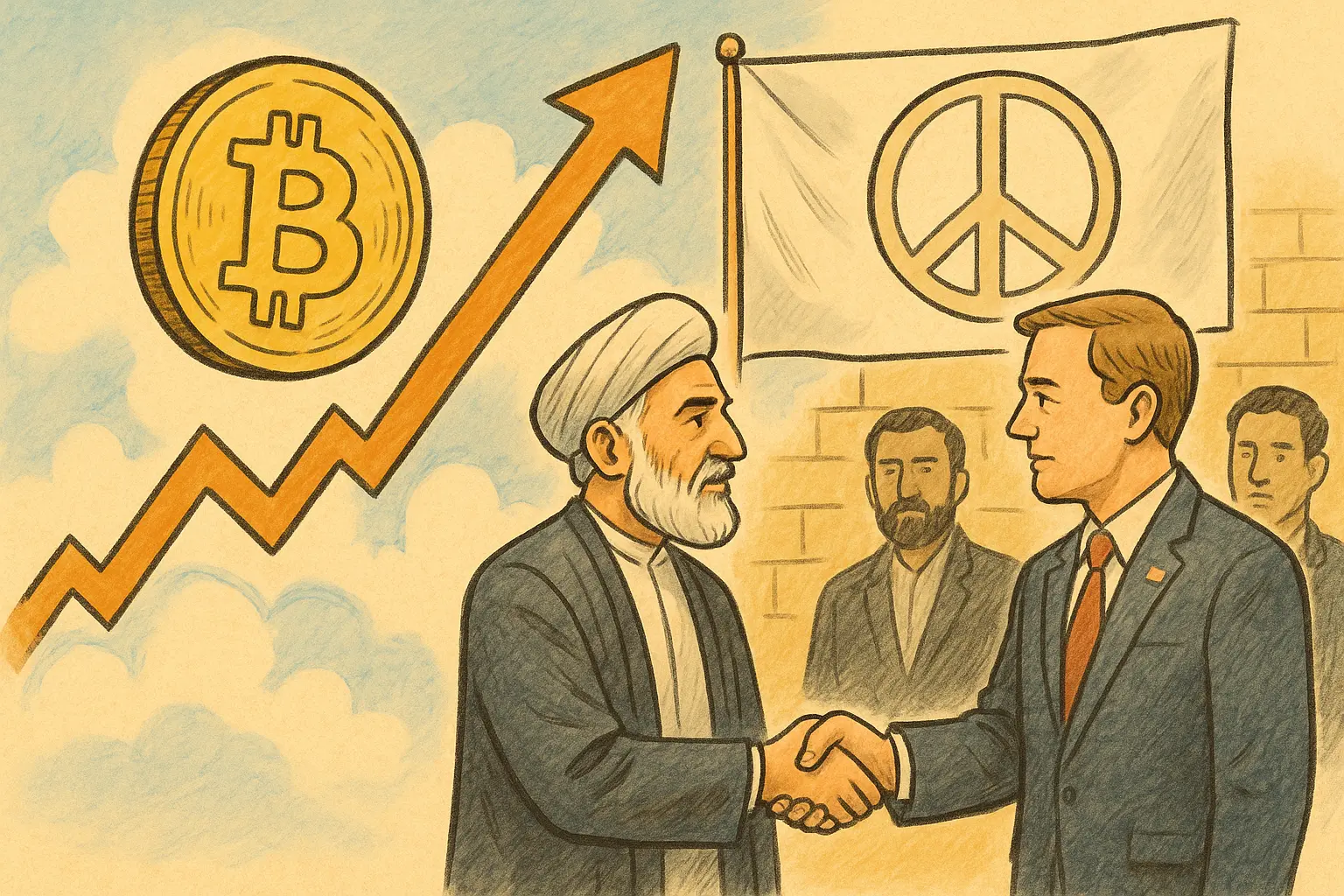
Late on April 7, U.S. Eastern Time, U.S. President Donald Trump announced on Truth Social that he would pause military operations against Iran for two weeks. Iran’s Supreme National Security Council subsequently confirmed that it accepted a two-week ceasefire proposal put forward by Pakistan. Driven by this news, Bitcoin surged nearly 3% after the announcement was released, reaching a high of $71,500.
The Core Logic Behind Bitcoin’s Rise Today: The Fast Disappearance of the Geopolitical Risk Premium
Bitcoin’s direct catalyst for rising today is the rapid removal of the geopolitical risk premium. Previously, the market had already priced in the likelihood that Iran’s infrastructure would suffer large-scale military strikes, which put broad pressure on risk assets and led traders to take a more defensive posture in their positioning. After Trump announced the pause in military operations, this risk scenario was removed, and the market repriced it in a short period of time, pushing BTC to rebound sharply from intraday lows.
During geopolitical conflicts, markets typically apply a “war discount” to risk assets—reflecting risk expectations of supply-chain disruptions, surging energy prices, and volatility in financial markets. The ceasefire announcement effectively eliminated some of these expectations, creating room for a near-term valuation repair in risk assets such as Bitcoin. In historical cases, easing geopolitical tensions has often been accompanied by a valuation recovery in risk assets, but the durability of this ceasefire still depends on the outcome of subsequent negotiations.
The Key Framework of the U.S.-Iran Ceasefire: A Ten-Point Proposal Under Pakistan’s Mediation
Achieving this ceasefire involves diplomatic intervention by multiple parties, resulting in a concrete negotiation framework. Pakistan played a key role in this round of mediation. Pakistani Prime Minister Shehbaz Sharif invited representatives from both the U.S. and Iran’s sides to Islamabad to begin negotiations.
Summary of the Core Terms of the Ceasefire Agreement
Ceasefire duration: Two weeks, effective beginning at 8:00 AM on April 8, Beijing Time
Negotiation location: Islamabad, Pakistan’s capital; formally begins on April 10
Strait of Hormuz: Iran agrees to “fully, immediately, and safely” reopen it; Pakistan and Oman assist with monitoring the passage-fee agreement
Iran’s ten-point proposal: Submitted to the U.S. side via Pakistan; Trump said he views it as a “viable basis for negotiations”
Delivery of orders: White House officials said that transmitting the ceasefire order to lower-level commanders of Iran’s Islamic Revolutionary Guard Corps (IRGC) would still take some time
In his statement, Trump said the U.S. had already achieved its predetermined military objectives, and that “nearly all of the past dispute points” between the U.S. and Iran had been agreed upon. The two-week deadline is intended to allow the final agreement to be finalized and take effect.
The Reopening of the Strait of Hormuz and the Macro Link to the Energy Market
The Strait of Hormuz is a critical chokepoint for global oil transportation, with about 20% of the world’s daily oil supply transiting through it. During the conflict period, concerns about safe passage through the strait raised expectations of uncertainty in global energy prices, which in turn disrupted countries’ central bank rate-decision pathways.
In this ceasefire, Iran’s agreement to reopen the strait is a core condition. If the agreement is implemented, it is expected to ease global tensions in oil supply chains. The indirect impact on the Bitcoin market is that cooling energy inflation pressures may give central banks more policy flexibility, while reduced uncertainty in rate decisions typically creates favorable conditions for risk assets.
Frequently Asked Questions
Why is Bitcoin up today?
Late on April 7, 2026, U.S. President Donald Trump announced that the U.S. would pause military operations against Iran for two weeks, and Iran also confirmed its acceptance of the ceasefire proposal put forward by Pakistan. The geopolitical risk premium rapidly fell away; after the news was released, Bitcoin surged nearly 3%, returning to $71,500, which is the direct reason for today’s rise.
How does the U.S.-Iran ceasefire affect risk assets beyond Bitcoin?
After the ceasefire news was released, broad risk assets generally rebounded because traders removed risk pricing related to escalation of the geopolitical conflict. The commitment to reopen the Strait of Hormuz also helps ease uncertainty in the global energy market, with the impact spanning stock, commodity, and cryptocurrency markets.
Does this two-week ceasefire mean the U.S.-Iran conflict is officially over?
This ceasefire lasts for two weeks and is defined as a prerequisite for formal negotiations. Trump said he is close to reaching a “long-term peace agreement,” but the final outcome depends on the progress of negotiations that begin in Islamabad starting April 10. The ceasefire agreement itself does not equal the official end of the conflict.
Disclaimer: The information on this page may come from third parties and does not represent the views or opinions of Gate. The content displayed on this page is for reference only and does not constitute any financial, investment, or legal advice. Gate does not guarantee the accuracy or completeness of the information and shall not be liable for any losses arising from the use of this information. Virtual asset investments carry high risks and are subject to significant price volatility. You may lose all of your invested principal. Please fully understand the relevant risks and make prudent decisions based on your own financial situation and risk tolerance. For details, please refer to
Disclaimer.


