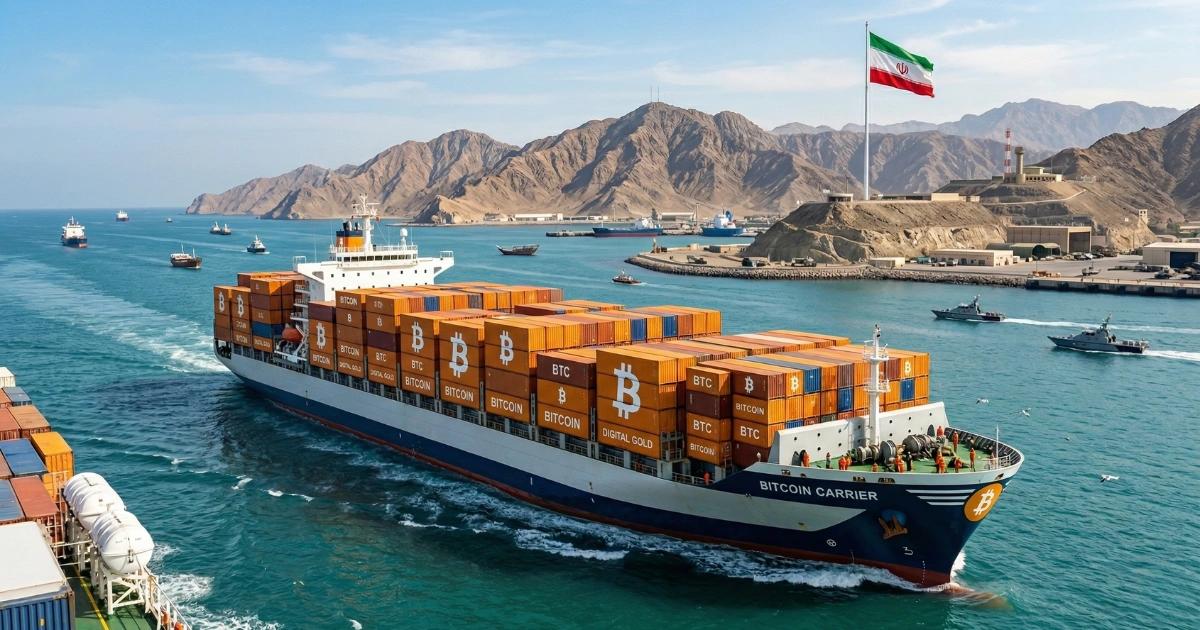
The Iranian government has officially imposed a $1-per-barrel transit fee on oil tankers passing through the Strait of Hormuz, and has also required that the payment be made in Bitcoin to circumvent U.S. sanctions, triggering sharp volatility across the cryptocurrency market.
Iran officially launches a cryptocurrency fee-collection plan and clearance mechanism
According to a report by The Financial Times, the Iranian government has already put in place a brand-new toll-collection plan, charging a transit fee of $1 per barrel of crude oil for all fully loaded tankers passing through the Strait of Hormuz.
A spokesperson for the Iran Oil, Gas and Petrochemical Exporters Union, Hamid Hosseini, confirmed that this policy has already been approved by Iran’s Supreme National Security Council. The core goal is to bypass the traditional financial system dominated by the United States and ensure that the country’s revenue will not be frozen or seized as a result of Western sanctions.
For a fully loaded large supertanker, the transit fee could be as high as $2 million. The operating process of this mechanism is extremely time-sensitive and precise: **shipowners must first submit a detailed cargo manifest and cargo contents to Iranian authorities via email; after the Iranian side completes its review and assessment, the vessel will have only a few seconds to complete****Bitcoin ($BTC)**payment.
Hosseini said bluntly that this instant and decentralized settlement method makes it difficult for funds to be tracked or intercepted.
This policy has currently been linked to the two-week ceasefire agreement reached at the beginning of April. Iran views digital assets as a key source of funding for rebuilding wartime infrastructure after the conflict. The scale of Iran’s domestic cryptocurrency ecosystem has now reached $7.8 billion. The government’s long-term support for Bitcoin mining and the stablecoin economy indicates its mature grasp of the application of digital assets.
- **Related news:**U.S.-Iran war ceasefire for 2 weeks! Bitcoin soars to $72k, and TSMC jumps higher—but don’t be too optimistic yet
The current state of the global energy corridor under shipping disruption and military control
The Strait of Hormuz is a critical passage for about one-third of the world’s crude oil supply, and even now the clearance efficiency remains extremely low. Although the ceasefire agreement has already been put into effect, according to observations by shipping data company Kpler, the Persian Gulf is currently experiencing a “sea parking lot” shutdown: about 187 tankers carrying 175 million barrels of oil are stuck on the water, and another 300 to 400 vessels of various types are waiting in line for passage.
Before the outbreak of the conflict, the number of ships transiting the strait per day was about 100 to 120. But the latest data shows that on April 8, the first day of the ceasefire, only four ships were approved to pass—and all of them were carriers of dry bulk cargo. According to a tracking report by MarineTraffic, the Greek-flag NJ Earth and the Liberian-flag Daytona Beach had already passed during the night, but these two ships are not tankers, so they cannot prove that the flow of energy commodities has returned to normal.
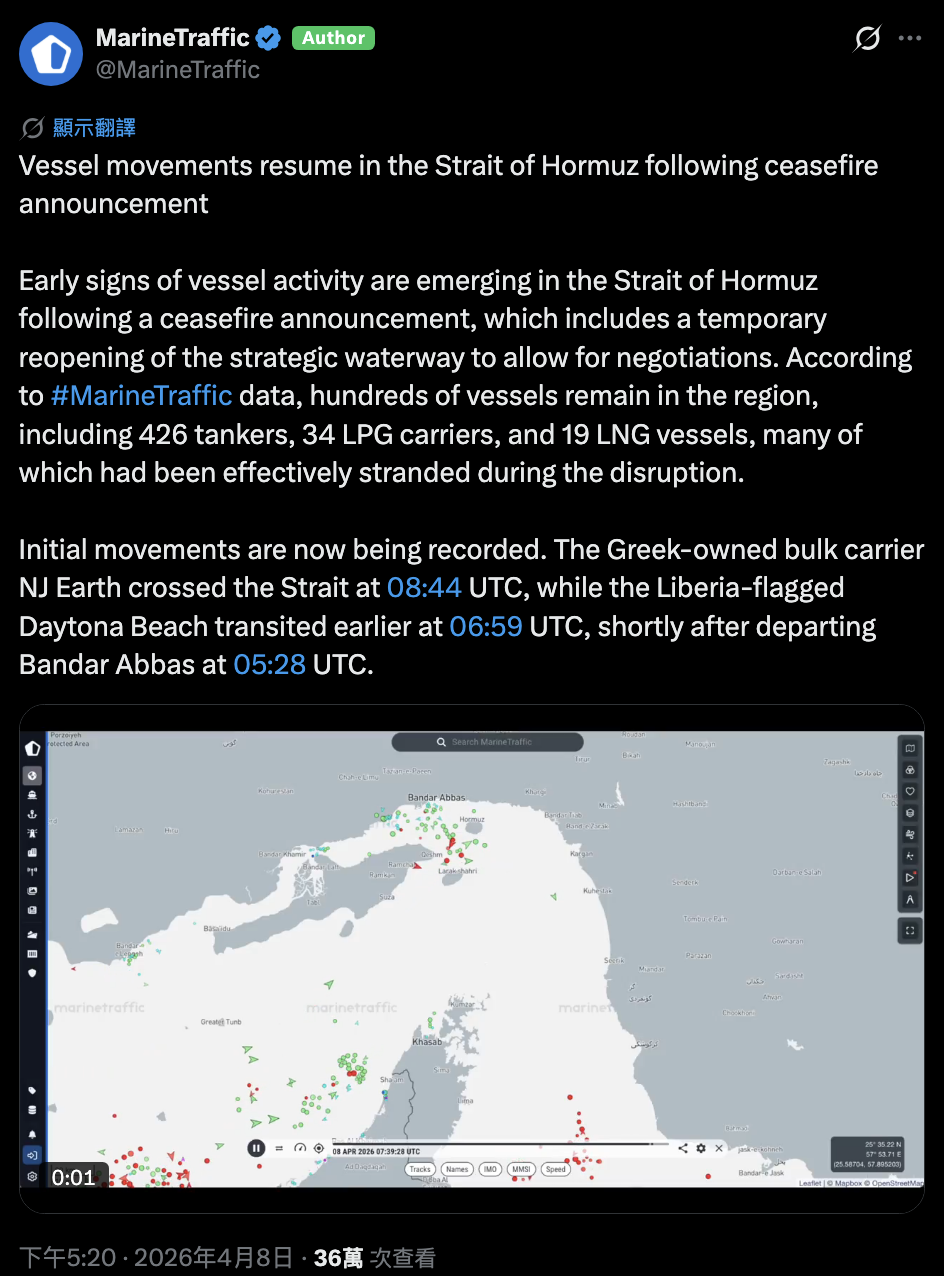
Source: X/@MarineTraffic On the first day of the ceasefire, only 4 ships were approved to pass, and all of them were dry bulk carriers.
Information is being passed through Iranian intermediaries via Pakistan, with rules that during the two-week ceasefire period, only 12 ships may pass per day, and that all actions must first be coordinated and approved by Iran’s Islamic Revolutionary Guard Corps (IRGC). The Iranian military has issued radio warnings to ships within the Persian Gulf, emphasizing that any vessel attempting to cross the strait without authorization will face military strikes and even destruction. Based on concerns about Iran’s “destroy if you don’t comply” warning, most shipping companies have still chosen to wait and watch rather than risk entering high-risk waters.
The Trump administration’s ultimatum and the tug-of-war in geopolitical negotiations
U.S. President Trump has taken an extremely hardline stance on the situation in the Strait of Hormuz. He issued an ultimatum through social platforms, demanding that Iran immediately, comprehensively, and safely open the shipping lanes; otherwise, it would face a devastating military strike. Trump even shared an astonishing idea with the media, suggesting that the U.S. and Iran might develop the strait transit fees into a “joint venture,” and calling it a “beautiful idea.” However, Iran has not yet provided any official response to this proposal for shared fees.
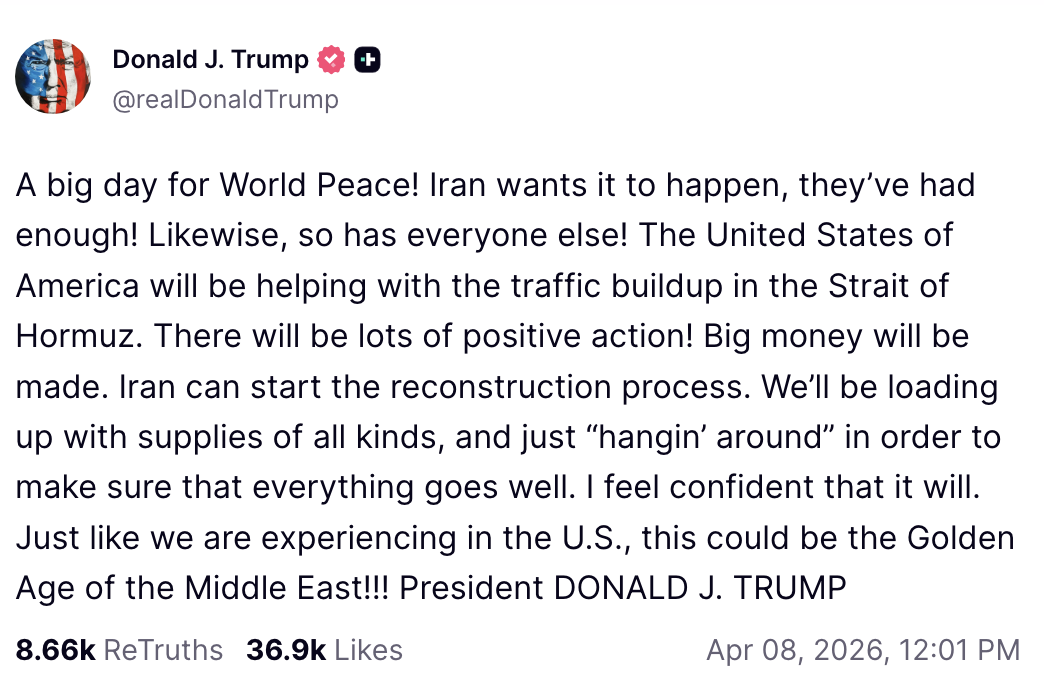
Source: Truth Social/@realDonaldTrump Trump suggested that the U.S. and Iran might turn strait transit fees into a “joint venture.”
U.S. Vice President James David Vance said at an event in Hungary that the current ceasefire is a “fragile truce.” He criticized some officials inside Iran for lacking good faith during the negotiation process. To cut off Iran’s military support, the Trump administration announced a harsh trade sanctions measure: any country that supplies Iran with military weapons will have all its exports to the United States immediately subject to a 50% tariff penalty, with absolutely no room for exemptions.
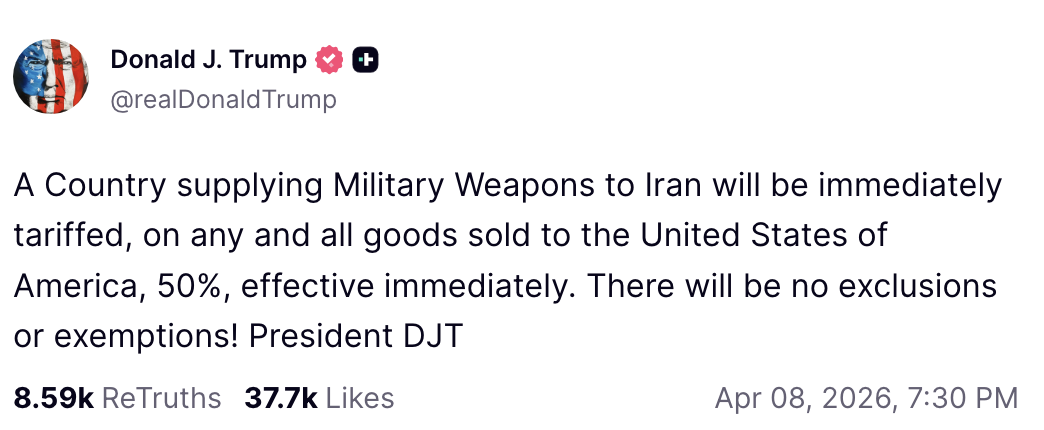
Source: Truth Social/@realDonaldTrump Trump announced that any country that supplies Iran with military weapons will have all its exports to the United States immediately hit with a 50% tariff penalty.
Iran’s Foreign Minister Abbas Araghchi responded by saying that Tehran’s concern is how to reach a durable agreement that can end an “illegal war.” At present, the situation shows that there is a huge gap between both sides’ interpretations of the ceasefire conditions: Iran insists on the Strait’s control and the lifting of sanctions as its core demands, while the United States is focused on maintaining an open and transparent global energy supply chain.
Financial markets jolted, and the role of digital assets in sovereign settlement
After news surfaced that Iran would incorporate cryptocurrency into the country’s national fee-collection system, global financial markets triggered a chain reaction. The cryptocurrency market saw major fluctuations within 24 hours, with liquidation positions reaching $657 million. Bitcoin’s price surged in a short period of time; at one point, the trading price briefly broke above the $72,000 and $73,000 thresholds, showing that market funds are highly focused on the real-world application of digital assets in geopolitical settlement.
According to CoinMarketCap data, Bitcoin’s daily trading volume jumped 64%, reaching about $54 billion. Wall Street investors were carrying out so-called “TACO trades,” betting that Trump would choose, at the last moment, to avoid a full-scale war and pivot to an economic compromise. The S&P 500 index recently recorded a 3.4% week-over-week gain, indicating that investors are still seeking upside opportunities amid the turmoil.
Beyond Bitcoin, market attention on privacy coins such as Monero ($XMR) and Zcash, as well as technical protocols like LayerZero, has also increased significantly—reflecting a growing demand for tools that help funds evade monitoring. Iran’s innovative payment initiative is directly pushing digital assets to the core of international political bargaining, making them a key weapon in the struggle between national sovereignty and international finance. This crisis—combining blockchain technology, energy supply chains, and great-power negotiations—is redefining the settlement route for future international trade fees, and posing an unprecedented challenge to the traditional U.S. dollar settlement system.
Disclaimer: The information on this page may come from third parties and does not represent the views or opinions of Gate. The content displayed on this page is for reference only and does not constitute any financial, investment, or legal advice. Gate does not guarantee the accuracy or completeness of the information and shall not be liable for any losses arising from the use of this information. Virtual asset investments carry high risks and are subject to significant price volatility. You may lose all of your invested principal. Please fully understand the relevant risks and make prudent decisions based on your own financial situation and risk tolerance. For details, please refer to
Disclaimer.
Related Articles
Gate Daily Report (April 27): Comments related to the Trump shooting incident boost the TRUMP coin; the U.S. Department of the Treasury will include Venmo in debt-inquiry donation payments
Bitcoin (BTC) sees a sharp short-term surge and rebound, temporarily trading at around $78,900 as of April 27. Trump’s provocative remarks about the shooting incident boosted the prices of meme coins such as TRUMP, MAGA, and DJT, because a carefully crafted narrative has once again come back into view. The U.S. Treasury has moved Venmo into the debt donation payment channel, after the previously strategic Bitcoin reserve bill stalled.
MarketWhisper20m ago
Ascending Triangle Breakout Loading? Top 5 Altcoins With 5x Upside Potential
Ascending triangles indicate growing buying pressure but need to be confirmed.
Toncoin and Fantom display better trends than others in consolidation.
Overall market conditions still play a crucial role in the success of breakouts.
A common technical pattern has begun to emerge among
CryptoNewsLand29m ago
Crypto Fear and Greed Index Rises to 47, Signaling Neutral Market Sentiment
Gate News message, April 27 — According to Alternative.me, the Crypto Fear and Greed Index stands at 47 today, indicating a neutral market sentiment. The index rose from 33 yesterday (April 26), reflecting a shift toward more balanced market
GateNews1h ago
Whale pension-usdt.eth's $110M Short on BTC and ETH Down $15.25M as April Rally Continues
Gate News message, April 27 — According to on-chain analyst Yujin's monitoring, whale pension-usdt.eth opened a 3x leveraged short position on $110 million worth of BTC and ETH near the start of April, but has since incurred a floating loss of $15.25 million as prices rallied throughout the month.
GateNews1h ago
BNB Price Steady Above $633 as Bulls Face Strong Barriers
Key Insights:
BNB holds above the 50-day EMA near $633, supported by whale activity, while mixed derivatives data keep price action within a consolidation range.
Technical indicators, including RSI and MACD, show mild bullish momentum, though strong resistance levels near $662 and $680
CryptoNewsLand6h ago
Chainlink Price Tightens as $10 Resistance Holds Firm
Key Insights:
Chainlink trades between $8.5 and $10 as a tightening range signals volatility expansion, with buyers showing early strength through higher lows formation.
Open interest drops to $380 million while persistent spot outflows indicate cautious sentiment, though declining selling p
CryptoNewsLand7h ago


