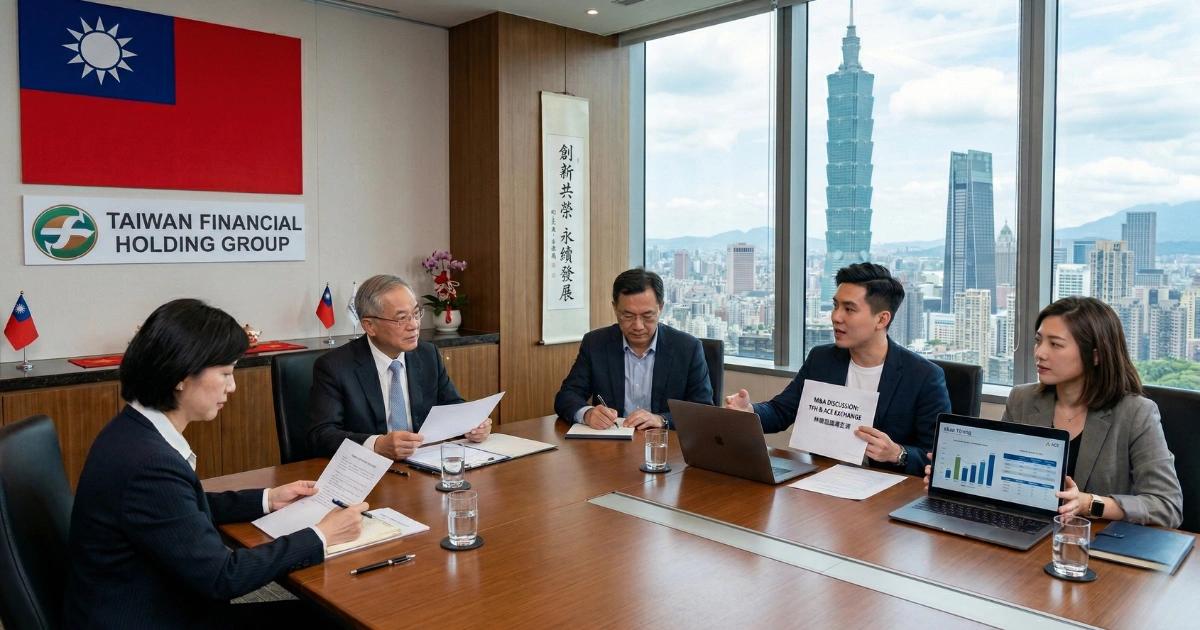
Taiwan’s crypto-specific regulatory bill is expected to go into effect this year. Economic Daily reports that the competition for mergers and acquisitions of VASPs (especially local exchanges) among Taiwan financial holding companies is now underway. Major players such as Fubon and Federal are positioning themselves through taking equity stakes or building their own platforms, symbolizing the accelerating convergence of traditional finance and the crypto industry.
Regulatory clarity is driving financial giants to pivot; the M&A competition for VASPs is officially underway
With the Financial Supervisory Commission (FSC) planning to roll out the “Virtual Asset Services Act” in 2026, Taiwan’s financial industry is seeing an unprecedented wave of transformation. The rapid formation of this regulatory bill provides a clear compliance path for traditional financial institutions to enter the cryptocurrency market. Looking at the current market context, financial holding groups have already shifted from merely arranging agent-based payment and settlement cooperation to seeking M&A strategies that grant them a leading role.
- Fubon Group has shown outstanding strategic foresight by establishing Fusheng Digital (TWEX Taiwan Virtual Asset Exchange) through its subsidiary Taiwan Mobile (3045). The platform officially launched in May 2025. This year, the cooperation memorandum between Mastercard and Fusheng Digital was signed to comprehensively advance on-chain transfers and cryptocurrency payment applications, making it the deepest financial holding presence in Taiwan at present. This telecom-led model combined with financial resources demonstrates traditional enterprises’ strong desire to expand their digital asset footprint.
- Federal Bank (2838) disclosed its investment layout in its year-end 2025 financial report. In August, the board approved investing USD 27.817 million to obtain about 9.67% equity in Modern Wealth Holding Company (MaiCoin Group’s parent company). Federal Bank also plans to transfer all the shares held by Federal Venture Capital to the bank entity itself, strengthening direct participation in virtual-asset business.
For financial holding groups, virtual assets are an emerging option within asset allocation. Against the backdrop of the Executive Yuan actively approving the draft legislation, issuing stablecoins without authorization would face severe penalties. This move effectively removes instability factors from the market, making compliant exchanges an excellent target in the eyes of financial institutions. M&A has become the best path for financial holding groups to quickly fill their technical shortfalls in on-chain finance.
- Related news: 2026 latest》Virtual Asset Services Act draft overview: Full解析 of stablecoins, licenses, and penalties
Valuation amounts range from the tens of billions to the hundreds of billions; financial holding companies and accounting firms conduct in-depth assessment
According to Economic Daily’s exclusive report, three bank-style financial holding companies and one life-insurance-style financial holding company have already shown strong willingness, and starting from early 2026, they will proactively approach various Virtual Asset Service Providers (VASP) to inquire about selling intentions. The core targets of these financial giants focus on vendors that have stable trading platform technology and large numbers of active users.
To ensure the precision of this cross-industry M&A, financial holding groups have already commissioned the “Big Four” accounting firms to conduct in-depth valuations and compliance risk assessments for specific targets. Financial institutions chose to step in at this time mainly because the bill has not yet fully cleared all requirements, and the value of the targets still allows room for negotiation. If they wait until the regulations are fully in effect and derivative product services are opened up, the valuation of quality targets will inevitably rise significantly, and entering the market then could mean missing the first-mover opportunity.
Based on industry analysis, the current M&A market quotation system is showing polarization. Taking MaiCoin Group, the largest local player in Taiwan as an example, if you estimate using Federal Bank’s investment amount and shareholding ratio, the M&A floor price is roughly around 10 billion yuan. If it cannot reach this valuation, vendors are highly likely to choose to push for an IPO (initial public offering).
As for up-and-coming firms with unique technical entry points or specific customer segments, their sale floor prices vary according to technical maturity, number of users, and growth prospects, ranging from several hundred million to several tens of billions. VASP vendors generally hold an open attitude toward this, believing that combining with financial holding groups can effectively close the gap between on-chain finance technology and traditional compliance teams. Especially in the process of promoting stablecoin regulations, the asset strength of financial institutions will become a key form of support for exchanges to move toward inclusive finance.
Up-and-comers show strong potential; HOYA BIT becomes a key piece of the on-chain puzzle
In this wave of M&A activity, the performance of emerging exchanges such as HOYA BIT (Hexia Digital Technology) has drawn intense market attention. Compared with traditional platforms that have been in operation for more than ten years, HOYA BIT demonstrates a very high degree of technical flexibility and market adaptability. The platform has long focused on providing a user-friendly trading experience; this customer-centered design philosophy and commitment to digital transformation align closely with bank-style financial holding companies.
Industry analysts believe that HOYA BIT’s technical architecture and its steadily growing user data make it an ideal target for mid-to-large financial holding companies looking to complete their virtual-asset portfolios. For financial holding companies that are currently watching from the sidelines, acquiring companies with high growth momentum and transparent operations can achieve transformation goals with more efficient costs.
In addition to HOYA BIT, vendors such as Taohuang Digital Technology and Cross-Chain Technology are also deepening their presence within their respective niche industries. Cross-Chain Technology focuses on serving institutional clients and reached an investment agreement with HeGu Venture Capital in January of this year. XREX Group, leveraging its advantages in institutional services and cross-border payments, attracted China Development Capital under Kai Fund (2883) as well as Tether, the world’s largest stablecoin issuer, to take an equity stake. The shared characteristic of these up-and-comers is that their interaction with financial institutions has long gone beyond simple capital flows and has moved into the deep-water zone of technology integration and business synergy.
BitoGroup trading sentiment remains solid; once the regulations are implemented, financial and crypto industries will accelerate their convergence
The fact that the M&A developments for BitoGroup are mentioned less often reflects differences in the degree of information disclosure. The estimated figure of 10 billion yuan for the MaiCoin Group exists because Federal Bank, as a listed company, must publicly disclose investment details in its financial reports, providing the market with an accurate reference coordinate.
As one of the two major giants alongside MaiCoin in Taiwan, BitoGroup has cultivated operations in Taiwan for over ten years, and its user base and capital scale still remain among the leading positions. The lack of publicly available valuation data only indicates that its current equity structure is relatively stable, or that it is in a more confidential negotiation phase. Its status as a benchmark leading player has not changed. When financial holding groups assess M&A targets, BitoGroup’s technical strength and market share remain weighty indicators that cannot be ignored.
Taiwan’s virtual-asset market is standing at a critical turning point for transformation. As stablecoin legislation and accounting guidance are gradually released,企業 recognizing stablecoin assets will become as readily deployable as deposits at any time, which will greatly stimulate demand from the corporate side for virtual-asset trading.
Whether it is three bank-style financial holding companies or life-insurance-style financial holding companies, their ultimate goal is to build an ecosystem of “on-chain integrated finance.” Even if some M&A negotiations ultimately do not come to fruition, cooperation between financial institutions and VASP operators will enter a brand-new phase. This M&A inquiry initiated by financial holding companies symbolizes that Taiwan’s crypto industry has officially moved on from a period of going it alone, and is accelerating into a new milestone of deep integration with the traditional financial system.
Disclaimer: The information on this page may come from third parties and does not represent the views or opinions of Gate. The content displayed on this page is for reference only and does not constitute any financial, investment, or legal advice. Gate does not guarantee the accuracy or completeness of the information and shall not be liable for any losses arising from the use of this information. Virtual asset investments carry high risks and are subject to significant price volatility. You may lose all of your invested principal. Please fully understand the relevant risks and make prudent decisions based on your own financial situation and risk tolerance. For details, please refer to
Disclaimer.
Related Articles
AWS Marketplace Integrates Chainlink Data Standards for Smart Contracts
AWS Marketplace is integrating Chainlink's data standards and services, enabling developers and enterprises to combine AWS compute, storage, database, and API infrastructure with smart contract capabilities, according to an announcement on Friday.
Chainlink Services Available on AWS
AWS users
CryptoFrontier2h ago
Aave Proposes 25,000 ETH to DeFi United for Kelp DAO Relief
Aave service providers put forth a governance proposal on Friday that would contribute 25,000 ETH worth nearly $58 million from the protocol's DAO to DeFi United, a coordinated relief effort to restore backing for rsETH following the Kelp DAO exploit, according to The Block.
The proposed contributi
CryptoFrontier3h ago
Aave, Kelp, LayerZero Propose Releasing $71M in Frozen ETH to Support rsETH Recovery
Gate News message, April 26 — A coalition of major DeFi protocols led by Aave Labs, joined by Kelp DAO, LayerZero, EtherFi, and Compound, filed a Constitutional AIP on Saturday morning asking the Arbitrum DAO to release approximately $71 million in frozen ETH to support DeFi United, a cross-protocol
GateNews7h ago
BHT Device Cluster DAPP Goes Live Globally, MOVA Ecosystem Application Layer Advances
Gate News message, April 26 — BHT (Balance Hub Terminal) announced today that its device cluster DAPP has officially launched globally, with operations beginning at 12:00 UTC / 08:00 ET on April 26, 2026.
As a core application layer within the MOVA Chain ecosystem, BHT focuses on device clusters an
GateNews10h ago
Fireblocks' 30 Web3 Partners Manage Over $200B in Monthly Stablecoin Flows
Gate News message, April 26 — Fireblocks, a leading institutional-grade asset transfer platform, operates a network of 30 Web3 business partners spanning DeFi protocols, payment settlement, compliance analysis, trading institutions, and multi-chain infrastructure. The partnership ecosystem is
GateNews11h ago
JPMorgan Says Tokenization Will Transform Funds Industry, but 'Good Use Cases' Still Years Away
Gate News message, April 26 — Ciarán Fitzpatrick, JPMorgan's global head of ETF product and securities services, said tokenization will drive change across the entire funds industry, not just ETFs. In a post on Friday (April 25), Fitzpatrick outlined how tokenized ETFs could offer enhanced
GateNews11h ago


