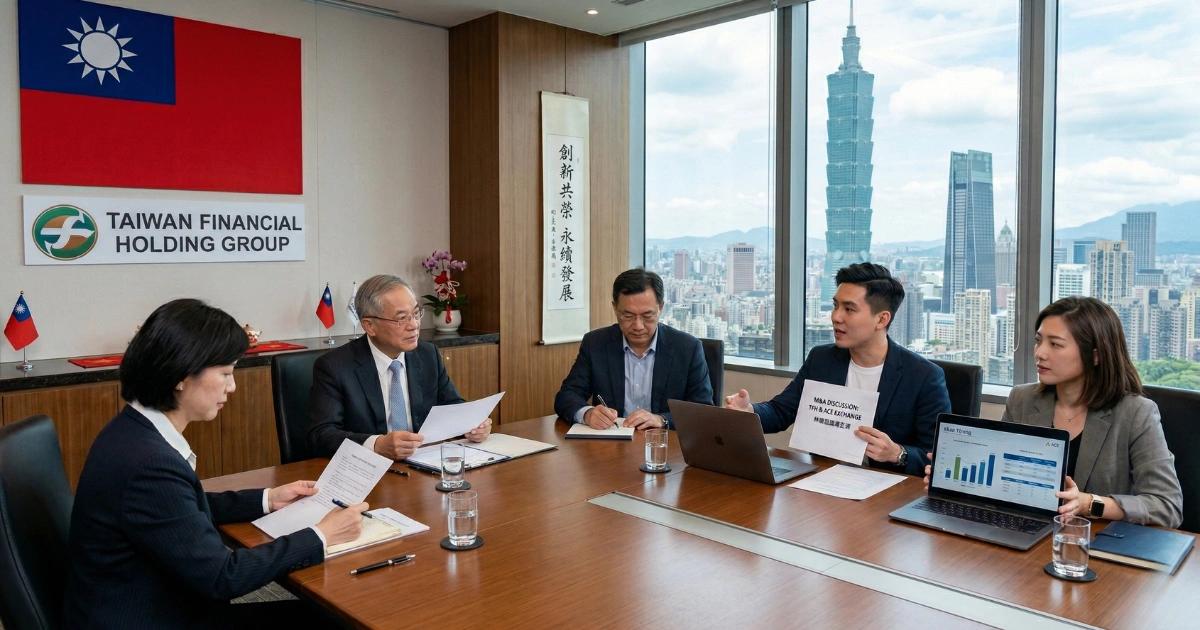
Taiwan’s crypto-specialized act appears likely to go into effect this year. Economic Daily reports that Taiwan financial holding company mergers and acquisitions (M&A) targeting VASPs—especially local exchanges—are getting underway. Giants such as Fubon and Federal are positioning themselves through taking equity stakes or building their own platforms, symbolizing faster convergence between traditional finance and the crypto industry.
Regulatory clarity is driving financial giants to pivot; the M&A competition for financial holding companies and VASPs is officially underway
With the Financial Supervisory Commission (FSC) expected to roll out the Virtual Asset Services Act in 2026, Taiwan’s financial sector is seeing an unprecedented wave of transformation. As this specialized legislation accelerates into form, it provides a clear compliance path for traditional financial institutions to enter the cryptocurrency market. Looking at the current market dynamics, financial holding groups have shifted from simply acting as agents for payment and settlement cooperation to seeking M&A strategies that come with stronger decision-making power.
- Fubon Group has demonstrated strong strategic foresight. Through its subsidiary Taiwan Mobile (3045), it set up Fu-Sheng Digital (TWEX Taiwan’s virtual asset exchange). The platform officially launched in May 2025. This year, Mastercard and Fu-Sheng Digital signed a memorandum of understanding for cooperation, fully推进 on-chain transfers and crypto payment application use cases, making it currently the deepest-penetrating financial-holding powerhouse in Taiwan’s布局. This model—combining a telecom leader with financial resources—shows traditional enterprises’ strong desire for a digital-asset footprint.
- Federal Bank (2838), meanwhile, disclosed its investment plans in its 2025 year-end financial report. In August, the board approved investing US$27.817 million to acquire about 9.67% equity in Modern Wealth Holdings Company (the parent of the MaiCoin Group). Federal Bank also expects to transfer all the shares held by Federal Venture Capital to the bank entity itself, strengthening its direct involvement in virtual asset business.
For financial holding groups, virtual assets are an emerging option in asset allocation. Against the backdrop of the Executive Yuan actively approving the draft specialized act, unilaterally issuing stablecoins would face strict penalties. This effectively eliminates instability factors in the market, allowing compliant exchanges—run in accordance with the rules—to become high-quality targets in the eyes of financial institutions. M&A has become the best path for financial holding groups to quickly close their technical gaps in on-chain finance.
- Related news: 2026 latest》Virtual Asset Services Act draft quick guide: stablecoins, licenses, and penalties—fully explained
Valuation amounts range from billions to tens of billions; financial holding groups and accounting firms kick off in-depth assessment
According to an exclusive report by Economic Daily, three bank-type financial holding companies and one life-insurance-type financial holding company have already shown strong intent and, starting in early 2026, will proactively reach out to various virtual asset service providers (VASPs) to ask about their willingness to sell. The core targets of these financial giants are firms that have stable trading platform technology and huge numbers of active users.
To ensure accuracy in this cross-industry M&A, financial holding companies have already commissioned the “big four” accounting firms to conduct deep valuation and compliance risk assessments on specific targets. The reason financial institutions are entering at this time is that the specialized act has not yet fully cleared the process, and the value of the targets still has room for negotiation. If they wait until regulations are fully implemented and derivative product services are opened, the valuation of high-quality targets is certain to rise significantly, and entering then may cause them to miss the opportunity.
Based on analysis from industry insiders, the current quotation framework in the M&A market shows a polarized pattern. Taking MaiCoin Group—the largest local player by scale in Taiwan—as an example, if you estimate based on Federal Bank’s investment amount and its ownership ratio, the M&A floor price would be roughly around NT$10 billion. If the deal can’t reach this valuation, industry players are highly likely to choose to push for an IPO—an initial public offering.
For up-and-coming players with unique technology entry points or specific customer segments, the sale floor price is distributed according to technology maturity, number of users, and growth prospects, ranging from several hundred million to tens of billions. VASP operators generally hold an open attitude toward this, believing that combining with financial holding companies can effectively close the gaps between on-chain financial technology and traditional financial compliance teams. Especially during the process of promoting stablecoin-related legislation, the asset strength of financial institutions will become key support for exchanges to move toward broader financial inclusion.
Up-and-coming players show strong potential; HOYA BIT becomes a key on-chain puzzle piece
In this wave of M&A activity, the performance of emerging exchanges such as HOYA BIT (禾亞數位科技) has attracted intense market attention. Compared with traditional platforms that have been operating for more than ten years, HOYA BIT demonstrates a very high degree of technical flexibility and market adaptability. The platform has long focused on providing a user-friendly trading experience. This customer-centered design philosophy and commitment to digital transformation closely aligns with bank-type financial holding companies.
Industry analysis believes that HOYA BIT’s technology architecture and steady, growing user data make it an ideal target for medium to large financial holding companies seeking to fill out their virtual asset portfolios. For financial holding companies that are currently observing, acquiring businesses like this—companies with high growth momentum and transparent operations—can achieve transformation goals at a more efficient cost.
In addition to HOYA BIT, firms such as 拓荒數碼科技 and 跨鏈科技 are also deepening their focus within their respective niche industries. 跨鏈科技 focuses on serving institutional clients and, in January of this year, reached an investment agreement with 合庫創投. XREX Group, leveraging its strengths in institutional services and cross-border payments, has attracted 中華開發資本 under 凯基金 (2883) and Tether, the world’s largest stablecoin issuer, to take equity stakes. A common trait among these emerging players is that their interaction with financial institutions has long moved beyond simple capital flows; it has entered the deep-water zone of technology integration and business synergy.
BitoGroup trading remains steady; the act’s implementation will accelerate the convergence of finance and crypto
The relatively low amount of discussion around BitoGroup M&A activity reflects differences in the level of information disclosure. The reason the MaiCoin Group’s estimated figure is NT$10 billion is that, as a listed company, Federal Bank must disclose investment details in its financial reports, providing the market with precise reference coordinates.
As one of the two major giants in Taiwan alongside MaiCoin, BitoGroup has cultivated the local market for more than ten years, and its user base and funding scale still remain at the forefront. The lack of publicly available valuation data only indicates that its current equity structure is relatively stable, or that it is in a more confidential negotiation stage. Its position as a flagship indicator leader has not changed. When financial holding groups assess M&A targets, BitoGroup’s technical strength and market share remain weighty indicators that cannot be ignored.
Taiwan’s virtual asset market is standing at a critical turning point. As stablecoin legislation and accounting guidance are gradually rolled out, recognizing stablecoins as corporate assets will be as readily deployable as deposits—this will substantially stimulate demand from corporate sides for virtual asset trading.
Whether it is three bank-type financial holding companies or life-insurance-type financial holding companies, their ultimate goal is to build an ecosystem of “on-chain integrated finance.” Even if some M&A negotiations ultimately fail to conclude, cooperation between financial institutions and VASP operators will enter an entirely new phase. This M&A inquiry initiated by financial holding groups symbolizes that Taiwan’s crypto industry has officially moved on from working alone, and is accelerating into a new milestone of deep integration with the traditional financial system.
Disclaimer: The information on this page may come from third parties and does not represent the views or opinions of Gate. The content displayed on this page is for reference only and does not constitute any financial, investment, or legal advice. Gate does not guarantee the accuracy or completeness of the information and shall not be liable for any losses arising from the use of this information. Virtual asset investments carry high risks and are subject to significant price volatility. You may lose all of your invested principal. Please fully understand the relevant risks and make prudent decisions based on your own financial situation and risk tolerance. For details, please refer to
Disclaimer.


