
For the week of April 6, the tokenized Pokémon trading card market’s weekly revenue rose to $5.38 million, slightly below the September 2025 peak. The path toward the near-high this time is structurally different: the September 2025 peak was concentrated in a single week driven by the Collector Crypt TGE, while the current high comes from an organically built-up total over six consecutive weeks, with Courtyard serving as the primary contributor.
The Courtyard Model: A Liquidity Wrapper for Physical Cards + Redeemable NFTs
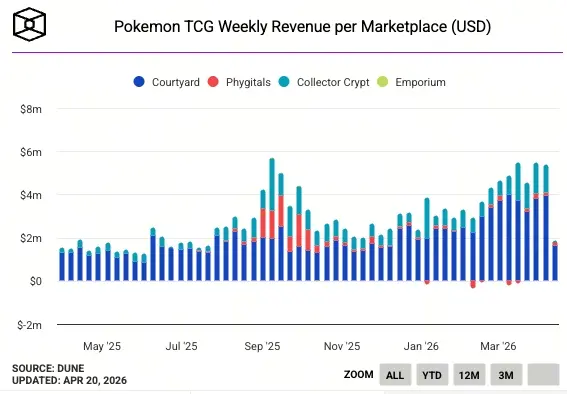
At the core of Courtyard’s design is this: users’ physical Pokémon cards are held in custody by a third-party institution, and the platform is backed by NFTs redeemable for physical cards. This design attracts a specific group of users—traditional collectors who want fragmented liquidity but are unwilling to take on crypto-native speculative risk. The tokenized layer plays the role of a “liquidity wrapper,” rather than a purely speculative tool.
More importantly, the tokens can be used directly for physical fulfillment, meaning the pricing function of the on-chain marketplace gains anchor validation from real assets—an essential capability that nearly all projects failed to achieve during the 2021 NFT boom.
The fundamental difference between tokenized collectibles and the NFT era
The root cause of the failure of most NFTs in 2021 was that most NFTs lacked real-asset anchoring or clear utility cases, with value heavily dependent on market sentiment. The sustainability of the Courtyard model is built on three structural differences:
Each NFT corresponds to a real card that is securely held by an institution and can be redeemed at any time; demand comes from the existing collectibles market for Pokémon cards and does not rely on a “crypto narrative”; tokenization makes it possible to circulate high-value physical cards on-chain, reducing transaction friction costs for trading premium cards.
This structure formally moves tokenized collectibles out of the “NFT-related” category, upgrading them into an RWA subcategory with standalone viability.
Long-term outlook: sports cards, luxury watches, or the next replicable track
Analysts note that if the Courtyard model is replicable, the next application areas with the most potential include sports cards (NBA, MLB), high-end luxury watches, limited-edition sneakers, and other categories—ones with established collectibles markets but constrained physical liquidity. The short-term risk is this: once the bullish cycle in the physical Pokémon card market ends, platform transaction volume could drop significantly.
Frequently Asked Questions
How do Courtyard tokenized Pokémon cards work?
After users hand their physical Pokémon cards over to a third-party institution for custody, they receive an NFT credential corresponding to those cards. These NFTs can be freely traded on-chain, and holders can request redemption of the corresponding physical cards at any time. This mechanism allows collectors to operate with liquidity without selling the physical cards, while also retaining ownership of the physical assets.
What is the fundamental difference between this peak and the 2021 NFT boom?
The trading volume of NFTs in 2021 was mainly driven by purely speculative demand, with no real-asset anchoring. Courtyard’s current peak is built on organic demand (sustained accumulation over 6 weeks rather than a one-week TGE burst), real-asset endorsement (each NFT corresponds to a real card), and service to the existing collectibles market (not relying on crypto-native users), making its sustainability significantly stronger.
What are the main short-term risks for the tokenized collectibles track?
The biggest short-term risk is the cyclical pullback of the physical Pokémon card market itself. Currently, Courtyard’s demand is highly dependent on the heat of the physical card market; once the Pokémon card collectibles hype fades, the tokenized market’s trading volume may also decline. Whether the platform can successfully expand into other categories such as sports cards and luxury watches is key to its long-term sustained growth.
Disclaimer: The information on this page may come from third parties and does not represent the views or opinions of Gate. The content displayed on this page is for reference only and does not constitute any financial, investment, or legal advice. Gate does not guarantee the accuracy or completeness of the information and shall not be liable for any losses arising from the use of this information. Virtual asset investments carry high risks and are subject to significant price volatility. You may lose all of your invested principal. Please fully understand the relevant risks and make prudent decisions based on your own financial situation and risk tolerance. For details, please refer to
Disclaimer.
Related Articles
Shiba Inu Outflows Hit 86B as Exchange Supply Tightens
Key Insights
Shiba Inu recorded over 86 billion tokens flowing out in 24 hours, reducing exchange supply and signaling lower immediate selling pressure across trading platforms.
Declining exchange reserves and negative net flows indicate ongoing asset withdrawals, tightening liquidity
CryptoNewsLand4h ago
Shiba Inu Outflows Hit 86B as Exchange Supply Tightens
Shiba Inu shows net exchange outflows, shrinking liquidity and easing near-term selling, amid price consolidation and active but limited retail repositioning.
An on-chain view of Shiba Inu shows a large 86 billion token outflow from centralized exchanges and persistent negative net flows, reducing near-term selling pressure. Price action is in a tight consolidation above support as exchange reserves shrink and withdrawals rise, creating supply-tight conditions. Activity indicates active repositioning with limited retail participation, implying a market rotation rather than a structural shift. The setup could yield stronger price moves if demand returns.
CryptoNewsLand4h ago
Aave, Kelp, LayerZero Propose Releasing $71M in Frozen ETH to Support rsETH Recovery
Gate News message, April 26 — A coalition of major DeFi protocols led by Aave Labs, joined by Kelp DAO, LayerZero, EtherFi, and Compound, filed a Constitutional AIP on Saturday morning asking the Arbitrum DAO to release approximately $71 million in frozen ETH to support DeFi United, a cross-protocol
GateNews7h ago
Metaplanet Issues ¥8B Bonds To Expand Bitcoin Holdings
Metaplanet raises ¥8B through zero-coupon bonds to fund Bitcoin purchases without immediate interest burden.
Firm grows BTC reserves to over 40K coins, targeting 100K by year-end despite valuation-driven losses.
Strategy relies on debt financing as stock declines, reflecting risk amid
CryptoFrontNews7h ago
Unknown Address Withdraws 219,000 LINK Worth $2.08M from Major CEX
Gate News message, April 26 — According to Onchain Lens, an unknown address has withdrawn 219,000 LINK tokens, valued at approximately $2.08 million, from a major CEX.
The address currently holds 785,000 LINK, worth approximately $7.43 million.
GateNews9h ago
Ethereum Foundation Sells 10K ETH To Bitmine OTC Deal
Ethereum Foundation sells 10K ETH through OTC to fund research, development, and ecosystem grants under treasury strategy.
Bitmine expands holdings through direct deals, nearing target to control about 5% of Ethereum total supply.
OTC transactions enable large crypto transfers with
CryptoFrontNews10h ago


