On April 6, Pi Network officially released Protocol 21.2 and simultaneously fully opened the Software Development Kit (SDK), covering the application development environment relied on by certified users—18 million in total—who have completed KYC identity verification within the ecosystem. Protocol 21.2 is a mandatory node upgrade; fully unlocking the SDK enables developers to build Pi payment integrations and deeper ecosystem applications.
Protocol 21.2: Mandatory Upgrade Threshold for Node Operators
 (Source: Pi Network forum moderators)
Protocol 21.2 is a mandatory upgrade for all Pi Network node operators. Nodes that have not been updated will lose their synchronized connection to the network and will be unable to continue participating in network operations. The primary goal of this upgrade is to enhance overall network stability. At the same time, it also prepares for higher-load activity levels, and builds foundational infrastructure for subsequent, more advanced decentralized features.
Three Core Upgrade Directions of Protocol 21.2
Strengthening Network Stability: Optimize node communication efficiency and establish a supporting foundation for larger-scale user activity
DEX Infrastructure Ready: Pre-establish the technical framework for future deployment of a decentralized exchange
Laying the Groundwork for Smart Contract Tools: Expand on-chain logic construction support to provide developers with a complete environment for later integrations
This upgrade is positioned as an important milestone in a more ambitious roadmap. Pi Network plans to gradually roll out more advanced decentralized features within the coming months.
Fully Unlocking the SDK: From Proof of Concept to Real Product Development
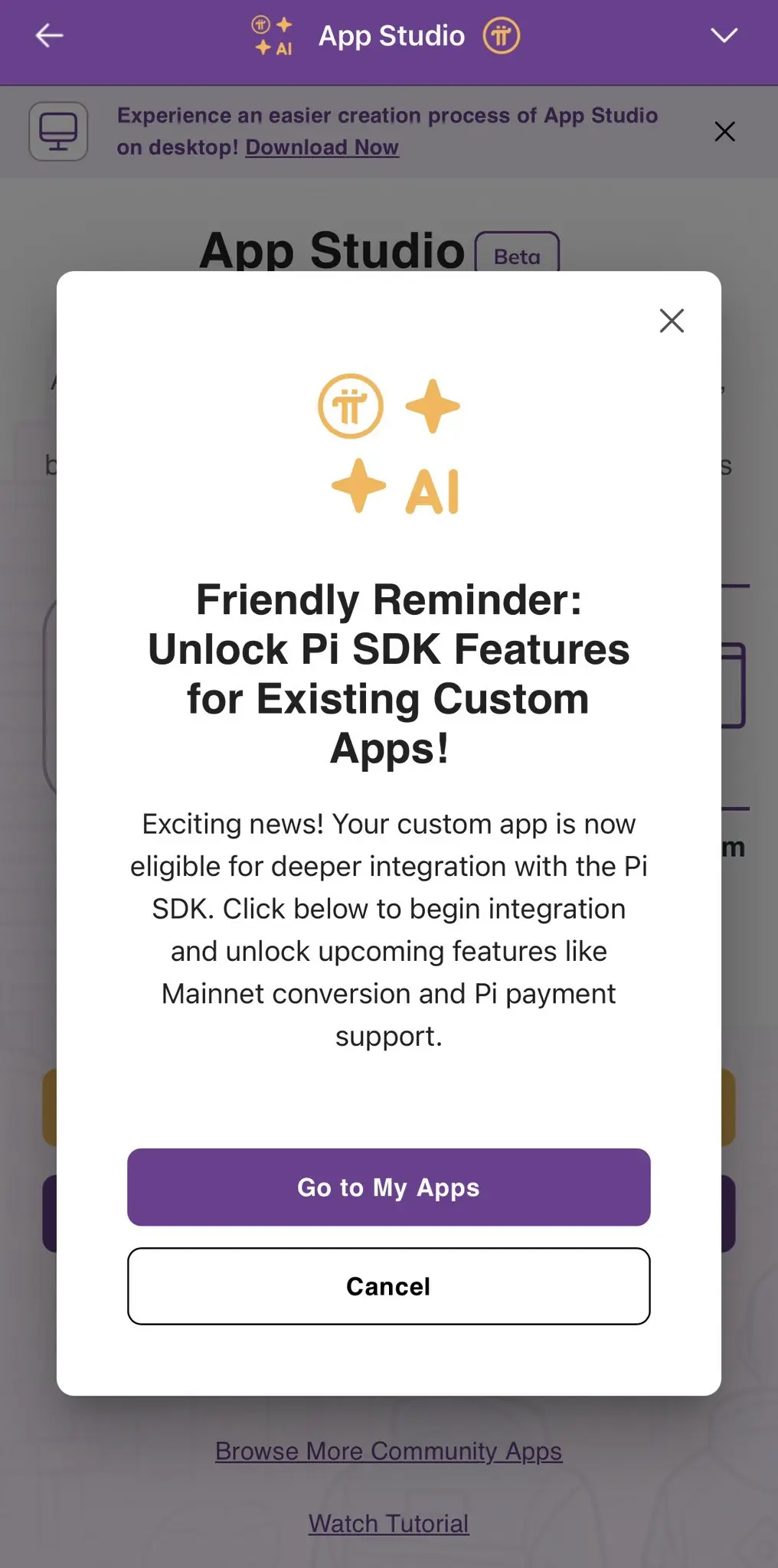 (Source: Pi App Studio)
Previously, the SDK features of Pi Network were limited, and developers could only conduct limited, trial-based application development. With the SDK fully opened, developers can now build functions that directly support Pi payments and begin preparations for the full launch of the mainnet, with the depth of integration between applications and the network increasing significantly.
This change has real significance for ecosystem development—developers are no longer confined to concept testing, but can build application products with real functionality using a more complete set of tools. Solana Foundation… Sorry, correction: Pi Network stated that as more developers join, the growth in the number of available applications is expected to further deepen overall network user engagement.
Ecosystem Transformation: Pi Network’s Strategic Shift Toward the Practical Application Layer
The simultaneous release of Protocol 21.2 and the SDK unlock jointly marks a clear shift in Pi Network’s development path—from an early construction phase centered on basic mining, moving into an application stage focused on payments, transactions, and decentralized services. The milestone of surpassing 18 million certified users provides scalable support for this transformation, in terms of a user base.
However, community responses are not entirely consistent. Some users hold a positive attitude toward the new tools and future direction, viewing this as a key turning point for ecosystem maturity; others express concerns about the transparency of the release process communication and the timing schedule, and inconsistencies in information about certain application versions have also led to confusion within the community. Despite this, Pi Network’s overall direction toward practical and usable ecosystem development remains steady. The transparency of execution and the quality of community communication will still be core indicators to watch going forward.
Frequently Asked Questions
Is Pi Network Protocol 21.2 a mandatory upgrade? What happens if you don’t upgrade?
Yes. Protocol 21.2 is a mandatory node upgrade. Users running nodes must complete the upgrade; otherwise, the node will lose its synchronized connection to the network and will be unable to continue participating normally in Pi Network operations.
What new features does the full SDK unlock for Pi Network bring to developers?
After the SDK is fully open, developers can build application functions that directly integrate Pi payments and make preparations for the full mainnet launch. The previously restricted integration capabilities are removed, enabling developers to move from concept testing to building complete products with real user scenarios.
What does the milestone of 18 million KYC-certified users mean for Pi Network?
18 million certified users is an important quantitative milestone for Pi Network as it moves toward the open-network stage. It indicates that the scale of active users with completed identity verification has already been established, providing direct user demand support for the rollout of ecosystem applications after the protocol upgrade and SDK opening.
Disclaimer: The information on this page may come from third parties and does not represent the views or opinions of Gate. The content displayed on this page is for reference only and does not constitute any financial, investment, or legal advice. Gate does not guarantee the accuracy or completeness of the information and shall not be liable for any losses arising from the use of this information. Virtual asset investments carry high risks and are subject to significant price volatility. You may lose all of your invested principal. Please fully understand the relevant risks and make prudent decisions based on your own financial situation and risk tolerance. For details, please refer to
Disclaimer.
Related Articles
Pi Network launches the PiRC1 token framework, banning projects that have no real-world applications from issuing tokens
Pi Network unveiled the Pi Token Design Framework PiRC1 on April 22 as part of the Protocol V22 upgrade. PiRC1’s core rule is: only projects that already have deployable applications within the Pi ecosystem and that have real user demand are eligible to issue tokens. Token proceeds do not flow to the project team; instead, they flow into a perpetual liquidity pool anchored by Pi Coin to prevent rug-pull behavior.
MarketWhisper04-24 03:27
OpenClaw 2026.4.22 Unifies Plugin Lifecycle Across Codex and Pi Harnesses, Reduces Plugin Load Time by Up to 90%
Gate News message, April 23 — OpenClaw, an open-source AI Agent platform, released version 2026.4.22 on April 22, with its biggest change being the alignment of Codex harness and Pi harness lifecycles. Previously, plugins behaved inconsistently across the two harness pathways, with some hooks
GateNews04-23 14:41
Pi Network releases an opinion solicitation draft for PiRC2, opening contract review for the testnet subscription
Pi Network core team released the second Pi Request for Comments draft (PiRC2) on April 23, announcing that the testnet will open subscription smart contracts for technical review and community feedback, and inviting developers to test the subscription feature integration, review contract design, and identify potential vulnerabilities. As of the time of reporting, the PI token is about $0.17, unchanged from the previous day.
MarketWhisper04-23 05:15
Pi Network founder May 7 discussed human identity verification in the AI era at Consensus 2026
Pi Network founder Nicolas Kokkalis will attend the Consensus 2026 conference in Miami on May 7, joining an expert panel to discuss online human identity verification issues in the age of artificial intelligence (AI). According to the official event schedule, this panel discussion will bring together experts in the fields of identity, privacy, and digital trust.
MarketWhisper04-21 06:20
Pi Network issues a node upgrade warning: if you haven’t upgraded by April 27, you risk being disconnected
Pi Network has issued an official notice to node operators, requiring them to complete the mandatory upgrade of the agreement version 22.1 (v22.1) by April 27, 2026; otherwise, they face the risk of their nodes being cut off from network connectivity. According to a Pi Network announcement, this upgrade must be carried out in strict version order. Currently, the system is running on version 21.2; the next step is to upgrade to v22.1, and no versions may be skipped.
MarketWhisper04-20 06:51


