
Blockchain security firm PeckShield monitoring shows that Hyperliquid’s liquidity vault HLP, a decentralized derivatives exchange, lost about $1.5 million over the past 24 hours. The attacker accumulated and built approximately $15 million worth of FARTCOIN long positions, and deliberately triggered a “suicidal” forced liquidation in a low-liquidity environment, forcing an on-paper loss of about $3 million.
Attack Tactics Breakdown: How the ADL Mechanism Is Systematically Exploited
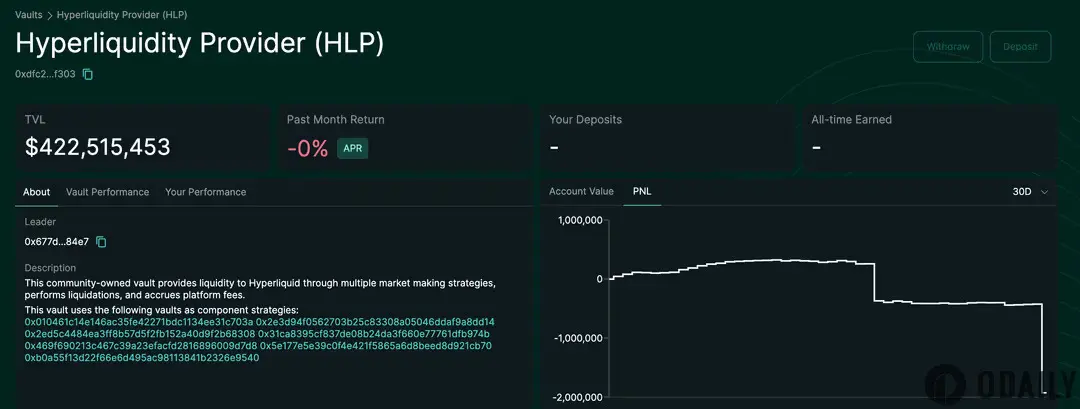 (Source: Hyperliquid)
On-chain analyst 0xMacroGuy on the X platform broke down in detail the operational logic behind this attack, revealing a new attack pattern targeting low-liquidity tokens and the ADL mechanism:
The Four-Step Execution Path of the “Suicidal Liquidation” Attack
Step 1 (Creating a Toxic Position): In four wallets, the attacker established high-leverage long positions for the FARTCOIN token, which has extremely poor liquidity, with a total size of $15 million
Step 2 (Intentionally Burning It): The attacker actively pushed the open positions into a losing state, burned its own margin, and triggered the forced liquidation conditions
Step 3 (Triggering ADL): After the positions were liquidated, Hyperliquid’s ADL mechanism was activated, forcing the system to transfer the toxic positions to the HLP liquidity vault
Step 4 (HLP Absorbs the Bad Debt): HLP was forced to absorb the attacker’s remaining bad positions and bad debt losses, with an on-paper loss of about $3 million
Actual Losses and Potential Hedging-Arbitrage Opportunities
There are some discrepancies in the data for this incident. PeckShield’s report puts the direct loss at about $1.5 million, while analyst 0xMacroGuy’s assessment shows that HLP lost about $1.2 million within 24 hours (about a 0.35% drawdown). The on-paper loss reached $3 million, but the analyst pointed out that the attacker may hold offsetting hedge positions elsewhere—while intentionally burning margin, it could realize a large net profit through cross-venue hedging.
This makes the nature of this incident closer to a carefully designed arbitrage operation rather than merely destructive behavior. Based on the latest data, the HLP vault’s total value locked (TVL) is reported at $420 million, and the annualized return over the past month is 0%.
ADL Mechanism Design Logic and Structural Risks
The ADL (automatic deleveraging) mechanism is the final line of defense for derivatives platforms after the insurance fund is depleted to prevent a market collapse. When position losses exceed the insurance fund’s capacity, the system automatically liquidates positions from the profitable side to cover the shortfall. The original intent of this mechanism is to maintain market stability, but this attack revealed a key vulnerability: in low-liquidity token markets, attackers can systematically exploit the ADL mechanism to shift their own losses to the liquidity vault, while completing hedging profits in external markets.
This is not the first time Hyperliquid has faced a similar issue. In March 2025, Hyperliquid encountered a similar liquidation manipulation incident mediated by the JellyJelly token; at that time, it took more controversial intervention measures to resolve the problem.
Frequently Asked Questions
What is a “suicidal liquidation” attack?
The attacker deliberately establishes high-leverage positions on a low-liquidity token, then intentionally pushes them into losses and triggers forced liquidation, activating the ADL mechanism and forcing HLP to take on toxic positions. At the same time, the attacker makes offset hedges in other places, thereby shifting losses and potentially realizing net profits.
What is the actual impact of this incident on Hyperliquid’s HLP?
PeckShield’s report shows that HLP’s direct loss is about $1.5 million, while analyst 0xMacroGuy estimates it at about $1.2 million (0.35% drawdown). The on-paper loss is about $3 million, but the attacker may achieve offsetting gains through cross-venue hedging. HLP TVL currently remains at $420 million.
Why was FARTCOIN chosen as the attack vehicle?
FARTCOIN has low-liquidity characteristics, which is a key condition for this type of attack. In low-liquidity markets, establishing and liquidating large positions causes a greater impact on the market price, making the ADL mechanism easier to trigger, and also making toxic positions harder to be absorbed and digested normally.
Disclaimer: The information on this page may come from third parties and does not represent the views or opinions of Gate. The content displayed on this page is for reference only and does not constitute any financial, investment, or legal advice. Gate does not guarantee the accuracy or completeness of the information and shall not be liable for any losses arising from the use of this information. Virtual asset investments carry high risks and are subject to significant price volatility. You may lose all of your invested principal. Please fully understand the relevant risks and make prudent decisions based on your own financial situation and risk tolerance. For details, please refer to
Disclaimer.
Related Articles
BNB Price Steady Above $633 as Bulls Face Strong Barriers
Key Insights:
BNB holds above the 50-day EMA near $633, supported by whale activity, while mixed derivatives data keep price action within a consolidation range.
Technical indicators, including RSI and MACD, show mild bullish momentum, though strong resistance levels near $662 and $680
CryptoNewsLand1h ago
Chainlink Price Tightens as $10 Resistance Holds Firm
Key Insights:
Chainlink trades between $8.5 and $10 as a tightening range signals volatility expansion, with buyers showing early strength through higher lows formation.
Open interest drops to $380 million while persistent spot outflows indicate cautious sentiment, though declining selling p
CryptoNewsLand2h ago
Solana Eyes $87 Breakout as Bullish Signals Strengthen
Solana sits near key resistance around $87 as on-chain activity and positive funding buoy bullish momentum; whale-led demand in derivatives supports a potential breakout. RSI >50 and positive MACD indicate rising upside, with a path toward $92–$97 and support near $77.
CryptoNewsLand2h ago
ETH Liquidation Cascade: $841M Long Positions at Risk Below $2,243, $395M Shorts Exposed Above $2,461
Gate News message, April 26 — According to Coinglass data, if Ethereum (ETH) falls below $2,243, cumulative long liquidations on major CEXs would reach $841 million.
Conversely, if ETH breaks above $2,461, cumulative short liquidations on major CEXs would total $395 million.
GateNews2h ago
Shiba Inu Price Compression Signals Imminent Breakout Phase
Key Insights:
Shiba Inu trades near $0.0000060 as tightening volatility and reduced momentum signal an approaching breakout phase after months of sustained decline.
Open interest declines to $68 million, while persistent spot outflows highlight cautious sentiment and limited conviction
CryptoNewsLand4h ago
Bitcoin Funding Rate Turns Negative at -0.0031%, Major CEXs Show Mixed Rates
Gate News message, April 26 — According to Coinglass, Bitcoin's 8-hour average funding rate across the network is currently -0.0031%, indicating a bearish sentiment among traders.
Among major centralized exchanges, funding rates vary: a leading CEX shows 0.0002%, another major CEX at -0.0004%, a th
GateNews5h ago


