
On-chain analysts Specter monitoring shows that on April 22, the North Korean hacker group TraderTraitor began money-laundering operations using the stolen funds from KelpDAO—only three hours after the Arbitrum Security Committee froze approximately 30,766 ETH. The attackers routed the funds via the THORChain bridge to the Bitcoin network, causing daily transactions to exceed 10 times the 30-day daily average.
Money-laundering operation details: three wallets, mixing methods, and cross-chain transfers
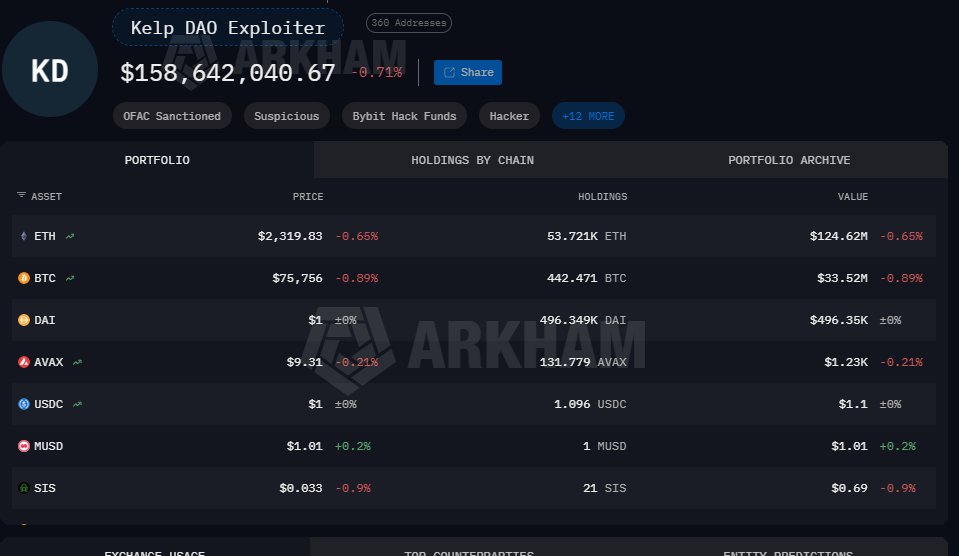
(Source: Arkham)
The attackers split the remaining funds across three wallets: the first held about 25k ETH (about $57.6 million), the second held about 25.7k ETH (about $59.2 million), and the third began laundering immediately after receiving the funds and currently has only about 3,800 ETH left (about $8 million).
During the laundering process, the stolen funds were mixed with the illicit proceeds from the BTC Turk (2025) and Bybit (2025) hacker incidents—this is a typical operational pattern for the TraderTraitor organization. By integrating funds from multiple incidents, it increases the difficulty of on-chain tracking. Specter noted that although it traced 356 related addresses, some intermediary wallets were not included in the statistics; the total number of addresses used throughout the process exceeds 400.
The downstream ripple effects of the KelpDAO attack: from Aave bad debt to a sharp drop in DeFi TVL
According to Messari’s analysis, the root cause of this attack lies in the LayerZero EndpointV2 1:1 DVN configuration, which allows attackers to forge cross-chain messages. After compromising two LayerZero DVN nodes, the attackers simulated the rsETH burn and triggered 116,500 unauthorized releases of rsETH.
The downstream impact spread rapidly across the entire DeFi ecosystem: estimated Aave bad debt ranges from $123.7 million to $230.1 million; TVL fell from about $45.8 billion to $35.7 billion; overall DeFi TVL declined by more than $13.0 billion within 48 hours; the AAVE token dropped by about 25%; and the WETH market reached 100% utilization, triggering a $6.2 billion outflow of funds.
Early response measures and the rsETH holder compensation plan
The main response measures include: the Arbitrum Security Committee freezing approximately 30,766 ETH; Kelp pausing all rsETH contracts on the mainnet and the L2 layer; and LayerZero prohibiting the future use of the 1:1 DVN configuration. Kelp is currently considering implementing a 16% proportional loss compensation measure for rsETH holders, but Messari pointed out that this could affect affected users’ confidence in the affected protocols and the pace of recovery.
Frequently Asked Questions
Why did TraderTraitor choose THORChain as the money-laundering channel?
THORChain is a permissionless cross-chain liquidity protocol that allows asset swaps between different blockchains without requiring KYC verification. In the earlier Bybit hacker incident, TraderTraitor also used the same THORChain channel, indicating that it has become the fixed operating pattern of the North Korean hacker group after large-scale theft.
Why did this money-laundering involve mixing funds with the Bybit and BTC Turk incidents?
Mixing funds is a standard money-laundering technique: after combining stolen funds from multiple incidents, it makes it harder for trackers to identify the original source and destination/ownership of specific funds. During the circulation of the stolen KelpDAO funds through THORChain, they were already mixed with illicit funds from the 2025 BTC Turk and Bybit hacker incidents, forming a funding trail that is even harder to unravel.
How will Kelp’s 16% proportional loss compensation plan affect rsETH holders?
If the compensation plan is ultimately confirmed, rsETH holders will bear approximately 16% of the loss according to their position size—meaning that for every 100 rsETH, the nominal value of assets will be discounted by about 16%. The compensation mechanism can help partially mitigate losses for affected users, but it may also affect how quickly the market restores confidence in rsETH and the Kelp protocol overall.
Disclaimer: The information on this page may come from third parties and does not represent the views or opinions of Gate. The content displayed on this page is for reference only and does not constitute any financial, investment, or legal advice. Gate does not guarantee the accuracy or completeness of the information and shall not be liable for any losses arising from the use of this information. Virtual asset investments carry high risks and are subject to significant price volatility. You may lose all of your invested principal. Please fully understand the relevant risks and make prudent decisions based on your own financial situation and risk tolerance. For details, please refer to
Disclaimer.
Related Articles
Shiba Inu Outflows Hit 86B as Exchange Supply Tightens
Key Insights
Shiba Inu recorded over 86 billion tokens flowing out in 24 hours, reducing exchange supply and signaling lower immediate selling pressure across trading platforms.
Declining exchange reserves and negative net flows indicate ongoing asset withdrawals, tightening liquidity
CryptoNewsLand52m ago
Shiba Inu Outflows Hit 86B as Exchange Supply Tightens
Shiba Inu shows net exchange outflows, shrinking liquidity and easing near-term selling, amid price consolidation and active but limited retail repositioning.
An on-chain view of Shiba Inu shows a large 86 billion token outflow from centralized exchanges and persistent negative net flows, reducing near-term selling pressure. Price action is in a tight consolidation above support as exchange reserves shrink and withdrawals rise, creating supply-tight conditions. Activity indicates active repositioning with limited retail participation, implying a market rotation rather than a structural shift. The setup could yield stronger price moves if demand returns.
CryptoNewsLand52m ago
Aave, Kelp, LayerZero Propose Releasing $71M in Frozen ETH to Support rsETH Recovery
Gate News message, April 26 — A coalition of major DeFi protocols led by Aave Labs, joined by Kelp DAO, LayerZero, EtherFi, and Compound, filed a Constitutional AIP on Saturday morning asking the Arbitrum DAO to release approximately $71 million in frozen ETH to support DeFi United, a cross-protocol
GateNews3h ago
Metaplanet Issues ¥8B Bonds To Expand Bitcoin Holdings
Metaplanet raises ¥8B through zero-coupon bonds to fund Bitcoin purchases without immediate interest burden.
Firm grows BTC reserves to over 40K coins, targeting 100K by year-end despite valuation-driven losses.
Strategy relies on debt financing as stock declines, reflecting risk amid
CryptoFrontNews4h ago
Unknown Address Withdraws 219,000 LINK Worth $2.08M from Major CEX
Gate News message, April 26 — According to Onchain Lens, an unknown address has withdrawn 219,000 LINK tokens, valued at approximately $2.08 million, from a major CEX.
The address currently holds 785,000 LINK, worth approximately $7.43 million.
GateNews6h ago
Ethereum Foundation Sells 10K ETH To Bitmine OTC Deal
Ethereum Foundation sells 10K ETH through OTC to fund research, development, and ecosystem grants under treasury strategy.
Bitmine expands holdings through direct deals, nearing target to control about 5% of Ethereum total supply.
OTC transactions enable large crypto transfers with
CryptoFrontNews7h ago


