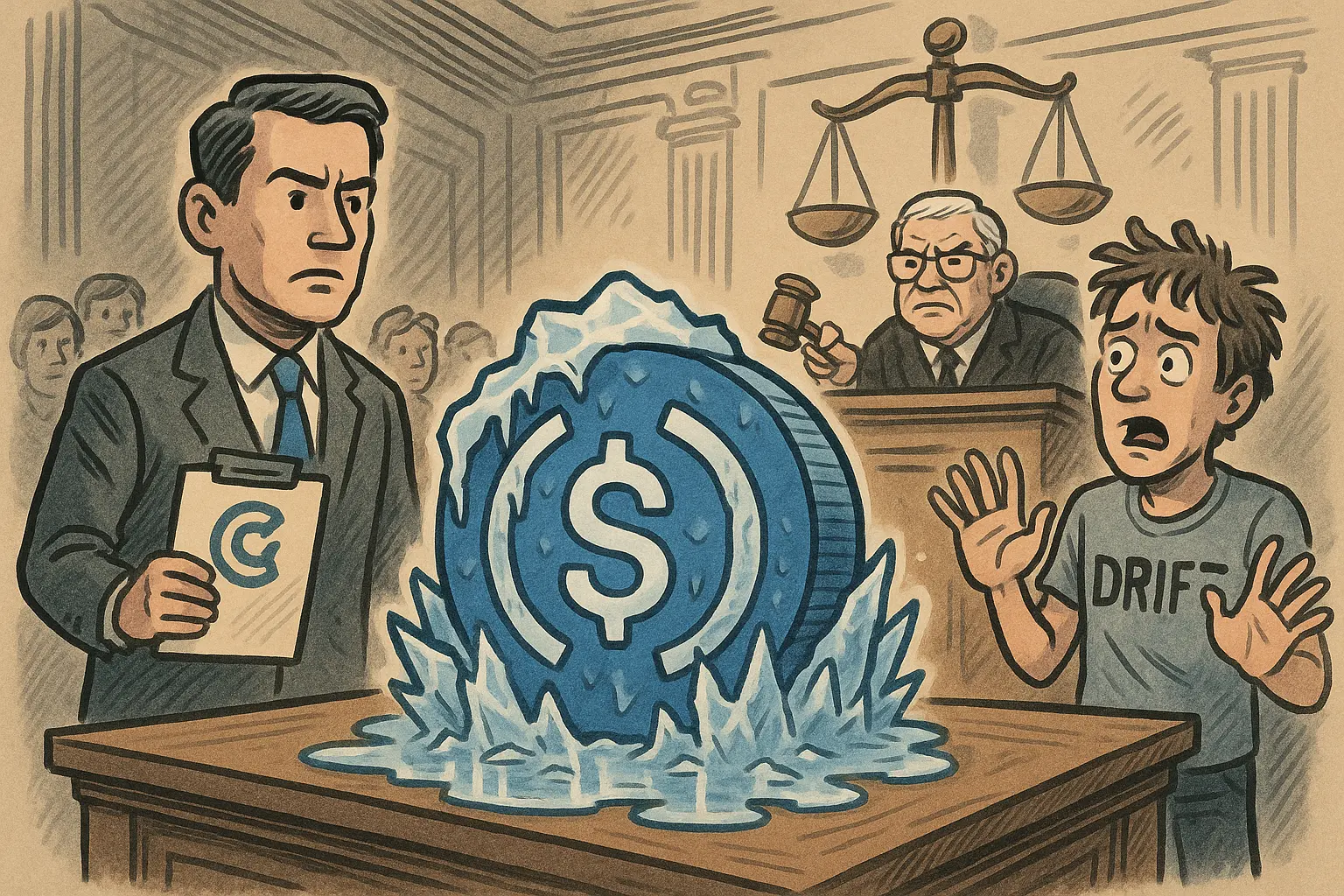
Representing more than 100 members, Joshua McCollum, a Drift Protocol investor, filed a lawsuit against Circle on Wednesday in the U.S. District Court for the District of Massachusetts. The lawsuit alleges that in the April 1 theft incident involving approximately $280 million worth of Drift Protocol, Circle allowed the attacker to transfer roughly $230 million USDC to Ethereum via a cross-chain transfer protocol.
The core of the lawsuit: The most compelling argument from a freezing precedent from a week earlier
Mira Gibb, the law firm representing McCollum, accused Circle of two violations: aiding and abetting misappropriation of assets, as well as negligence. The complaint states, “If Circle had taken action in time, these losses would not have occurred, or would have been significantly reduced.”
The strongest argument from the plaintiffs comes from a time-based comparison: about a week before the Drift incident, Circle had frozen 16 USDC wallets in a sealed U.S. civil case. The lawyers cite this fact to directly show that Circle had the technical capability to carry out an emergency freeze, yet chose to do nothing in the Drift case—shifting the dispute focus from “whether it could freeze” to “why it did not freeze.”
The amount of damages has not been determined and will be decided at the discretion of the trial outcome. As of now, Circle has not publicly commented on the lawsuit.
Questions around the North Korean hackers and the Tornado Cash money-laundering route
According to Elliptic’s investigation and analysis, during U.S. business hours in the location of Circle’s headquarters, the attacker executed more than 100 transactions using CCTP bridge technology. The operational pattern closely matches methods previously used by North Korea state-supported hacking groups. After the stolen USDC was transferred to Ethereum, it was converted into ETH and then used privacy-mixing through the Tornado Cash privacy protocol to obscure the trail of the funds.
Lorenzo Valente, head of digital assets research at ARK Invest, speculates that the stolen funds were likely ultimately used to fund North Korea’s nuclear weapons program, but also emphasized, “Whether the Circle case’s ruling is correct depends on how you weigh the rule-of-law principles against the real-world harm. Rational people have different opinions on this.”
Circle’s dilemma: Does freezing capability equal a freezing obligation?
Despite facing strong criticism, Valente publicly defended Circle’s decision, pointing out that freezing funds on its own without a court order would open the door for unfettered discretion in the future: “From now on, every freeze of an account is a judgment, and every decision not to freeze is a kind of political statement. Why freeze the Drift hacker’s account, but not that suspicious scam wallet?”
This argument highlights the structural dilemma faced by crypto companies between technical capability and legal authorization—whether stablecoin issuers should become active participants in on-chain enforcement, or whether they should simply rely on court orders. The federal court’s ruling in Massachusetts this time will set a key precedent for the industry’s boundary of responsibility.
Frequently Asked Questions
What specific legal allegations does Circle face in the Drift case?
The lawsuit includes two main allegations: first, failing to stop the attacker from transferring $230 million USDC via the CCTP bridging protocol, which constitutes aiding and abetting the misappropriation of assets; second, failing to take preventative measures against known security risks, which constitutes negligence. The plaintiffs’ attorneys seek monetary damages, with the specific amount to be determined at trial.
Why is the fact that 16 wallets were frozen a week earlier so critical to the lawsuit?
This fact directly undermines the potential defense position that “Circle is technically unable to implement an emergency freeze.” If Circle could freeze a week earlier but chose not to freeze in the Drift case, the court needs to examine whether its decision had reasonable grounds, or whether it constitutes blameworthy inaction. This is the core of how the plaintiffs build their argument for liability.
What broader impact would the ruling in this case have on the stablecoin industry?
If the court rules that Circle is responsible for failing to freeze the funds, it will have a major impact on the entire stablecoin industry: it would mean that issuers have a legal obligation to take proactive intervention within the scope of their technical capabilities, which could prompt other stablecoin issuers such as Tether and Paxos to re-examine their emergency response policies. Conversely, if Circle wins the case, it would establish a market standard of “no freezing without a court order.”
Disclaimer: The information on this page may come from third parties and does not represent the views or opinions of Gate. The content displayed on this page is for reference only and does not constitute any financial, investment, or legal advice. Gate does not guarantee the accuracy or completeness of the information and shall not be liable for any losses arising from the use of this information. Virtual asset investments carry high risks and are subject to significant price volatility. You may lose all of your invested principal. Please fully understand the relevant risks and make prudent decisions based on your own financial situation and risk tolerance. For details, please refer to
Disclaimer.
Related Articles
USDC Circulation Decreases by 700M Over Past 7 Days, Total Supply Reaches 78B
Gate News message, April 26 — Over the past seven days through April 23, Circle issued approximately 5.1 billion USDC while redeeming about 5.8 billion USDC, resulting in a net decrease of 700 million USDC in circulation.
USDAC's total supply stands at 78 billion, backed by approximately $78.2 bill
GateNews14h ago
RookieXBT-Linked Wallet Purchases 1.89M SPIKE Tokens for 25,000 USDC
Gate News message, a wallet address associated with @RookieXBT has executed a transaction spending 25,000 USDC to acquire 1.89 million SPIKE tokens.
GateNews04-26 00:41
USDC Circulation Decreases by 700M in 7 Days to 78B; Reserves Stand at 78.2B
Gate News message, April 25 — In the seven days through April 23, Circle issued approximately 5.1 billion USDC while redeeming about 5.8 billion, resulting in a net decrease of 700 million USDC in circulation. Total USDC circulation stands at 78 billion, backed by approximately 78.2 billion in
GateNews04-25 11:05
OSL Group and Circle Partner to Expand USDC Access Across Trading and Payment Platforms
Gate News message, April 24 — OSL Group (HKEX: 863), a global stablecoin payment and trading platform, announced a partnership with Circle (NYSE: CRCL), a leading financial platform company, on April 22 to expand USDC access across OSL's payment and trading ecosystem.
Through OSL Global, OSL's
GateNews04-24 19:19
Major CEX Launches Crypto Payment Card on Mastercard Network in Australia, Enabling USDC Payments
Gate News message, April 24 — A leading centralized exchange has launched a crypto payment card in Australia, partnering with Mastercard and Immersve to enable crypto-backed payments at merchants accepting Mastercard, including Google Play and Apple Pay. The service supports USDC and 37 USDC
GateNews04-24 18:42
Circle Mints 500M USDC on Solana in Two Transactions
Gate News message, April 24 — Circle, the stablecoin issuer, just minted 500 million USDC on the Solana blockchain, according to on-chain data.
The minting was completed in two separate transactions, each involving 250 million USDC.
GateNews04-24 15:32


