
Open-source AI desktop client Cherry Studio found to have a privacy-design flaw: after users shut off the option “anonymously sending error reports and data statistics,” the client continues to transmit identification data including device IDs, system information, and CPU architecture. After GitHub user Yuerchu posted packet-capture screenshots in Issue #14387 , developer kangfenmao acknowledged in the comments that the problem is real.
Issue breakdown: three types of events vary in how strictly they follow the “off” setting
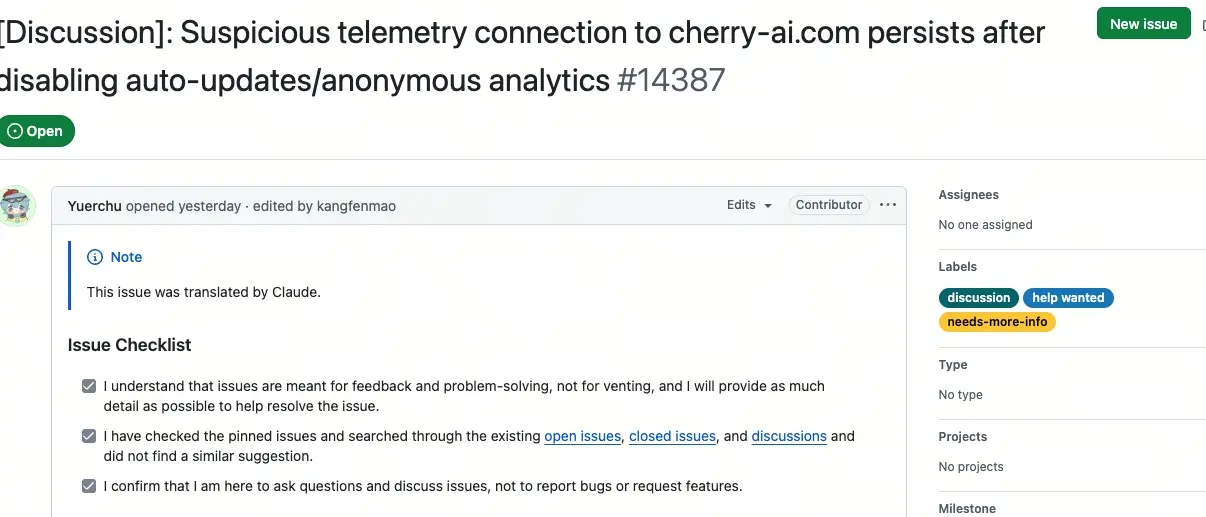
(Source: Github)
According to code auditing, the Cherry Studio client reports three types of events, but the behavior of all three differs fundamentally:
AI conversations: normally complies with the user’s switch setting; once turned off, nothing is reported.
App launch: directly bypasses the switch setting; it will be reported regardless of how the user sets it.
Update checks: also directly bypasses the switch setting; it will be reported regardless of how the user sets it.
Each outbound request includes a dedicated device ID, plus an operating system version, CPU architecture, and the app version number—forming a long-term device identification and tracking combination.
Code audit: the switch was deliberately removed on March 22
Community members reviewed the code and found that when this reporting mechanism was first added in February 2026, the switch worked for all three event types. However, on March 22, maintainer kangfenmao submitted a change that didn’t just remove the switch-check logic for app launches and update checks—it also bundled additional device identification information into the request headers.
This problematic code ran continuously across four versions—v1.8.3, v1.8.4, v1.9.0, and v1.9.1—for about a month before the community discovered it and publicly disclosed it.
An even earlier old hole: a hidden script that silently re-enables the upgrade switch
While tracking older versions of the code, the community found another layer of the issue: when the analytics feature was first added in February 2025, an upgrade script was also embedded—whenever a user was upgraded from an older version, the “anonymous statistics” switch would automatically be turned on once. After that, although the analytics service backend was changed in sequence from Google Analytics to PostHog and Sentry, and then to the current self-hosted analytics.cherry-ai.com, this script that automatically turns the switch back on was never removed.
The practical impact is: users who installed Cherry Studio before February 2025 and then performed any upgrades—regardless of whether they previously manually turned off that setting—will have the switch silently re-enabled after every upgrade, and they must manually turn it off again after upgrading.
FAQ
What device information does Cherry Studio specifically collect?
According to code auditing, each reporting request contains: a unique device ID (persistent tracking across sessions), the operating system version, CPU architecture, and the app version number. This combination of information allows long-term identification and tracking of specific devices in the analytics backend; even without a name or account details, it can still form an effective device fingerprint.
Are sensitive data such as chat content and API keys also sent out?
Developer kangfenmao has explicitly stated that sensitive data such as chat content, user input, documents, and API keys does not go through this reporting channel and is outside the scope of impacted data. What is currently being sent is only device-identification-related metadata.
What actions should affected users take now?
The fixed version has been merged via PR #14390, and it is recommended that users update immediately to the latest version. After updating, users should manually confirm that the privacy statistics switch is turned off—because of the issue with the old upgrade script, the upgrade process itself may turn the switch back on again. If you have higher requirements for privacy, it is recommended that after updating you verify—using a network monitoring tool—that requests to analytics.cherry-ai.com have stopped.
Disclaimer: The information on this page may come from third parties and does not represent the views or opinions of Gate. The content displayed on this page is for reference only and does not constitute any financial, investment, or legal advice. Gate does not guarantee the accuracy or completeness of the information and shall not be liable for any losses arising from the use of this information. Virtual asset investments carry high risks and are subject to significant price volatility. You may lose all of your invested principal. Please fully understand the relevant risks and make prudent decisions based on your own financial situation and risk tolerance. For details, please refer to
Disclaimer.
Related Articles
ComfyUI Raises $30M at $500M Valuation in Craft Ventures-Led Round
Gate News message, April 25 — ComfyUI, an AI creator tools startup, has raised $30 million at a $500 million valuation in a funding round led by Craft Ventures. Pace Capital, Chemistry, and TruArrow also participated in the investment, following a $19 million Series A round in late 2024 backed by Ch
GateNews16h ago
XChat Launches on App Store with End-to-End Encryption and Grok Integration
Gate News message, April 25 — XChat, the standalone messaging app from X (formerly Twitter), officially launched on Apple's App Store on April 25. The app is now available for download and use on iOS, with the Android version coming soon.
XChat allows users to log in directly with their X account,
GateNews17h ago
DeepSeek V4-Flash goes live on Ollama Cloud, US-hosted: Claude Code, OpenClaw one-click integration
Ollama Cloud has launched DeepSeek V4-Flash, with inference hosted on U.S. servers, providing three sets of one-click commands to connect Claude Code, OpenClaw, and Hermes. V4-Flash/V4-Pro use a MoE architecture, with native support for 1M context, and reduce costs with Token-wise compression + DSA sparse attention. In a 1M scenario, token FLOPs per token drop by 27%, and KV cache drops by 10%. API-compatible with OpenAI ChatCompletions and Anthropic, making it easy to switch between multiple workflows and lowering costs and data-sovereignty risk.
ChainNewsAbmedia04-24 10:45
OristaPay Launches AI-Powered Payment System on Telegram, Enables Instant USDT Settlements on TON
Gate News message, April 24 — OristaPay, a brand operating under RD Technologies, announced a complete payment pathway enabling AI agents to execute transactions within the Telegram ecosystem during the Hong Kong Web3 Festival. The system allows users to trigger digital asset transactions through na
GateNews04-24 07:01
DBS Expands Spark GenAI Program for Singapore SMEs
DBS announced on April 24 the expansion of its Spark GenAI program, developed in partnership with Enterprise Singapore and the Infocomm Media Development Authority (IMDA), to support local small and medium-sized enterprises (SMEs) in adopting artificial intelligence. The program uses a three-tier
CryptoFrontier04-24 06:41


