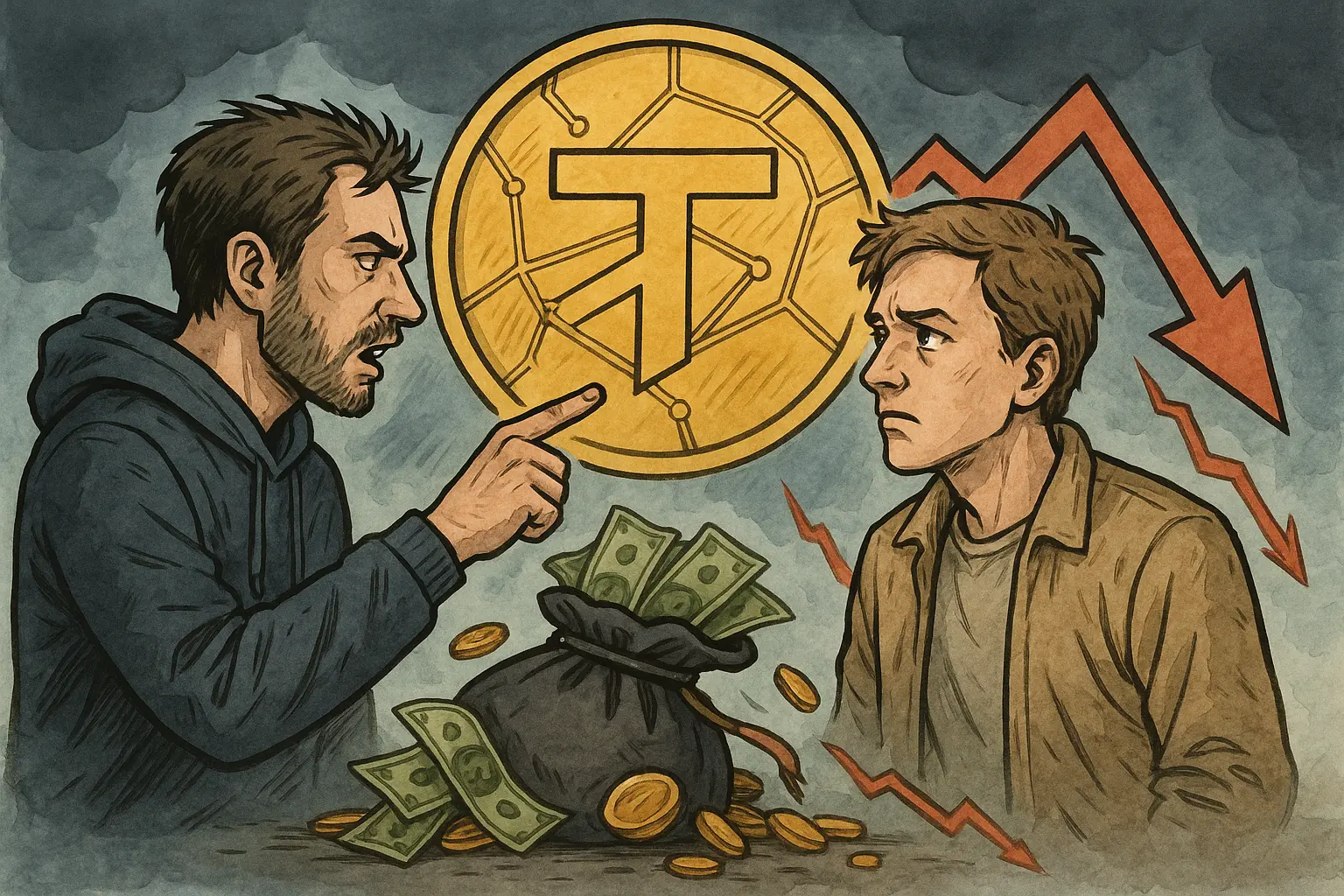
Bittensor co-founder Jacob Steeves has broken his silence over the Covenant AI exit event, accusing its key figure Simon Dare of intentionally causing the greatest possible harm to the agreement and the community, and calling it a “betrayal by someone who was like a brother to us.” The TAO token fell to $253 over the weekend and triggered a $9.1 million long liquidation, with the price rebounding to $263 on April 13.
Event Trigger: Covenant AI Exits and Both Sides Publicly Point Fingers at Each Other
The direct trigger for TAO’s sharp drop was Covenant AI’s sudden exit. On the X platform, Simon Dare explained the background behind his resignation by implying that the decline in TAO’s price in the days leading up to the turmoil was caused by Steeves selling tokens, indirectly accusing him of putting pressure on community members through his sell-off actions.
Steeves immediately responded in a personal statement, saying Dare had been “someone he viewed like a brother,” and accusing him that the way he exited was intended to create “the greatest possible pain.” “He let down everyone who bought his tokens and trusted him. He betrayed all of us,” Steeves said.
Steeves also rejected Dare’s claims about centralization in Bittensor as “unfounded,” and suggested that his former partner may be facing a personal crisis. Even so, he acknowledged that the incident indeed revealed the “real threat” to network stability, and apologized to investors who felt that during this turmoil, the “financial rug was pulled out from under them.”
Locked Staking Proposal: Replace Personal Trust With Cryptographic Promises
Steeves believes that this crisis exposed inherent weaknesses in human-led governance—“greed and selfishness” being the root problem Bittensor was originally designed to counter. He proposed shifting the governance foundation of the agreement from legal responsibility to cryptographic commitments that can be enforced by code on-chain.
Its core solution is the “Lock Stake” mechanism:
Core Design Points of the Lock Stake Mechanism
Verifiable Long-Term Commitments: Subnet owners can lock tokens for a specific period; during the lock-up period, the tokens cannot be transferred, providing the community with a record of on-chain commitments that can be checked
Quantifiable Dimensions of Commitments: Use the remaining time before tokens become transferable combined with the current holdings to measure the strength of the commitment
Prevent “Financial Runaway”: During the lock-up period, the founder cannot carry out large-scale token transfers, reducing the likelihood of a sudden exit from a mechanism-level perspective
Pure Mathematical Rules Replace Brand Trust: The agreement’s stability no longer depends on personal credibility, but is guaranteed by publicly auditable on-chain rules
Steeves plans to hold a public meeting next Thursday on Bittensor’s Discord channel, formally presenting the design proposal for the lock staking mechanism and taking questions from the community.
Rebuilding the Affected Subnets: The Resilience Advantage of Open-Source Architecture
For the related subnets that fell into uncertainty due to Covenant AI’s exit, Steeves confirmed that the community has initiated a reorganization process. Since Bittensor is built entirely on open-source code, miners and remaining community members will take over and revive the related projects, and the agreement itself’s continued operation does not rely on any single team.
“Functionally speaking, these subnets should not change,” Steeves pointed out, emphasizing that the vision for the related tools belongs to the entire ecosystem rather than any individual. He reiterated that Bittensor is still “the most decentralized AI protocol to date,” and characterized this crisis as the necessary evolution of the protocol toward maturity, not a fundamental structural collapse.
Frequently Asked Questions
Why did Bittensor’s TAO token plunge 25% on April 10?
The sudden exit of Covenant AI was the direct trigger for this TAO drop. After the incident broke out, market confidence deteriorated rapidly; within less than six hours, TAO fell from $337 to $253, with a market cap evaporation of about $650 million, and it triggered a forced long liquidation of $9.1M. The public standoff between the co-founders on social media further intensified market panic.
How does the Lock Stake mechanism prevent similar events from happening again?
Lock staking allows subnet owners to lock tokens for a specific period, during which the tokens cannot be transferred. This mechanism replaces personal credibility with on-chain code, providing the community with a verifiable long-term commitment signal, preventing the founders from conducting large-scale sell-offs or suddenly exiting the protocol without warning—shifting from legal accountability to cryptographic enforcement.
After Covenant AI exits, can the related subnets continue to operate?
Steeves confirmed that because Bittensor is fully open source, the affected subnets will be taken over by miners and community members and reorganized. He said, “Functionally speaking, these subnets should not change,” and that the protocol’s open-source design is the core mechanism for preventing single points of failure and ensuring the ecosystem continues to operate.
Disclaimer: The information on this page may come from third parties and does not represent the views or opinions of Gate. The content displayed on this page is for reference only and does not constitute any financial, investment, or legal advice. Gate does not guarantee the accuracy or completeness of the information and shall not be liable for any losses arising from the use of this information. Virtual asset investments carry high risks and are subject to significant price volatility. You may lose all of your invested principal. Please fully understand the relevant risks and make prudent decisions based on your own financial situation and risk tolerance. For details, please refer to
Disclaimer.
Related Articles
Gate Daily Report (April 27): Comments related to the Trump shooting incident boost the TRUMP coin; the U.S. Department of the Treasury will include Venmo in debt-inquiry donation payments
Bitcoin (BTC) sees a sharp short-term surge and rebound, temporarily trading at around $78,900 as of April 27. Trump’s provocative remarks about the shooting incident boosted the prices of meme coins such as TRUMP, MAGA, and DJT, because a carefully crafted narrative has once again come back into view. The U.S. Treasury has moved Venmo into the debt donation payment channel, after the previously strategic Bitcoin reserve bill stalled.
MarketWhisper1h ago
Ascending Triangle Breakout Loading? Top 5 Altcoins With 5x Upside Potential
Ascending triangles indicate growing buying pressure but need to be confirmed.
Toncoin and Fantom display better trends than others in consolidation.
Overall market conditions still play a crucial role in the success of breakouts.
A common technical pattern has begun to emerge among
CryptoNewsLand1h ago
Crypto Fear and Greed Index Rises to 47, Signaling Neutral Market Sentiment
Gate News message, April 27 — According to Alternative.me, the Crypto Fear and Greed Index stands at 47 today, indicating a neutral market sentiment. The index rose from 33 yesterday (April 26), reflecting a shift toward more balanced market
GateNews2h ago
Whale pension-usdt.eth's $110M Short on BTC and ETH Down $15.25M as April Rally Continues
Gate News message, April 27 — According to on-chain analyst Yujin's monitoring, whale pension-usdt.eth opened a 3x leveraged short position on $110 million worth of BTC and ETH near the start of April, but has since incurred a floating loss of $15.25 million as prices rallied throughout the month.
GateNews3h ago
BNB Price Steady Above $633 as Bulls Face Strong Barriers
Key Insights:
BNB holds above the 50-day EMA near $633, supported by whale activity, while mixed derivatives data keep price action within a consolidation range.
Technical indicators, including RSI and MACD, show mild bullish momentum, though strong resistance levels near $662 and $680
CryptoNewsLand7h ago
Chainlink Price Tightens as $10 Resistance Holds Firm
Key Insights:
Chainlink trades between $8.5 and $10 as a tightening range signals volatility expansion, with buyers showing early strength through higher lows formation.
Open interest drops to $380 million while persistent spot outflows indicate cautious sentiment, though declining selling p
CryptoNewsLand8h ago


