
On April 17, an on-chain analyst, Ai Auntie, disclosed on the X platform that a long-term whale who has held a large amount of tokens since the Ethereum ICO period transferred 2,000 ETH (about $4.63 million) to a multi-signature address. The receiving address has been identified as a “designated sell” address in its history—funds are typically deposited to an exchange shortly after the transfer.
On-chain path: ICO address to a suspected exchange-selling channel
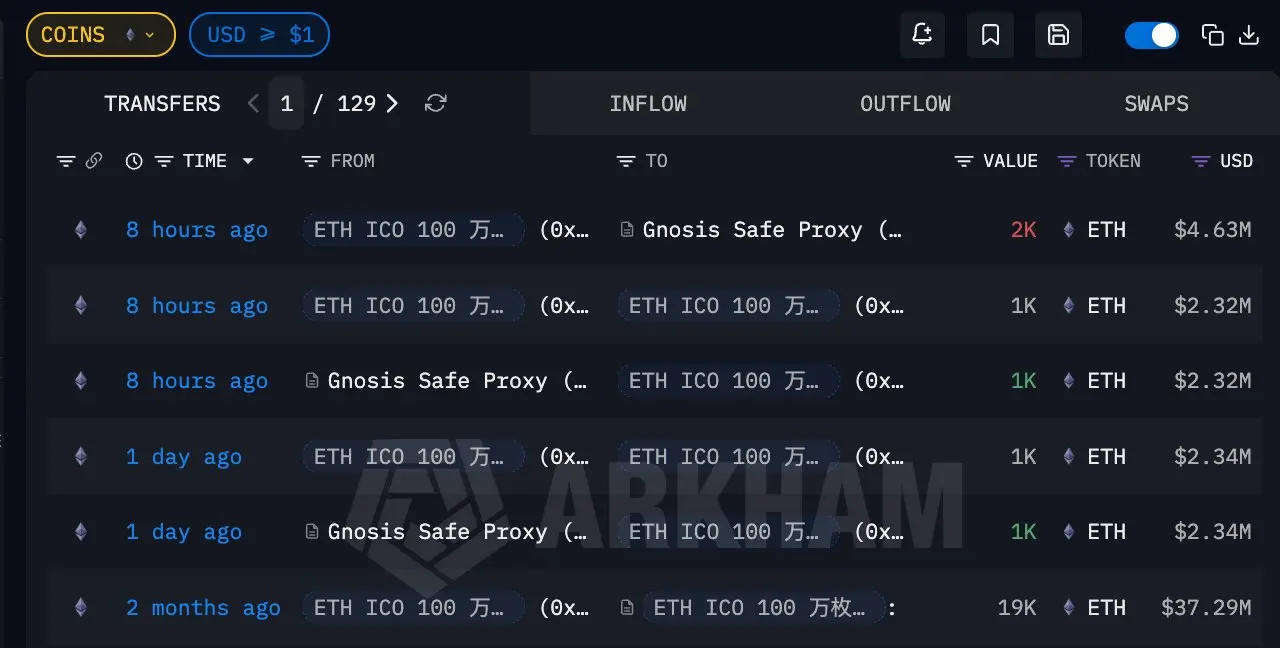
(Source: Arkham)
According to Ai Auntie’s tracking analysis, this capital flow shows a three-layer structure: original ICO address (0x7d61…841B4) → funding source address (0x2bf…E4087) → suspected sell address (0x26ca…B9392). The source address 0x2bf…E4087 has frequent on-chain interactions with block builders BuilderNet and Titan Build, while the receiving address has been categorized as an exchange funding channel based on its historical behavior patterns.
It’s worth noting that, as of now, the funds have only been confirmed to have reached the multi-signature address stage; whether they ultimately flow to the exchange for selling still requires confirmation from subsequent on-chain transfer records.
Technical view: an ascending channel and 100-day EMA support structure
Since ETH hit a low near $1,800 on February 24, it has been trading within an ascending channel on the daily chart. The 100-day exponential moving average (EMA) is currently at $2,355, and ETH is hovering around this level. If the closing price can hold above this level, it will confirm short-term technical strength.
The most closely watched bullish signal comes from the “Smart Money Index” (SMI)—this indicator tracks the price action during the 30 minutes before trades start and end, measuring the directional positions of informed traders. After the SMI broke above the zero axis in early April, it has continued to rise and is still holding above the zero axis, indicating that major institutional participants still tend to build long positions.
Bull-bear divergence: the whale reduces holdings and the derivative market sends a contrarian signal of turning short
However, on-chain and derivatives data provide a counterbalance to the technical optimism. On-chain data shows that, after excluding exchange holdings, the number of ETH held by the whale in the past 24 hours fell from 123.61 million to 123.44 million—down by about 170,000 ETH. At the current price, that is worth roughly $400 million—directional significance matters more than the absolute number.
The derivatives market also sends a cautious signal: ETH open interest decreased from $12.31 billion on April 14 to $11.98 billion, and the funding rate also shifted from positive 0.011% to negative 0.005%, suggesting that short positions have increased relative to before. However, the current short momentum is still not enough to trigger a strong liquidation squeeze—open interest has not seen a sharp contraction, and the funding rate is only slightly negative. The characteristics of large holders are more consistent with hedging rather than actively going short.
FAQ
Is this transfer of 2,000 ETH confirmed as a sell signal?
At present, only confirmation is that the funds have been transferred to a multi-signature address historically associated with exchanges; it has not been confirmed that the funds have entered the exchange to sell. Ai Auntie’s conclusion is based on the address’s historical behavior pattern. This is a probabilistic prediction rather than a definitive conclusion, and it requires confirmation by subsequent on-chain transfer records.
What signal is the Smart Money Index (SMI) currently sending?
Since early April, after breaking above the zero axis, the SMI has remained above the zero axis. Traditionally, this is interpreted as a positive indicator that informed traders are building long positions. However, the SMI has some lag; it should be interpreted together with other on-chain and derivatives data, and it should not be used alone as the basis for entering or exiting trades.
What impact does turning the funding rate negative have on ETH’s short-term price action?
When the funding rate flips from positive to negative, it means that short positions on the perpetual contract market have increased relatively, and longs need to pay shorts the funding fee. Currently, -0.005% is a mild negative value, which usually indicates a cooling of sentiment in the short term rather than a strong bearish signal. But if the negative value continues to expand, it could put downward pressure on ETH spot prices, and it may also increase the likelihood that shorts are forced to liquidate in the future.
Disclaimer: The information on this page may come from third parties and does not represent the views or opinions of Gate. The content displayed on this page is for reference only and does not constitute any financial, investment, or legal advice. Gate does not guarantee the accuracy or completeness of the information and shall not be liable for any losses arising from the use of this information. Virtual asset investments carry high risks and are subject to significant price volatility. You may lose all of your invested principal. Please fully understand the relevant risks and make prudent decisions based on your own financial situation and risk tolerance. For details, please refer to
Disclaimer.
Related Articles
Aave Proposes 25,000 ETH to DeFi United for Kelp DAO Relief
Aave service providers put forth a governance proposal on Friday that would contribute 25,000 ETH worth nearly $58 million from the protocol's DAO to DeFi United, a coordinated relief effort to restore backing for rsETH following the Kelp DAO exploit, according to The Block.
The proposed contributi
CryptoFrontier2h ago
ETH Liquidation Cascade: $841M Long Positions at Risk Below $2,243, $395M Shorts Exposed Above $2,461
Gate News message, April 26 — According to Coinglass data, if Ethereum (ETH) falls below $2,243, cumulative long liquidations on major CEXs would reach $841 million.
Conversely, if ETH breaks above $2,461, cumulative short liquidations on major CEXs would total $395 million.
GateNews3h ago
Aave, Kelp, LayerZero Seek $71M Frozen ETH Release on Arbitrum
A coalition of major DeFi protocols including Aave Labs, Kelp DAO, LayerZero, EtherFi, and Compound filed a Constitutional AIP on the Arbitrum forum Saturday requesting the network's DAO release approximately $71 million in frozen ETH for the rsETH recovery effort known as DeFi United. The Arbitrum
CryptoFrontier4h ago
Aave, Kelp, LayerZero Propose Releasing $71M in Frozen ETH to Support rsETH Recovery
Gate News message, April 26 — A coalition of major DeFi protocols led by Aave Labs, joined by Kelp DAO, LayerZero, EtherFi, and Compound, filed a Constitutional AIP on Saturday morning asking the Arbitrum DAO to release approximately $71 million in frozen ETH to support DeFi United, a cross-protocol
GateNews7h ago
Ethereum Foundation Sells 10K ETH To Bitmine OTC Deal
Ethereum Foundation sells 10K ETH through OTC to fund research, development, and ecosystem grants under treasury strategy.
Bitmine expands holdings through direct deals, nearing target to control about 5% of Ethereum total supply.
OTC transactions enable large crypto transfers with
CryptoFrontNews10h ago
ETH Liquidation Cascade: $635M Long Positions at Risk Below $2,217, $504M Shorts Exposed Above $2,430
Gate News message, April 26 — According to Coinglass data, if Ethereum falls below $2,217, cumulative long liquidations across major CEX platforms would reach $635 million. Conversely, if ETH surges above $2,430, cumulative short liquidations would total $504 million.
GateNews11h ago


