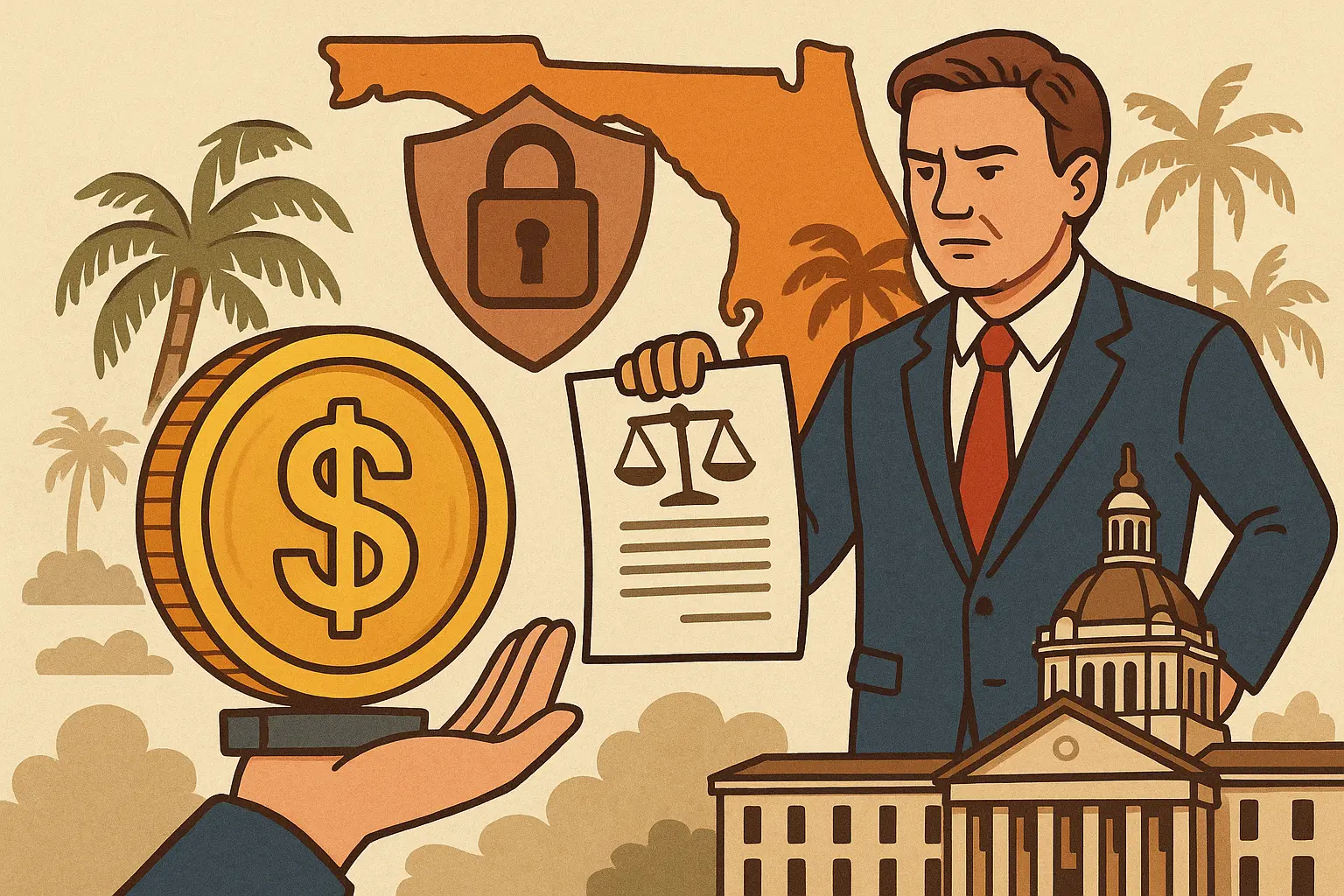
The Florida State Senate voted on Friday to pass Senate Bill 314, which requires stablecoin issuers operating in the state to obtain a license from the Florida Office of Financial Regulation before issuing tokens to residents. The bill aims to align state-level regulation with the federal framework established by the GENIUS Act signed into law by President Trump earlier this year. It is currently awaiting the governor Ron DeSantis’s signature.
SB 314 Bill Core Content: Licensing System and Federal Alignment
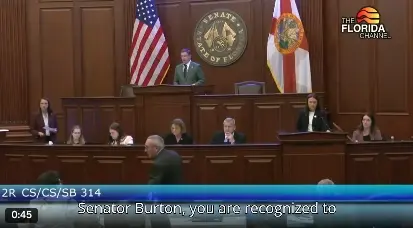
(Source: X)
The core mechanism of Senate Bill 314 is the establishment of a state-level licensing system. Any entity wishing to issue stablecoins to residents in Florida must first obtain a license issued by the Office of Financial Regulation before conducting business. This requirement applies to both in-state institutions and out-of-state issuers operating across borders.
Senator Burton explicitly stated that the design logic of the bill is to coordinate Florida’s regulatory approach with the framework of the federal GENIUS Act. The GENIUS Act allows banks and other approved entities to issue stablecoins, provided they hold qualified reserves such as U.S. Treasuries and disclose holdings monthly to ensure consumer protection and financial stability.
From Banning CBDC to Promoting Stablecoin Regulation: Florida’s Consistent Crypto Stance
Florida’s position on digital assets is highly consistent, rather than seemingly contradictory. Earlier, DeSantis made Florida the first state in the U.S. to legislate against Central Bank Digital Currencies (CBDCs). The core logic behind this is that government-issued digital currencies could threaten the private cryptocurrency market and expand government surveillance over citizens’ financial activities.
Banning CBDC and promoting stablecoin regulation reflect the same underlying policy logic:
Supporting the Private Market: Stablecoins issued by private entities align with market competition principles; CBDCs represent direct government control over currency.
Opposing Government Surveillance: The programmable nature of CBDCs allows governments to track every transaction, whereas private stablecoins, though regulated, retain core financial autonomy.
Regulation, Not Prohibition: This legislation is not about suppressing stablecoins but establishing a clear compliance framework to attract more crypto businesses to Florida.
During his early presidential campaign, DeSantis explicitly promised to protect Bitcoin and digital assets from restrictive regulations. Signing the stablecoin bill aligns with this stance.
Global Stablecoin Regulation Race: U.S. Context and Data Overview
Behind this legislation is the explosive growth of the global stablecoin market and the accelerated implementation of regulations worldwide. According to Bloomberg data compiled by Artemis Analytics, the global stablecoin trading volume is projected to reach $33 trillion in 2025, a 72% increase from the previous year. In terms of trading volume, USDC leads with $18.3 trillion, while Tether’s USDT volume is $13.3 trillion, but its market cap remains the largest at $187 billion.
On the international stage, Japan has established a legal framework for stablecoin issuance since 2023, Hong Kong plans to start issuing stablecoin licenses this year, and China, after briefly exploring allowing private companies to issue yuan-pegged tokens, has halted pilot programs and shifted to permitting commercial banks to pay interest on digital yuan balances.
Within the U.S., the Clarity Act remains controversial. Companies like Coinbase hope to allow stablecoin issuers to offer rewards to holders, while banking groups warn that such incentives could lead to deposit outflows to crypto platforms. Trump recently stated that banks should not interfere with government-supported cryptocurrency policies.
Frequently Asked Questions
Q: What specific impact will Florida SB 314 have on stablecoin issuers operating in the state after passage?
If signed by DeSantis, all entities wishing to issue stablecoins to residents in Florida, regardless of whether they are headquartered there, will need to apply for and obtain a license from the Florida Office of Financial Regulation beforehand. Existing issuers will need to assess their compliance status in Florida and may need to adjust reserve management and disclosure processes to meet licensing requirements.
Q: How does Florida’s stablecoin regulation framework relate to the federal GENIUS Act?
SB 314 explicitly aims to align state regulations with the federal GENIUS Act rather than create a parallel or conflicting regulatory system. The GENIUS Act requires stablecoin issuers to hold qualified reserves (such as U.S. Treasuries) and disclose holdings regularly. Florida’s licensing system will add a state-level approval layer on top of this, forming a dual-layer regulatory framework at both federal and state levels.
Q: If signed into law, how will Florida becoming the first state with a stablecoin regulation framework influence other states?
This marks a turning point in the evolution of U.S. stablecoin regulation from purely federal to a coordinated state-level approach. The actual implementation, including licensing procedures, approval timelines, and enforcement, will serve as a practical reference for other states developing similar frameworks. Given that the global stablecoin market’s trading volume reached $33 trillion in 2025, establishing a regulatory framework early could attract more related companies to set up operations in Florida.
Disclaimer: The information on this page may come from third parties and does not represent the views or opinions of Gate. The content displayed on this page is for reference only and does not constitute any financial, investment, or legal advice. Gate does not guarantee the accuracy or completeness of the information and shall not be liable for any losses arising from the use of this information. Virtual asset investments carry high risks and are subject to significant price volatility. You may lose all of your invested principal. Please fully understand the relevant risks and make prudent decisions based on your own financial situation and risk tolerance. For details, please refer to
Disclaimer.


