
Friday, XRP trading price remains steady at $1.40, supported by multiple market factors providing buffer. WTI crude oil fell about 2.40% to $78.65 per barrel, easing recent geopolitical conflict-driven oil price increases that contributed to inflationary pressures in the crypto market. Ripple CEO Brad Garlinghouse publicly supports the U.S. CLARITY Act, boosting market expectations for regulatory clarity.
Oil Price Retreat: How the Oil Market Becomes a Macro Transmission Channel for XRP
Since the outbreak of conflict between the U.S. and Iran, the oil market has become one of the most important macro transmission channels for the cryptocurrency market: rising oil prices → increased inflation expectations → delayed market expectations for rate cuts → suppression of risk assets → transmission to downward pressure on cryptocurrencies. The oil price decline on Friday interrupted this transmission chain, driven by factors including: potential U.S. intervention in futures markets allowing more Russian oil purchases; Treasury Secretary Scott Bessent announcing a 30-day temporary exemption allowing Indian refiners to buy Russian oil; and Trump administration energy policies pushing U.S. oil and gas production to record highs. Brent crude fell to about $83, WTI dropped to $78.65, providing some relief for XRP’s macro pressure.
CLARITY Act: Regulatory Clarity Expectations Supported by Ripple CEO
The CLARITY Act aims to establish clear rules to clarify the classification and regulatory framework for digital assets within the U.S., reducing current regulatory ambiguity. Brad Garlinghouse explicitly expressed support on March 3 on X platform, sharing strong signals from the Trump administration promoting regulatory clarity. For the XRP market, the expectation of regulatory clarity has multiple structural implications:
Enhancing Exchange Confidence: Clear classification standards reduce compliance uncertainty, encouraging more exchanges to list related products.
Promoting Institutional Participation: A clear legal framework is a prerequisite for institutional investors to enter.
Driving Product Development: Complete legal foundations are needed for XRP-based ETFs and structured financial instruments.
Derivatives Market Signals: Negative Funding Rates and DEX Activity Show Bullish-Bearish Divergence
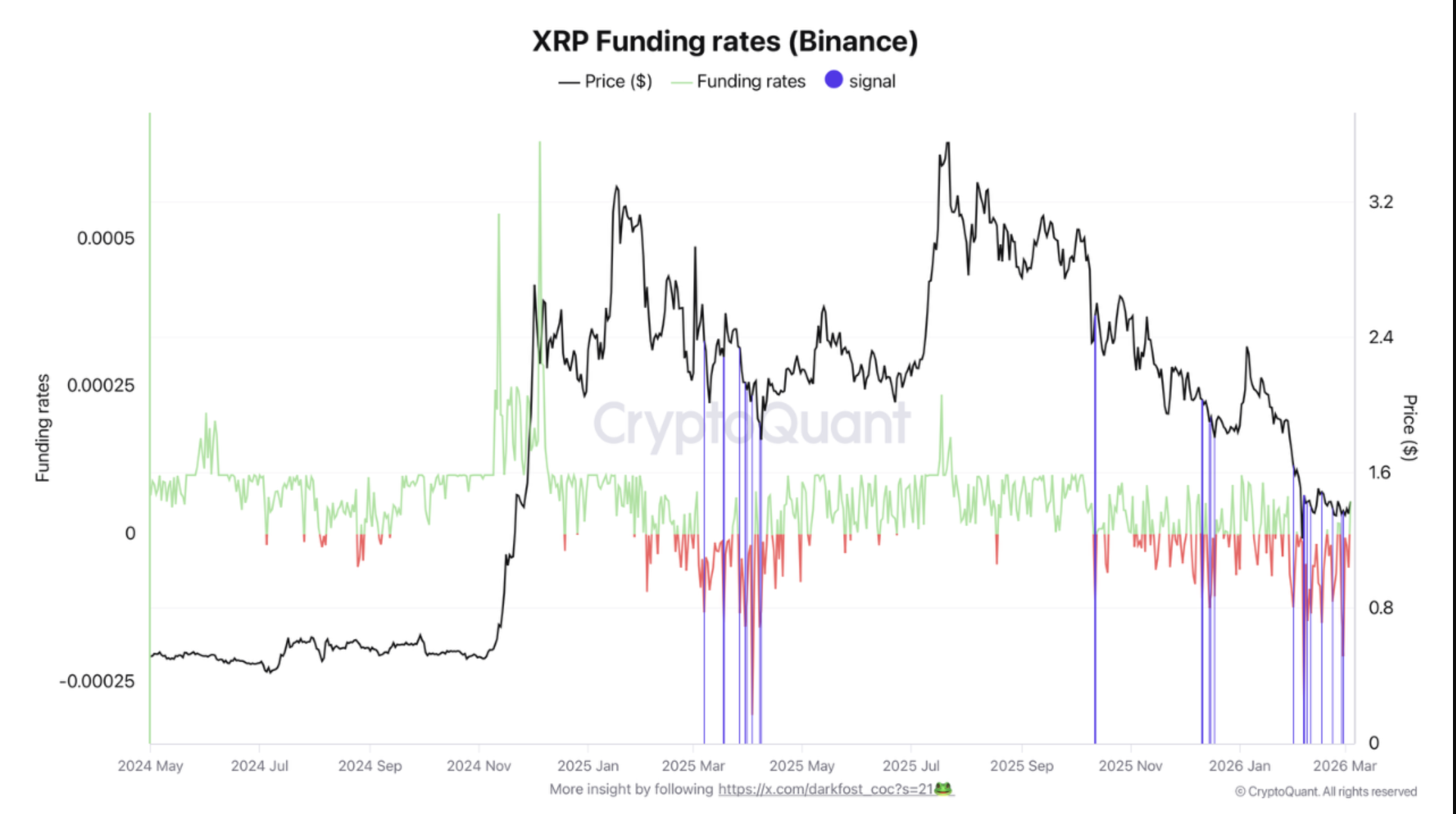 (Source: CryptoQuant)
On-chain analyst Darkfost (CryptoQuant affiliated) points out that XRP’s funding rate on Binance has turned significantly negative, with the current trading range between $1.35 and $1.50. Deeply negative funding rates typically indicate large leveraged traders betting on declines; when short positions are overly concentrated, such extreme readings often precede short-term rebounds or short squeezes. Darkfost also clearly states that this signal does not confirm XRP has bottomed, especially after experiencing about 60% correction in recent months, and should be evaluated in conjunction with other indicators.
Meanwhile, XRP Ledger’s DEX trading volume dropped from about $30 million in early February to approximately $5.1 million on March 3, a decline of over 80%. The significant contraction in DEX activity reflects weak speculative demand and declining on-chain participation, representing a major recent technical negative signal. However, its impact should be interpreted alongside funding rates, exchange volume, and overall macro sentiment.
Frequently Asked Questions
How does falling oil prices affect XRP’s market performance?
Rising oil prices intensify inflation expectations, delay rate cut timelines, and suppress risk assets like cryptocurrencies. The decline in oil prices reverses this transmission chain: Brent crude drops to about $83, WTI to $78.65, somewhat alleviating the macro pressure on XRP. This is a key macro background for XRP’s ability to stabilize around $1.40 on Friday.
What are the potential implications of the CLARITY Act for XRP?
The CLARITY Act aims to clarify the classification and regulatory framework for digital assets in the U.S. For XRP, regulatory clarity can help increase exchange listing willingness, promote institutional capital inflows, and facilitate the development of innovative financial products like ETFs centered on XRP, which are viewed as positive structural factors in the long term.
What does Binance XRP funding rate deep into negative territory imply?
According to CryptoQuant analyst Darkfost, a deeply negative funding rate indicates that many leveraged traders are betting on XRP’s decline. Historically, such excessive short positioning often precedes short-term rebounds, serving as a contrarian indicator. It should be evaluated together with other market indicators and not used as a direct prediction of price movement.
Disclaimer: The information on this page may come from third parties and does not represent the views or opinions of Gate. The content displayed on this page is for reference only and does not constitute any financial, investment, or legal advice. Gate does not guarantee the accuracy or completeness of the information and shall not be liable for any losses arising from the use of this information. Virtual asset investments carry high risks and are subject to significant price volatility. You may lose all of your invested principal. Please fully understand the relevant risks and make prudent decisions based on your own financial situation and risk tolerance. For details, please refer to
Disclaimer.


