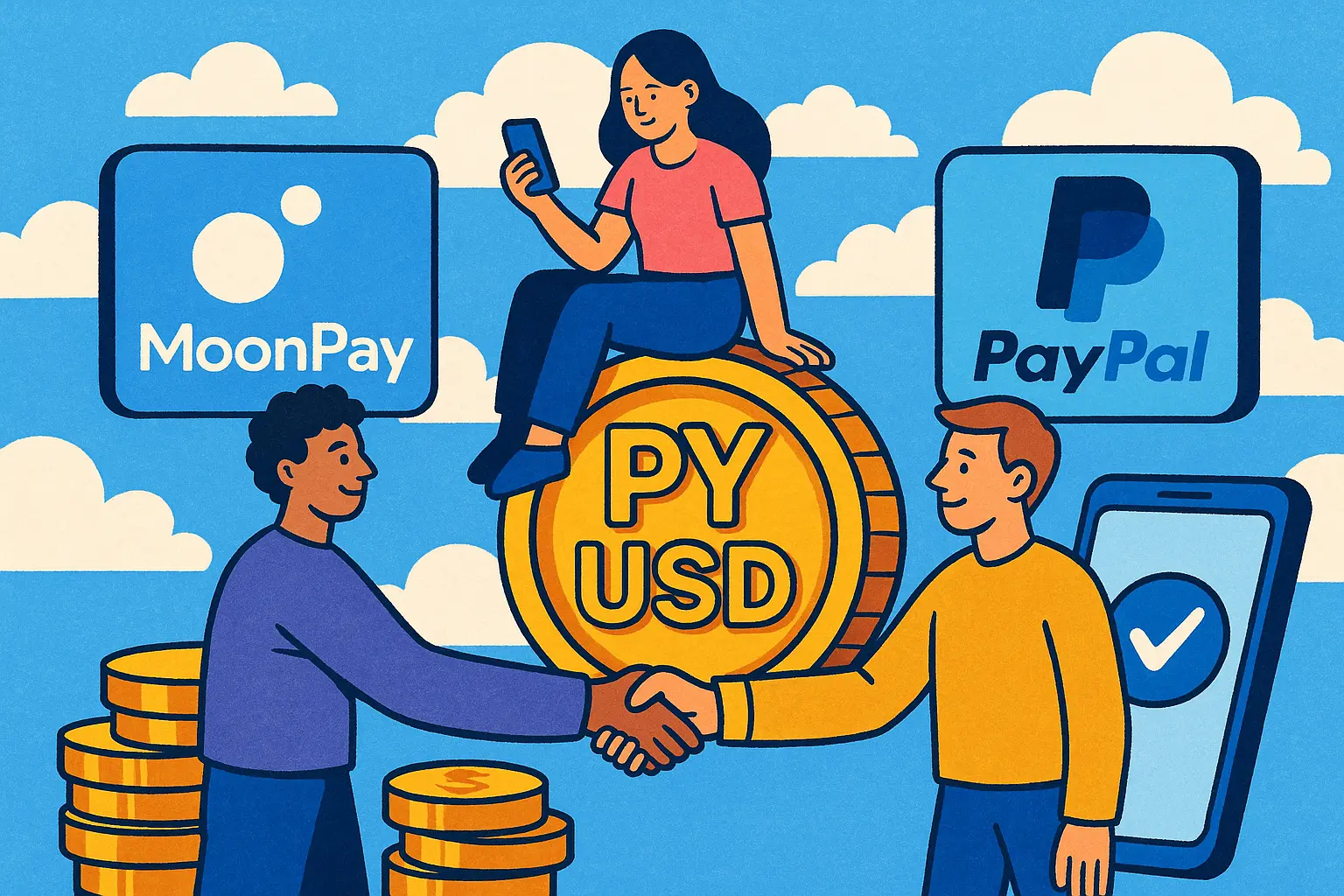
MoonPay and M0 announced the launch of the PYUSDx framework on February 27, allowing developers to quickly issue application-specific branded stablecoins using PayPal dollars (PYUSD) as a reserve asset, with the goal of reducing deployment time from months to days without the need to build issuance, custody and liquidity infrastructure themselves.
PYUSDx Framework: Infrastructure that lowers the barrier to entry for branded stablecoin deployment
PYUSDx’s core value proposition is to significantly lower the technical and compliance threshold for developers to launch their own stablecoins. Through this framework, developers can directly utilize PYUSD as a reserve asset, with MoonPay’s subsidiary MoonPay Digital Assets Limited as an independent tokenization and issuance framework operator, and PYUSD itself is issued and managed by the federally regulated Paxos Trust Company.
It is worth noting that tokens created through PYUSDx are two different assets from PYUSD itself - these branded tokens do not support storage or trading in PayPal or Venmo accounts, and their usage scenarios are defined by the deployed application party. This design allows PYUSD to extend to third-party ecosystems without directly integrating into PayPal’s consumer applications - PYUSD has long lagged behind USDC and USDT in circulation, and PYUSDx provides a differentiated expansion path.
MoonPay’s two-line layout: the stablecoin framework and AI agents are advancing in tandem
The launch of PYUSDx is not an isolated event but the latest step in MoonPay’s accelerated transformation. Just earlier that same week, MoonPay announced the launch of “MoonPay Agents,” a non-custodial layer designed to empower AI systems to autonomously create crypto wallets and execute transactions, representing MoonPay’s official foray into the AI-driven financial infrastructure space.
The two-line layout (PYUSDx framework + MoonPay Agents) shows that MoonPay’s positioning is shifting from a traditional fiat-to-crypto entrance to a middle-layer infrastructure provider between regulated stablecoin issuers and AI-driven financial application developers.
PYUSDx framework key architectural essentials
Reserve assets:P YUSD (issued by Paxos Trust Company, federally regulated)
framework operator:MoonPay Digital Assets Limited (a subsidiary of MoonPay)
Deployment velocity targets: Complete branded stablecoin deployment within a few days (compared to months of traditional processes)
Important Limitations:P YUSDx token is a different asset from PYUSD and does not support PayPal or Venmo account storage/trading
partners:M0 (technical partner of the collaborative launch framework)
Market Background:P YUSD circulation has been lower than USDC and USDT for a long time; PYUSDx offers a differentiated expansion path
Frequently Asked Questions
How does the PYUSDx framework relate to and differ from PYUSD itself?
PYUSDx is a tokenized issuance framework for PYUSD-based reserve assets, operated by MoonPay Digital Assets Limited as a standalone framework, while PYUSD itself is issued and managed by Paxos Trust Company. Branded tokens created through PYUSDx are separate assets that are not supported for use in PayPal or Venmo accounts, and their functionality is defined by the application party deploying the token.
How is MoonPay’s PYUSDx strategically connected to MoonPay Agents?
Together, the two form MoonPay’s infrastructure transformation strategy: PYUSDx allows developers to quickly deploy branded stablecoins, and MoonPay Agents enables AI systems to conduct crypto transactions autonomously. MoonPay is trying to become an intermediary layer between regulated stablecoins and AI-driven applications, serving the infrastructure needs of fintech developers and AI builders.
Why is PYUSD in circulation lower than USDC and USDT, and can PYUSDx improve this situation?
PYUSD lags behind in circulation, partly due to its primary channels being confined to the PayPal and Venmo ecosystems. The PYUSDx framework allows third-party developers to create their own branded tokens with PYUSD as a reserve, expanding its reach in the broader ecosystem without directly integrating PYUSD, but the ultimate effect depends on the scale of developer adoption.
Disclaimer: The information on this page may come from third parties and does not represent the views or opinions of Gate. The content displayed on this page is for reference only and does not constitute any financial, investment, or legal advice. Gate does not guarantee the accuracy or completeness of the information and shall not be liable for any losses arising from the use of this information. Virtual asset investments carry high risks and are subject to significant price volatility. You may lose all of your invested principal. Please fully understand the relevant risks and make prudent decisions based on your own financial situation and risk tolerance. For details, please refer to
Disclaimer.
Related Articles
Aave Labs audits 1.5 million with zero vulnerabilities in 900 people, the V4 security revolution is here
Aave Labs invested $1.5 million in a comprehensive security audit lasting 345 days before the V4 release, collaborating with four top security firms, launching a public competition that attracted 900 researchers. The audit employed multi-angle parallel testing and formal verification to enhance security and foster institutional trust. The new architecture design of V4 helps reduce DeFi risks and aims to maintain zero major incidents after the mainnet launch.
MarketWhisper28m ago
GMX responds to MegaETH launch progress concerns, contract deployed, official launch date to be announced
GMX responded to community questions about the MegaETH launch progress by stating that since the mainnet went live in February, ecosystem development has been steadily progressing, with most protocols still in testing. The team has deployed smart contracts and is working to ensure liquidity and optimize user experience, but a formal launch date has not yet been determined.
GateNews1h ago
Backpack US appoints former CFTC Commissioner and DTCC Acting Chairman Mark Wetjen as President
PANews March 6 News, according to Cointelegraph, Backpack US has appointed Mark Wetjen as President. Mark Wetjen previously served as a Commissioner and Acting Chairman of the U.S. Commodity Futures Trading Commission (CFTC), and worked at the Depository Trust & Clearing Corporation (DTCC).
GateNews1h ago
Vitalik calls for a rethinking of Ethereum's application layer: assuming there are no users, how would the white paper be rewritten?
Ethereum co-founder Vitalik Buterin recently called on the community to be more bold in innovating at the application layer while maintaining core values. He believes that the security and principles of the base layer should remain unshaken, but the application layer should be more disruptive and experimental. He explored the future design of privacy technologies and DeFi, and advocated for rethinking Ethereum's applications, even suggesting that if there were no users, developers should consider how to rewrite the application section of the white paper from scratch to face future challenges.
ChainNewsAbmedia2h ago
U.S. Bitcoin reserves expand to enter the top 20 globally, Tinder founder increases purchase by 1.8 million shares
American Bitcoin Company (ABTC) Bitcoin reserves increase to 6,500 coins, ranking among the top 20 publicly listed companies worldwide. Despite stock price fluctuations, the reserve news prompted an 11.7% rise in stock price. ABTC is expanding its mining machine hash rate and plans to invest in reducing Bitcoin acquisition costs. Board member Tinder founder recently increased his holdings by purchasing 1.8 million shares.
ChainNewsAbmedia3h ago


