Ethereum Foundation researcher Justin Drake officially released the “Strawmap” roadmap on February 18, outlining plans to complete seven protocol forks by the end of 2029, with upgrades scheduled every six months. The roadmap focuses on L1 finality, Gigagas L1 scaling, Teragas L2 data processing, post-quantum cryptography security upgrades, and native L1 privacy protection.
Analysis of the Five Core Goals of Strawmap
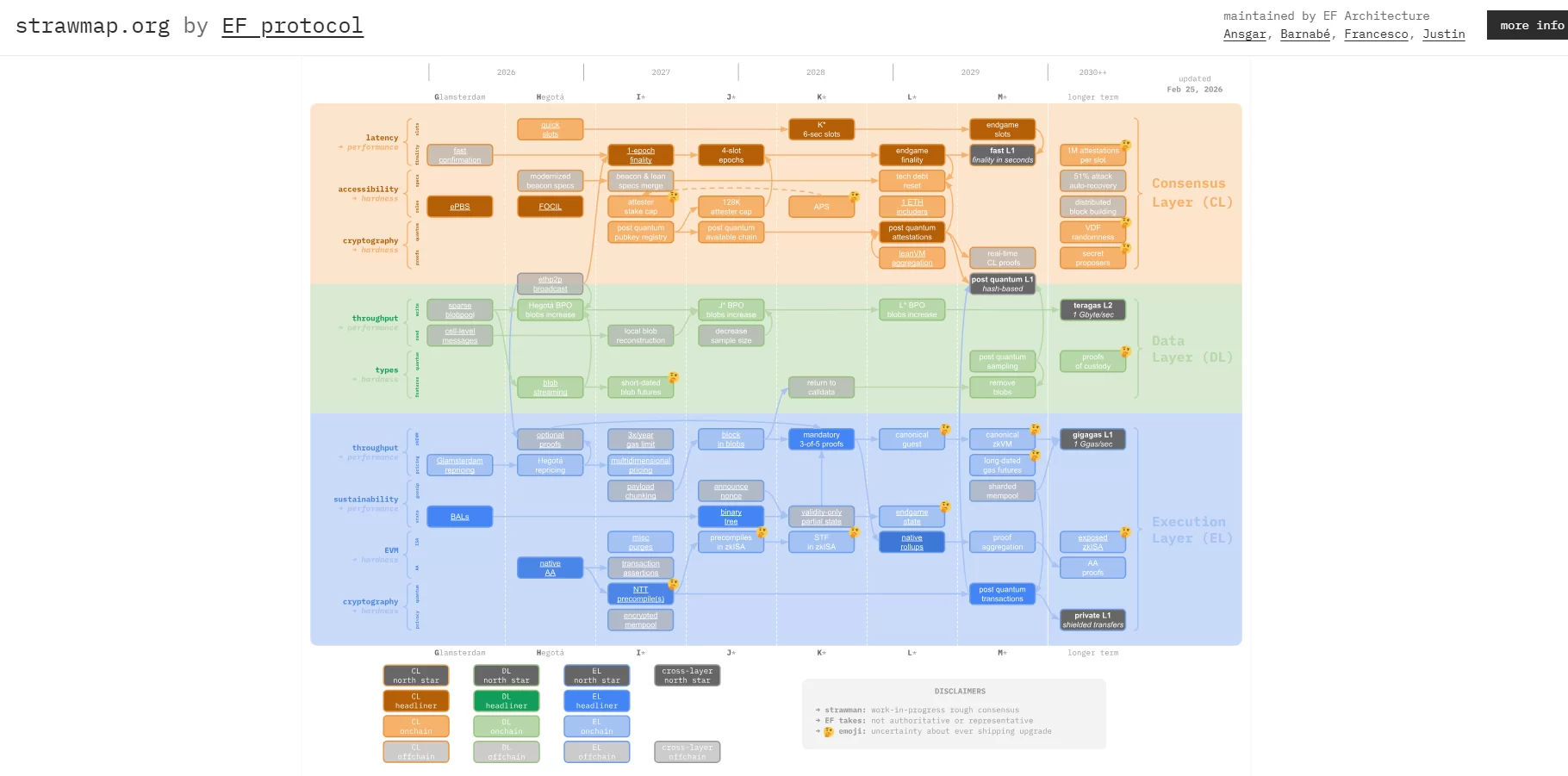
The five main objectives of Strawmap correspond to key technical bottlenecks currently faced by Ethereum, each with clear technical pathways.
Achieving rapid L1 finality centers on implementing Single Slot Finality (SSF), reducing block slot times from the current 12 seconds to 8 seconds or less, enabling near-instant transaction confirmation and significantly improving the mainnet user experience.
Gigagas L1 aims for the mainnet to reach a processing capacity of 1 billion gas per second (1 Gigagas/sec), equivalent to about 10,000 TPS, achieved through built-in zero-knowledge proof systems (zkEVM) at the protocol level, without requiring users to purchase additional hardware.
Teragas L2 targets the entire Ethereum Layer 2 ecosystem, utilizing PeerDAS (Peer-to-Peer Data Availability Sampling) technology to allow Layer 2 networks to access the mainnet data layer at near-zero cost, achieving an overall data throughput of approximately 10 million TPS.
Summary of the Five Goals of Strawmap
Rapid L1 Finality: Single Slot Finality (SSF), reducing slot time to under 8 seconds, eliminating transaction delays.
Gigagas L1: Built-in zkEVM, mainnet reaching 10,000 TPS, no additional hardware needed for users.
Teragas L2: Using PeerDAS, Layer 2 ecosystem achieving about 10 million TPS data processing capacity.
Post-Quantum Cryptography: Transitioning from ECDSA signatures to quantum-resistant schemes based on hash functions or lattice cryptography.
Native L1 Privacy: Integrating ETH transfers as a built-in protocol feature, not optional modules.
Upgrade Schedule: Seven Forks and Key Milestones by 2026
The Strawmap roadmap reorganizes Ethereum’s development phases. The original phases like “The Surge,” “The Scourge,” and “The Verge” are consolidated into three core workflows: Scale (scalability improvements), Improve UX (user experience optimization), and Harden L1 (mainnet security upgrades), making the overall development focus clearer.
In the near-term plan for 2026, Ethereum aims to achieve two key technical milestones: the Glamsterdam upgrade in the first half of the year and the Hegotá upgrade in the second half. These two forks mark the beginning of the entire seven-upgrade plan, laying the foundation for larger-scale Gigagas scaling and post-quantum security migration.
Ethereum co-founder Vitalik Buterin has recently emphasized that strengthening the Ethereum mainnet (L1) is the core strategy to ensure long-term blockchain competitiveness, noting that some early promises of Layer 2 solutions have not been fully realized, which further elevates the priority of enhancing the mainnet’s own technology.
Frequently Asked Questions
What is the core of the Ethereum Foundation Strawmap roadmap?
Strawmap is a protocol upgrade roadmap released by the Ethereum Foundation on February 18, 2026, planning to complete seven protocol forks by the end of 2029, with upgrades every six months. Its five main goals cover L1 scaling, post-quantum security, and native privacy protection.
What is the difference between Gigagas L1 and Teragas L2?
Gigagas L1 targets the Ethereum mainnet layer, achieving 10,000 TPS through built-in zkEVM. Teragas L2 focuses on the Layer 2 ecosystem, using PeerDAS data availability technology to reach about 10 million TPS across Layer 2. They differ fundamentally in architecture and technical approach.
Why is post-quantum cryptography upgrade listed as a core goal for Ethereum?
Advances in quantum computing pose a future risk of breaking current ECDSA elliptic curve signatures. The Ethereum Foundation plans to migrate to quantum-resistant signature schemes based on hash functions or lattice cryptography to ensure long-term security of the Ethereum network in the era of quantum computing.
Disclaimer: The information on this page may come from third parties and does not represent the views or opinions of Gate. The content displayed on this page is for reference only and does not constitute any financial, investment, or legal advice. Gate does not guarantee the accuracy or completeness of the information and shall not be liable for any losses arising from the use of this information. Virtual asset investments carry high risks and are subject to significant price volatility. You may lose all of your invested principal. Please fully understand the relevant risks and make prudent decisions based on your own financial situation and risk tolerance. For details, please refer to
Disclaimer.
Related Articles
BlackRock ETHA deposits 12,397 ETH into a CEX, worth 25.59 million USD
Gate News Report, March 6th, according to Arkham monitoring, BlackRock ETHA address deposited 12,397 ETH to a CEX, worth 25.59 million USD.
GateNews21m ago
Ethereum Day will be held in Hong Kong on March 11, focusing on the three major areas of AI, RWA, and DeFi
The Ethereum Foundation, SNZ, and ETHTAO held the Ethereum Day event with the theme of AI/RWA/DeFi in Hong Kong on March 11, discussing technological integration and ecosystem collaboration. Participating projects included Alias and Hubble AI.
GateNews1h ago
Data: If ETH breaks through $2,167, the total liquidation strength of long positions on mainstream CEXs will reach $918 million.
ChainCatcher reports that, according to Coinglass data, if ETH breaks above $2,167, the total liquidation strength of long positions on major CEXs will reach $918 million. Conversely, if ETH drops below $1,965, the total liquidation strength of short positions on major CEXs will reach $504 million.
GateNews1h ago
Cumberland withdrew 14,800 ETH from a certain CEX 30 minutes ago, worth approximately $30.8 million.
Gate News reports that on March 6th, Lookonchain monitoring showed that market maker Cumberland continued to increase its Ethereum holdings, approximately 30 minutes ago, withdrawing 14,800 ETH from a CEX, worth about $30.8 million.
GateNews2h ago
In the past 24 hours, the total liquidation amount across the entire network was $231 million, with 72% of the liquidations being long positions.
Gate News Report, March 6th: In the past 24 hours, the entire network experienced liquidations totaling $231 million, including $166 million from long positions and $65.71 million from short positions. By cryptocurrency, Bitcoin liquidations amounted to approximately $105 million, and Ethereum liquidations were about $40.64 million.
GateNews2h ago


