


BitMine increases ETH holdings to 4.42 million coins, Fundstrat predicts an 87% win rate

Last week, BitMine (BMNR) purchased 51,162 ETH, marking the largest weekly increase since December of last year, bringing its total ETH holdings to 4.42 million. According to a report from research firm Fundstrat, ETH’s current trading price is approximately 22% below the on-chain average cost basis of investors, with an implied 12-month return of 81% and a historical success rate of 87%.
BitMine’s ETH Reserve Strategy: Continuing Accumulation Despite Over $8.4 Billion in Losses
BitMine Chairman Thomas Lee stated in a Monday announcement that the company will continue to systematically execute its ETH reserve strategy during the current “small crypto winter,” aiming to steadily accumulate holdings and optimize long-term returns. As ETH has fallen over 50% in recent months and remains significantly below the average purchase cost of $3,821, data from the smart money tracking platform Lookonchain shows that BitMine currently has an unrealized paper loss of approximately $8.4 billion.
In addition to ETH holdings, BitMine’s balance sheet includes diversified assets:
Bitcoin (BTC): 193 coins
Beast Industries Shares: Market value approximately $200 million
Worldcoin (WLD) Treasury Shares: Market value approximately $17 million
Cash and other liquid assets: Total approximately $691 million
Lee’s announcement of increased holdings comes shortly after the release of a bullish Fundstrat report, with both signals emerging within the same timeframe, forming a primary basis for market expectations of ETH bottoming.
Fundstrat On-Chain Analysis: ETH Nearing Historical Bottom Reference Zone
Fundstrat analyst Sean Farrell, based on an on-chain actual cost basis model, pointed out that ETH’s current trading price is about 22% below the investor average cost, close to the historical reference values at the 2025 bear market low (21%) and the 2022 bottom (39%), indicating that the chip structure has entered a historical bottom zone.
According to this model, ETH’s implied bottom range is between $1,770 and $1,367, with an implied 12-month return of 81% and a success rate of 87%. Currently, ETH is trading around $1,896, above the implied bottom levels but still significantly below the average purchase cost.
Meanwhile, data from SoSoValue shows that Ethereum ETF (Exchange-Traded Fund) experienced net outflows of $123 million last week, indicating that institutional funds remain cautious in the short term, which somewhat conflicts with the on-chain bottom signals mentioned above.
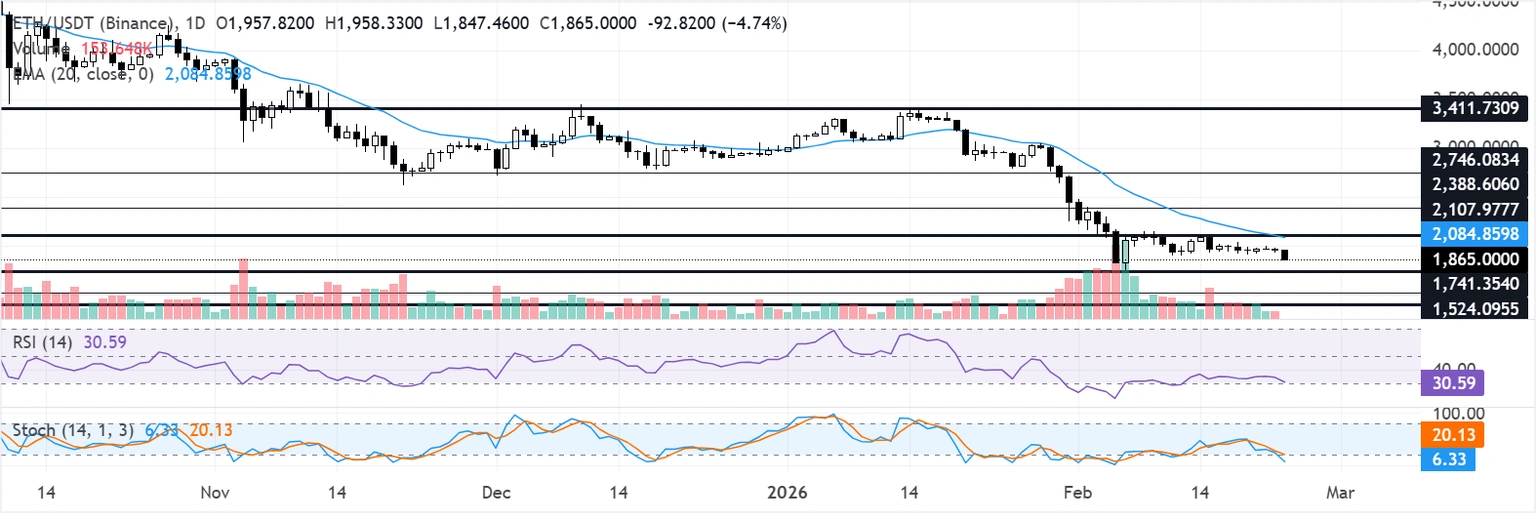
Technical Outlook: Support at $1,404 and Resistance at $2,746 Dominating Short-Term Trends
(Source: TradingView)
The daily chart shows ETH at $1,896, with the 20-day exponential moving average (EMA) at $2,087 and trending downward. The Relative Strength Index (RSI) is at 31, approaching oversold territory; the stochastic indicator (Stoch) is at 17, indicating short-term selling dominance, but the oversold condition could trigger a technical rebound.
According to Coinglass data, ETH experienced $135.8 million in liquidations over the past 24 hours, with longs accounting for $112 million, reflecting continued leverage pressure. Key technical levels are as follows: short-term resistance at $2,107 and $2,388, with further resistance at $2,746; support levels are at $1,741 and $1,524, with a critical support at $1,404 if broken.
Frequently Asked Questions
Q: Why is BitMine continuing to accumulate ETH despite huge unrealized losses on its books?
A: BitMine employs a long-term corporate asset reserve strategy, viewing ETH as a core reserve asset. Chairman Thomas Lee stated that the company evaluates its strategy from a long-term holding perspective. Short-term paper losses do not alter the overall direction, and the goal of increased accumulation is to optimize long-term returns.
Q: How should the 87% success rate from Fundstrat be interpreted?
A: Fundstrat compares ETH’s current market price to the on-chain investor average cost basis. Historically, in scenarios where the deviation is similar (around 22% below cost), holding ETH for 12 months has resulted in positive returns approximately 87% of the time. This is a statistical historical success rate and not a direct prediction of future performance.
Q: Does the continued outflow from ETH ETFs contradict the bottoming signals from on-chain data?
A: ETF fund flows reflect short-term institutional sentiment, while on-chain cost basis models measure long-term chip structure. They are different analytical frameworks and should be evaluated separately. Fundstrat’s bottom model primarily relies on on-chain data and does not incorporate ETF flows as a main variable.
Related Articles
Adam Back's Bitcoin reserve company BSTR rushes to go public on the US stock market! Expected to hold 30,000 BTC and list on NASDAQ, possibly approved as early as April
In the past 24 hours, the total liquidation on the entire network's contracts reached $311 million, mainly from long positions.
Stripe: Stablecoins are becoming a fundamental part of the global payment infrastructure