


Why did Bitcoin plummet today! Trump considers new tariffs, miners liquidate 2000 BTC
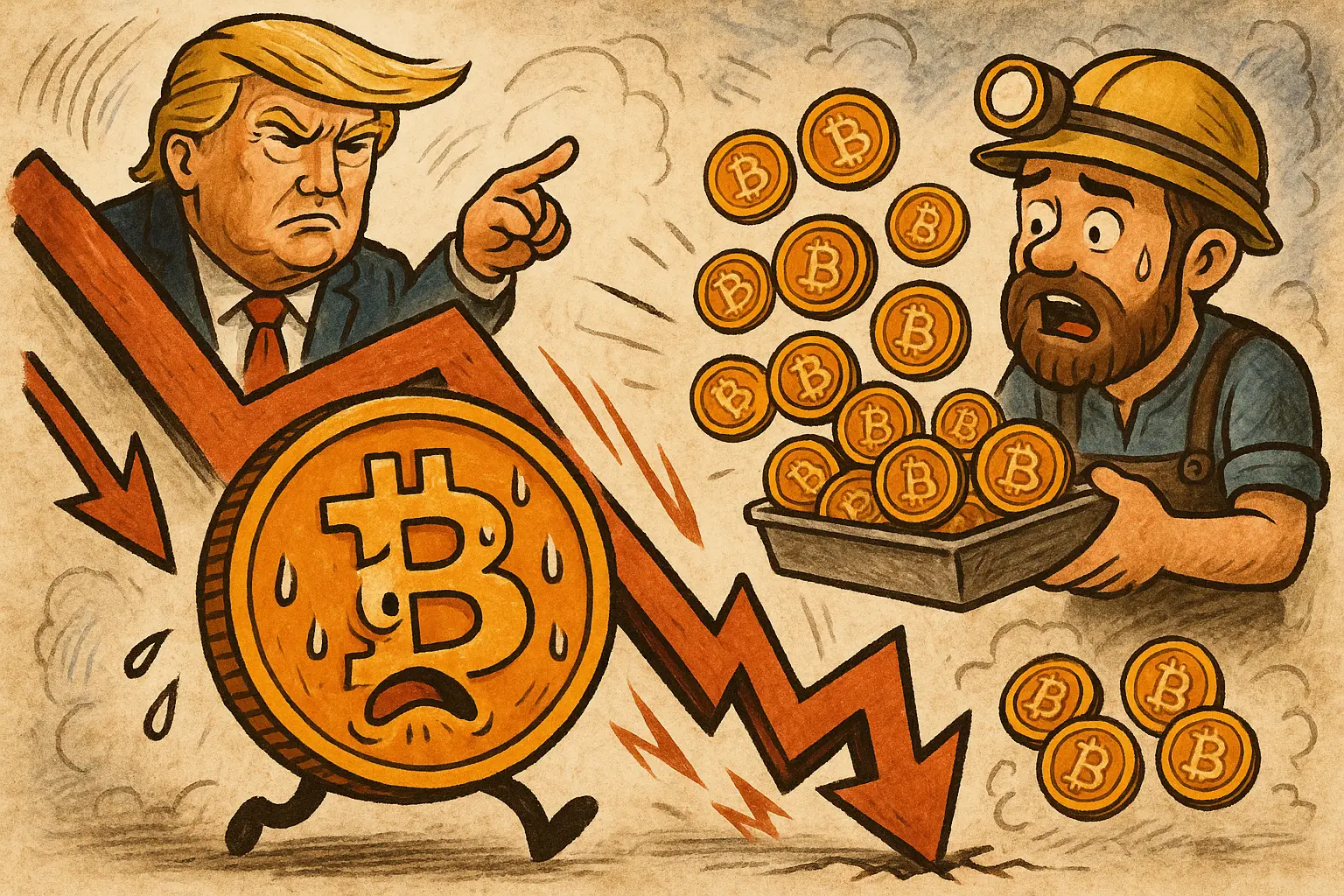
Bitcoin has recently experienced a sharp decline, with the market facing two simultaneous pressures. Major miner Bitdeer has liquidated over 2,000 coins from its reserves within eight weeks, strategically shifting to an immediate sell-off mode; the U.S. Supreme Court ruled that Trump’s reciprocal tariffs are illegal, bringing a new wave of national security tariff issues to the forefront, causing global risk assets to panic sell. On the technical side, the situation has also worsened, with Bitcoin breaking below the triangle support, with short-term focus directly on the critical $64,000 level.
Miners Shift from Holding to Liquidation: A Warning Signal from Bitdeer
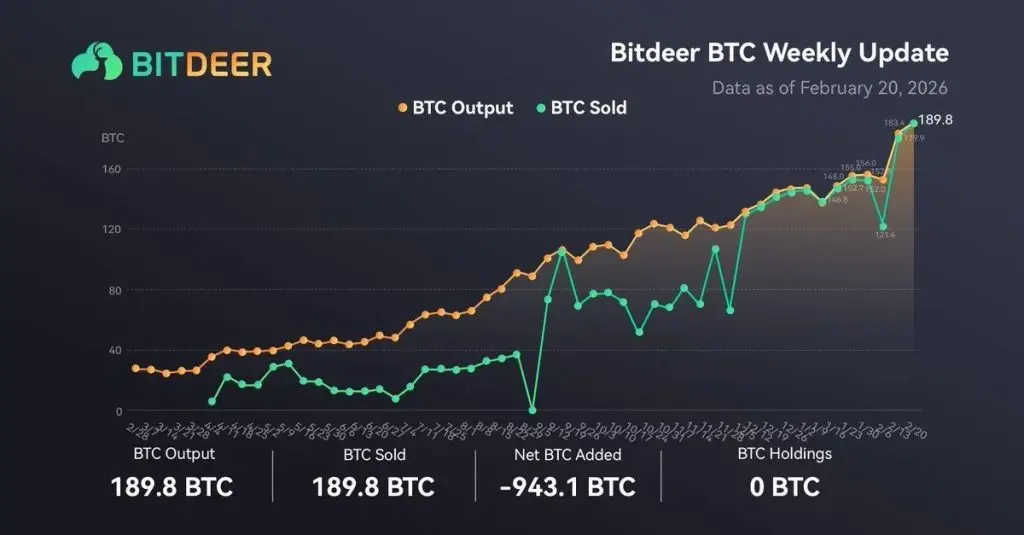
(Source: Bitdeer)
Bitdeer is one of the most noteworthy on-chain indicators during this Bitcoin decline. This large miner has been reducing its holdings since late December last year, depleting its reserves of over 2,000 BTC over eight weeks. More concerning is its strategic shift—In January, Bitdeer mined 668 BTC but sold over 1,100 BTC, far exceeding its monthly production, now entering a full-speed liquidation mode of “mine in the week, sell in the same week.”
Miner behavior has always been a leading market indicator. When long-term holders turn into continuous sellers, it signals not just a one-time impact but the formation of a structural medium-term selling pressure.
Three Core Reasons Behind Bitdeer’s Liquidation
Halving Effect Compresses Profits: After the block reward halving, mining rewards plummeted, increasing the relative cost basis for holding coins.
Urgent Need for Business Transformation Capital: Bitdeer is heavily expanding its AI high-performance computing infrastructure through convertible bonds and equity financing.
Immediate Financial Pressure Relief: With the stock price continuously declining, selling BTC becomes the fastest way to replenish cash flow.
These triple pressures have triggered a coordinated response, and liquidation is no longer a short-term move but an inevitable choice under the business transformation.
Trump Tariff U-turn: Policy Uncertainty Sparks Market Panic
Macroeconomic turbulence has added fuel to Bitcoin’s sharp decline today. The U.S. Supreme Court ruled that Trump’s reciprocal tariff mechanism is illegal, casting a shadow over several ongoing trade agreements. The European Parliament announced delays in approving agreements with the U.S., India has paused its official visit to the U.S., and Japan’s ruling party described the situation as “a tangled mess.”
Trump immediately announced that the U.S. would maintain a 15% baseline tariff globally. According to The Wall Street Journal, the government is also evaluating new national security tariffs on six major industries—including large batteries, industrial chemicals, and power grid equipment—under Section 232 of the Trade Expansion Act.
Goldman Sachs strategists in their latest report pointed out that policy uncertainty is “one of the most destructive channels” impacting market confidence, as it directly suppresses investor decision-making and corporate capital expenditure. While a weaker dollar supports gold, for Bitcoin, risk-averse capital outflows driven by safe-haven sentiment remain the primary short-term bearish force.
Technical Analysis: $64,000 Is the Key Support Level for Bulls and Bears
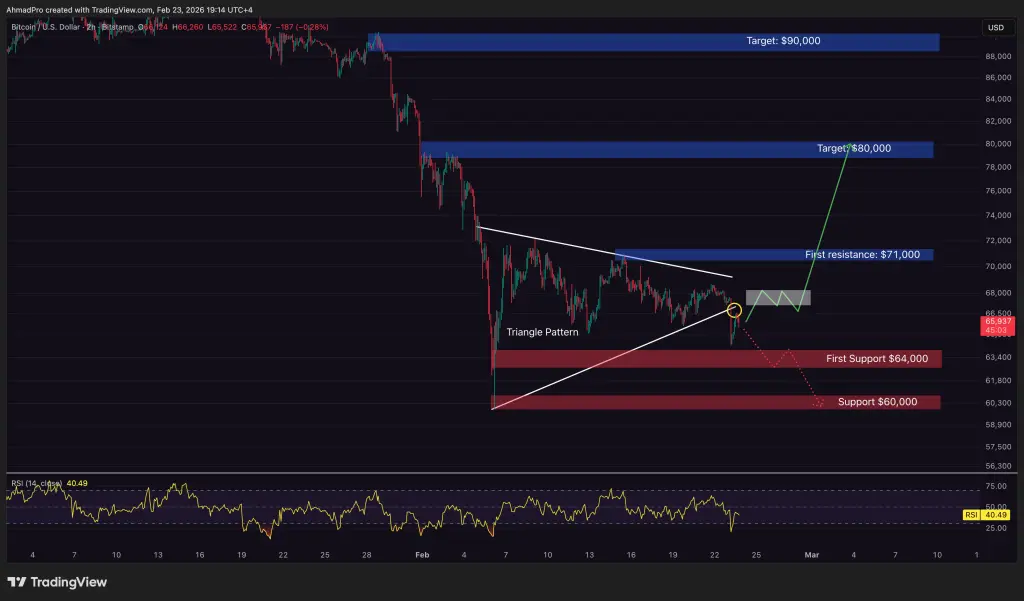
(Source: TradingView)
After Bitcoin broke below the contracting triangle’s lower boundary, the previously supportive upward structure was invalidated. Short-term momentum shifted from neutral to clearly bearish, with price consolidating around $65,000. If the $64,000 support fails, the market will face a severe test at the macro bottom of $60,000; breaking this level would cause a fundamental breakdown of the higher timeframe bullish structure.
The reversal conditions are also clear: BTC needs to regain the trendline and break above $71,000 to confirm the bullish momentum recovery. Until then, each rebound should be viewed cautiously and not as a sign of trend reversal.
Related Articles
In the past 24 hours, the total liquidation on the entire network's contracts reached $311 million, mainly from long positions.
Stripe: Stablecoins are becoming a fundamental part of the global payment infrastructure