


U商's "abnormal" business? Key defense points and boundaries of the three major charges

Author: Lawyer Shao Shiwei
Recently, in a case involving a U商 (U trader) buying and selling USDT (Tether), the parties involved were accused by judicial authorities of engaging in illegal foreign exchange operations by using virtual currencies as a medium for illegal business activities.
Although, in Lawyer Shao’s view, the case has not yet established a complete chain of evidence sufficient for conviction, because the involved amount reaches hundreds of millions and in recent years the parties have used dozens of bank cards of friends and family to facilitate virtual currency transactions and payments, from the perspective of investigators, this operational mode does not resemble a “normal” business. Therefore, prosecutors are considering charges beyond illegal business operations, such as obstructing credit card management, aiding and abetting, and concealing or disguising criminal proceeds.
In the article “Case Notes | What Are the Risks of Using Others’ Bank Cards to Receive Payments in USDT Transactions? — A Review of the Boundaries and Defense Points in a Virtual Currency Case Involving Hundreds of Millions,” I have already provided a preliminary analysis of related issues. This article will further focus on practical disputes and systematically discuss the following core questions:
Why does buying and selling virtual currency for profit not constitute illegal foreign exchange operations, aiding and abetting, or concealing or disguising criminal proceeds?
1. Judicial Presumption of Guilt: Is Making a Profit from Virtual Currency Trading Considered an Unusual Business?
From the perspective of case handling, the mode of earning a spread through U商 typically has two characteristics:
First, the use of multiple bank cards for collection and payment; second, the large volume of funds involved.
Compared to traditional businesses, this financial flow is more likely to be presumed as carrying illegal risks. For this reason, even if the illegal business operation charge cannot be firmly established, authorities often seek other “fallback” charges.
However, Lawyer Shao emphasizes that, according to domestic policies, trading virtual currencies (over-the-counter OTC) is not prohibited by law, and there are objective facts of many U商, arbitrageurs, and ordinary investors participating in OTC trading within China.
For example, on Binance’s platform, when opening the C2C section and selecting the currency CNY (Renminbi), there are 1,300 merchants listed (10 per page, 130 pages). This indicates that OTC U商 is not an isolated phenomenon but a large-scale industry.
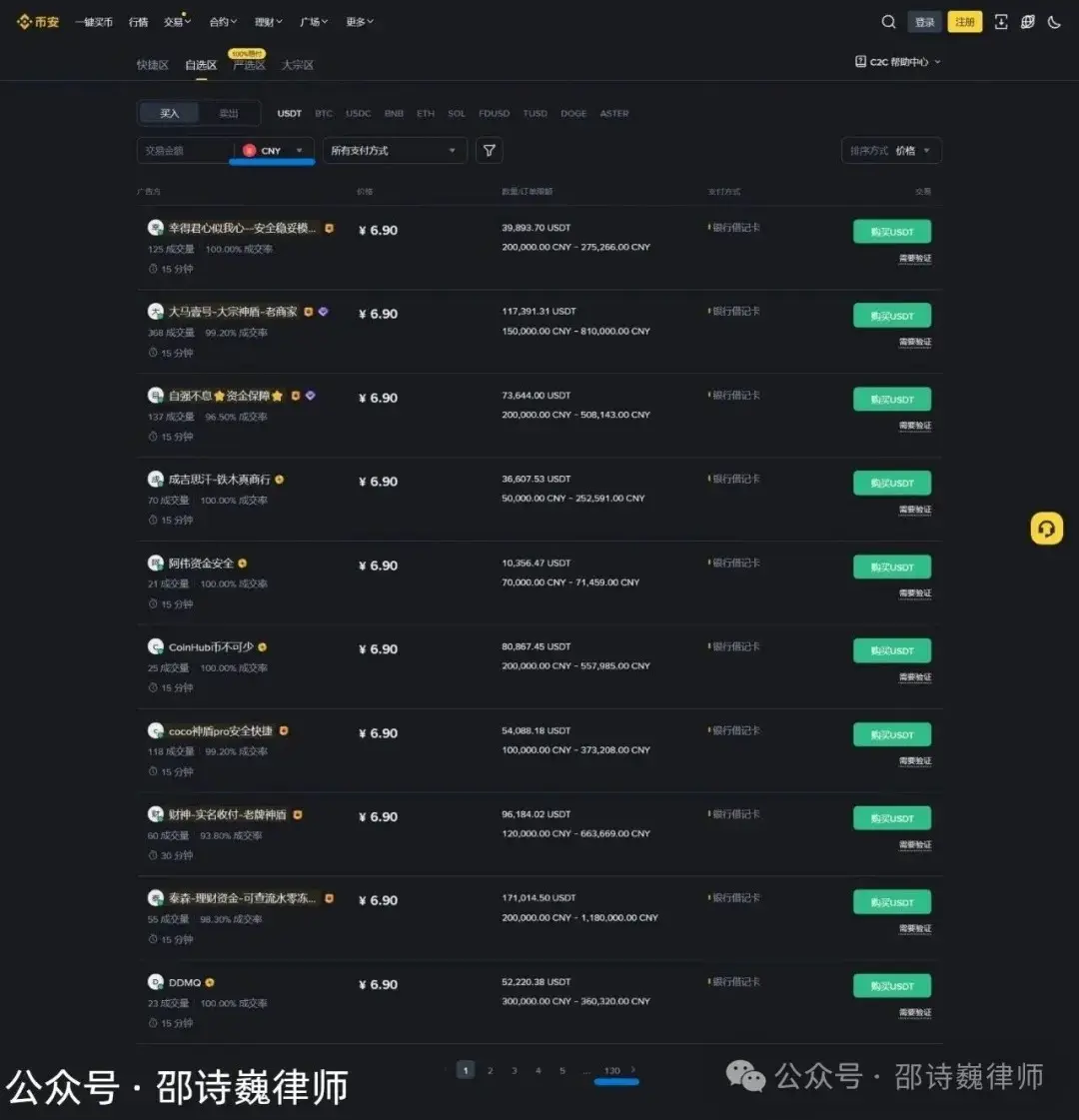
Furthermore, on mainstream platforms such as OKX, Bybit, Bitget, MEXC, and Gate.io, U商 generally operate as compliant merchants registered on the trading matching pages.
It is important to note that these platform merchants are only the tip of the iceberg. In practice, there are also many offline U商 who facilitate matching through social groups, acquaintances, or channels like Telegram and WhatsApp, and their volume is equally enormous.
Looking at recent cases, Lawyer Shao believes that the focus of judicial crackdowns is not on “buying and selling USDT itself,” but on three types of behaviors:
- Continuing to trade despite knowing the funds are involved in fraud;
- Using virtual currencies to assist in money laundering;
- Knowing that upstream entities are covertly engaging in foreign exchange transactions and still providing assistance.
Therefore, whether the profit-making mode of OTC merchants is “normal” should not be measured against traditional business models but rather compared within the normal industry practices of U商. The key is whether the behavior of the parties involved is abnormal.
Otherwise, if we judge this industry and its participants with suspicion solely because the mode is unfamiliar, it risks presuming guilt.
Next, Lawyer Shao will systematically explain why these behaviors do not constitute illegal business operations, nor do they amount to concealing or disguising criminal proceeds, or aiding information network crimes.
2. Reasons Why It Does Not Constitute Illegal Business Operations
The premise for establishing that a person commits the crime of illegal foreign exchange operations through virtual currency trading is evidence proving that they knowingly assist upstream entities engaged in “matched exchange” (i.e., “dubbing” or “round-trip” currency exchange).
The Supreme People’s Procuratorate’s December 21, 2024, release of the case of Lin and Yan’s illegal business activities is a typical example:
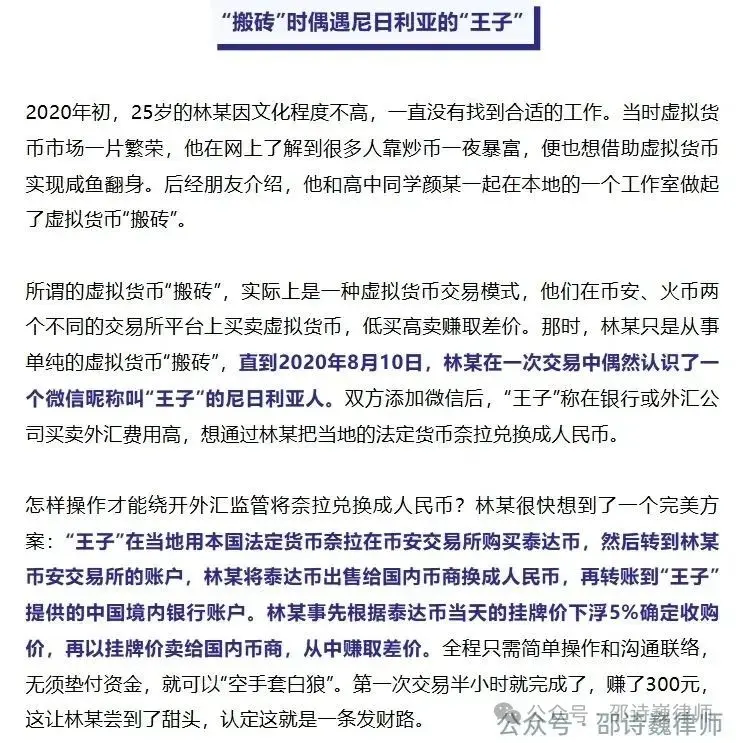
- From the perspective of subjective knowledge, Lin was informed explicitly by Nigerian Prince Wang about his exchange intentions, and Lin continued to assist him despite knowing;
- From the perspective of fund flow, Lin participated in the entire process where Wang converted Nigerian Naira into virtual currency (USDT) and then into RMB.
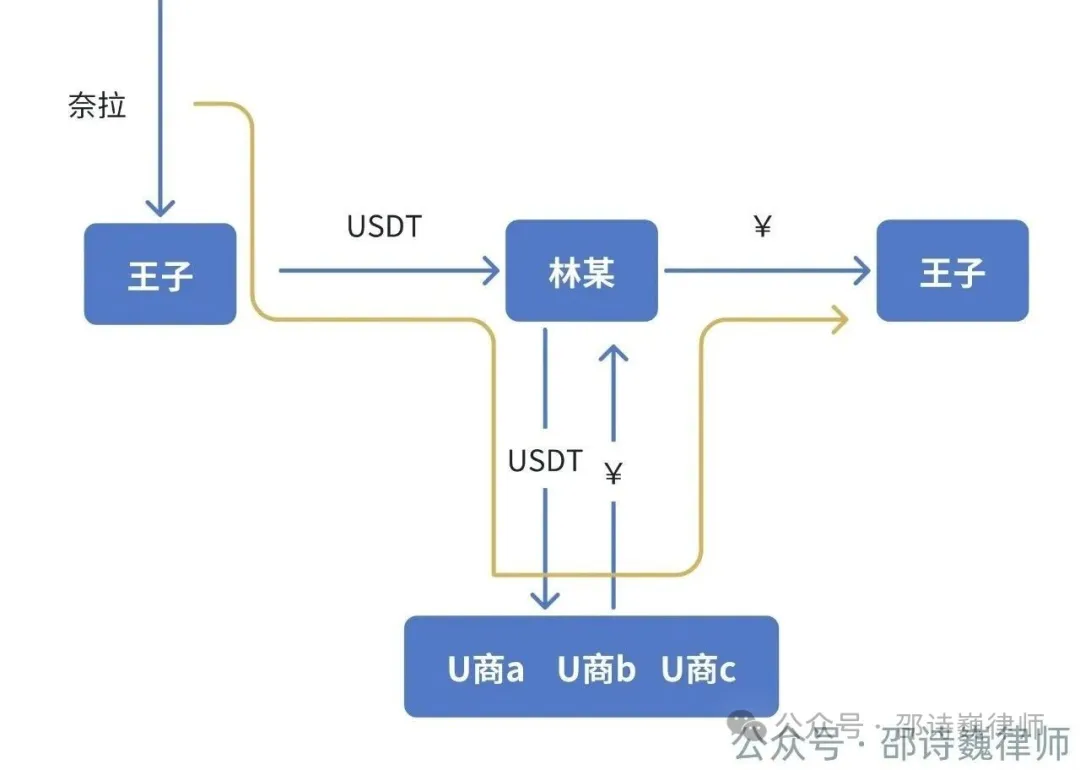
Thus, Lin’s so-called “arbitrage” was actually directed by the Nigerian “Prince”: Wang transferred Naira into Lin’s Binance account, Lin sold the USDT received to domestic U商 for RMB, and then transferred the funds back to Wang. Lin set the purchase price at 5% below the USDT listing price and sold at the listed price, earning the spread, which constitutes illegal business operations.
Therefore, U商 a, b, c, etc., do not become co-conspirators in Lin’s illegal business just because they have transacted with him. Moreover, from the flow of funds, the reason why U商 a, b, c do not constitute illegal business is that their transactions are limited to one-way exchanges between USDT and RMB, earning only the spread. In contrast, Lin’s crime lies in using virtual currency as a medium to facilitate the actual exchange of different currencies for Wang, thus constituting illegal foreign exchange operations.
3. Reasons Why It Does Not Constitute Concealing or Disguising Criminal Proceeds
Can we easily conclude that U商 involved in large fund flows and multiple bank card transactions are suspected of concealing or disguising criminal proceeds?
Lawyer Shao believes that such a conclusion cannot be based solely on “complex fund chains,” “multi-card circulation,” or “large transactions,” but must return to the core elements of criminal law: what exactly constitutes criminal proceeds?
According to interpretative opinions published on the Supreme People’s Procuratorate’s official website, criminal proceeds refer to the increase in property benefits obtained through criminal acts and the retention of the part of personal property that should decrease. Simply put, criminal proceeds are the “profits” or “cost savings” generated by the crime, not the “principal” used to commit the crime.
For example, in typical underground foreign exchange schemes, the funds used by clients are usually legally obtained RMB or foreign currency, but they are used for illegal foreign exchange activities. These funds are the client’s principal; for underground money changers, they are not their criminal gains. The real illegal gains of underground money changers are usually the exchange fees or the spread they earn.
In other words, the principal used for exchange does not automatically become “criminal proceeds” just because it is used in illegal exchange. Only the profits actually obtained by underground money changers from providing services may constitute criminal gains.
Applying this reasoning to U商, most of their actions are simply buying and selling USDT at market prices to earn the spread. The funds they receive are mainly the principal paid by counterparties in RMB or USDT, not the “laundered” criminal gains of underground money laundering operations.
In other words, U商 are more involved in the circulation of principal funds rather than helping transfer, hide, or realize the underground money laundering gains.
This is a common point of confusion in many cases: investigators often see “upstream criminal activity + downstream receipt of funds” and habitually assume the downstream is concealing criminal proceeds. However, if the upstream funds are not criminal proceeds, then even if downstream parties participate in the flow, they lack the core object of concealment or disguise.
In practice, the typical behaviors targeted by concealment crimes include helping transfer fraud proceeds, splitting funds to evade regulation, layering transactions, acting as intermediaries for cashing out, or converting criminal gains into “seemingly legitimate” assets. Pure OTC trading, normal matching of buy and sell orders, and market-price-based exchanges do not fall into this “concealment” pattern.
Therefore, in most scenarios of simple USDT profit-making transactions, if U商:
- Do not participate in the overall underground money exchange cycle;
- Are not aware of and do not assist in the transfer of underground funds;
- Only engage in normal market-based matching and trading;
then even if upstream illegal foreign exchange activities exist, it is difficult to establish that U商 constitute the crime of concealing or disguising criminal proceeds solely based on fund flows.
4. Reasons Why It Does Not Constitute Aiding Information Network Crime
Aiding and abetting is also a frequently considered charge in such cases. However, according to Article 287-2, Paragraph 1 of the Criminal Law, the premise for applying this charge is “knowing that others are committing crimes using information networks.” Therefore, whether U商 can be charged depends on whether the upstream crime involves an information network crime.
What is an information network crime? The key issue is whether the core criminal act relies on or is carried out through an information network.
Even if the buyers and sellers agree on exchange rates via communication apps, and the transfer of RMB and foreign currency is completed entirely through offline bank transfers or cash within China, then the information network is merely a communication tool, and the core illegal activity (illegal foreign exchange trading) is carried out offline. In this case, the crime is not an information network crime.
If, however, the parties communicate via apps like WeChat, Telegram, or WhatsApp, and the receipt and payment of funds (especially using domestic RMB accounts and foreign currency accounts abroad) are completed entirely through online banking or third-party payment platforms, then the core of the illegal business—payment and settlement—depends on the information network. Such behavior may be recognized as “using information networks to commit crimes.” If the person provides bank cards to facilitate online collection, then the charge of aiding and abetting may apply.
A typical case of aiding and abetting in illegal foreign exchange using virtual currency is the case published by the Supreme Court on June 18, 2025—Guo and Fan’s illegal business and assistance to information network crimes (Case No. 2025-03-1-169-001). This case is also one of the typical cases jointly issued by the Supreme Procuratorate and the State Administration of Foreign Exchange in December 2023.
Basic facts:
Guo is the builder of an illegal foreign exchange website.
Fan is involved in virtual currency trading within an illegal foreign exchange ring.
Zhan and Liang provided virtual currency trading platform accounts and RMB bank accounts to Fan.
From January 2018 to September 2021, Chen Guo and others set up websites like “TW711” and “Huosu,” using virtual currency Tether (USDT) as a medium to provide foreign currency and RMB exchange services. Customers deposit and pay on these websites, then transfer foreign currency to designated overseas accounts. The websites buy Tether abroad with the foreign currency, and Fan sells the Tether through illegal channels to obtain RMB, which is then paid to designated domestic third-party payment accounts at the agreed exchange rate, earning exchange rate spreads and service fees. These websites illegally exchanged over 220 million RMB. Fan, through accounts provided by Zhan and Liang, received over 6 million Tether from Chen Guo and others, exchanging them for over 40 million RMB.
Judgment reasoning in this case:
- The case involved Chen Guo and Wang, who built illegal foreign exchange websites that used overseas accounts to receive New Taiwan Dollars and domestic accounts to pay RMB, constituting illegal business operations.
- Guo was responsible for technical support without participating in specific operations or profit sharing; Fan followed instructions during transactions and should be considered an accessory to illegal business.
- Zhan and Liang provided bank accounts to facilitate the use of information networks, thus constituting aiding and abetting.
This case shows that, when upstream illegal foreign exchange is prosecuted as illegal business, the reason Zhan and Liang are convicted of aiding and abetting is that the core of the illegal foreign exchange activity relies on the use of information networks.
Therefore, if the parties communicate only via apps (like WeChat, Telegram, WhatsApp) but the illegal foreign exchange activity is carried out offline, then the upstream crime does not involve an “information network crime.” Consequently, the downstream U商 receiving funds cannot be charged with aiding and abetting.
Additionally, authorities often cite cases where the bank cards involved in virtual currency transactions are frozen or restricted, believing that the person has subjective knowledge of aiding and abetting. However, according to judicial interpretations, “knowing” only applies when the person receives funds involved in fraud or other illegal activities. In illegal foreign exchange cases, U商’s involvement is usually in receiving exchange funds from upstream underground money lenders’ clients (often their legitimate income sources), not funds involved in “fraud” as described in these interpretations.
Opinions of the Supreme People’s Court, Supreme People’s Procuratorate, and Ministry of Public Security on Several Issues Concerning the Handling of Criminal Cases of Aiding Information Network Crimes
- Accurate determination of “knowing” in aiding information network crimes…
(2) Continuing to implement related behaviors after being restricted or suspended by financial institutions, telecom operators, or internet service providers due to fraud or other abnormal circumstances.