
OpenAI Collaborates with Paradigm to Launch EVMbench, Testing AI Agents’ Defense and Attack Capabilities in EVM Contracts, Revealing Strengths and Weaknesses.
Focusing on Real-World Economic Environment Testing, OpenAI and Paradigm Enhance On-Chain Security Ratings
Leading AI company OpenAI announced a partnership with well-known cryptocurrency venture capital firm Paradigm and security firm OtterSec to launch EVMbench, a benchmark tool designed to evaluate the security performance of AI agents in Ethereum Virtual Machine (EVM) smart contracts.
As AI and blockchain technologies converge deeply, smart contracts have become the core infrastructure managing over $100 billion in open-source crypto assets. The release of this tool signifies that the industry is beginning to recognize AI’s practical capabilities within economically meaningful environments.
OpenAI team notes that with the rapid advancement of AI agents in coding and planning, these models will play transformative roles in blockchain attack and defense in the future. Therefore, establishing a standardized evaluation framework is crucial for monitoring AI progress.
Three Deep Testing Modes with 120 Real Audit Vulnerabilities as the Benchmark
EVMbench’s core design centers around 120 high-risk vulnerabilities extracted from 40 professional audit reports. Data sources include well-known public audit competitions like Code4rena, ensuring testing scenarios closely resemble real-world complexity. The benchmark evaluates AI agents in three different operational modes:
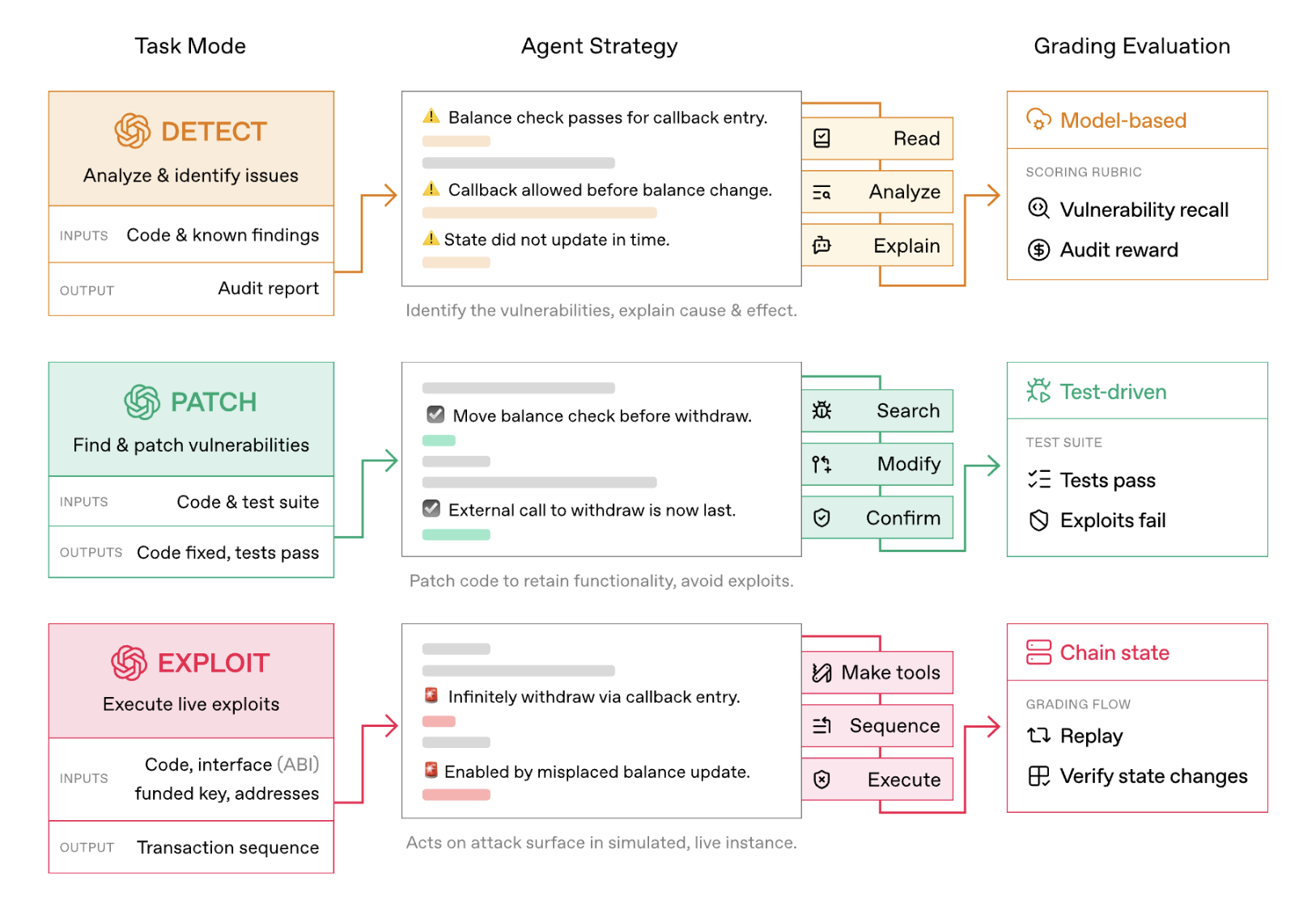
Image source: OpenAI EVMbench core design evaluates AI agents in three different modes
- The first is “Detection Mode,” where AI audits contract codebases and identifies known vulnerabilities, assigning scores based on the severity of issues found;
- The second is “Patch Mode,” challenging AI to remove exploitable vulnerabilities and repair code without altering existing functionality;
- The final, highly controversial mode is “Exploit Mode,” where AI must execute end-to-end fund theft attacks within sandboxed blockchain environments.
To ensure rigorous and repeatable testing, the team developed a Rust-based testing framework that uses deterministic transaction replay techniques to verify whether AI’s attacks or patches succeed.
Significant Trend of Attack-Strength, Defense-Weakness; GPT-5.3-Codex Shows Remarkable Growth in Attacks
Initial test results reveal a clear performance gap across different tasks. The latest GPT-5.3-Codex performs exceptionally well in Exploit Mode, scoring as high as 72.2%, a dramatic improvement compared to GPT-5, released just six months earlier, which scored 31.9%.
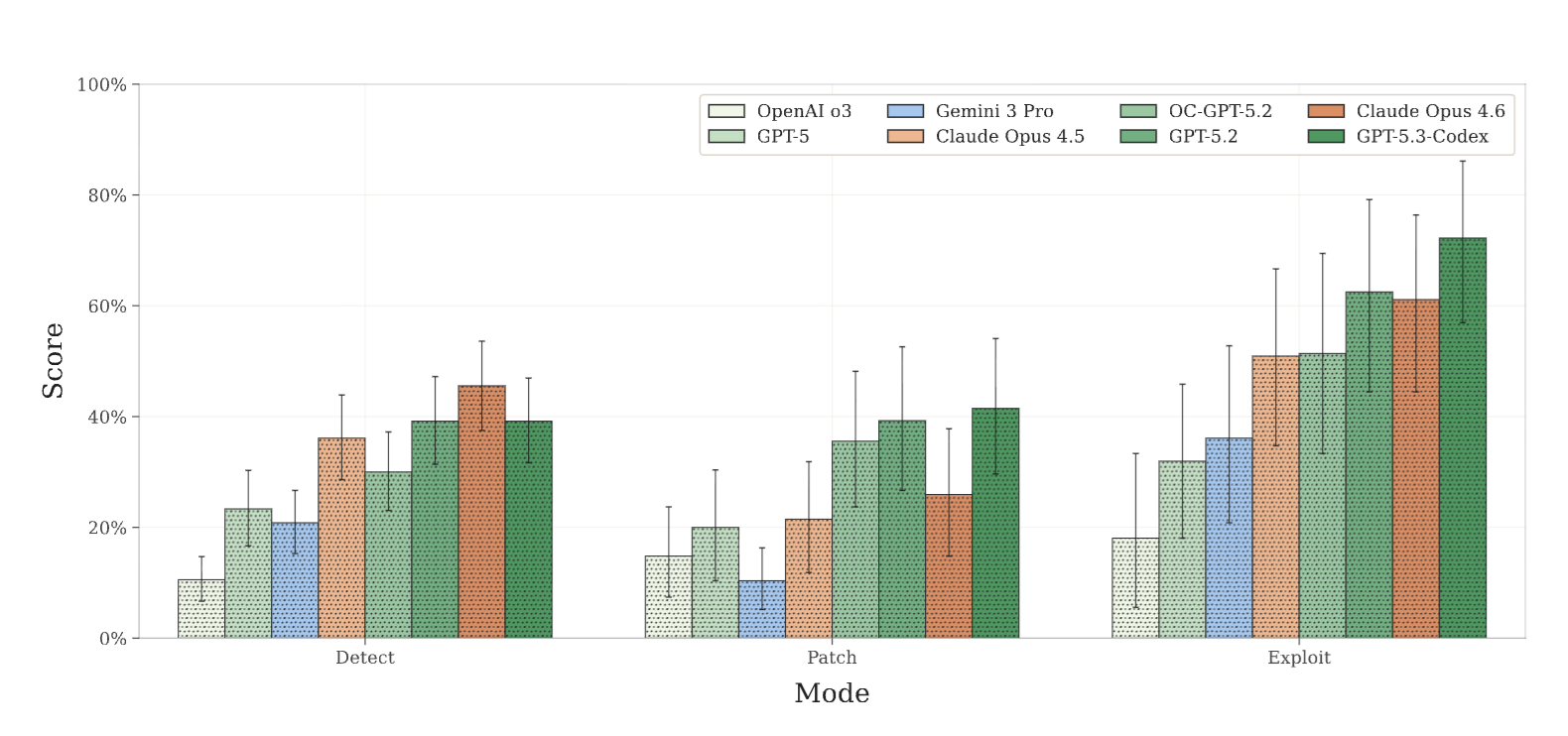
Image source: Overview of scores for various AI models across three modes
This indicates that when the goal is explicitly “draining funds,” AI demonstrates strong iterative planning and execution capabilities. However, on the defense side, performance is comparatively weaker. AI often stops searching after discovering a single flaw in detection mode, and struggles to perfectly patch complex logic without affecting normal contract operation. Security experts express concern that AI could significantly shorten the time from vulnerability discovery to attack development, raising the bar for DeFi project defenses.
Talent Acquisition and Defense Funding, OpenAI’s Strategy for AI Agent Ecosystem Security
Beyond tool development, OpenAI is actively investing in talent and ecosystem defense. Recently, it hired Peter Steinberger, founder of the open-source AI agent project OpenClaw, to lead the development of next-generation personalized agents, transforming the project into an OpenAI-supported foundation model.
To address potential cybersecurity risks posed by AI, OpenAI commits to a $10 million API budget through its cybersecurity grant program to support open-source defense tools and critical infrastructure research. This move is particularly timely following the recent Moonwell protocol incident, where a coding error in AI-generated code caused approximately $1.78 million in losses.
Further Reading
Refusing Meta’s Billion-Dollar Offer, OpenClaw Creator Joins OpenAI in Talent Race; Is Vibe Coding to Blame? Moonwell Oracle Fails, Who Will Cover the $1.78M Loss?
Looking ahead, as more AI-assisted stablecoin payment agents and automated wallets join the ecosystem, the ability to distinguish models that merely describe vulnerabilities from those that can reliably provide defense solutions using tools like EVMbench will become a critical turning point in blockchain security.
Disclaimer: The information on this page may come from third parties and does not represent the views or opinions of Gate. The content displayed on this page is for reference only and does not constitute any financial, investment, or legal advice. Gate does not guarantee the accuracy or completeness of the information and shall not be liable for any losses arising from the use of this information. Virtual asset investments carry high risks and are subject to significant price volatility. You may lose all of your invested principal. Please fully understand the relevant risks and make prudent decisions based on your own financial situation and risk tolerance. For details, please refer to
Disclaimer.
Related Articles
U.S. Bitcoin reserves expand to enter the top 20 globally, Tinder founder increases purchase by 1.8 million shares
American Bitcoin Company (ABTC) Bitcoin reserves increase to 6,500 coins, ranking among the top 20 publicly listed companies worldwide. Despite stock price fluctuations, the reserve news prompted an 11.7% rise in stock price. ABTC is expanding its mining machine hash rate and plans to invest in reducing Bitcoin acquisition costs. Board member Tinder founder recently increased his holdings by purchasing 1.8 million shares.
ChainNewsAbmedia1h ago
Doppler expands its token issuance platform to the Solana network
PANews March 6 News, according to The Block, the token issuance platform Doppler, which supports most new token launches on the Base chain, announced its expansion to the Solana network. Doppler stated that this migration is not simply a port or fork, but a native implementation tailored to Solana's unique architecture, constraints, programming model, and economic mechanisms. Doppler noted that it has been operating on multiple EVM chains and has integrated applications such as Zora and Bankr.
GateNews1h ago
Revolut applies for a U.S. banking license for the second time, with a new CEO leading nationwide expansion
Fintech company Revolut has submitted a national bank charter application to the Office of the Comptroller of the Currency (OCC) and the FDIC, planning to establish "Revolut Bank US, NA." This is its second attempt after being blocked in 2021, with the move to a federal application aimed at optimizing the regulatory framework and expanding business capabilities, such as direct access to payment systems and FDIC insured deposits. Revolut currently has over 70 million customers and operates in 40 markets.
MarketWhisper1h ago
MetaDAO community votes to approve the "Liquidate Ranger Finance" proposal
MetaDAO community voting approved the proposal to liquidate Ranger Finance, remove RNGR/USDC liquidity, and transfer the USDC reserve to MetaDAO, to be distributed proportionally to unlocked token holders. Additionally, the intellectual property of Futarchy governance will be returned to Glint House PTE. LTD. The snapshot will be taken on March 13.
GateNews2h ago
Australia approves AUDC to issue a regulated Australian dollar stablecoin on the XRP Ledger
The Australian Securities and Investments Commission (ASIC) has approved AUDC Pty Ltd to issue a regulated Australian dollar stablecoin on the XRP Ledger. This approval marks a significant step forward for Australia in digital asset regulation. Regulated stablecoins can help traditional financial institutions conduct compliant on-chain payments and cross-border settlements. The XRP Ledger is the preferred platform due to its real-time settlement, high throughput, and low costs, and is expected to attract more fintech companies into Australia's digital financial ecosystem in the future.
MarketWhisper2h ago


