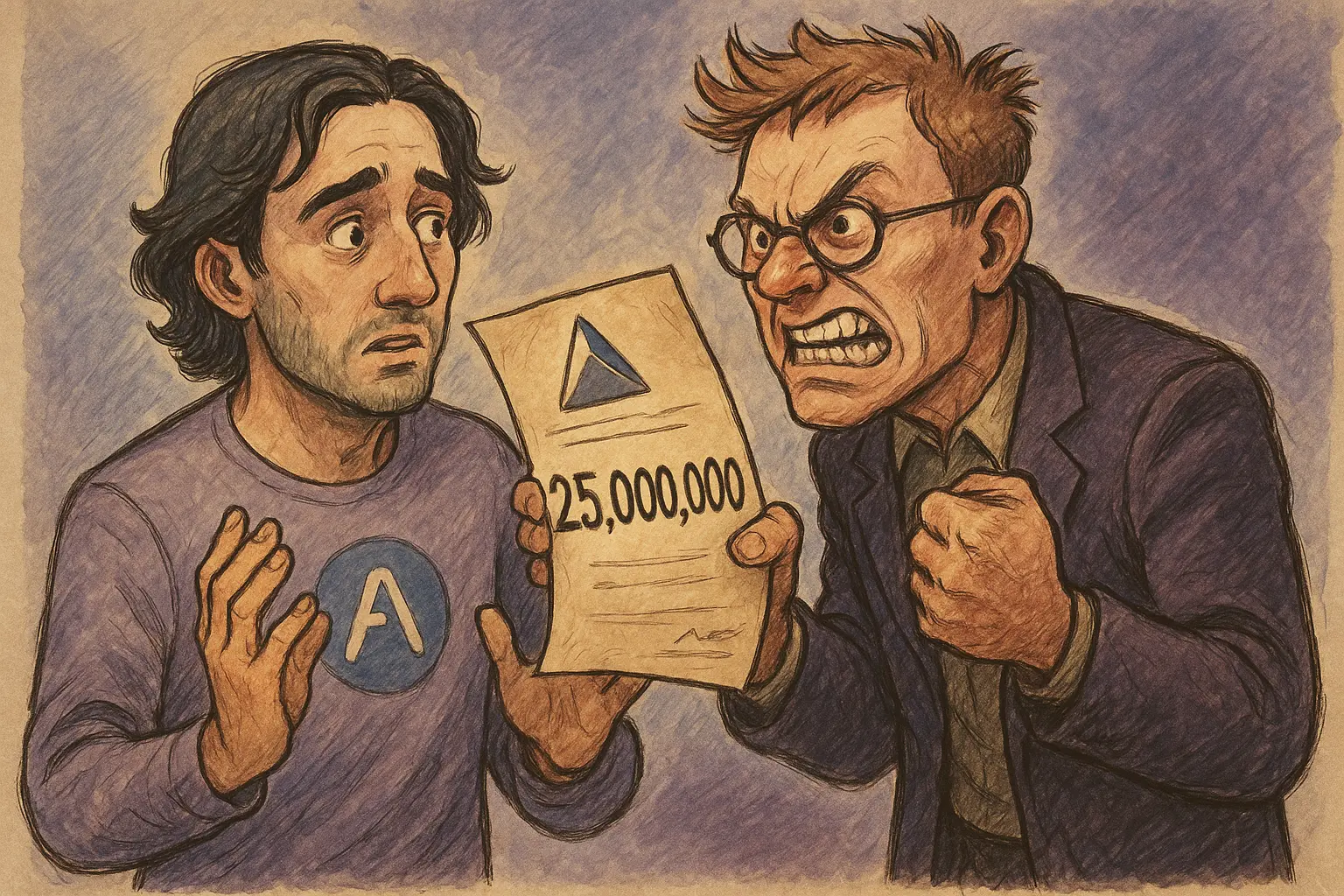
Aave Labs has submitted a radical proposal to transfer revenue to Aave DAO and transfer intellectual property rights to a new foundation, effectively bringing this startup into the hands of token holders. In exchange, they request $25 million in stablecoins, 75,000 AAVE tokens, and other funds. Marc Zeller, founder of ACI, believes this proposal is a disguised scheme to extort funds under the guise of charity.
Aave Labs Plans to Exchange Revenue for $25 Million in Stablecoins
According to the proposal, Aave Labs plans to funnel all income from Aave branded products—including fees from Aave v3 and upcoming v4 protocols, revenue from aave.com frontend, and other future business lines such as Aave Card and AAVE ETF—into the Aave DAO treasury. They also propose establishing a new Aave Foundation to hold trademarks and intellectual property rights.
As part of this plan, Aave Labs requests the DAO to commit to a financing model to cover operational costs, specifically requesting $25 million in stablecoins, 75,000 AAVE tokens, and additional funds for specific product launches. Specifically, the proposal calls for an upfront payment of $5 million, with $20 million paid in installments over one year, plus a monthly linear unlock of 75,000 AAVE over the next two years.
The plan also seeks three grants of $5 million each to fund development and marketing of Aave App, Aave Pro, and Aave Card, plus an additional $2.5 million for Aave Kit development. If approved, Aave Labs would receive approximately $50 million in cash plus 75,000 AAVE tokens (worth about $150 each, totaling roughly $1.125 million), for a total of about $61.25 million.
Breakdown of Funds Requested by Aave Labs
Operational Costs: $25 million stablecoins ($5 million upfront + $20 million in installments)
AAVE Tokens: 75,000 tokens, linearly unlocked over two years (worth about $1.125 million)
Product Development: $5 million each for Aave App, Pro, and Card (total $15 million)
Aave Kit: $2.5 million
Total: approximately $61.25 million
Although the requested amount is “substantial,” the proposal notes that most of the funds’ disbursement depends on Aave Labs delivering truly valuable results. The annual budget also requires separate governance votes “to enable the DAO to continuously oversee fund allocation.” Aave Labs states: “Under this framework, the DAO chooses to directly fund broader operational areas, including product engineering, marketing execution, legal and compliance work related to products, and business development.”
Zeller Denounces the Most Expensive Extortion Scheme in History
While this proposal would fundamentally reshape Aave’s ownership structure, representing a real attempt at DAO management of a multibillion-dollar brand, it has already faced criticism. Aave Labs proposes to abandon its current profit model, but does it really stand to lose? “I want to expose this attempt to deceive the public right now,” responded Marc Zeller, founder of Aave Chan Initiative and a key member of Aave DAO.
“We’ve seen this trick before: first throwing out excessive demands, facing public backlash, then packaging smaller requests as ‘reasonable compromises,’ while still extracting huge benefits.” Zeller’s critique is sharply pointed, characterizing Aave Labs’ proposal as a negotiation tactic rather than genuine compromise. They first make extreme demands (over $50 million + tokens), expecting rejection or reduction, then “settle” for $30 million, making the DAO feel it’s “less than 50 million” and accept.
“Let’s be honest: Labs’ behavior is like they can impose results without regard for governance processes,” Zeller wrote. “If token holders are satisfied, so be it, but I won’t pretend this is healthy governance.” His core argument is that Aave Labs unilaterally presented this ‘all-or-nothing’ plan without proper negotiation with the DAO, which is a disrespect to DAO governance.
Although discussions are just beginning, Zeller has already described Aave Labs’ demands as a $50 million extortion attempt, allegedly made without any prior dialogue between Labs and the DAO. This “shock and awe” approach is highly inappropriate under the principles of decentralized governance. The ideal process would be for Labs to first have informal discussions with key DAO members, gather feedback, adjust the proposal, and then formally submit it. Instead, Labs directly presented a complete plan and initiated a vote, giving the impression of coercion.
Frontend Fee Incident Before December Sparks Power Struggle
Prior to this, the Aave community had been confused for months over the true ownership of Aave—whether it was the DAO, which has controlled the lending protocol since its governance token launch, or the original startup Aave Labs that built the brand. In December last year, Aave Labs transferred transaction fees from the official aave.com frontend, previously used to fund the Aave DAO treasury, to a private wallet controlled by the company. This move sparked controversy within the community.
This incident was the catalyst for current conflicts. The aave.com frontend is the main interface for users interacting with the Aave protocol, and the fees generated (typically 0.1-0.3% of transaction amounts) originally flowed into the DAO treasury. But Aave Labs unilaterally redirected these fees to their own wallet, revealing that Labs controls the frontend’s smart contracts and can change fee flows at will. This display of dominance enraged DAO members.
In response, a token holder proposed a “poison pill” acquisition to seize Aave Labs’ intellectual property, code, brand assets, and equity. This proposal aimed to turn the company into a DAO subsidiary but was rejected during governance voting over the holiday period. A “poison pill” is a defensive M&A tactic—usually involving measures like issuing large amounts of shares to dilute a hostile acquirer. In this case, it was a reverse move, with the DAO attempting to forcibly take control of Labs via governance vote.
Although the poison pill was rejected, it appears to have prompted Aave Labs CEO Stani Kulechov to begin discussions on revenue and brand sharing agreements. The current “100% revenue for funding” proposal is a compromise born under this pressure. Notably, all this occurred during a major restructuring at Aave Labs, which included shutting down non-lending Web3 projects under the Avara brand. The startup sold its social media protocol Lens and is gradually shutting down its Family wallet to focus more on DeFi.
Aave V4 and the Ambitions for the Next Decade
A key part of the Aave Will Win framework is the launch of Aave v4, a multi-year upgrade to the protocol. Aave Labs states that v4’s architecture “unlocks revenue streams previously difficult to realize in earlier versions,” which are also expected to flow into the DAO. This includes a new “centralized-radiation model,” which “can expand Aave into new markets or applications, with its own risk parameters and revenue models,” thereby broadening the protocol’s scope.
For reference, Aave V3’s annualized revenue has already exceeded $100 million. If V4 can boost revenue to $200–300 million, with 100% flowing into the DAO treasury, it would be highly attractive. But the question remains: without ongoing development and maintenance from Aave Labs, can V4 succeed? That’s the leverage Labs holds. They imply, “I can give you all the revenue, but you need to support me; otherwise, there will be no V4, and everyone will suffer.”
The proposal calls for Aave Labs and the DAO to coordinate V4 development while de-prioritizing new features for V3. The initial plan suggests that after V4’s launch, V3 will be gradually phased out over 8–12 months, including parameter adjustments to encourage users to migrate to the new protocol. This “push migration” strategy also raises questions. If the DAO refuses Labs’ funding demands, will Labs refuse to develop V4 or deliberately make V3 difficult to use?
For Aave token holders and DeFi users, this internal conflict is highly disruptive. Regardless of who wins, the dispute damages Aave’s brand and community cohesion. Competitors like Compound and MakerDAO could seize market share. The ideal outcome would be a genuine compromise that protects Labs’ reasonable interests while maintaining DAO governance authority. But given the current hostility, such a compromise might take months of stalemate to reach.


