As Pi Coin price battles at the critical $0.15 support, Pi Network launches its Pi Ad Network to fuel real utility. This analysis explores the technical make-or-break moment and the long-term ecosystem strategy driven by community GCV vision.
Pi Coin Price Prediction: A Critical Technical Showdown at $0.15
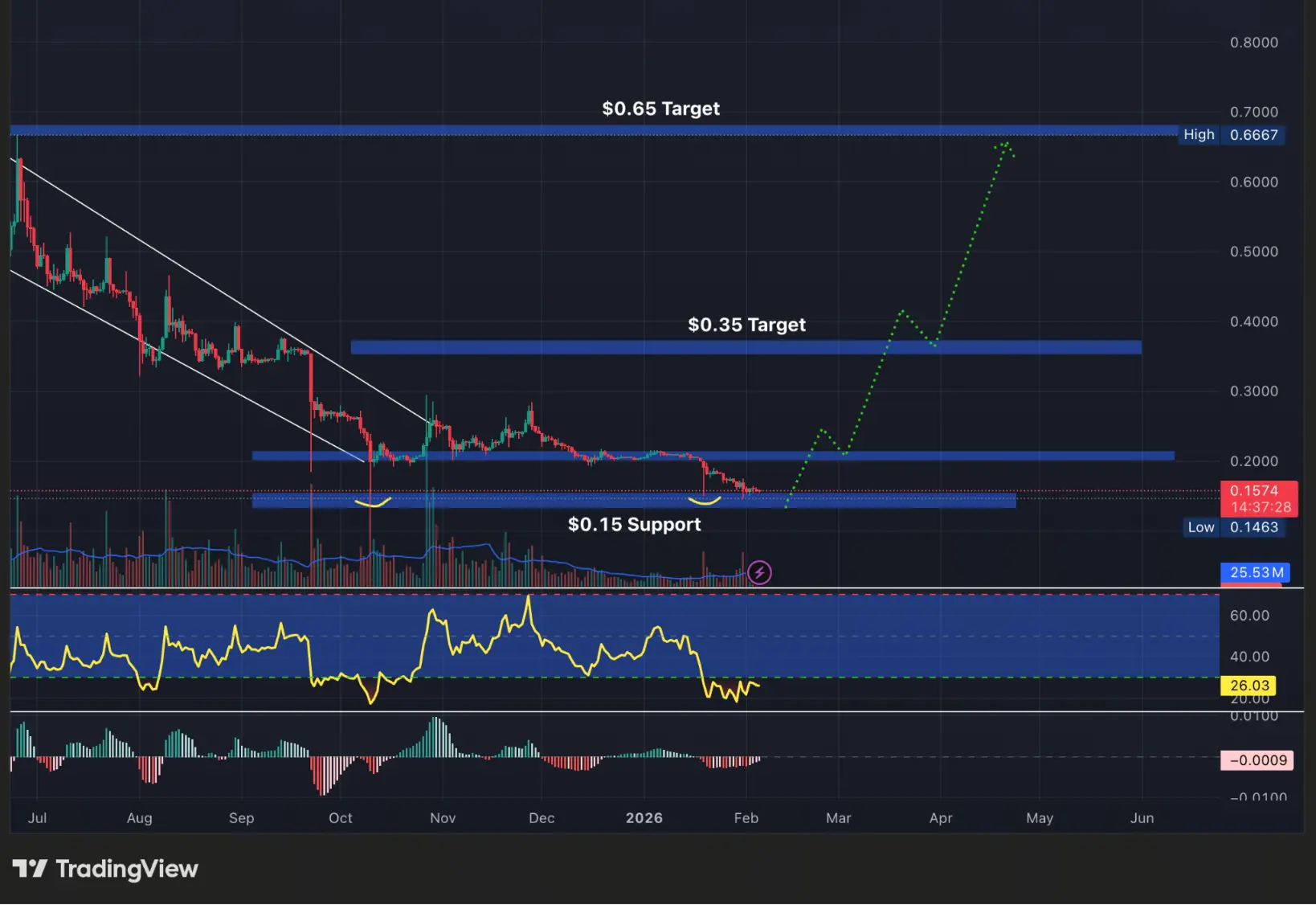
The Pi Network token finds itself at a pivotal juncture in early February 2026. After a prolonged downtrend, the Pi Coin price is clinging to a crucial long-term support level around $0.15. This zone has emerged as the final defensive line for bulls; a breach below could trigger a descent into uncharted and potentially volatile territory due to a lack of historical trading activity and established support structures. Conversely, a successful hold and rebound from this level could validate it as a sturdy launchpad for recovery, setting the stage for a potential bullish reversal.
(Source:TradingView)
From a technical analysis perspective, the situation presents a fascinating conflict. The bearish narrative is straightforward: sustained selling pressure has pushed the price to a critical low, and failure here could lead to significant further losses. However, several on-chain and momentum indicators are beginning to whisper a more optimistic tale. The Relative Strength Index (RSI) has plunged into oversold territory below 30, a condition often associated with seller exhaustion and capitulation—a classic precursor to a trend reversal. Similarly, the Moving Average Convergence Divergence (MACD) is showing signs of convergence, narrowing in on a potential bullish crossover above its signal line.
If the bulls can successfully defend the $0.15 support and engineer a rebound, the immediate technical roadmap becomes clearer. The first major resistance hurdle sits at the $0.20 level. A convincing break and close above this price would signal that fresh demand is outweighing selling pressure, potentially opening the path toward higher resistance zones. Some analysts frame this as a potential launchpad scenario, where a hold at current levels could precede significant upward moves, with hypothetical targets ranging from a 135% push to reclaim previous highs, to more ambitious 330% gains targeting the $0.65 area. However, these projections remain highly contingent on the integrity of the current support holding firm.
The Pi Network Community’s Parallel Reality: GCV Vision vs. Market Price
While the market price engages in a tense battle on the charts, the Pi Network community operates within a parallel, often philosophical, reality. Across social media platforms, the dominant narrative is not focused on the daily price tick but on the long-term aspirational value known as GCV 314,159. This number, a direct and scaled reference to the mathematical constant Pi (π), is championed by supporters as a symbolic north star. It represents the community’s ultimate vision for the project’s maturity and its integration into the global digital economy, deliberately framed as an ideal rather than a short-term trading target.
This community-driven messaging emphasizes patience, discipline, and building trust within the ecosystem. The core message targets “long-term builders,” urging them to focus on utility, application development, and network growth over speculative gains. Visual content shared within these circles often features optimistic graphics with upward arrows and branding that reinforces a sense of inevitable, long-term growth. This sustained campaign plays a crucial role in maintaining morale and engagement among the project’s massive user base, which is reported to have surpassed 50 million pioneers globally.
This creates a unique dichotomy for Pi Network. On one hand, there exists a publicly traded token (Pi Coin) subject to the volatile whims of the market, currently testing a critical support level. On the other, there is a vast, closed ecosystem of millions of users who are largely indifferent to this external market price, guided instead by an internal, community-crafted vision. This split is intentional, as the Core Team maintains tight control over the mainnet migration pace and has not pursued official listings on major centralized exchanges, thereby intentionally restricting liquidity and insulating the internal ecosystem from external speculation.
Pi Network’s Ecosystem Growth and Development Metrics
- User Base: Over 50 million registered users, with an estimated 16-17 million having completed identity verification (KYC) and mainnet migration.
- Core Utility Launch: The Pi Ad Network provides a direct monetization path for developers within the Pi Browser, creating internal demand for Pi Coin.
- Migration Progress: Recent unblocking of migration for approximately 2.5 million users indicates ongoing scaling of core infrastructure.
- Community Vision: The “GCV 314,159” narrative is a community-led, philosophical benchmark focusing on ultimate ecosystem value, not current price.
- Development Focus: Steady rollout of features like palm-print KYC and ecosystem tools prioritizes stability and utility over exchange listings.
Pi Ad Network Launch: Building Real Utility from the Inside Out
Amidst the price volatility and community vision-building, the Pi Core Team has deployed its most concrete utility tool to date: the Pi Ad Network. Launched in 2026 after a phased testing period beginning in 2024, this feature represents a strategic attempt to bootstrap a functional internal economy. The mechanics are elegantly simple: advertisers pay for ad placements using Pi tokens, and these tokens are distributed directly to developers of the Pi Browser apps where the ads are displayed. This creates a closed-loop economic system where attention and engagement generate tangible rewards within the ecosystem.
The strategic importance of the Pi Ad Network cannot be overstated. For years, a critical challenge for Pi Network has been answering the question, “What can I do with my Pi?” For developers, the answer is now clearer. They have a direct incentive to build higher-quality, more engaging applications, as user attention can be monetized in real-time. This addresses a fundamental hurdle in ecosystem development—retaining developer talent. For the network itself, it creates organic, utility-driven demand for the Pi Coin, as advertisers must acquire Pi to participate. This demand is theoretically decoupled from speculative trading and tied directly to ecosystem activity.
This launch coincides with other significant infrastructure updates. The network continues to process its massive KYC and mainnet migration backlog, having recently enabled another 2.5 million users. The mention of a large token unlock in February 2026 (approximately 189 million Pi) adds another layer of complexity to the market dynamics, potentially influencing the supply-side pressure on the PI price. The Core Team’s consistent message remains that the current priority is infrastructure, utility, and ecosystem strength, not the external market price. The Pi Ad Network is the clearest embodiment of this philosophy in action, offering a practical, if nascent, answer to the utility question.
Analysis and Forward Outlook: Utility Versus Speculation
The current state of Pi Network presents a fascinating case study in the conflict between intrinsic utility and speculative market value. The price action at $0.15 is a pure reflection of speculative market forces—liquidity, trader sentiment, and technical levels. Meanwhile, the launch of the Pi Ad Network and the push for GCV represent a concerted effort to build intrinsic value from the ground up, independent of exchanges. The project’s fate may hinge on which of these forces wins the race against time: can the Core Team build enough real, demonstrable utility and migrate enough users to create sustainable demand before speculative interest completely evaporates?
For investors and pioneers, the path forward involves careful consideration of these two parallel tracks. Traders analyzing the PI token must respect the technical levels, with the $0.15 support being the key line in the sand. A breakdown could see accelerated selling, while a bounce could offer a tactical opportunity, with $0.20 acting as the first major resistance test. For community members and long-term believers, the focus remains on ecosystem participation: building apps, utilizing the Pi Ad Network, and contributing to the internal economy. Their belief is that if the utility foundation becomes strong enough, the market price will eventually reflect that reality.
Looking ahead, key metrics to watch will be the adoption rate of the Pi Ad Network, the volume of Pi tokens circulating within this internal ad economy, and the continued pace of successful mainnet migrations. The large token unlock is also a variable that could impact the external market. Ultimately, Pi Network is attempting one of the most ambitious bootstrap operations in crypto: creating a usable digital economy for tens of millions of users before achieving mainstream liquidity. Whether the price stabilizes at $0.15 or not, the real story continues to unfold within the Pi Browser and the community’s steadfast long-term vision.
Disclaimer: The information on this page may come from third parties and does not represent the views or opinions of Gate. The content displayed on this page is for reference only and does not constitute any financial, investment, or legal advice. Gate does not guarantee the accuracy or completeness of the information and shall not be liable for any losses arising from the use of this information. Virtual asset investments carry high risks and are subject to significant price volatility. You may lose all of your invested principal. Please fully understand the relevant risks and make prudent decisions based on your own financial situation and risk tolerance. For details, please refer to
Disclaimer.


