


The cryptocurrency market hits a 6-month low amid escalating tensions between Iran and the US
Economic data released during the week generally had a neutral, even slightly positive, impact on the cryptocurrency market. As a result, investors had hoped for a mild rebound in the second half of the week. However, the last two days’ developments went in the opposite direction.
In the past 24 hours, the cryptocurrency market experienced a widespread “capitulation” sell-off, following President Donald Trump’s announcement that the US military is moving toward Iran.
Previously, the total market capitalization had recovered slightly and surpassed the $3 trillion mark. However, escalating geopolitical tensions caused by this statement triggered a strong capital outflow, reducing the total market cap by more than 6% to approximately $2.78 trillion at the time of recording.
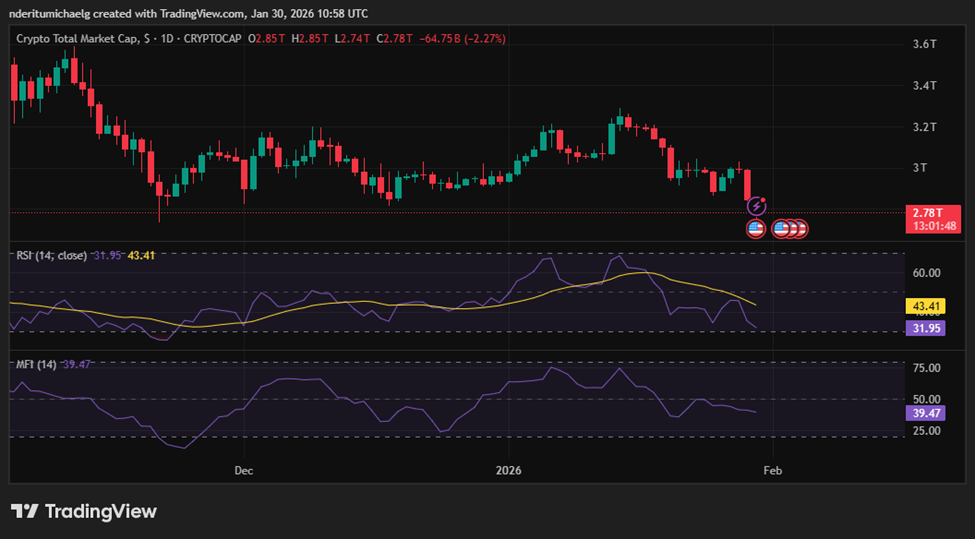
Notably, this decline brought the market back to levels comparable to November, thereby testing a key support zone formed over the past six months.
Market plummets as geopolitical risks increase
Following Trump’s announcement, Russia and China also took new actions on the “geopolitical chessboard,” significantly increasing the likelihood of conflict and weakening investor sentiment.
The Fear & Greed Index of the cryptocurrency market dropped to 16 points within 24 hours — the lowest since the beginning of the year — indicating the market has entered an “extreme fear” state.
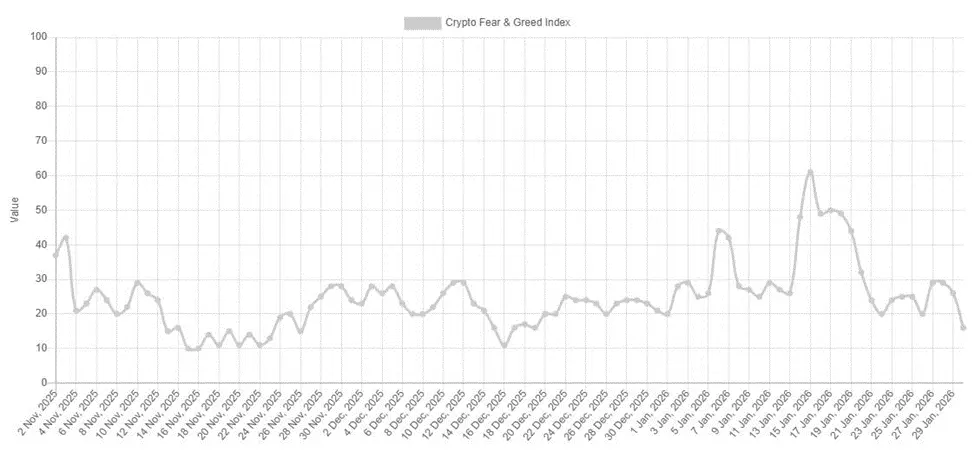 Cryptocurrency Market Fear & Greed Index | Source: Alternative.meThis movement is not surprising, as cryptocurrencies are inherently high-risk assets. When geopolitical uncertainty rises, investors tend to prioritize capital preservation and reduce their positions, leading to increased selling pressure.
A similar scenario occurred in early 2022 when tensions between Russia and Ukraine escalated. At that time, the market was expected to benefit from liquidity flowing out of gold. However, this time, a contrary reaction emerged.
Gold prices have fallen more than 5% from their Thursday peak. Nevertheless, after Trump’s announcement, capital has tended to seek cash as a safe haven. This is clearly reflected in the rising US Dollar Index (DXY), which rebounded from a low of 95.5 on Tuesday to above 96.5 at the observation point.
Liquidation wave indicates the level of impact
Geopolitical tensions erupted just as the market was expected to recover after a period of negative volatility in the latter half of last week. However, the FUD (fear, uncertainty, doubt) wave surrounding the Iran–US escalation caught the market off guard, triggering a large-scale long liquidation.
According to CoinGlass, the total long liquidation value exceeded $1.8 billion in the past 24 hours. Bitcoin (BTC) alone accounted for nearly $800 million, reflecting leverage levels and the “bullish” tendency of the market before the bad news appeared.
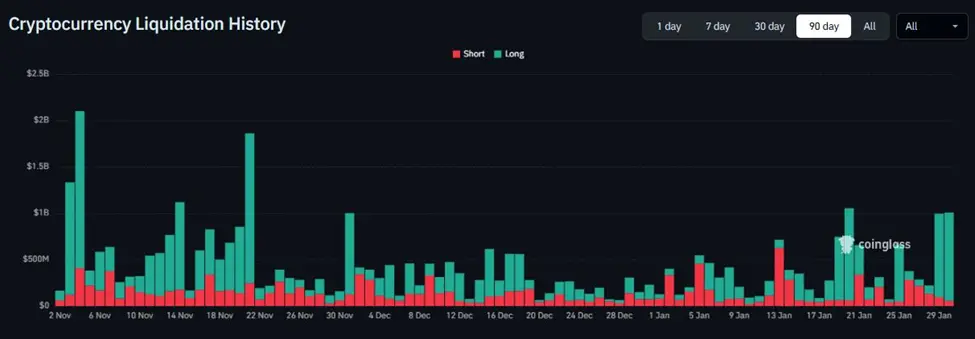 Cryptocurrency Market Liquidation | Source: CoinGlassFrom here, the key question is: will the market recover quickly or continue to weaken?
In 2022, geopolitical tensions caused the market to be suppressed for weeks or even months. If history is a useful reference, the current risk environment could continue to exert pressure on cryptocurrencies.
However, the macroeconomic landscape has changed significantly, with increased participation from institutional investors and a different regulatory environment. Data shows whale activity implying expectations of a short-term rebound, while signals from institutional blocks reflect a worsening sentiment.
Mr. Giáo